This chapter is for the Game Master. It covers table tone, seven campaign modes, using real history at the table, scene frameworks, pacing and the Era Cast. The tables a GM rolls on (the dates to use, rumors, road encounters and depot complications) are in Places and Campaign Tools, Part Three. Rules are in Era Rules and are cited here by name. Dates and institutions come from The Era, Factions and Powers, Cheyenne, Denver and the Historical Reference.
The GM's Approach
Accuracy and Rolls
The record decides what the world contains: the railroad, the treaty lines, the licensed saloon, the sheriff with two deputies, the territory where women vote and the territory next door where they do not. Keep those facts as written. Roll only for the parts of the world that carry a decision: a long ride, a bad winter or a hard bargain is worth a roll only when something depends on the result.
Four working principles:
- The record wins over the genre. Where a Western film and the record differ, run the record. The Historical Reference, Part Four, lists the common cases (see What Hollywood Gets Wrong, below).
- Most characters are competent at ordinary life. A drover can saddle a horse, cook a meal, mend a harness and read weather. A clerk can keep books. A laundress can run a business. Do not call for a check on any of it. Call for a check when a person, a clock or a consequence stands in the way.
- No survival bookkeeping. Do not track food, water, ammunition counts below a scene's needs, or feed for horses beyond the Keeping a Horse rule. Living expenses are covered by the Role's Pay (Money and Credit). Journeys are narrated with at most one hazard (Travel at the Table).
- Pressure comes from people. The best trouble in the corridor is a creditor, a clerk, a council, a posted notice, a hungry camp or a neighbor with a grudge. Weather and distance are the setting; institutions with competing aims supply the plots.
When to Add Harsher Realism
The default is grounded and playable. Add weight only when the table asks for it, and add it one dial at a time.
| Dial | Default | Harsher option | Rules to use |
|---|---|---|---|
| Illness | A Calamity or an announced outbreak starts it | Announce an outbreak at the start of a season, or run a Grave illness | Illness (Era Rules). Grave illness is the only kind that can kill |
| Horses | Three days of grace away from a town or station | Poor grazing, a hard winter, a lamed mount with no day to spare | Keeping a Horse; The Stable |
| Law | A warrant helps; most arrests end without a shot | Courts far away, a crowd at the jail door, a posse that disbands | Law in Play |
| Money | Pay covers keep; credit is available | Broke characters, called-in debts, the Panic of 1873 as a campaign backdrop | Money and Credit |
| Violence | Showdowns often end in a Stand Down | Winning a Showdown does not stop a friend from firing early | The Showdown |
| Prejudice | Applied to scenes by audience and marker | Audiences with long memories; Closed doors in some towns | Prejudice (Attitude) |
Agree on the dials before the first session. Do not raise a dial in the middle of play without warning the table.
Campaign Modes
Each mode below is a way to run a whole campaign. A mode names a premise, the powers in play (all from Factions and Powers), recurring hooks and typical scenes. Any mode can be played with the Era Cast: Deveney and Marchand as patrons, Tolliver, Ybarra, Harrow, Wong and the two Tribal characters as player characters, Carrick as the recurring adversary. Real people are not used as NPCs (see Real People at the Table).
Mixing is expected. The railroad investigation runs into the cattlemen; the diplomacy game runs into the Army. Pick one mode as the spine and let the others walk in. The Campaign Frame in Places and Campaign Tools gives six dated sessions from 1869 to 1876; a mode can run inside that frame or on its own.
The Oglala Lakota warrior and the Northern Cheyenne interpreter in the other modes. Mode Five is theirs; the others seat them this way. In the cattleman campaign the warrior is a hunter who sells meat and hides to an outfit, or a guide across hunting country the drive must cross, and the interpreter is the go-between on an agency beef contract. In the railroad investigation the survey crosses the treaty line (Harrow's tie) and the interpreter is the only person who can say what the camps were told. In the political drama a delegation passes through Cheyenne on its way to the agency or Washington, and the interpreter is hired by the side that wants its words read right. In frontier law a wrong between one of the nations' people and a settler is a federal matter brought through the agent (Law in Play, the 1868 treaty's Article I), so the deputy marshal needs a witness and an interpreter. In the freight game the trader's wagon is bound for an agency, and the warrior knows which trader sells whiskey. In the urban game a delegation is at the Denver depot and the town is watching. The warrior answers to his band and the interpreter to her family and her employer; the table says why each rides with the party, as the Pregenerated Characters' Ties do.
Mode One: A Cattleman Campaign
The Range, 1869 to 1876
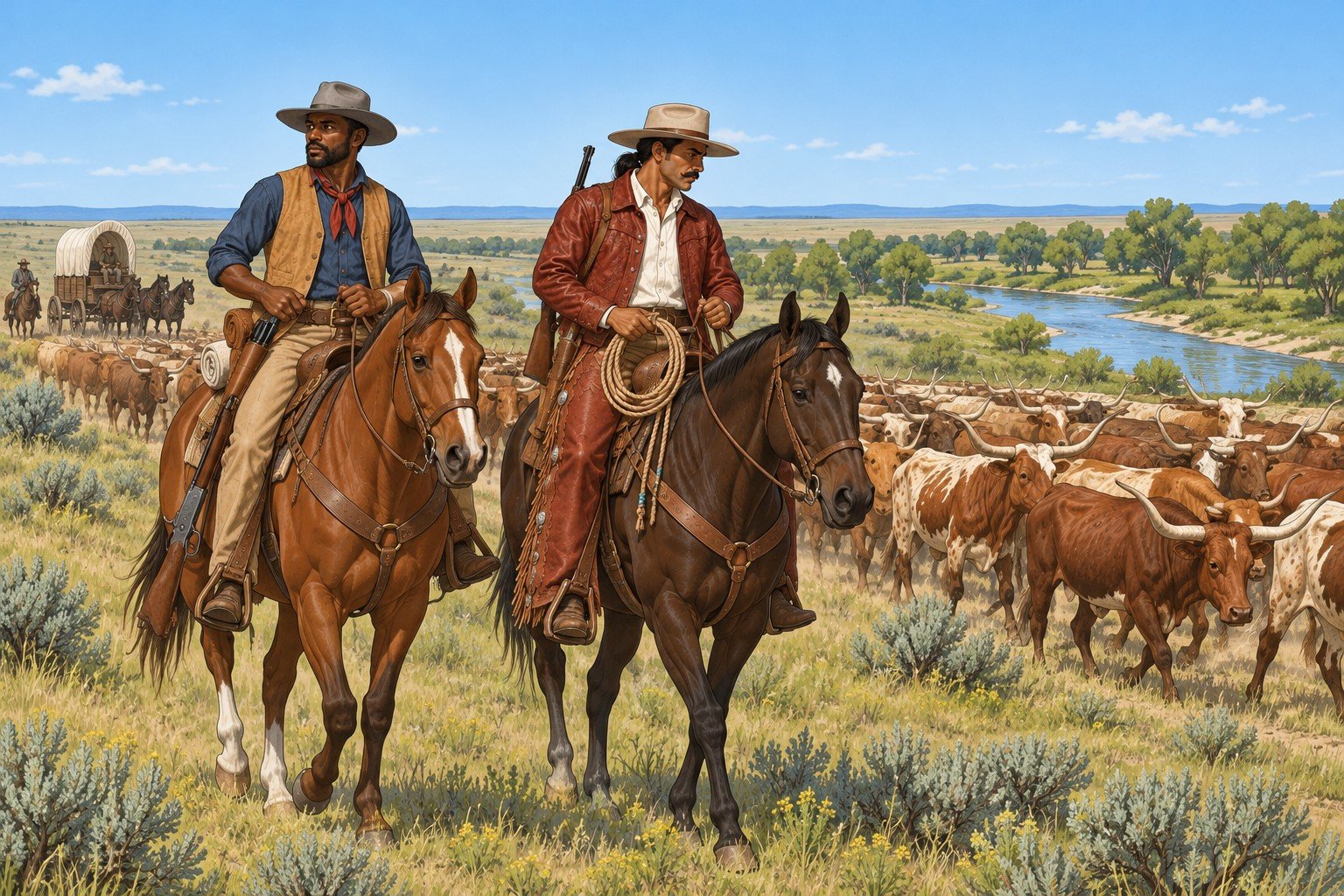
Premise. The party works for an outfit on the grass around Cheyenne: Texas herds arrive from 1869, shipping goes out by rail, and the stockmen organize against thieves and against each other. Stockmen organize in Cheyenne from 1871 (the Wyoming Stock Graziers Association); the Laramie County association that became the Wyoming Stock Growers Association in 1879 dates itself to 1872 and met in Cheyenne on 29 November 1873.
Powers. Cattle Interests, the Railroads (shipping rates and the yards), the Wyoming Territory government (livestock law), the Cheyenne press, sheep raisers, homesteaders, the Tribal Nations whose hunting country the range borders.
Hooks.
- A herd arrives with a brand altered by a running iron, and the man holding it has a bill of sale.
- The railroad holds a herd at the yards until a rate is agreed.
- A buyer in Cheyenne pays cash and asks nothing, and the stock he buys came through Wade Carrick's hands.
- A Tejano horse dealer's string is held at the yards on a complaint from a commission house.
- A big outfit and a small one both claim the same unbranded stock.
Typical scenes. A hiring at the gate (Prejudice, Attitude); a trail drive narrated with one hazard check; a brand inspection; a Stakes contest over a cattle sale; a Showdown at the yards; a Bounty posted by the county commissioners.
Cattlemen are financiers and employers with differing interests. Most hands are wage laborers. Some outfits paid a Tejano or Black hand less for the same work (Anselmo Ybarra's background shows it); the Prejudice rule handles this at the pay window, with an audience and a marker.
Mode Two: A Railroad Investigation
The Line, 1869 to 1876
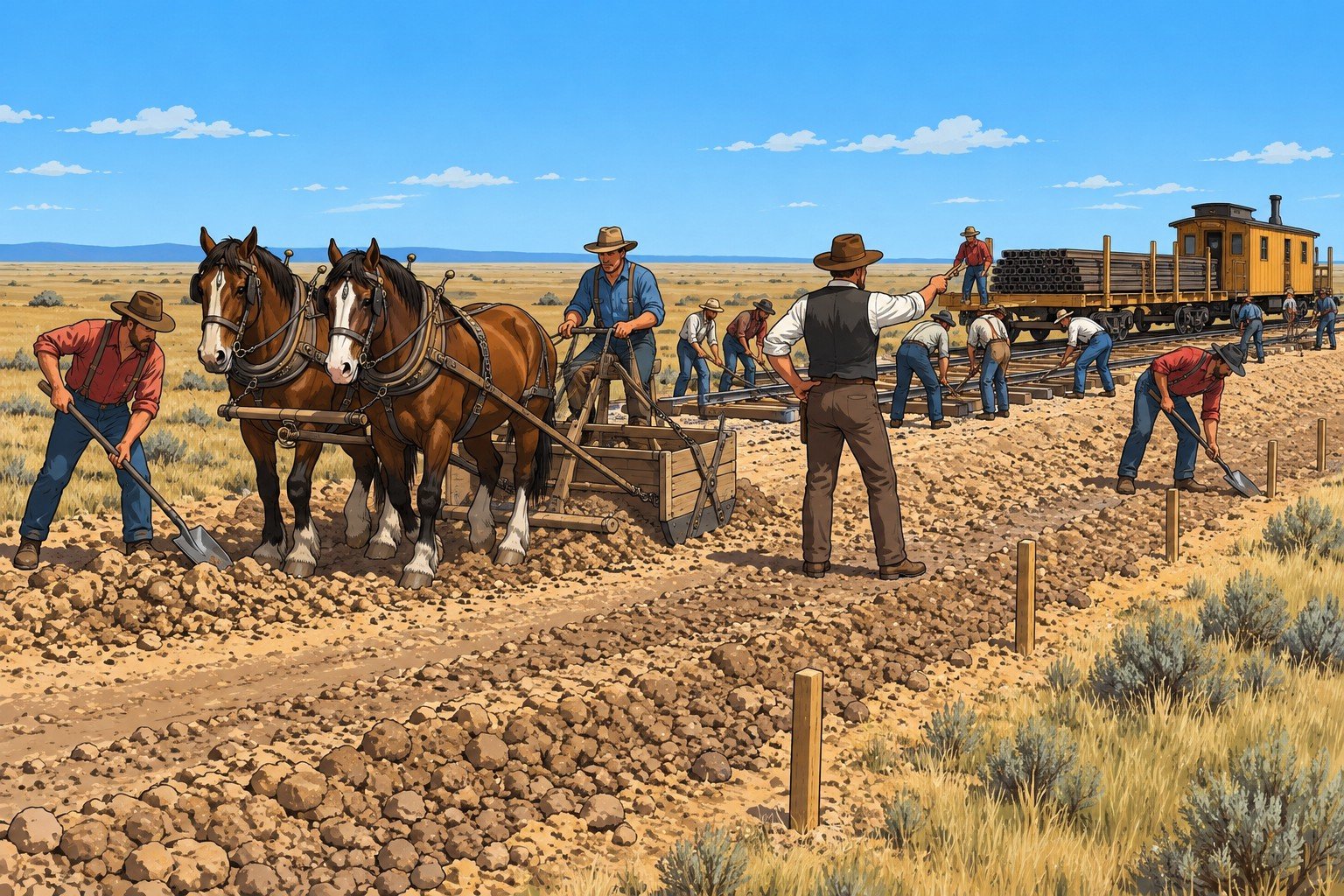
Premise. The party works for or against the railroads: an agent tracing losses on the Denver Pacific (finished between Denver and Cheyenne in June 1870), a land department clerk with doubts, a special agent, a freighter caught between two rates.
Powers. The Railroads, the Army (which guards the line and supplies from Camp Carlin), the territorial governments, the Cheyenne and Denver city governments, the Bureau of Indian Affairs (freight to the agencies), the Tribal Nations whose land the survey crosses.
Hooks.
- A freight car of mining machinery is marked delivered and arrives nowhere (Denver chapter, The Missing Car).
- Survey stakes run toward the unceded territory; a teamster with the crew has seen the treaty map and the foreman has not (Edmund Harrow's crew).
- A filing at the land office is recorded twice with different owners.
- A telegram reaches the wrong man.
Typical scenes. A depot at night with a manifest; a telegraph office; a Law in Play scene about who may arrest a railroad employee (a special agent has only a private citizen's power; see the Who Answers to Whom table); a Stakes contest over a claim before an official.
The railroad is an employer with its own interests, a private police force with no public authority, and a map that other powers dispute.
Mode Three: A Political Drama
The Capitol and the Parlor, 1869 to 1876
Premise. Cheyenne is a territorial capital where the legislature met from 12 October to 10 December 1869 and gave women the vote on the last day. Denver is a capital that wants statehood (it comes on 1 August 1876). The party moves among offices, newspapers, parlors and polling places.
Powers. Wyoming and Colorado territorial governments, city governments, the newspapers, the railroads, the stock association, the churches and civic bodies, the Cheyenne parlor houses where, as the Cheyenne chapter says, deals are made.
Hooks.
- A close precinct in which a foreman, a parlor-house keeper and a rancher's widow all vote, each told how by a different patron.
- An appointment that goes to whoever delivers a precinct.
- In spring 1874 the governor and the territorial secretary both sign as governor while Washington decides, and a clerk holds the paper each wants.
- An editor holds a story about an association officer and a land deal and wants a second source.
Typical scenes. A hearing; a closed meeting; a Stakes contest over a precinct, with favors as the stakes; a paper's front page reporting a deed (a Notoriety gain); a Showdown in a parlor, where Stand Down is the only honest exit.
Run the political mode as an investigation into who owes whom. Wyoming women voting is a fact of the setting and a source of scenes. Colorado voters rejected the vote for women on 2 October 1877, which is after the range and can be a rumor the players cannot yet know.
Mode Four: Frontier Law
The Sheriff's Writ, 1869 to 1876
Premise. The party serves a county sheriff, a deputy U.S. marshal or a justice, or works the other side of the warrant. The law runs by jurisdiction: a city marshal, a county sheriff, a U.S. Marshal, the Army and the Tribal Nations each hold a different edge (Law in Play).
Powers. County sheriff and deputies, city marshals, the district court and the justice of the peace, the U.S. Marshal, the Army, the stock association's detectives, vigilance committees (a short-lived fact in Cheyenne in early 1868), the press.
Hooks.
- A man arrested in one county for a theft in another, and the warrant names the wrong horse.
- A grand jury member has been offered money, and nobody can say which.
- A prisoner wanted in both territories, and a Cheyenne court order that does not hold in Colorado (Denver chapter, The Warrant That Stops at the Line).
- A crowd wants the prisoner and the jail has one deputy.
- A mail sack is missing from the Fort Laramie stage and the deputy marshal needs riders who will swear to what they find.
- Liquor is going to the agencies in flour barrels; the agent writes to the marshal, and the marshal sends Deveney.
- A sheriff's warrant stops at the Albany County line; the deputy marshal's does not, but the charge in his hand must be federal.
Typical scenes. A complaint before a justice; an arrest (Warrants and Arrests); a posse call and a morale check; a Showdown at the jail door; a trial; a reward claim.
The law is thin and slow. Most matters end in a hearing and a fine. Build scenes on the gap between the paper and the practice rather than on quick-draw contests.
Mode Five: A Tribal Diplomacy Game
Council and Agency, 1869 to 1876
Premise. The party carries messages, reads treaties, interprets, escorts delegations, trades and watches the agencies: the go-betweens of a period in which every nation was bargaining with the United States and with its neighbors. The 1868 Fort Laramie Treaty is the document everything refers to, and it is under strain from the Black Hills expedition of 2 July to 30 August 1874 onward.
Powers. The Oglala Lakota and other Lakota bands, the Northern Cheyenne, the Northern Arapaho, the Eastern Shoshone, the Ute, the Bureau of Indian Affairs and its agents, the Army, miners, traders. Each nation is a power with its own aims; none is a bloc.
Hooks.
- A delegation needs an escort and a letter to reach a telegraph office, and a contractor's clerk in Cheyenne wants the message delayed.
- A wagon of agency flour is short; the agent blames the quartermaster and the quartermaster blames the contractor (Factions and Powers, The short shipment; Tribal Nations, The Short Wagon).
- In the weeks before 4 July 1874 a rider learns that Camp Brown and its Shoshone scouts mean to strike an Arapaho camp (Tribal Nations, Northern Arapaho); the players can carry a warning, not stop the column.
- An agency interpreter is asked to report what a council said.
- A Ute delegation is asked to sign a paper whose English and translation do not match (Denver chapter).
Typical scenes. A council where the question is who speaks first and who is not in the room (Adversaries, Band Leader and Council Speaker); a trader's counter; an escort across the treaty line; a ration count; a long ride to a camp that may refuse the visit.
Run a council as a series of scenes. Stakes is not a rule for treaty councils (Era Rules, Stakes). Use Prejudice for the Attitudes of agents, officers and councils, and set the Attitude of a council by its own interests, as the Sample Audiences table shows for a Tribal council hearing an agent's offer. An agreement with one leader binds that leader's band or society; the Bureau and the Army often forget it, and the players should not.
Mode Six: A Trader and Freight Game
The Wagon Road, 1869 to 1876
Premise. The party hauls, buys and sells. Camp Carlin's wagon trains supply the posts and agencies (Factions and Powers); stage lines run where rail does not; from February 1876 the road north from Cheyenne carries the Black Hills trade (three stage trips to Custer City on 3, 7 and 10 February 1876, run by Yates and Brown before the line was sold on 12 February).
Powers. The Army quartermaster, contractors, the railroads, the Bureau of Indian Affairs and its licensed traders, the Tribal Nations at the agencies, miners, outlaws on the road.
Hooks.
- A load for a distant post is short six crates and the manifest has been rewritten.
- A trader's wagon crosses toward the Powder River; the trader says calico and a Black teamster in the next wagon says whiskey.
- Wagons to the Hills in 1876 need an escort, and a stranger wants a seat.
- A hired team comes back lame and the owner wants payment.
Typical scenes. A loading yard; a river crossing as a single hazard (Travel at the Table); a trader's ledger and Credit; a Stakes contest over a freight rate; a stop at a stage station.
Army officers and agents watched for the sale of whiskey or arms to a Tribal Nation, and it is a ready source of trouble. Both Tribal traders and white traders appear in the freight game, and the agency store is where credit against hides and goods was extended.
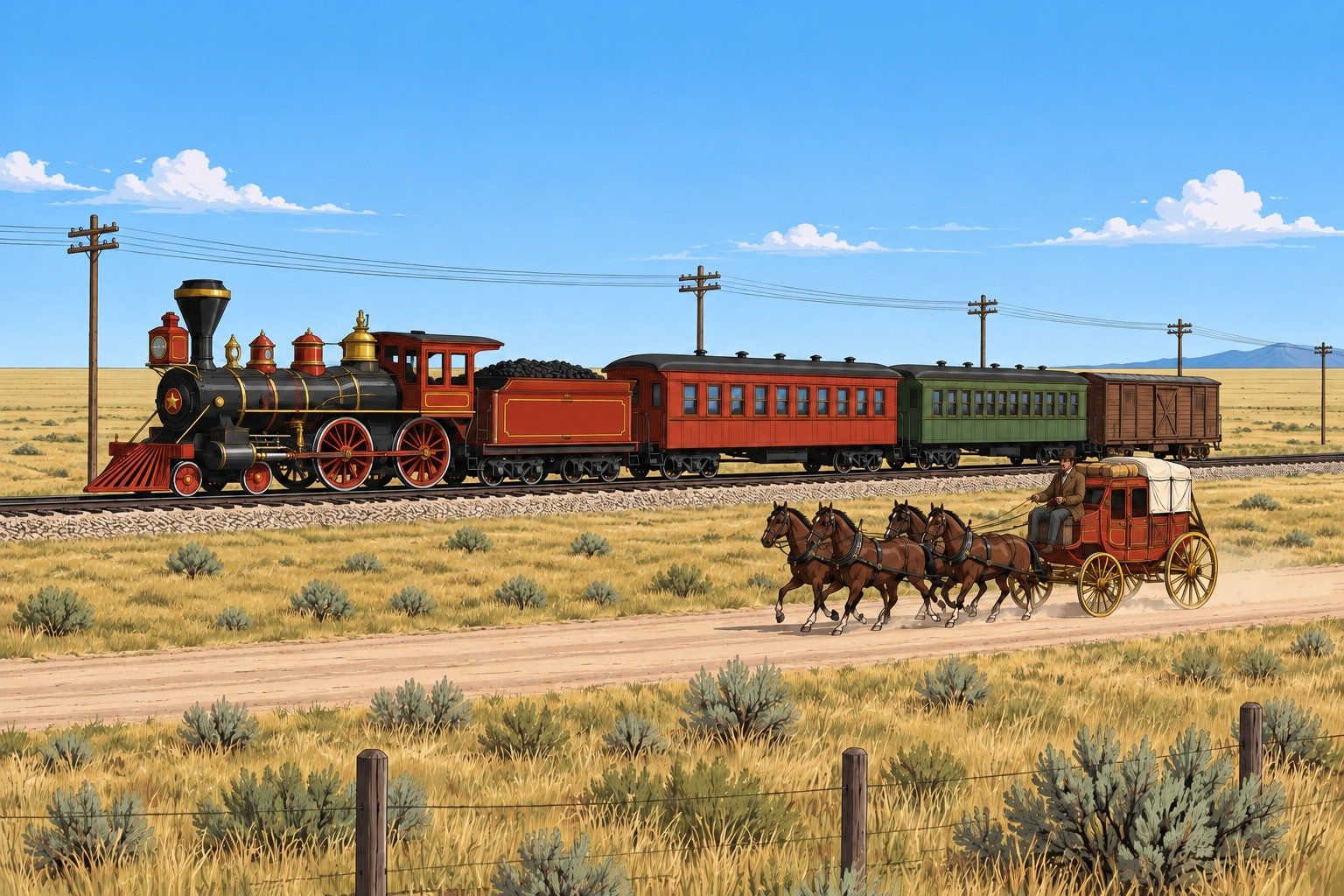
Mode Seven: A Cheyenne-Denver Urban Game
Two Capitals, 1870 to 1876
Premise. A hundred miles of track join two cities that are rivals in trade and neighbors in everything else. The party works the line between them: a lawyer's investigator, a depot clerk, a boarding-house network, a church committee, a courier with a bank draft.
Powers. The city governments, county sheriffs, the railroads, the press, churches and civic bodies, the stock association, the mining interests, and the communities of each city (Black Denver, Irish Cheyenne and Denver, German, Jewish, Chinese and Hispano residents).
Hooks.
- Wong's clerk and a boarding-house keeper both find the same trunk, with a survey map in it.
- Odette Marchand holds a note from a Denver banker who says it was paid; the ledger says it was not.
- A small fire destroys a laundry after a saloon fight, and the cause may be ordinary (Denver chapter, The Wazee Street Laundry Fire).
- A relief fund's donors want a say in who is helped.
Typical scenes. A train compartment; a hotel lobby; a boarding-house breakfast; a church hall; a telegraph office; a livery; a courtroom.
Use the rail line as the campaign's spine. Most urban adventures start from a ticket, a manifest or a telegram.
Real People at the Table
Real people are not characters, NPCs or stat blocks. The Historical Reference holds dated entries for people, events and institutions, each with an "At the table" line. Use it this way.
- Use the office, not the officeholder. The governor, the Commissioner of Indian Affairs, the post commander, the department commander, the editor, the president of the railroad. An NPC may be the governor's secretary or the commander's adjutant, and the office speaks through that NPC.
- Use the event, not the person. The table can arrive at a treaty council, a Black Hills expedition or a stage departure without any famous person speaking. Describe the scene by what happens: who is present by role, what is said by office, what follows.
- Use the institution. The Army, the Union Pacific, the stock association, the Cheyenne Leader, the Bureau of Indian Affairs. Institutions have habits, rules and agendas a GM can play.
- Hear them at one remove. A rumor, a notice, a newspaper item or a reported speech may mention a real person. The players never meet him or her, and the GM never gives that person lines or a roll.
- Dates are anchors. Let the dated events come when they come. The players may be nearby, may be caught by them or may hear of them later; they do not replace or relocate them.
- No stats or secrets. Give no real person a stat block, a skill or a secret.
If a table wants a famous name in a scene, treat it as a name the characters have heard of, and ask what the fictional people around that name want.
Alternate-History Cautions
The default campaign follows the record. If the table wants to change it, agree and note it before play.
| If the players try to | What the record says | Advice |
|---|---|---|
| Stop the Black Hills rush | The Custer expedition left on 2 July 1874; the Army expelled trespassers before then; the rush followed in 1875 | Let the players slow a party, expose a fraud or help a Lakota delegation. The pressure remains; the dated events (the Allison commission council, 20 September 1875; the deadline of 31 January 1876) still arrive |
| Prevent the Great Sioux War | The war begins in earnest on 17 March 1876 | Allow local outcomes: a camp warned, a message delivered, a patrol turned. The war results from many powers, not one scene |
| Save Colorado from statehood, or hasten it | Statehood is 1 August 1876 | Use it as a deadline |
| "Fix" the treaty system | Congress ended treaty-making on 3 March 1871; the Brunot Agreement was ratified as law on 29 April 1874 | A character can win a point in a council; the system does not change |
| Reverse prejudice | Prejudice varied by town, employer and year | Scenes can turn; the setting does not become a modern one |
| Bring in anachronisms | Barbed wire is patented on 24 November 1874; the telephone on 7 March 1876 | Allow an invention only after its date and only as a rumor before a use |
The players change their corner of the world: a herd delivered, a prisoner held, a message carried, a debt paid. They do not change the nation.
Scenes and Encounter Frameworks
A session is a chain of scenes. The frameworks below use the Showdown, Notoriety and Stakes (Era Rules) and Prejudice (Attitude).
TERMS: THE SCENE CARD
Before a scene, write five lines.
- Want. What the scene's chief NPC wants, in a sentence.
- Audience. Who decides the outcome, and up to three markers they react to (Prejudice).
- Pressure. The clock or danger: a train, a sunrise, a council vote, a crowd.
- Tools. The rules most likely to appear: a Showdown, Stakes, an arrest, a Bounty claim, an Illness.
- Exit. Two ways the scene can end, and what changes in each.
Run the scene. When it ends, note any Notoriety change, any Debt, any Bounty posted or withdrawn.
| Scene type | When to use | Rule | Typical outcome |
|---|---|---|---|
| The stand-off | An arrest, an insult, a claim dispute, a gun in hand in a street | The Showdown (name it; Stare; Stand Down or Draw) | Most end with a Stand Down. The loser is Backed Down before witnesses |
| The deal | A cattle sale, a freight rate, a horse trade, a bid | Stakes (Ante, Exchanges, Raise, Call or Fold) | Cash, property or a favor changes hands; a third party may intervene on a Calamity |
| The hearing | A justice, a grand jury, a land office, a commander's tent | Law in Play and Prejudice (Attitude) | An order, a warrant or a closed door |
| The posted notice | An offense reported, a reward offered, a hunter on the trail | Notoriety and Bounty (Find, Identify, Take, Claim) | A capture, a rumor, a disputed claim |
| The sickbed | A Calamity in a bad place, or a declared outbreak | Illness (clock, Care) | Bedridden for days, not dead, unless Grave |
| The journey | A trip between towns | Travel at the Table (one hazard) | A lost day or a complication |
| The council | A meeting of powers, a treaty talk, an agency issue day | Prejudice (Attitude) and ordinary play; not Stakes | A position, a refusal, a promise that someone must carry out |
Three encounter shapes recur.
- Talk first, shoot later. Open with a Showdown or a hearing. If it ends in a Draw, the winning side takes the first slot of round one, and the fight is short.
- The long way around. Give the players a faster route that crosses a jurisdiction: a county line, a treaty line, an Army post. The faster route is a scene with an official, not a roll.
- The bill comes due. Let a past choice (a Bounty, a Debt, a Name) appear in a scene several sessions later.
Pacing a Session
A session of about three hours has a rhythm that suits the rules.
| Stage | Share of the session | What happens |
|---|---|---|
| Hook | One-sixth | A patron, a notice, a telegram or a body. State what is wanted and who else wants it |
| Legwork | One-third | Two or three scenes of talk, travel and looking: people, ledgers, rails, livery stalls |
| Complication | One-sixth | The thing the players did not know: a second claimant, a Closed door, a sick friend, a rival |
| Reckoning | One-sixth | The Showdown, the deal, the hearing or the fight |
| Aftermath | One-sixth | Pay, Notoriety, Debts, rumors, and the hook for next time |
Rules of pace:
- Cut the journey. Start in the next town and say how long the road took.
- Show the clock. A train, a court term, a deadline on a note, a season.
- End on a decision. Stop a session on a choice, a posted notice or an arrival, not on a roll.
- Use the rumor table (Places and Campaign Tools) at the end of a session to carry the world forward.
- Allow quiet sessions. A session built on a hearing needs no fight.
Advancing the calendar. Move the date at the end of every session and say it aloud, because the rules keep time in months and seasons.
- Each session, choose how much time passed: a day, a week, a month. The Campaign Frame moves years between its sessions; a mode moves weeks.
- At the end of each month, every Debt due that month falls due (Money and Credit); a creation Debt falls due at the end of the second month. A character out of work for the month is Broke.
- At the end of each season, Notoriety drops by 1 for every character who stayed out of the news and outside its Reach (Lie Low makes it monthly), and a chronic illness in remission may return (Illness).
- At twelve months, a Bounty with no new offense lapses (Notoriety and Bounty).
- By the calendar, use the corridor's own clock: the district court sits in a county twice a year, the roundup is spring, the Texas herds arrive from midsummer, the roads north close in the worst of winter, and Dates to Use (Places and Campaign Tools) arrive whether the party is there or not.
Running the Cast
The Era Cast are fictional ordinary people of the period. The Pregenerated Characters chapter owns the player characters; the Adversaries chapter owns Wade Carrick's stat block. This section covers how to run each as a patron, an ally or a rival.
| Cast member | Run as | Wants | Will not |
|---|---|---|---|
| Michael Deveney, deputy U.S. marshal at Cheyenne | Patron, ally, sometimes obstacle | A quiet line, the Irish crews quiet, the stolen stock traced | Hand a prisoner to a mob; take a bribe in public; arrest for a territorial crime without the sheriff's commission, unless it happens in front of him |
| Odette Marchand, parlor-house keeper and voter | Patron, broker, creditor | Deals, debts remembered, her house left alone | Raise her voice; give up her ledger |
| Edmund Harrow, Union Pacific land agent and surveyor | Player character or patron | A survey that holds, a line that pays | Admit that his stakes are what trouble the nations |
| Si Tolliver, drover and marksman | Player character or ally | Pay, a safe road, to be left alone | Be the first to draw |
| Anselmo Ybarra, Tejano horse breaker and tracker | Player character or ally | Work that is paid fairly; the horses | Hurt a horse; beg |
| Wong Yik Lun, merchant and labor contractor | Player character, patron, supplier or creditor | Accounts paid, crews supplied, no trouble that reaches the store | Lend to a man who has not paid another Chinese house; carry a gun where anyone can see it |
| Elk Walks First, Oglala Lakota warrior | Player character or ally | The treaty kept; his people fed | Be spoken for by an agent |
| Marie Tessier, Northern Cheyenne interpreter | Player character or go-between | Her family's safety; to be paid and trusted as far as she is useful | Carry a message she thinks will cause a killing without saying so |
| Wade Carrick, stock thief and road agent | Recurring adversary | A buyer, a road, a quiet exit | Rush; rob someone he cannot afford to be seen with |
Notes for the GM:
- Deveney's commission. He is a deputy U.S. marshal: federal warrants anywhere in Wyoming, territorial ones only beside the sheriff. The real marshals and sheriffs are in Cheyenne and Historical Reference.
- Marchand's house. Deals are made there. Do not play scenes inside the sporting trade; show Marchand's business through what she knows and whom she knows.
- Carrick. He is affable, patient and has buyers. Players solve him with a ledger, a witness or a posse, not a duel.
What Hollywood Gets Wrong
Each correction is in the Historical Reference, Part Four. The table gives the GM action.
| Common idea | Where to look | GM action |
|---|---|---|
| Everyone wears a gun in town | Guns in town; Arms in Town (Era Rules) | Ask a stranger to leave a weapon at a lodging; make the request a scene |
| The noon duel | Duels at noon; The Showdown | Open with a Stare, not a draw |
| Constant killing | Violence | Let most confrontations end without a shot |
| Chinese workers built the whole railroad | Who built the railroad | Show Chinese workers where the record puts them: Union Pacific section and repair crews from 1869, Rock Springs mines from 1875, and cooks, laundry owners and merchants in both cities |
| The Black Hills were sold | The Black Hills were sold | Keep the three-fourths consent article in view |
| One chief per nation | One chief for all | Make each treaty a question of who signed |
| Little Bighorn as a last stand | Little Bighorn | Use it as news that arrives in July 1876 |
| Who shot Tall Bull | Who shot Tall Bull; Tall Bull | Do not stage it; it is background |
| Women had no vote | Women and the vote | Let Wyoming women vote in a scene |
| Cowboys were white Texans | Where cowboys came from | Mix a crew; set the pay by outfit |
| Lynching as frontier justice | Vigilantes | Show it as what happens where the courts are absent or slow |