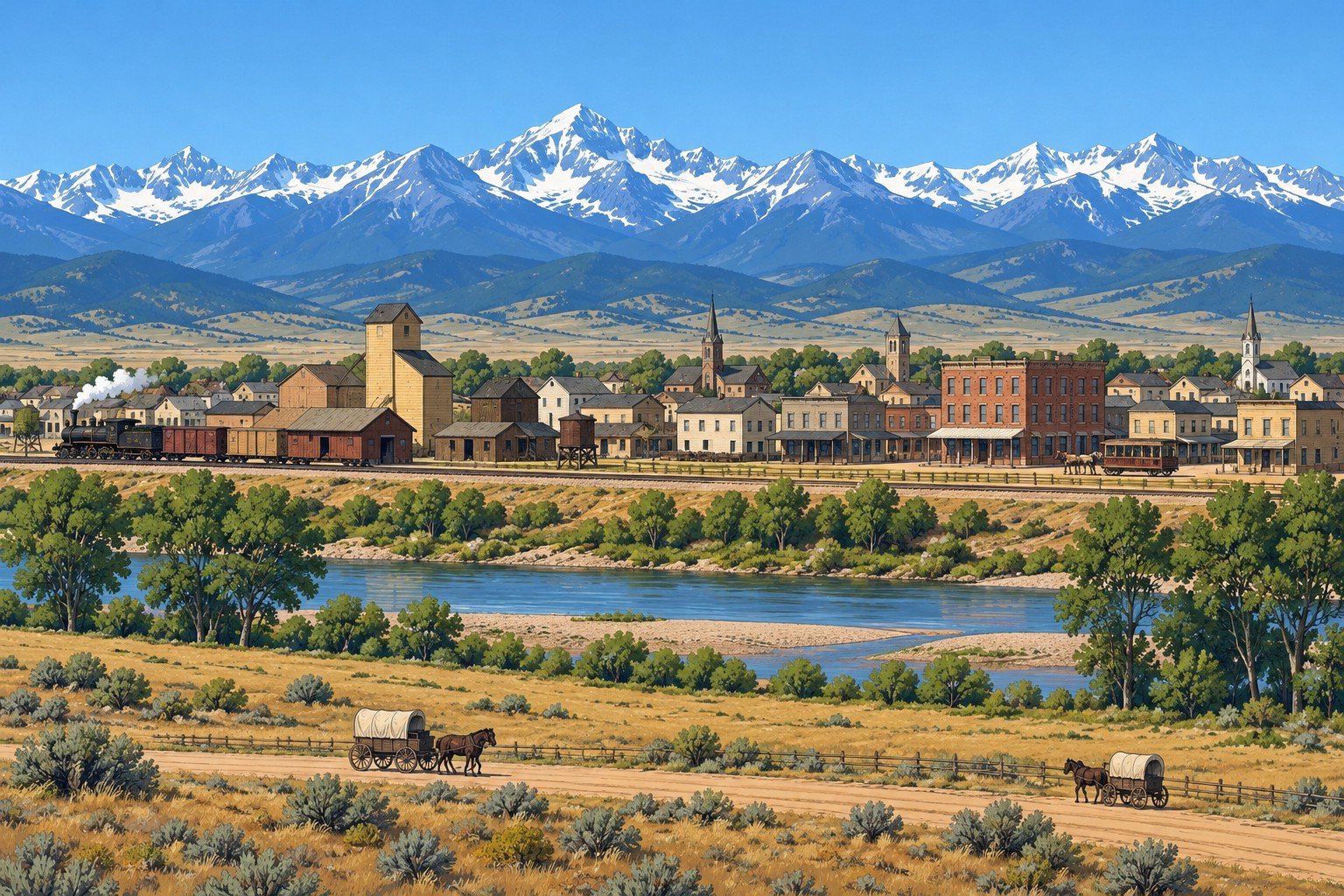
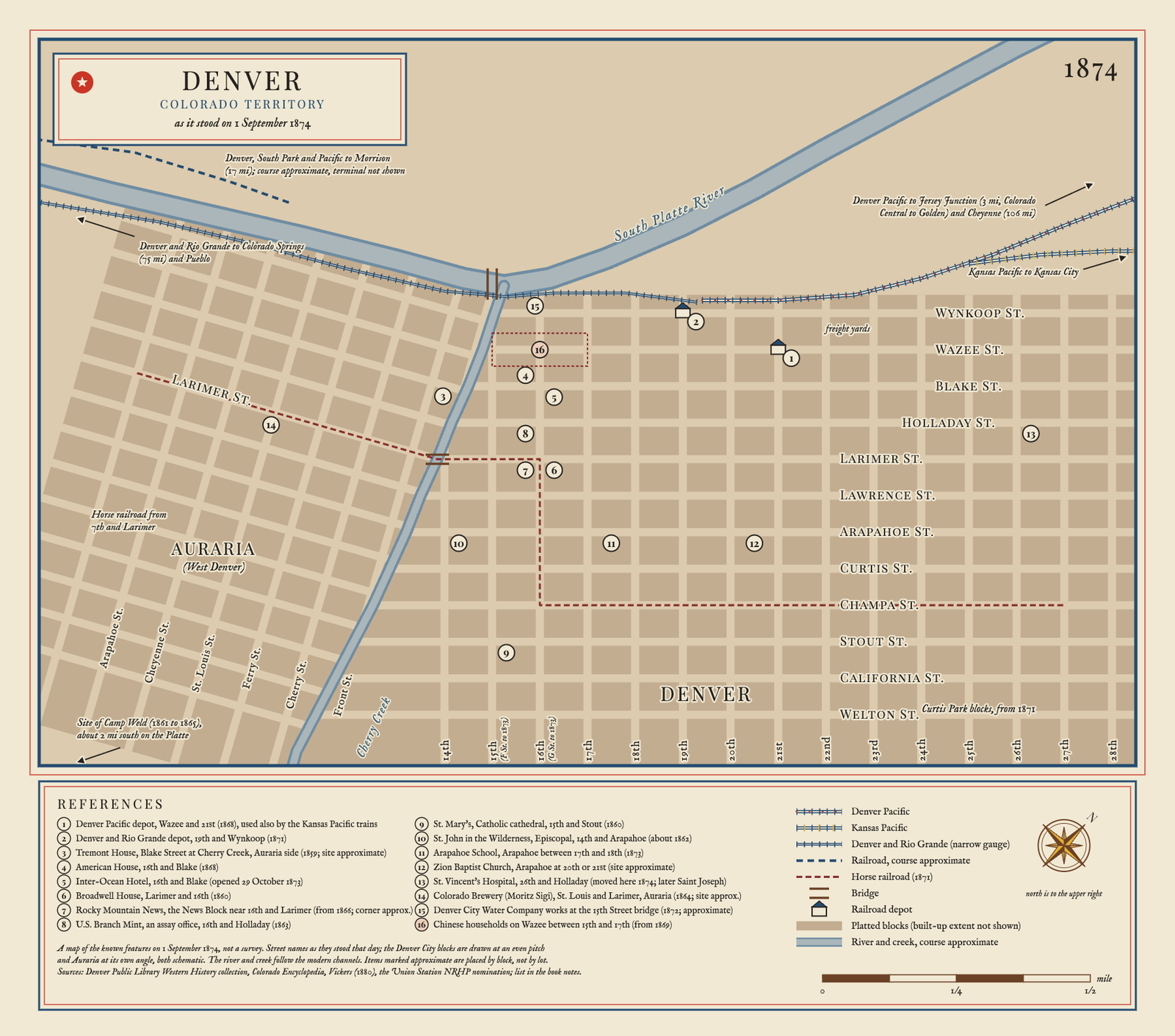
Denver is the capital of Colorado Territory and the end of the Denver Pacific Railway, a hundred miles south of Cheyenne. In 1870 the census counted 4,759 people; by 1880 it counted 35,629. Between those two counts the town got three railroads, a horse-drawn streetcar line, a water company and its first synagogue. This chapter gives a GM the history, the layout, the institutions and the people a party meets there between 1869 and 1876, and the roads out to the mountain camps. Cheyenne is covered in its own chapter; the two cities are linked by one rail line, one telegraph and one set of freight contracts.
Where accounts differ on a date, the text says so.
Denver at a Glance
| Item | Detail |
|---|---|
| Status in the play range | Seat of Arapahoe County; capital of Colorado Territory since December 1867; temporary state capital from 1 August 1876 |
| Population | 4,759 in the 1870 census; 35,629 in 1880. The jump falls mostly after 1876. |
| Rail | Denver Pacific to Cheyenne and the Union Pacific (1870); Kansas Pacific from Kansas (1870); Colorado Central to Golden (1870); Denver and Rio Grande south to Colorado Springs (1871); Denver, South Park and Pacific to Morrison (1874) |
| Setting | The South Platte River and Cherry Creek meet here; the Front Range stands to the west |
| Law | Mayor and council; city marshal and police; Arapahoe County sheriff; territorial courts; federal officers |
| What it sells | Freight, mining supplies, banking, outfitting, lodging, a market for cattle and farm produce |
| What it buys | Ore, hides, timber, lumber, grain, beef |
History, 1858 to 1876
| Date | Event |
|---|---|
| July 1858 | Placer gold is found near Little Dry Creek, starting the Pike's Peak gold rush. |
| 3 October 1858 | Green Russell’s party founds Auraria on the south bank of Cherry Creek, by the usual date about a month before Denver City. The Auraria Town Company is formally organized on 6 November 1858. |
| 22 November 1858 | William Larimer's party stakes Denver City on the east bank. |
| 23 April 1859 | The first Rocky Mountain News is printed. |
| 5 or 6 April 1860 | Auraria and Denver City agree to merge; accounts give 5 April (ratification meeting) or 6 April (merger). |
| 28 February 1861 | Congress creates Colorado Territory. |
| 19 April 1863 | A fire destroys much of the wooden business district; the city requires brick construction afterward. |
| 19 May 1864 | Cherry Creek floods and kills eight people in Auraria. |
| 29 November 1864 | Sand Creek (see "Cheyenne and Arapaho Memory," below). |
| 15 November 1865 | Zion Baptist Church is organized by Black Denverites. |
| December 1867 | The territorial capital moves from Golden to Denver (some accounts say 9 December). |
| 18 May 1868 | Work begins on the Denver Pacific Railway. |
| 29 June 1869 | The Colorado Tribune announces "the first John Chinaman in Denver." |
| 24 June 1870 | The first train from Cheyenne reaches Denver (track finished 22 June). |
| 15 August 1870 | The Kansas Pacific is completed near Strasburg, giving Denver its second rail link; through service to Kansas City begins 1 September. |
| 24 September 1870 | The standard-gauge Colorado Central reaches Jersey Junction, three miles north of Denver, on its Golden line. |
| November 1870 | Denver City Water Company is formed. |
| 28 July 1871 | The first rails of the Denver and Rio Grande are laid out of Denver. |
| 21 October 1871 | The Denver and Rio Grande reaches Colorado Springs. |
| 17 December 1871 | The Denver Horse Railroad (later Denver City Railway) begins running; a formal opening was held 2 January 1872. |
| 1872 | The Denver City Water Company begins supplying water from a well and two Holly steam pumps at the Platte near F (15th) Street, through about four miles of mains. |
| 13 September 1873 | The Brunot Agreement is signed at Los Pinos Agency (see "The Ute Nation and Denver"). |
| 1873 | Sisters of Charity of Leavenworth open a hospital, St. Vincent's, on 22 September. |
| 1874 | Congregation Emanuel incorporates; the City sets up a police department with appointed members and a chief of police in April. |
| 20 June 1874 | Denver, South Park and Pacific track reaches Morrison; scheduled Denver to Morrison service begins 3 July 1874. |
| 28 September 1875 | The Temple Emanuel synagogue is dedicated at 19th and Curtis. |
| Late May 1876 | The South Platte runs its highest since the flood of 1864 (The Era, Seasons and Weather). |
| 1 August 1876 | Colorado becomes a state. Denver is its temporary capital. |
Why the railroads mattered
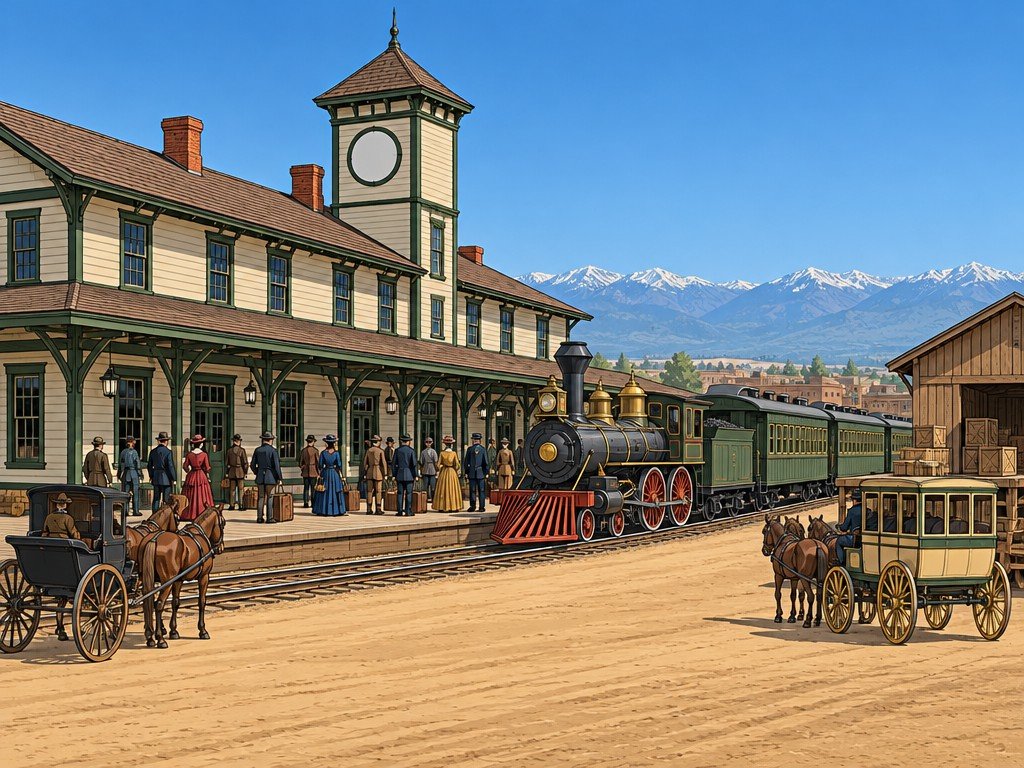
Before 1870 Denver was a hundred miles off the Union Pacific main line and relied on freight wagons and stage coaches. The Denver Pacific (about 106 miles) was incorporated 19 November 1867, broke ground 18 May 1868, and ran its first train from Cheyenne on 24 June 1870 (track finished 22 June). Its Denver depot stood at Wazee and 21st Street. Two months later the Kansas Pacific gave Denver a second connection, from the east; its trains used the Denver Pacific depot, and through service to Kansas City began 1 September 1870. The Colorado Central joined the Denver Pacific at Jersey Junction, three miles north, that September. Freight rates fell from stage and wagon levels, and mining machinery and smelting equipment could come in by rail. A party can now cover the Cheyenne to Denver road in a day, and a rail-borne lawman, creditor or telegram can be in Denver before a fugitive.
The Colorado Central (standard gauge to Golden, 1870; narrow gauge up Clear Creek to Black Hawk by December 1872) and the Denver and Rio Grande (narrow gauge, south to Colorado Springs, 1871) tie the city to the mines and to the new towns of the plains. The Denver, South Park and Pacific, reorganized 16 June 1873, reached Morrison in 1874 and did not go farther into the mountains within the play range.
Layout and Districts
Denver sits where Cherry Creek enters the South Platte. The oldest settlements lie on opposite banks and still keep separate characters.
| District | What it is in 1874 | Play use |
|---|---|---|
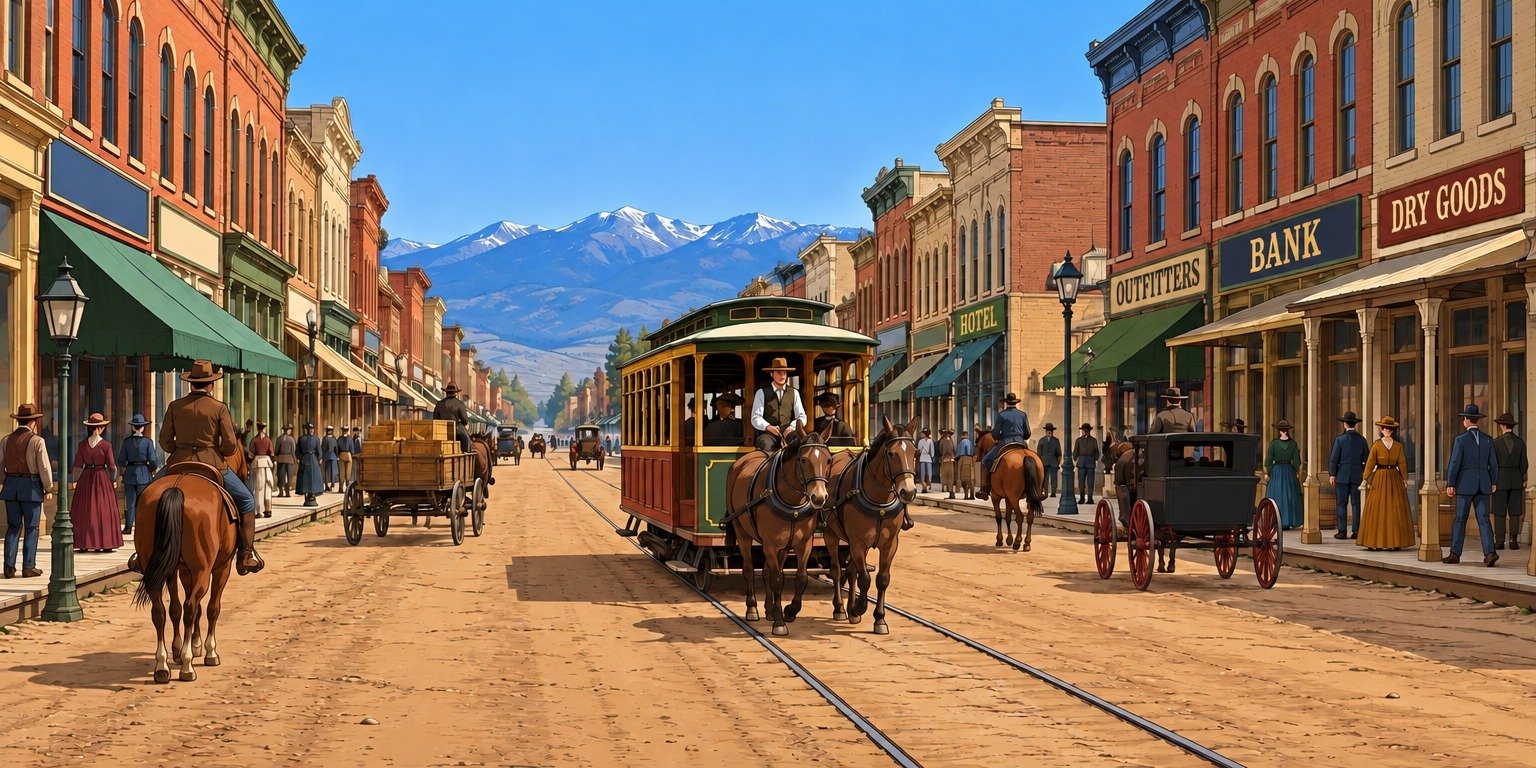
| Larimer Street | The principal business street of the mid-1870s: banks, stores, theaters and the horsecar line. | Offices, outfitters, gunsmiths, the lawyer you need |
| Blake Street | Saloons and gambling rooms; two large gambling halls stand here. | Card games, informers, hired hands |
| Wazee and the railroad flats | The Denver Pacific depot at Wazee and 21st, the Denver and Rio Grande depot at 19th and Wynkoop (1871); freight yards and warehouses; the earliest Chinese households on Wazee Street. | Freight disputes, arrivals, the telegraph office |
| Holladay Street (McGaa Street until 1866, Market Street from 1889) | The district where prostitution was tolerated; Holladay Street was its name in the range. | Informants, hidden debts, a witness who will not appear in court |
| Auraria and West Denver | The earlier town west of Cherry Creek, working class and largely German and Irish; Sigi's Colorado Brewery (the later Tivoli) stood here; flood risk remained. | Cheap lodging, breweries, church halls |
| Curtis Park and the east side | Newer residential blocks east of downtown, served by the horsecar line (Larimer to 16th, then Champa to 27th) that ends in the blocks later called Five Points. | Merchants' homes, the new synagogue |
| Capitol Hill and the far east | Open ground and a few houses in 1874; not yet fashionable. | Not a district yet |
| The Platte flats and the Cherry Creek bed | Camps for teamsters, freighters and the poor; the stretch most exposed to floods. | Fights, camps, a body found at dawn |
Denver's grid follows the creek and river rather than the compass, and street names changed more than once. Use the names above as given.
Arriving in Denver
The train from Cheyenne takes a day and comes in at the Denver Pacific depot at Wazee and 21st Street (Gear and Prices, Passage, has the fare). Hacks wait at the depot; Gear and Prices gives the rate. The near hotels are the American House and the Inter-Ocean, both at 16th and Blake, with the Tremont and the Broadwell on Larimer; In 1872 the principal houses are the American, Tremont, Sargents and Broadwell. The horsecar runs along Larimer from December 1871. A livery takes a party's horses, and the freight houses by the depot take a wagon. A concealed pistol or knife is an offense under the territorial act of 1862, and the marshal's men know the depot. A stranger's first audience is the hotel clerk; Prejudice (Attitude) applies as in Cheyenne (Era Rules).
Government and Law
The territory and the city
Colorado Territory had been organized 28 February 1861. The capital moved from Denver City to Colorado City (July 1862), to Golden (14 August 1862), and back to Denver by December 1867. From that date the legislature meets in Denver, the governor sits here, and the federal officers for the territory work from the city.
| Dates | Territorial governor (federal appointee) | Note |
|---|---|---|
| 1869 to 1873 | Edward M. McCook | 19 April 1869 to 17 April 1873. |
| 1873 to 1874 | Samuel H. Elbert | 17 April 1873 to about 19 June 1874; he still claimed the office in July. In spring 1874, after President Grant removed him and renamed McCook, Elbert and Territorial Secretary John W. Jenkins both signed as governor until the Senate confirmed McCook on 19 June 1874. |
| 1874 to 1875 | McCook again | 19 June 1874 to 29 March 1875, when President Grant removed him. |
| 1875 to 1876 | John L. Routt | Appointed 29 March 1875 and governor until statehood; elected the first state governor on 3 October 1876. |
The governor is a political appointee from Washington. He has the Army's attention and the legislature's suspicion, and he decides whether the territorial militia is called.
City, county and courts
-
City: Denver is governed by a mayor and council under a charter that dates from 1861. The city's first marshal was elected in December 1859, and a formal police department with appointed members and a chief of police was set up in April 1874.
-
County: Denver is the seat of Arapahoe County. The county sheriff is the main officer for serious crime outside city limits and for serving process. David J. Cook was Denver city marshal from 1866 to 1869 and Arapahoe County sheriff from 1869 to 1873 (Factions and Powers).
-
Courts: The territorial supreme court and the district court for the district that includes Arapahoe County sit in Denver, and the governor, the secretary, the Surveyor General, the district land office and the U.S. Marshal keep offices in the city, in rented rooms on or near Larimer and Fifteenth Streets; the legislature too meets in rented rooms, and no capitol building stands in the range. The one federal office with a fixed address is the United States Mint, in the former Clark, Gruber and Company building at Sixteenth and Holladay Streets: it assays and buys gold and casts bars, has struck no coin since the government bought it in 1863, and was made an assay office in name in 1869. In 1874 the U.S. Marshal for Colorado Territory is M. A. Shaffenburg (succeeded by Charles C. Tompkins in February 1875).
-
Jurisdiction at the table: Offences inside the city go to the marshal and municipal court; felonies go to the county and territorial district court; theft of mail or federal property goes to the federal officers. Cheyenne's sheriff has no authority in Colorado, and Denver's has none in Wyoming; a prisoner crossing the line needs extradition or the cooperation of both offices. A deputy U.S. marshal for Wyoming stops at the line too: a federal fugitive found in Denver is taken by Colorado's marshal or a Colorado magistrate and removed on a judge's warrant.
Law enforcement
The city had marshals from 1859 and a police department from April 1874. The force is small, partly part-time, and paid by a city that is always short of money. In practice:
- The marshal handles drunkenness, brawls, vagrancy, gambling and vice at the edges of tolerance.
- The sheriff's deputies serve warrants, run the jail and carry prisoners to court.
- Railroad detectives and the freight companies' own guards protect the depots.
- Private watchmen and the Army (when asked through the territorial government) fill other gaps.
Carrying firearms in the city: a territorial act of 1862 bars carrying concealed pistols, Bowie knives, daggers and other deadly weapons in any city, town or village, with a fine of $5 to $35. No Denver ordinance on carrying arms openly in 1869 to 1876 is on record; the GM sets whether loaded pistols may be carried in the open on the main streets.
Commerce and Industry
| Sector | In 1874 | Notes |
|---|---|---|
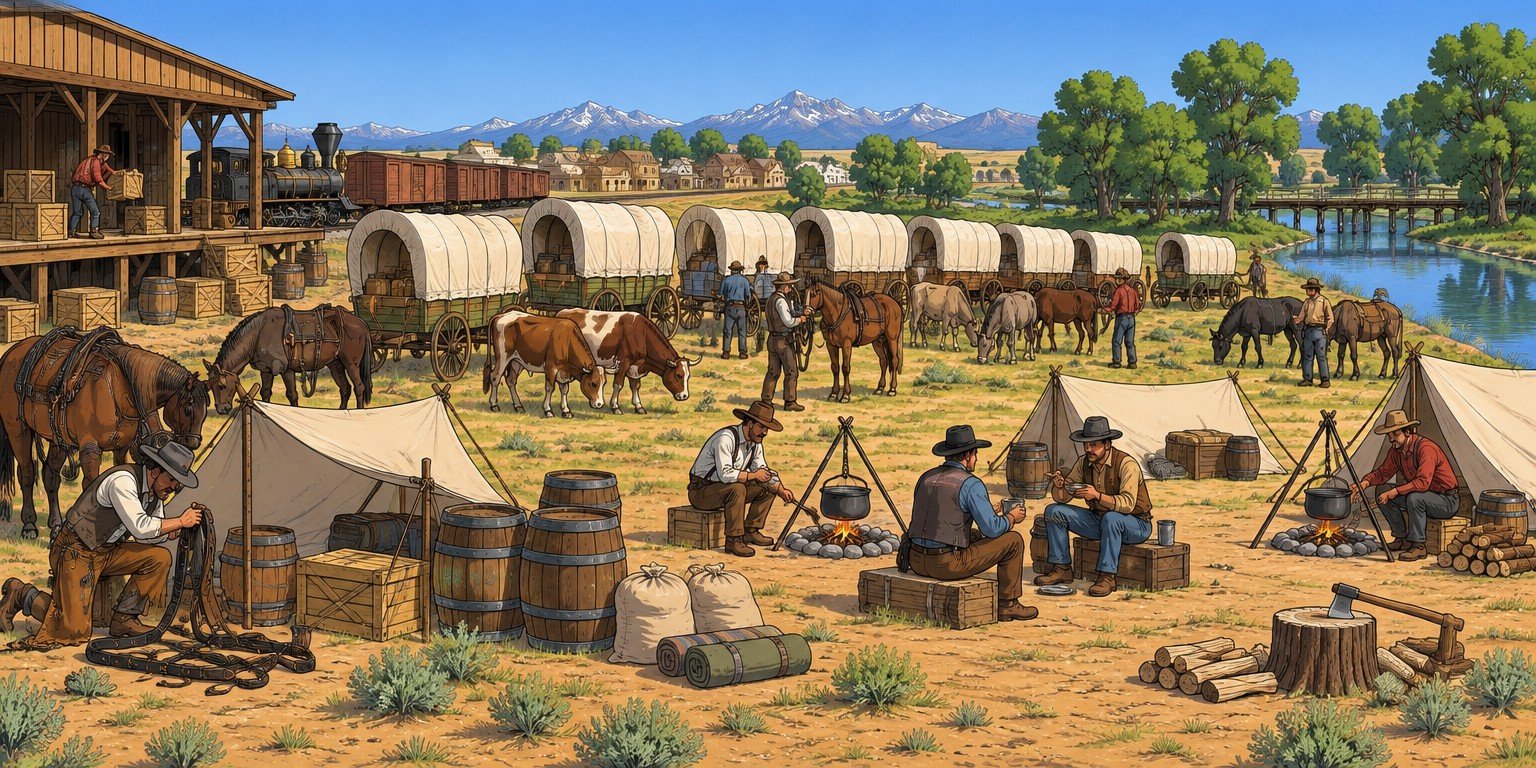
| Freight and forwarding | The depot freight houses and wagon yards ship goods to the mining camps and to the Army. | The rail head is the point of conflict between the Denver Pacific, Kansas Pacific and Union Pacific interests. |
| Mining supply and banking | Banks, assayers and outfitters on Larimer and Blake streets. | Mining equipment arrives by rail. Ore reaches the smelters in the mountains. |
| Smelting | In the range the major smelters are in the mountains (Black Hawk, Georgetown, Golden). A modest lead smelter (Denver Smelting Works) operates in Denver from 1873. The Boston and Colorado Smelting Company moves its works to Argo in 1878–1879, after the play range. | Assayers and sampling works serve the trade in town. |
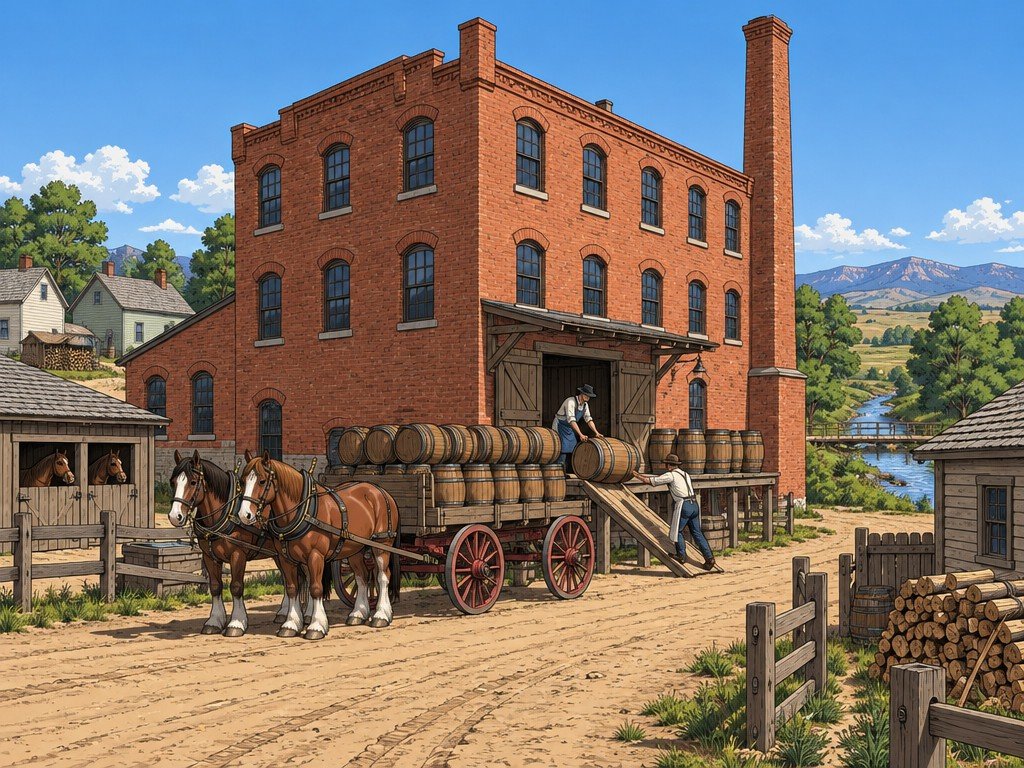
| Brewing | Moritz Sigi's Colorado Brewery in Auraria (the later Tivoli) expanded in the early 1870s; Sigi died after a street accident on 23 March 1874 and his widow ran it until 1878 or 1879. | An ordinary trade with German ties |
| Agriculture | Irrigated farms along the South Platte; the City Ditch (dug from 1865, flowing 1867) feeds the city. | The newspaper's editor promoted farming over mining. |
| Cattle | Kansas Pacific yards bring cattle and horses to the mountain markets. | Linked to the Texas drives |
| Lodging | Hotels and boardinghouses downtown. | See below. |
Hotels
| Hotel | Dated facts |
|---|---|
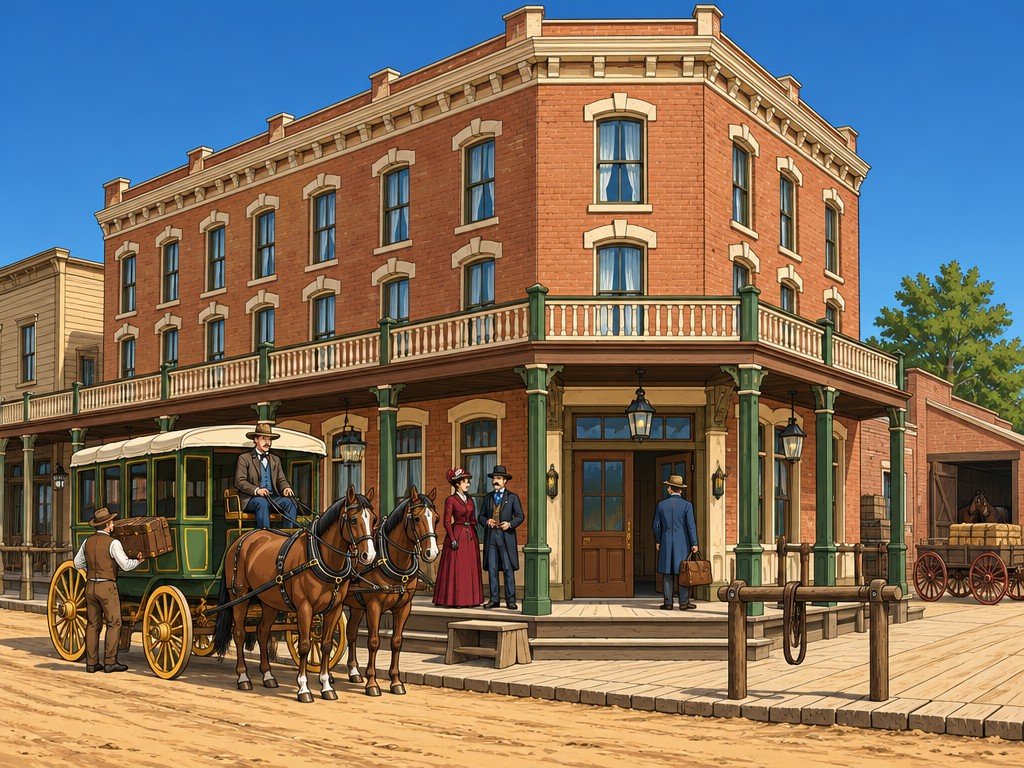
| Tremont House | Opened late 1859 as a temperance boardinghouse; renamed Tremont House by July 1860; stood through the 1860s and 1870s. |
| American House | Built 1868 at 16th and Blake; listed in 1872. |
| Broadwell House | Larimer at 16th, 1859; listed in 1872; plans for a Broadwell building were drawn in 1873. |
| Sargents | Listed in 1872 with the American, Tremont and Broadwell. |
| Inter-Ocean Hotel | Opened 29 October 1873 at 16th and Blake by Barney L. Ford, who built Cheyenne's hotel of the same name in 1875. |
| Hotel Windsor | Opened 1880, after the play range; not yet in town. |
Room, meal, stabling and horsecar rates follow Gear and Prices.
Newspapers and the telegraph
The Rocky Mountain News began 23 April 1859 and remained under its founder as editor until 1878 (a daily since 1860). The Colorado Tribune ran from 15 May 1867 to 19 January 1871 and was followed by the Denver Daily Tribune; the Denver Times began as a daily on 1 April 1872. Telegraph service reached Denver in 1863; a message can reach Cheyenne in minutes, which is why an informed sheriff knows who is coming before the train does. The train itself takes a day from the Wazee and 21st Street depot to Cheyenne. An express leaves Denver mid-morning and reaching Cheyenne in the early afternoon; the ordinary first-class fare in the early 1870s was about $10, falling toward the $7 figure recorded for 1877 (Gear and Prices, Passage).
Communities
Each community in Denver has its own churches, newspapers and benevolent societies. Prejudice follows the social condition in Era Rules.
| Community | Facts | GM use |
|---|---|---|
| Black Denver | Zion Baptist Church organized 15 November 1865; Shorter A.M.E. Church organized 1868. In 1868, at parents’ request, a separate school for Black students opened at 16th and Market; it later met in the African Baptist and African M.E. churches until the integrated Arapahoe School opened in 1872–1873. | Church halls, business owners, a lawyer who knows the law better than the judge. A Black drover like Tolliver would find allies here. |
| Irish | Irish Catholics worship at St. Mary's (the only Catholic parish until St. Elizabeth's, 1878); an Irish parish of their own, St. Leo's, comes in 1887. | Grading crews, soldiers and day laborers; Deveney's country. |
| German | The Denver Turnverein formed in 1865; by 1880 its hall was the largest in the city; Germans held political weight. Sigi's Colorado Brewery, 1864. | Beer halls, singing societies, a political ally for the right party |
| Jewish | A burial and prayer society in 1866; the Hebrew Benevolent Society 1871 and B'nai B'rith lodge 1872; Congregation Emanuel incorporated 1874 with 22 members; its first synagogue dedicated 28 September 1875 at 19th and Curtis. | Merchants, bankers, clothiers; a rabbi hired in early 1876 |
| Hispano | Spanish-speaking people from New Mexico and the San Luis Valley passed through and worked in Denver; no permanent community is on record in the 1870s. The large Auraria Mexican community is of the early 1900s. | Drovers, freighters and horse breakers like Ybarra pass through; keep numbers small and local |
| Chinese | See the next section. |
The Chinese quarter
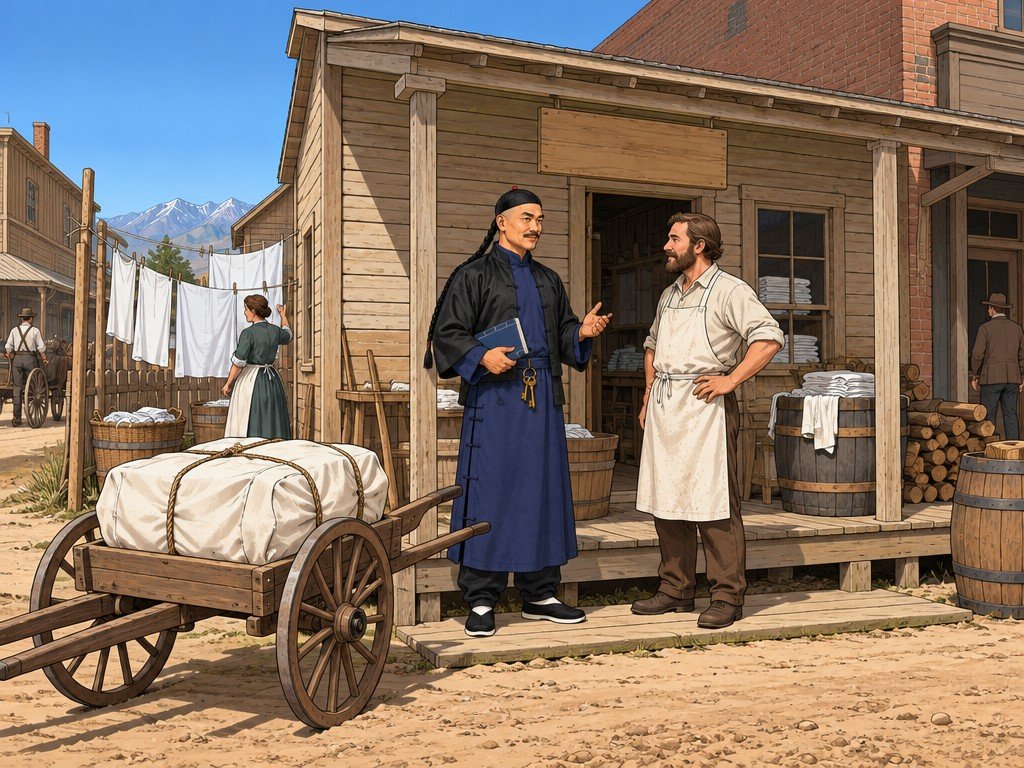
The Colorado Tribune reported Denver’s first Chinese resident on 29 June 1869; Hong Lee, a laundryman who lived in a shanty at Wazee and F streets, arrived about a month later and is the first whose name the record keeps. By fall 1870 a later account counts about 42 Chinese men and women living along Wazee Street, near Holladay Street, though the 1870 census shows far fewer. Most people in the quarter ran laundries or worked as cooks and servants; others were merchants, former railroad or placer workers who had come from the West Coast. The street was called Chinaman’s Row; the later nickname “Hop Alley” (from the slang for opium) is the name that survives, though its first use is unclear.
The 1880 census counted 238 Chinese residents (225 men, 13 women), and an anti-Chinese riot on 31 October 1880 killed one man and wrecked the quarter. The riot falls after the play range. The GM may use rising hostility in 1874 as a situation but not as a certainty.
Chinese Denver in 1874 has its own economy: a laundry that extends credit to four households, a cook who keeps accounts for twenty boarders, and a merchant who imports tea and medicine (Wong Yik Lun of the Era Cast, whose Wo Hing store is on Wazee Street). Characters of Chinese background are playable (see Character Creation and Roles).
Religion and Civic Life
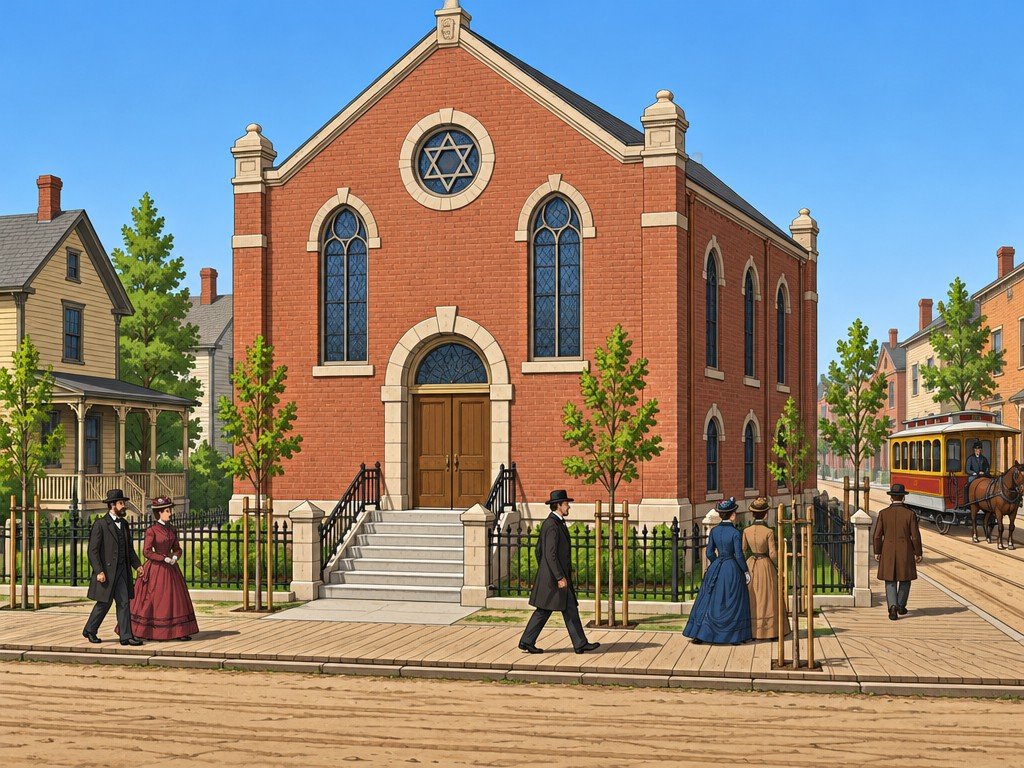
| Institution | Dated facts |
|---|---|
| St. John's Episcopal | First Episcopal community in Colorado, 1860; met at 14th and Arapahoe; named a cathedral in 1879 and moved to 20th and Welton in 1881. |
| St. Mary's, Roman Catholic | First Mass in Denver's first Catholic church on Christmas Eve 1860 at 15th and Stout; became the cathedral in 1868 when Joseph P. Machebeuf became bishop. |
| Congregation Emanuel | See Jewish Denver. Incorporated 1874; synagogue dedicated 28 September 1875. |
| Zion Baptist and Shorter A.M.E. | 1865 and 1868; centers of Black Denver. |
| Methodist | The Lawrence Street Methodist Episcopal church at 14th and Lawrence, built 1864 to 1865, is the city's principal Methodist congregation (later Trinity). The Methodist Episcopal Church founded Colorado Seminary in 1864; it became the University of Denver. |
| Catholic parishes | St. Mary's is the only one in the range; the German St. Elizabeth's (1878) and the Irish St. Leo's (1887) are after it. |
| Presbyterian | First Presbyterian was organized in 1860 under the Reverend A. T. Rankin; the congregation took the name Central Presbyterian in 1874, and its church was finished in 1878. |
Fraternal and benevolent bodies (the Turnverein, B'nai B'rith, the Masons and others) provide credit, burial and introductions. A character who joins one gains a contact and an obligation.
Medicine and Public Health
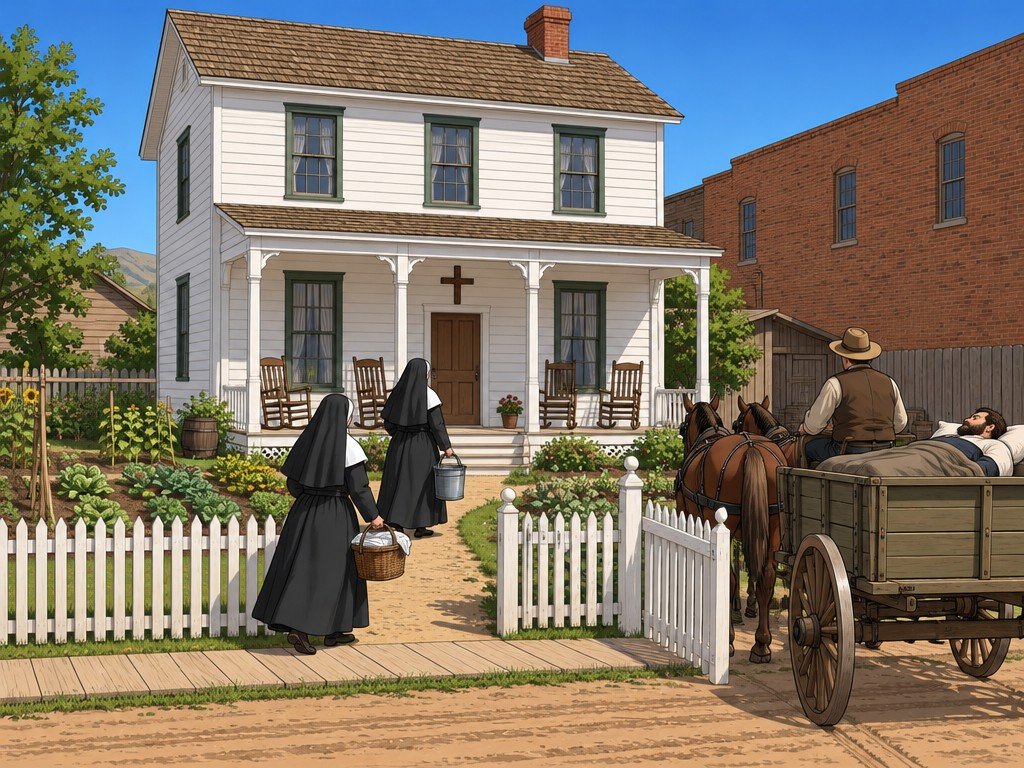
| Institution | Dated facts | Use |
|---|---|---|
| Saint Joseph (Sisters of Charity of Leavenworth) | Opened as St. Vincent's on 22 September 1873 in a donated house at 14th and Arapahoe; moved in 1874 to 26th and Holladay; renamed Saint Joseph and moved to 18th and Humboldt in 1876. | A real bed, run by nuns, open to the poor and the paying |
| Arapahoe County Hospital | Built in 1873 by the county commissioners on the present Denver Health site: a two-story house-like building with a men’s ward of about twelve cots, a physician’s office, pharmacy, and rooms for women. It treats the indigent and serious illness, including typhoid and other contagion. | Contagion cases, the indigent |
| Doctors and drug stores | Private physicians, apothecaries and drug stores on Larimer and nearby streets. | See the Apothecary book for medicines and the Era Rules for illness |
The 1879 typhoid outbreak, which sickened more than 600 and killed at least 40 from contaminated water, is after the play range. Water in the 1870s is a ditch, a river and a new company formed in 1870.
Social Life and Recreation
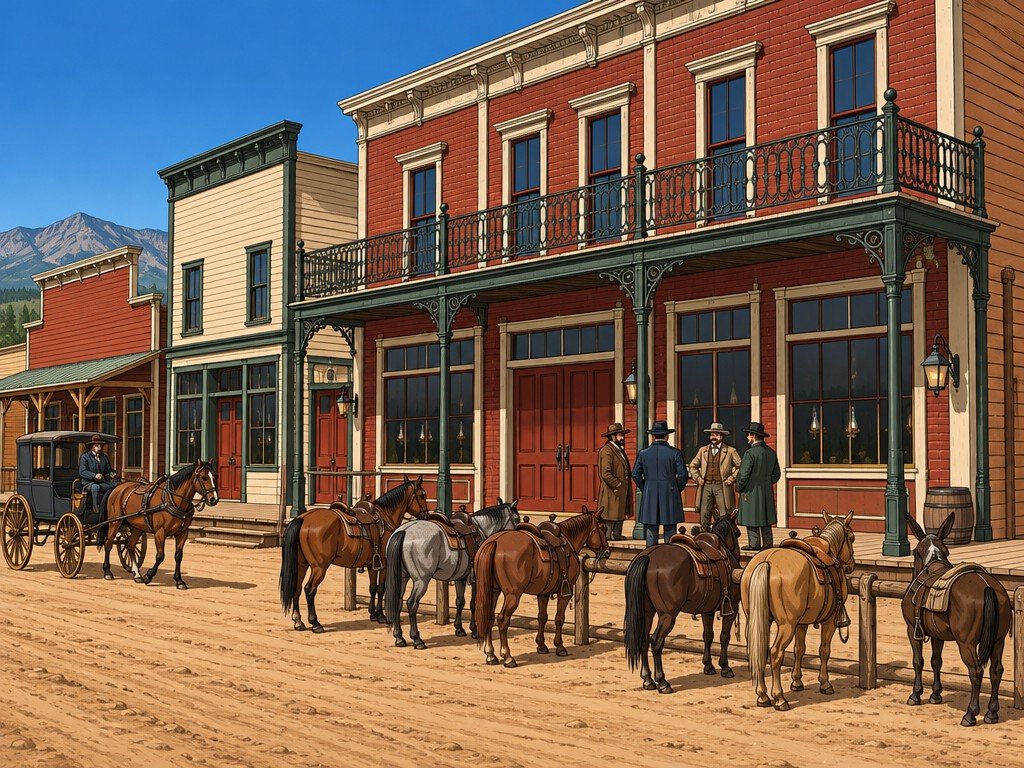
- Theater and music: Denver had a theater by 1859 and its first opera performance in 1864. Ed Chase’s Progressive Hall on Blake Street (rebuilt after the 1863 fire) is the large gambling house of the range; his Palace Theater, a variety house and gambling rooms at 15th and Blake, is later, about 1880. Traveling companies come by rail.
- Saloons and gambling: Blake and Larimer streets. Gambling is tolerated, and the marshal's attention follows the proprietor's standing.
- Horsecar rides: The Denver Horse Railroad (1871) is a cheap way to cross town and a good place to overhear a conversation.
- Societies: Turnverein (German gymnastics and singing), B'nai B'rith, Masonic lodges, church socials.
- Vice: Holladay Street is the district of record. Authorities tolerate it when they do not license it, and the people who keep houses pay fines and fees and have allies in the council.
Cheyenne and Arapaho Memory
Denver is the city where, on 28 September 1864, Governor Evans and Colonel Chivington met Black Kettle, White Antelope and Bull Bear of the Cheyenne and Neva, Bosse, Heap of Buffalo and Na-ta-nee of the Arapaho at Camp Weld (the camp stood on the east bank of the South Platte about two miles southwest of the town and was abandoned in 1865), and the city to which soldiers returned after the attack at Sand Creek on 29 November 1864. At dawn that day troops under Colonel John Chivington attacked a camp of Cheyenne and Arapaho people on Sand Creek; about two-thirds of the roughly 230 people killed were women, children and older people. Black Kettle, the Cheyenne leader who flew the American flag, survived. The Denver response is a matter of record: first a hero's welcome, then federal investigations.
In 1869 to 1876 the Cheyenne and Arapaho people who suffered at Sand Creek and survived are not living in Denver. By treaty the Southern Cheyenne and Southern Arapaho have been assigned to a reservation in Indian Territory; the Northern Cheyenne and Northern Arapaho draw rations at the Red Cloud and other agencies and have no reservation of their own in the range (see Tribal Nations). A Cheyenne or Arapaho character arriving in Denver arrives in a city whose residents remember the event differently from the nations that lived it.
The Ute Nation and Denver
The Ute people (the Nuche; the Tabeguache (Uncompahgre), Muache, Capote, Weeminuche, Yampa, Grand River (Parianuche) and Uintah bands are the bands named in the 1873 agreement) hold the western half of Colorado under an 1868 treaty. Gold and silver prospecting in the San Juan Mountains puts that land under pressure from Colorado's territorial government and its mining interests, and Denver is where that pressure is organized.
| Date | Event |
|---|---|
| 1868 | A treaty sets aside a large reservation across western Colorado; the government later tries to buy the Utes out of other rights and fails. |
| 1872 | Talks fail when the Utes refuse to give up any part of the reservation. A delegation under Ouray travels to Washington, leaving Los Pinos agency 10 November 1872 and returning January 1873. |
| 13 September 1873 | The Brunot Agreement is signed at the Los Pinos Agency. About 3.7 million acres in the San Juans are ceded (figures run from 3.45 to 4 million). The agreement is not a treaty, since Congress had ended treaty-making with tribal nations in 1871. |
| 29 April 1874 | Congress ratifies the agreement. |
| 1881 | Utes are removed from Colorado. After the play range. |
Ute delegations travel through Denver on the way to Washington. A Commissioner of Indian Affairs report mentions Ouray in Denver and wanting to see the commissioner. Denver is a place where an interpreter, a lawyer and a land agent can bargain over an agreement that the Utes themselves regard as extracted from them under pressure.
Nearby Destinations

| Place | Distance and link | 1869 to 1876 facts |
|---|---|---|
| Golden | About 15 miles west; Colorado Central | Territorial capital 1862 to 1867; Colorado Central to Golden 1870; the mines' gateway. |
| Boulder | Northwest, along the foothills; Colorado Central branch from 1873 | Supply town for the Boulder County mines. |
| Greeley | North on the Denver Pacific | Founded 1870 as a temperance colony. |
| Morrison | Southwest, 3 July 1874 service | Denver, South Park and Pacific. |
| Colorado Springs | About 75 miles south on the Denver and Rio Grande, from 21 October 1871 | Palmer's planned resort town, founded 1871. |
| Black Hawk and Central City | In the mountains west, by Colorado Central narrow gauge to Black Hawk by December 1872 | Gold and silver-lead ores; Boston and Colorado smelter at Black Hawk. |
| Georgetown | West on Clear Creek | Silver camp; rails reached it in 1877; stage in the range. |
| The Front Range | Directly west | Hayden's survey of 1873 started at Denver. |
Fictional Denver NPCs
Hannah Voss, Boardinghouse Keeper (fictional)
A German-born widow who rents rooms near the Turnverein to railroaders, miners and visiting lawmen. She keeps a ledger of who owes what and knows when a guest leaves in a hurry. She sells information to anyone who pays the board.
Ezekiel Moore, Church Trustee (fictional)
A Black businessman and trustee at one of the city's Black churches. He wants a petition delivered to the territorial legislature and knows which lawyers will take a Black client's case and which will not. He will help a character who helps his congregation.
Pádraig O'Hare, Freight Foreman (fictional)
An Irish foreman at the Denver Pacific freight house. The same crates have gone missing three times, and he wants the thief found before the company blames him.
Jung Sik Ming, Laundryman and Money Lender (fictional)
A Chinese laundry owner on Wazee Street, from Taishan. He sends money to family in Guangdong, lends to other households, and is owed by slow-paying soldiers and tradesmen. He wants a debt collected quietly.
Rebecca Adler, Clothier's Wife (fictional)
A member of Denver's Jewish community who keeps the books for her husband's dry-goods store and raises money for the new synagogue. She notices when a customer pays in coin not from Denver.
Margaret Sullivan, Seamstress and Dressmaker (fictional)
An Irish widow with a shop on Larimer Street who dresses the wives of merchants and mine owners and the women of the line below. She learns who is rising and who is ruined by the size of the orders. Hook: a customer leaves a gown unpaid, and a man comes asking where she lives.
Dolores Archuleta, Laundress and Midwife (fictional)
A Hispano woman who takes in washing and attends births in Auraria, west of Cherry Creek. Families bring her their quarrels before they bring them to the court. Hook: she will vouch for a young man wanted by the marshal, if someone finds the horse he is accused of taking.
Anna Pfeiffer, Hotel Cook (fictional)
A German-born cook at a Larimer Street hotel who feeds drummers, lawmen and legislators and hears what they say over the plates. She pays her kitchen hands in full and on time. Hook: a guest left a sealed packet in her pantry and has not come back for it.
Marshal's Man (fictional)
A city officer with a short list of known troublemakers, a long list of favors owed and no ambition. He treats fellow officers fairly and strangers as possible danger. He is not corrupt and not brave.
Hooks
Hook: The Missing Car
A freight car of mining machinery bound for Black Hawk leaves the Denver Pacific yard marked delivered and arrives nowhere. The Union Pacific, the freight house and the consignee each blame the others. Tolliver's outfit can provide the muscle; Harrow, if involved, wants the record changed. The truth is the GM's choice: the bill of lading was sold twice by a depot clerk, rewritten by the consignee's agent, or misrouted by a switching error.
Hook: The Warrant and the Line
Deveney, a deputy U.S. marshal whose writ stops at the Wyoming line, asks the party to bring a federal prisoner from Denver to Cheyenne once Colorado's marshal has taken him and a judge has signed the removal warrant. The Arapahoe County sheriff wants the same man for a different crime, and a Cheyenne court order does not hold in Colorado.
Hook: The Wazee Street Laundry Fire
A small fire destroys a Wazee Street laundry the night after a saloon fight. The marshal calls it an accident. Wong Yik Lun (Era Cast) wants the party to find who started it before the neighbors do. The cause is the GM's choice: a lamp, a lease debt, a grudge or a rival's arson.
Hook: The Ute Delegation
A Ute delegation passes through on its way to Washington; a mining syndicate wants its members' signatures on a document first. A Ute-speaking interpreter is the only person who can read both versions, and she is sure the English and the translation do not match. Land agents, the Army and the territory press her.
Hook: Odette's Debt
Odette Marchand (see the Cast) holds a note from a Denver banker and sends the party to Denver to collect. The banker says the note was paid. The ledger says it was not; either book may be in error. The bank is the creditor of three people the party likes.
Hook: The Stolen Stock
Wade Carrick (see the Cast) has run a string of stolen horses to Denver and sold them through a livery. A rancher recognizes his brand. The livery keeper says he bought the horses honestly. The party must decide whether to bring Carrick in or follow the money.