This chapter lists the real people, events and institutions of the corridor from 1865 to 1880. Each entry gives who or what it was, where and when, and one line on why it matters at the table. The play range is 1869 to 1876; entries outside it are lead-ins or aftermath.
NOTICE
Entries. Entries are alphabetical within each part, by the name most used, and other chapters cite them by anchor (#hr-person-surname, #hr-event-name, #hr-inst-name, #hr-myth-topic). Dates are written day, month, year. Where sources differ, the entry says so.
Real people. The people listed here are historical figures. Player characters and NPCs are fictional, and no entry changes a rule.
Part One: People
Birth and death years are given where sources agree. "c." means the sources differ or the record is approximate.
American Horse (the elder)
Oglala Lakota leader, c. 1830 to 9 September 1876. Active in the Powder River and Black Hills country, 1860s to 1876. Listed among the Oglala names in the 1868 Fort Laramie Treaty transcript. Died of wounds after the fight at Slim Buttes on 9 to 10 September 1876, when Captain Anson Mills's column attacked his camp. Not the younger American Horse (c. 1840 to 1908), who was unrelated. At the table: a Lakota leader whose camp the Army attacked on 9 September 1876, after Little Bighorn.
Augur, Christopher C.
U.S. Army general, 1821 to 1898. Commanded the Department of the Platte, headquartered at Omaha, from January 1867 to November 1871. Signed the 1868 Fort Laramie Treaty as a commissioner. Camp Augur, later Camp Brown and then Fort Washakie, was named for the general. At the table: the theater commander over every post in Wyoming and Nebraska at the start of the play range.
Bancroft, Frederick J.
Physician, 1834 to 1903. Denver, from 1865. Denver city physician 1872 to 1877 and 1878 to 1879; first president of the Colorado State Board of Health, 1876; pressed for vaccination and sanitation measures. After the Cherry Creek flood of 22 May 1878 and the epidemic of 1879, Denver built its first sewer system. At the table: a representative of the doctors who ran city health work and dealt with smallpox in a dry, fast-growing city.
Bird, Isabella
English travel writer, 1831 to 1904. In Colorado, autumn 1873. Rode through Colorado's Front Range, including Estes Park, and described camps, ranches and boarding houses in letters published as a book in 1879. At the table: a firsthand outsider's view of the Front Range in the middle of the play range.
Black Coal
Northern Arapaho leader, c. 1840 to 1893. With Sharp Nose he went to Washington in 1877 to press for a reservation for the Northern Arapaho; about 950 Northern Arapaho people were brought to the Wind River Valley in spring 1878. At the table: the Northern Arapaho are in negotiation and movement during the whole play range; the Wind River arrangement is 1878, after the book's map.
Black Kettle
Southern Cheyenne peace chief, c. 1803 to 27 November 1868. Survived the Sand Creek attack of 29 November 1864 in Colorado Territory and was killed four years later at the Washita River in Indian Territory. At the table: a Cheyenne leader who sought peace with the Army; his camp was attacked at Sand Creek in 1864 and at the Washita in 1868.
Bright, William H.
Saloon keeper and territorial legislator, c. 1826 to 1912. South Pass City. Born at Alexandria, then in the District of Columbia; a Union soldier in the war; came to South Pass City in the summer of 1867 and opened a saloon there in 1868. Elected to the Council of the first territorial legislature on 2 September 1869 as a Democrat and chosen its president, he introduced the women's suffrage bill; the Council passed it 6 to 2 and Campbell signed it on 10 December 1869. He later said his wife was as good as any man and a better voter than convicts and idiots; the same record shows him opposed to the Black vote. His saloon failed, the family moved to Denver and then to Washington, where he died in 1912. At the table: the law that opens the play range had an author with mixed motives.
Brown, Clara
Black entrepreneur and philanthropist, born enslaved, c. 1800 to 1885. Central City and Denver, 1859 onward. Ran a laundry in Colorado mining towns, saved money, and paid for relatives and other formerly enslaved people to come to Colorado. Voted into the Society of Colorado Pioneers in 1885. At the table: a Black property owner in a Colorado mining town whose standing came from money, church and service.
Brunot, Felix R.
Chairman of the Board of Indian Commissioners, 1820 to 1898. Pittsburgh. Chaired the board from its creation in 1869 until the original members resigned early in 1874; met Red Cloud and the Oglala at Fort Laramie in June 1871; negotiated the Shoshone cession of 26 September 1872 and the Ute agreement of 13 September 1873, both known by his name (Tribal Nations). At the table: the Peace Policy's civilian face; both cessions the map hatches are his.
Byers, William N.
Newspaper publisher, 1831 to 1903. Denver, 1859 onward. Founded the Rocky Mountain News and promoted Colorado settlement, railroads and statehood. His paper was a main voice for the settler side during the Sand Creek period. At the table: Denver's leading newspaper publisher and a promoter of settlement and statehood.
Campbell, John A.
First governor of Wyoming Territory, 1835 to 1880. Arrived in Cheyenne on 7 May 1869 and signed the women's suffrage bill on 10 December 1869. Governor from 1869 to 1 March 1875. At the table: the territorial executive whose signature made Wyoming the first place in the nation to give women the vote.
Carr, Eugene A.
U.S. Army officer, 1830 to 1910. 5th Cavalry. Led the column that destroyed Tall Bull's Cheyenne camp at Summit Springs, Colorado Territory, on 11 July 1869, with 50 Pawnee Scouts under Major Frank North. At the table: commanded the winning side at the last large fight the Cheyenne Dog Soldiers fought in the Colorado plains.
Chaffee, Jerome B.
Banker and politician, 1825 to 1886. Denver. Co-founder of the First National Bank of Denver; Colorado's territorial delegate 1871 to 1875; one of Colorado's first two U.S. senators, 1876 to 1879. At the table: representative of Denver money and territorial politics.
Chin Lin Sou
Chinese labor contractor and merchant, 29 September 1836 to 10 August 1894. Black Hawk and Denver, about 1870 onward. Worked for the Central Pacific in California, Nevada and Utah, rising to foreman, then for the Union Pacific in Utah and Wyoming, then managed Chinese mining crews at Black Hawk from about 1870 and later became a Denver merchant. At the table: how Chinese labor was hired in Colorado, through contractors.
Chivington, John M.
Methodist minister and Colorado militia colonel, 1821 to 1894. Commanded the Colorado volunteers at Sand Creek on 29 November 1864. Investigations followed in 1865. At the table: the commander at Sand Creek, whose conduct Denver residents debated openly and whom the 1865 investigations examined.
Cody, William F. ("Buffalo Bill")
Army scout and showman, 1846 to 1917. Served as a scout with the 5th Cavalry in 1869 and is often credited with shooting Tall Bull at Summit Springs; some accounts credit Frank North or another soldier. At the table: a reminder that credit for famous shots was disputed and later promoted.
Crazy Horse (Tȟašúŋke Witkó)
Oglala Lakota war leader, c. 1840 to 5 September 1877. Fought in Red Cloud's War, at Rosebud on 17 June 1876 and at Little Bighorn on 25 to 26 June 1876. Died at Camp Robinson, Nebraska, after surrendering in 1877. At the table: a war leader of the northern Lakota who stayed out of the agencies until 1877.
Crook, George
U.S. Army general, 1828 to 1890. Commanded the Department of the Platte from 1875; his columns fought at Powder River (17 March 1876) and Rosebud (17 June 1876), then at Slim Buttes. At the table: the Army's commander for the northern plains in the Great Sioux War, with Cheyenne as his supply base.
Custer, George Armstrong
U.S. Army officer, 1839 to 25 June 1876. 7th Cavalry. Led the Black Hills Expedition from Fort Abraham Lincoln, which left on 2 July 1874 and reported gold on French Creek between 30 July and 2 August. Killed with five companies at Little Bighorn on 25 June 1876. At the table: his report set off the Black Hills gold rush that drew Cheyenne's traffic north.
Dodge, Grenville M.
Civil War general and railroad engineer, 1831 to 1916. Chief engineer of the Union Pacific from 1866; laid out the line to Cheyenne in 1867. At the table: the engineer behind the route Cheyenne sits on.
Dull Knife (Morning Star)
Northern Cheyenne leader, c. 1810 to 1883. His village was attacked on 25 November 1876 by troops under Colonel Ranald Mackenzie (aftermath of the Great Sioux War). At the table: a leader whose people fought at Little Bighorn and were attacked five months later.
Evans, John
Physician, governor and railroad promoter, 1814 to 1897. Colorado Territorial governor 1862 to 1865; removed after Sand Creek. President of the Denver Pacific. At the table: the man whose name is on the Denver railroad connection to Cheyenne.
Ford, Barney L.
Black businessman and civil rights advocate, 1822 to 1902. Denver and Cheyenne. Born enslaved in Virginia; escaped; ran restaurants and hotels in Denver, and in 1875 opened a second Inter-Ocean Hotel in Cheyenne, built at a cost of about $65,000; close friend of Clara Brown; active in the push for Black men's vote in the territory. At the table: a prominent Black businessman in both cities.
Goodnight, Charles
Texas cattleman, 1836 to 1929. Took Texas herds up the Goodnight-Loving Trail to Colorado from 1866 and, under an 1868 contract with John W. Iliff, on past Greeley and up Crow Creek to Cheyenne; ranched near Pueblo, Colorado Territory, about 1869 to 1875. At the table: the route by which Texas cattle came to Cheyenne markets.
Hardin, William J.
Black barber and politician, c. 1831 to 13 September 1889. Born in Kentucky; the first Black man elected to Wyoming's territorial legislature, elected in 1879 and 1880 and sitting in the 1879 and 1882 sessions. At the table: a Black barber, orator and legislator in Cheyenne's public life near the end of the history range.
Hayden, Ferdinand V.
Physician and geologist, 1829 to 1887. Led U.S. geological surveys of the Territories: the 1870 season worked out of Cheyenne and Fort D.A. Russell; the 1871 Yellowstone party left Ogden, Utah, in early June 1871; the 1873 season started at Denver. At the table: a government surveyor whose maps and reports were used to claim land and to find routes.
Hickok, James Butler ("Wild Bill")
Scout, lawman and gambler, 1837 to 2 August 1876. In Cheyenne in 1874 and 1876; married Agnes Lake there on 5 March 1876; shot by Jack McCall in Deadwood on 2 August 1876, the day after the play range closes. One face-to-face gunfight is documented, with Davis Tutt in Springfield, Missouri, on 21 July 1865; the rest of his reputed tally grew in print. At the table: a famous name in Cheyenne gambling rooms.
Howe, Church
First U.S. marshal for Wyoming Territory, 1839 to 1915. Cheyenne, 1869 to late 1870. Appointed by Grant in 1869; helped organize the territorial government; moved to Nebraska in 1871 and later sat in its legislature. At the table: the office a deputy marshal like Deveney answers to; not the judge John H. Howe.
Howe, John H.
Chief Justice of Wyoming Territory, 1822 to 1873. Chief justice 6 April 1869 to 14 October 1871. Seated women on the grand jury in Laramie in March 1870 over an objection from the Albany County attorney; women were excluded from Wyoming juries after he left the bench. At the table: the judge behind the first women's jury service.
Iliff, John W.
Colorado cattleman, 1831 to 1878. Supplied beef to railroad crews and Indian agencies. At the table: a cattle supplier whose contracts tied ranches to the agencies and the railroad.
Little Raven
Southern Arapaho principal chief, c. 1810 to 1889. First signer for the Arapaho at Fort Wise on 18 February 1861 and a signer at Medicine Lodge in October 1867; went east with other leaders in 1871 to argue for peace; kept most of the Southern Arapaho out of the Red River War of 1874 to 1875 (Factions and Powers). Died at Cantonment, Indian Territory, in 1889. At the table: the Southern Arapaho position rests on his choices; a Cheyenne or Arapaho visitor to Denver in the range carries his name as the peace side.
Little Wolf
Northern Cheyenne chief, c. 1820 to 1904. Fought in Red Cloud's War, including the Fetterman fight; signed the Fort Laramie treaty with the Northern Cheyenne and Northern Arapaho on 10 May 1868; with Dull Knife led the November 1873 delegation to Washington that said the Northern Cheyenne had never given up their homeland and would not move south (Factions and Powers); fought in 1876, and his village with Dull Knife's was attacked on 25 November 1876. Surrendered in May 1877 and was sent to Indian Territory; led the journey north from September 1878 and surrendered near the Powder River in March 1879 (after the range). At the table: the Northern Cheyenne leader who put the nation's refusal to move south on the record in 1873.
Machebeuf, Joseph P.
Catholic priest and bishop, 1812 to 1889. Denver, from 1860. Built Catholic parishes and schools in Colorado; Vicar Apostolic of Colorado from 1868. At the table: the Catholic Church in Denver and the mining towns.
Mills, Anson
U.S. Army officer, 1834 to 1924. Captain, 3rd Cavalry. Led the attack on American Horse's camp at Slim Buttes on 9 September 1876. At the table: a field officer in the Great Sioux War.
Morris, Esther Hobart
Justice of the peace, 1814 to 1902. South Pass City, Wyoming Territory. Appointed on 14 February 1870. Accounts differ on whom she replaced: R. S. Barr, who resigned in protest at the suffrage law, or J. W. Stillman, whom she had arrested when he refused to hand over the docket. She served about eight months. Her popular credit as the author of the suffrage bill is not supported; the bill's sponsor was William H. Bright. At the table: the first woman judge in the nation, in a mining camp.
North, Frank
Army scout and officer, 1840 to 1885. Commanded the Pawnee Scouts; at Summit Springs he led them under Carr. At the table: the Pawnee were allies of the Army against the Cheyenne and Lakota, for their own reasons.
O'Brien, Nicholas J.
Deputy U.S. marshal and Laramie County sheriff, 1839 to 1916. Cheyenne. Born in County Wexford, Ireland; came to the United States in 1848; moved from Colorado to Cheyenne, served there as a deputy U.S. marshal, and was elected sheriff in 1874, serving 1874 to 1875 (Cheyenne). Died in Denver in 1916. At the table: the one sheriff of the play range who wore a deputy marshal's star first, which is Deveney's own career (Era Cast); an Irish-born sheriff in the chair in 1874.
Ouray
Tabeguache (Uncompahgre) Ute leader, 1833 to 1880. Principal Ute negotiator in 1868 and in the Brunot talks in September 1873. The government treated him as head of all Colorado Utes; other Ute leaders did not accept this. Died in 1880 after his last trip to Washington. At the table: the Utes had divided leadership, and U.S. officials chose which voice to hear.
Palmer, William Jackson
Railroad builder, 1836 to 1909. Founded the Denver and Rio Grande in 1870 and Colorado Springs in 1871. At the table: a rival to the Denver Pacific system.
Post, Amalia
Cheyenne woman, c. 1826 to 1897. Served as foreman of a Cheyenne jury of six men and six women at a murder trial in 1871, the first woman foreman in the territory; the jury convicted. At the table: a Cheyenne woman who served in a public legal role.
Red Cloud (Mahpíya Lúta)
Oglala Lakota leader, 1822 to 1909. Led the fight that closed the Bozeman Trail in 1866 to 1868 and signed the Fort Laramie Treaty only on 6 November 1868, after the Army abandoned its forts. Did not fight in 1876. At the table: the main Oglala negotiator with the United States, and the signer of the 1868 treaty for the Oglala.
Routt, John L.
Last territorial governor and first state governor of Colorado, 1826 to 1907. Appointed 29 March 1875; elected the first state governor on 3 October 1876. At the table: the executive of the Colorado transition.
Sharp Nose
Northern Arapaho leader, c. 1830 to 1907. Signed the 1868 Fort Laramie Treaty with Black Coal; went to Washington with him in 1877; considered second-ranking chief by government officials until Black Coal's death in 1893; his band settled near Ethete after the 1878 move. At the table: Northern Arapaho leadership was shared.
Sheridan, Philip H.
U.S. Army general, 1831 to 1888. Commanded the Military Division of the Missouri from 1869; directed the Plains campaigns from Chicago. At the table: the commanding general over both Wyoming and Colorado.
Silks, Martha ("Mattie")
Denver madam, c. 1846 to 1929. Came to Denver about 1876 and opened a house on Holladay Street; the Rocky Mountain News first reports her in August 1877. Prostitution was tolerated and taxed or fined rather than legalized. At the table: a prominent figure in Denver's sex trade, which authorities ignored when it was not legal.
Sitting Bull (Tȟatȟáŋka Íyotake)
Hunkpapa Lakota leader, c. 1831 to 1890. A leader of the northern camps at Little Bighorn. Not the same person as the "Sitting Bull" listed as an Oglala signer of the 1868 treaty. At the table: a Hunkpapa leader who remained out of the agencies.
Spotted Tail (Sinte Glešká)
Sicangu (Brule) Lakota leader, c. 1823 to 5 August 1881. Signed the 1868 treaty; he and Red Cloud went to Washington in 1875 and refused to bargain for their people over the Black Hills. At the table: a negotiator who dealt with the United States directly.
Swain, Louisa Ann
Laramie woman, c. 1801 to 1880. First woman to cast a ballot in a general election under equal suffrage, in Laramie on 6 September 1870. At the table: the first woman voter.
Tall Bull
Southern Cheyenne Dog Soldier leader, died 11 July 1869 (born about 1830). Spoke for the Cheyenne at the Medicine Lodge council in October 1867; after the Washita attack of November 1868 led the Dog Soldier camp to the Republican River; Carr's 5th Cavalry struck it in the spring of 1869 and again at Summit Springs, Colorado Territory, on 11 July 1869, where he was killed and his wife and daughter were taken. Frank North, Cody and a soldier are each credited with the shot (Who shot Tall Bull). At the table: the last Dog Soldier leader on the Colorado plains; he died in the summer of the year the play range opens.
Washakie
Eastern Shoshone leader, c. 1804 to 1900 (sources give birth between 1798 and 1810). Signed the Fort Bridger Treaty on 3 July 1868, which created the Wind River Reservation. Recognized by the United States as the Eastern Shoshone head from 1851. At the table: a Shoshone leader in a long relationship with the Army, whose people were rivals of the Lakota and Cheyenne.
Wynkoop, Edward W.
Frontier officer and Indian agent, 1836 to 1891. Denver and Fort Lyon. Worked to bring Cheyenne and Arapaho leaders into peace talks in 1864 and was later an agent for them. At the table: an Indian agent who held peace talks with Cheyenne and Arapaho leaders and disagreed with territorial officials.
Part Two: Events
The table lists the dated events in time order and links to the entries, which are alphabetical.
| Date | Event |
|---|---|
| 29 Nov 1864 | Sand Creek (lead-in) |
| 26 Jul 1865 | Platte Bridge |
| 21 Dec 1866 | Fetterman Fight |
| 4 Jul 1867 | Cheyenne founded |
| 13 Nov 1867 | Union Pacific reaches Cheyenne |
| 21 Mar 1868 | Cheyenne lynching |
| 29 Apr 1868 | Fort Laramie Treaty |
| 3 Jul 1868 | Fort Bridger Treaty |
| 25 Jul 1868 | Wyoming Territory created |
| 10 May 1869 | Promontory |
| 11 Jul 1869 | Summit Springs |
| 10 Dec 1869 | Wyoming women's suffrage |
| 14 Feb 1870 | Morris appointed justice of the peace |
| 7 Mar 1870 | First women jurors |
| 24 Jun 1870 | Denver Pacific completed |
| 15 Aug 1870 | Kansas Pacific reaches Denver |
| 6 Sep 1870 | First women's vote |
| 13 Sep 1873 | Brunot Agreement |
| 29 Nov 1873 | Laramie County stockmen organize |
| 2 Jul 1874 | Black Hills Expedition |
| 4 Jul 1874 | Bates Creek |
| 20 Sep 1875 | Allison Commission |
| Feb 1876 | Cheyenne to the Black Hills stage |
| 17 Mar 1876 | Great Sioux War |
| 25 to 26 Jun 1876 | Little Bighorn |
| 1 Aug 1876 | Colorado statehood |
| 31 Oct 1880 | Denver riot |
Allison Commission council, 20 September 1875
Northwestern Nebraska. A U.S. commission met Lakota leaders to buy the Black Hills or lease mining rights. Offers of $6 million for the Hills, or $400,000 a year for mining rights, were rejected. The failure led to the 15 August 1876 appropriations act that cut Sioux rations until the Hills were given up, and then the Act of 28 February 1877. At the table: the Black Hills were not sold; Congress took them by statute, although the Fort Laramie Treaty required three-fourths of adult Lakota men to agree.
Bates Creek, 4 July 1874
Bighorn Mountains, Wyoming Territory. Cavalry from Camp Brown under Captain Alfred E. Bates and about 160 Shoshone warriors, 30 of them enlisted Army scouts, attacked a Northern Arapaho camp; the Army estimated about 24 Arapaho killed and 200 horses taken. At the table: the Army at Camp Brown treated the Northern Arapaho as allies of the Lakota, and the Shoshone fought beside it; the Northern Arapaho were not on the Wind River Reservation until 1878.
Black Hills Expedition, 2 July to 30 August 1874
Fort Abraham Lincoln, Dakota Territory, into the Black Hills. Custer's column of the 7th Cavalry left on 2 July 1874. Civilians attached to the column reported gold on French Creek between 30 July and 2 August 1874: the first colour on 30 July, the richer find on 1 and 2 August. Yields were small, and the news set off a rush that Cheyenne and Fort Laramie felt first. At the table: the hook for outfitters, freight and stage traffic out of Cheyenne.
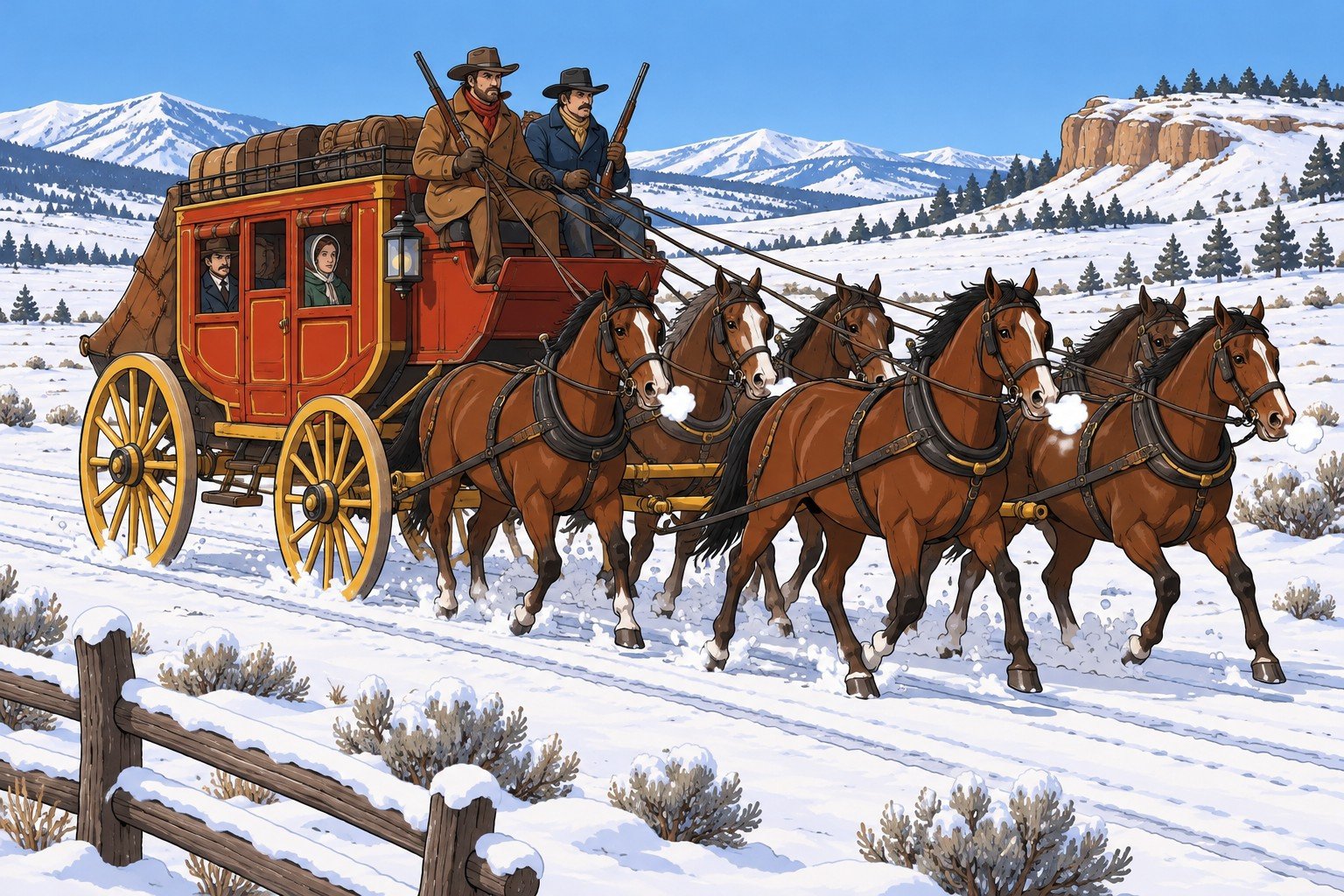
Black Hills stage, February 1876
Cheyenne to Custer City. The first stage trips ran on 3, 7 and 10 February 1876 under Yates and Brown, who sold the line on 12 February to Gilmer, Salisbury and Patrick; the new owners' first Concord coaches left Cheyenne on 3 April 1876. A coach reached Deadwood on 25 September 1876, after the play range closes on 1 August 1876; the Deadwood run is an epilogue. At the table: the road from Cheyenne into land still unceded under the 1868 treaty.
Brunot Agreement, 13 September 1873
Los Pinos Agency, Colorado Territory. Commissioner Felix Brunot and Ute leaders, including Ouray, agreed to give up about 3.7 million acres of the San Juan Mountains. The agreement names seven bands as parties (Tabeguache, Muache, Capote, Weeminuche, Yampa, Grand River and Uintah); many Ute men refused to sign, and the commission brought in Otto Mears and offered Ouray a salary to end the deadlock. Congress approved it on 29 April 1874. It was an agreement, not a treaty. At the table: miners in the San Juans traveled on Ute land.
Cheyenne founded, 4 July 1867
Dakota Territory, now Wyoming. The Union Pacific chose the townsite on 4 July 1867 and platted it on 5 July; the town was laid out as a winter terminus, and several thousand workers gathered. At the table: the town was a railroad construction camp before it was a county seat.
Cheyenne lynching, 21 March 1868
Cheyenne. In January 1868 the committee seized three men accused of stealing $900; accounts differ on whether they were hanged or placarded and run out. On 21 March 1868 about fifteen masked men took Charles Martin from a dance house and lynched him, and Charles J. Morgan was hanged a few hours later; no one was charged. Cheyenne's vigilantism was not extensive. At the table: vigilance committees existed because courts and officers were weak; after Wyoming Territory was organized, they were less common.
Colorado statehood, 1 August 1876
Denver. President Grant proclaimed Colorado a state. Congress had passed the enabling act on 3 March 1875. John L. Routt had been appointed territorial governor on 29 March 1875 and was elected the first state governor on 3 October 1876. At the table: the closing date of the play range; territorial appointees give way to elected state officers.

Denver Pacific completion, 24 June 1870
Cheyenne to Denver. The Denver Pacific linked Denver to the Union Pacific: first train 24 June 1870 (track finished 22 June), with ceremonies that day. At the table: Denver is a few hours by rail from the Union Pacific at Cheyenne.
Denver riot, 31 October 1880
Denver, Chinatown on Wazee Street (Hop Alley). A mob of several thousand attacked Chinese homes and businesses. One Chinese man, Look Young, 28, a worker at the Sing Lee laundry, was killed. Damage was more than $53,000. Men tried for the killing were acquitted in February 1881, and the Chinese consul's compensation claim was denied. At the table: aftermath event, outside the play range.
Fetterman Fight, 21 December 1866
Near Fort Phil Kearny, Dakota Territory (now Wyoming). Lakota, Cheyenne and Arapaho warriors killed Captain William Fetterman's command of 81 men, soldiers and two civilians. John "Portugee" Phillips carried news to Fort Laramie. At the table: the Bozeman Trail forts were abandoned in 1868 because of this war.
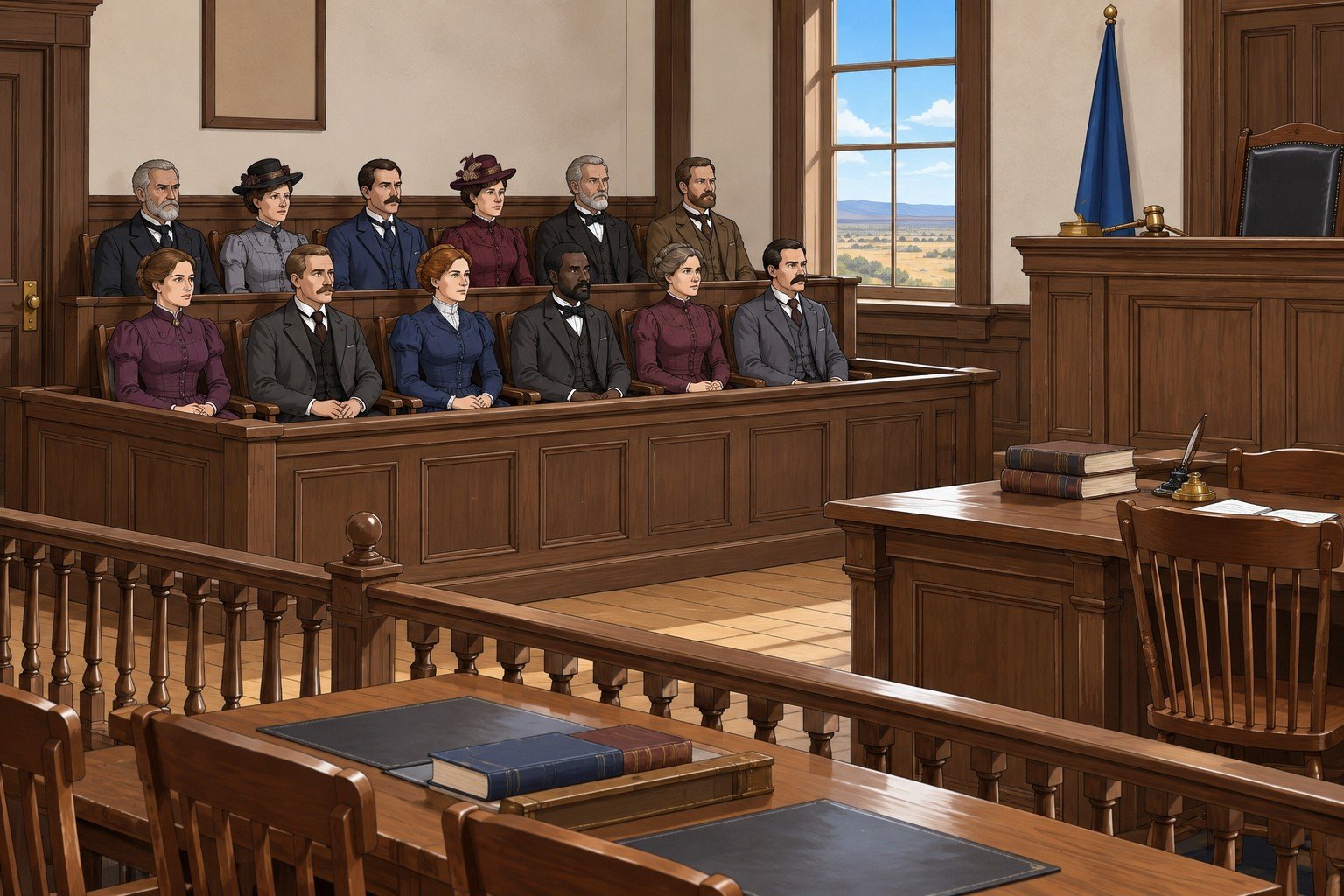
First women jurors, 7 March 1870
Laramie. Judge John Howe seated a grand jury of men and six women; Eliza Stewart was the first woman called. Albany County Attorney Stephen W. Downey moved to exclude the women on 7 March 1870 and Howe refused. The first woman jury foreman, Amalia Post, served at a Cheyenne murder trial in 1871. At the table: women served as jurors in Wyoming years before most places.
First women's vote, 6 September 1870
Laramie. Louisa Swain cast a vote in the territorial election. At the table: women voted in Wyoming from the start of the play range.
Fort Bridger Treaty, 3 July 1868
Fort Bridger, Utah Territory. Washakie and other Eastern Shoshone and Bannock leaders signed. The treaty created the Wind River Reservation. The Northern Arapaho moved onto it in spring 1878. At the table: the Eastern Shoshone had a Wind River reservation of about three million acres by 1868; the Northern Arapaho were not on it until 1878.

Fort Laramie Treaty, 29 April 1868
Fort Laramie, Dakota Territory. Signed with Lakota and Arapaho leaders by the Indian Peace Commission; Red Cloud signed on 6 November. The Senate advised ratification on 16 February 1869 and President Johnson proclaimed it on 24 February 1869. Article II set a Great Sioux Reservation west of the Missouri River; Article XI kept Lakota hunting rights north of the North Platte while buffalo remained; Article XII required three-fourths of adult men to approve any land sale; Article XVI set aside unceded territory east of the Big Horn summits and north of the North Platte, and closed the Bozeman Trail forts. At the table: the Black Hills belonged to the Great Sioux Reservation, and the country around the Powder River was unceded.
Great Sioux War, 17 March 1876 to May 1877
Wyoming, Montana and Dakota. Starting dates and main fights: Powder River (17 March 1876), Rosebud (17 June 1876), Little Bighorn (25 and 26 June 1876), Slim Buttes (9 to 10 September 1876). On 15 August 1876 Congress cut off rations until the Lakota gave up the Black Hills; the cession became law on 28 February 1877. The last major fights were Wolf Mountain (8 January 1877) and Muddy Creek (May 1877). At the table: most of the fighting is north of the corridor, but the army column, rations and news travel through Cheyenne.
Kansas Pacific reaches Denver, 15 August 1870
Denver. Denver now has two rail connections. At the table: freight to eastern cities can go two ways.
Little Bighorn, 25 to 26 June 1876
Montana Territory. Lakota, Cheyenne and Arapaho warriors defeated the 7th Cavalry. Custer was killed. The steamer Far West brought the news to Bismarck late on 5 July 1876 and the telegraph carried it from 6 July; Denver's Rocky Mountain News printed General Terry's report on 9 July. At the table: news reached Cheyenne and Denver within days and reshaped enlistments and public attitudes.
Morris appointed justice of the peace, 14 February 1870
South Pass City. See Morris, Esther Hobart. At the table: a woman judge in a mining camp.
Platte Bridge, 26 July 1865
Near present-day Casper. Lt. Caspar Collins was killed; the post was renamed Fort Caspar. The 1865 Powder River Expedition under General Patrick Connor also took place. At the table: pre-treaty fighting set the pattern of post-based Army operations.
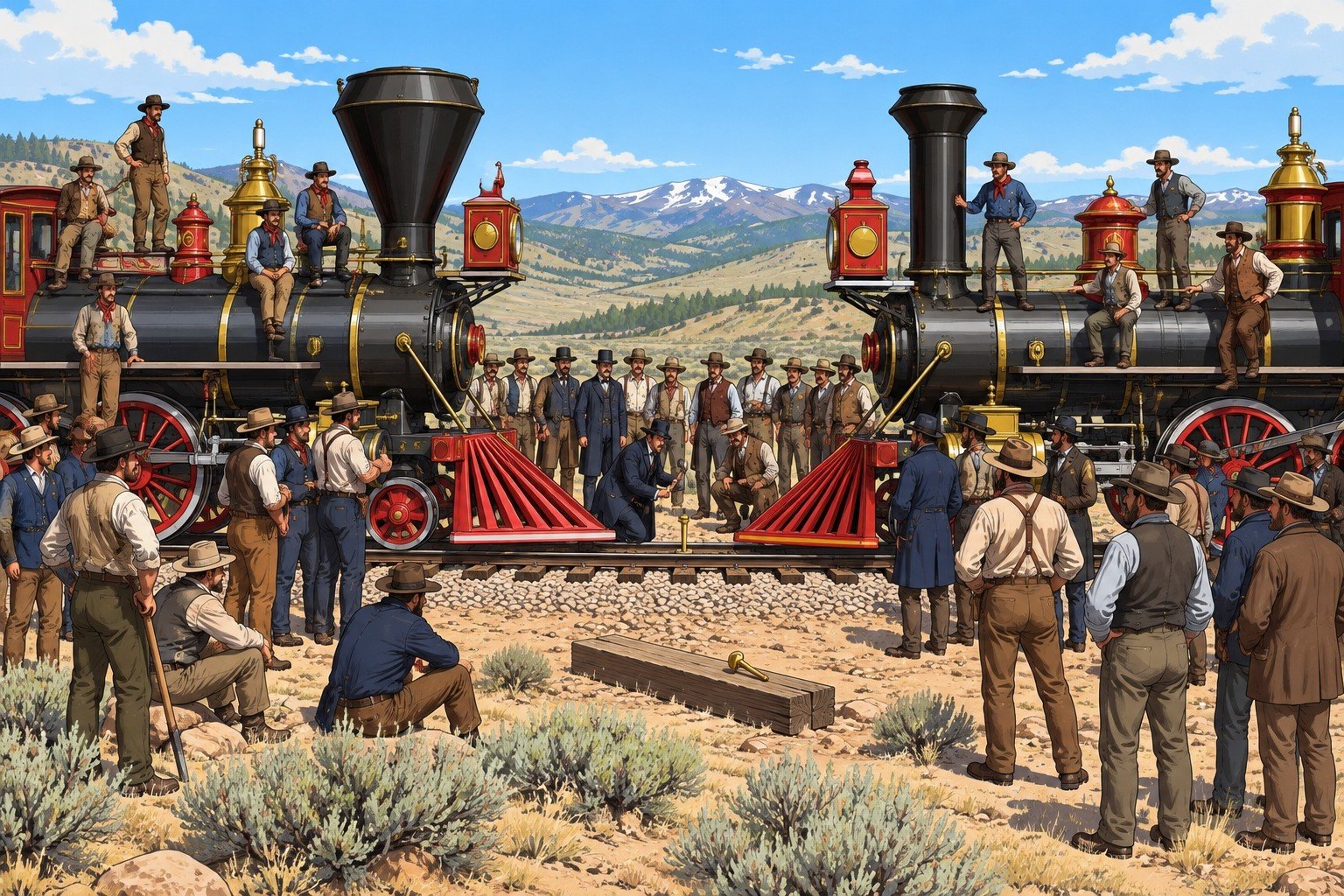
Promontory, 10 May 1869
Promontory Summit, Utah Territory. The Union Pacific and Central Pacific met. At the table: the transcontinental line is complete; the Union Pacific crossed Wyoming, but Chinese workers built the Central Pacific side.
Sand Creek, 29 November 1864
Eastern Colorado Territory. Colorado volunteers under Colonel John Chivington attacked a Cheyenne and Arapaho camp led by Black Kettle. The attack preceded the play range but explains the later relations between Colorado and the Cheyenne and Arapaho. At the table: a root cause of the 1865 raids, including the Julesburg raids of 7 January and 2 February 1865.
Stockmen organize, 29 November 1873
Cheyenne. Cattlemen formed the Laramie County stock association (29 November 1873), renamed the Wyoming Stock Growers Association in 1879. At the table: ranchers act together, and the association becomes a political power.
Summit Springs, 11 July 1869
Northeastern Colorado. The 5th Cavalry and 50 Pawnee Scouts attacked a Cheyenne Dog Soldier camp. Tall Bull was killed; accounts differ on who killed him. Carr reported 52 Cheyenne dead and 17 women and children captured; other counts give 35 dead. Of two captive women, Susanna Alderdice was killed and Maria Weichel survived, wounded. At the table: it ended the Dog Soldiers as a force on the Colorado plains.
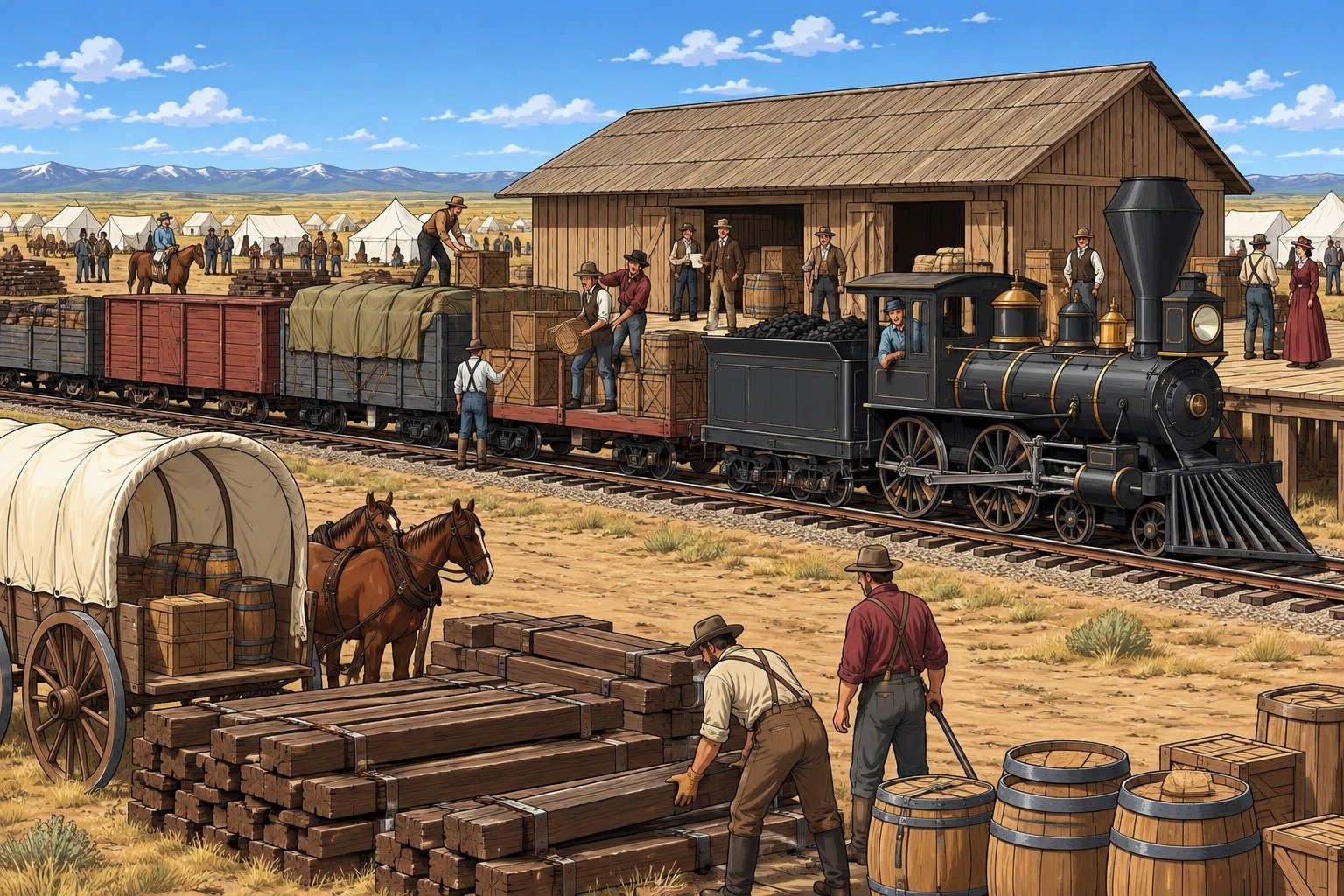
Union Pacific reaches Cheyenne, 13 November 1867
Cheyenne. Rail service began. At the table: Cheyenne's economy ran on this connection.
Wyoming Territory created, 25 July 1868
Washington and Cheyenne. Congress passed the organic act on 25 July 1868. Governor John Campbell arrived on 7 May 1869; the government was organized on 19 May 1869. The first legislature met from 12 October to 10 December 1869; the later sessions sat at Cheyenne from 7 November to 16 December 1871, 4 November to 12 December 1873, and 5 November to 1 December 1875. At the table: Wyoming Territory has its own law from 1869.
Wyoming women's suffrage, 10 December 1869
Cheyenne. Governor Campbell signed the bill giving women the vote and the right to hold office. The bill's sponsor was William H. Bright. At the table: Wyoming women vote and hold office.
Part Three: Institutions
Board of Indian Commissioners
Created by the Act of 10 April 1869. A civilian board created under Grant to oversee Indian affairs.
Bureau of Indian Affairs
Office of the Interior Department; set up in the War Department on 11 March 1824, given a Commissioner by Congress in 1832 and moved to the Interior Department in 1849. Its own reports call it the Office of Indian Affairs. Headed by the Commissioner of Indian Affairs: Ely S. Parker 1869 to 1871, Francis A. Walker 1871 to 1873, Edward P. Smith 1873 to 1875, John Q. Smith 1875 to 1877. The agents, the annuity goods and the passes run through it (Factions and Powers; Tribal Nations).
Camp Carlin
1867. Army supply depot at Cheyenne, next to Fort D.A. Russell. Officially the Cheyenne Depot; receiving and issuing supplies from 10 December 1867; its trains of 10 to 30 wagons, with pack mules, supply 12 posts and agencies (Factions and Powers).
Cheyenne Club
Founded 1880. Cattlemen's social club. Outside the play range.
Cheyenne Leader
First issue 19 September 1867. The first newspaper in Cheyenne and the first after the territory was created (a short-lived Fort Bridger sheet ran in 1863). Founded by Nathan A. Baker and James E. Gates, who moved from Colorado. Baker started the Laramie Sentinel on 1 May 1869.
Denver and Rio Grande Railway
Incorporated 27 October 1870. Built south from Denver.
Denver Pacific Railway and Telegraph Company
Chartered November 1867; first train 24 June 1870 (track finished 22 June). Connected Denver to the Union Pacific at Cheyenne. Absorbed into the Union Pacific in January 1880.
Fort D.A. Russell
Established July 1867. Army post at Cheyenne, placed to guard the Union Pacific construction. First garrisoned on 21 July 1867 by Colonel John D. Stevenson with three companies of the 30th Infantry; named by General Order 33, Department of the Platte, on 31 July 1867.

Fort Laramie
Army post from 1849; trading post from 1834. The site of the 1851 and 1868 treaties. Cavalry barracks built 1872 to 1874; the North Platte crossed by ferry or ford until the iron bridge was finished for the 1876 campaigns; the staging point for 1876 (Places and Campaign Tools).
Fort Sanders
1866 to 1882. Army post on the Overland Trail near Laramie, built in July 1866 as Fort John Buford, renamed Fort Sanders in September 1866 and abandoned in May 1882.
Fort Washakie (as Camp Augur and Camp Brown)
Established 1869 as Camp Augur; renamed Camp Brown in March 1870 and Fort Washakie on 30 December 1878. Army post at the Wind River Reservation.
Indian Peace Commission
Created by act of Congress on 20 July 1867; dissolved 10 October 1868. Nathaniel G. Taylor, Commissioner of Indian Affairs; Senator John B. Henderson; Generals Sherman, Harney and Terry, with Augur added by President Johnson; John B. Sanborn and Samuel F. Tappan. Negotiated the Medicine Lodge treaties of October 1867, the Fort Laramie treaties of 1868 and the Fort Bridger treaty of 3 July 1868 (Tribal Nations); reported to the President on 7 January 1868; its last report, from Chicago on 9 October 1868, recommended that the nations no longer be dealt with as independent powers, that every person be subject to United States law, and that the Bureau return to the War Department. At the table: every treaty the book quotes came from one body of eight men in fifteen months.
Kansas Pacific Railway
Reached Denver 15 August 1870.
Pawnee Scouts
Army scout units recruited from the Pawnee Nation, mustered 1864 to 1877. Served under Frank North.
Red Cloud Agency
Established 1871 on the North Platte about 30 miles below Fort Laramie, at the Nebraska line; moved to the White River near present Crawford, Nebraska, in August 1873. Camp Robinson was set up beside it in March 1874.
Rocky Mountain News
Denver, from 1859. Founded by William Byers.
Society of Colorado Pioneers
Formed 1872. Clara Brown was voted a member in 1885.
Union Pacific Railroad
Authorized 1862; reached Cheyenne in 1867; met the Central Pacific in 1869. Its labor force was mainly Irish and other European immigrants; Civil War veterans and freedmen also worked on it. Chinese workers built the Central Pacific.
United States Marshal for Wyoming Territory
A federal office under the Organic Act of 1868; the marshal is appointed by the President for four years and appoints his own deputies. The marshal and his deputies execute the district courts' federal process across the whole territory; the territory's own process is the sheriffs' and constables' work. Until the salary act of 1896 the office ran on fees: $2 for serving a warrant, 6 cents a mile, $2 a day guarding prisoners, with a deputy keeping up to three quarters of what he earned and the marshal the rest; a deputy had no deputies and no jail, and lodged federal prisoners in the county jail at federal expense. Church Howe was the first marshal (1869 to late 1870); Gilbert Adams held the office by 1875 and Frank Wolcott replaced him in September 1875. N. J. O'Brien left a deputy marshal's post at Cheyenne to be elected Laramie County sheriff in 1874. At the table: the office behind Michael Deveney's star (Era Cast, a fictional deputy); federal warrants run county lines notwithstanding, territorial ones do not.
Wells Fargo and Company
Express company, founded 1852. Bought Ben Holladay's Overland Mail and Express stage lines on 1 November 1866 and gave up running stages in 1869 when the Pacific railroad opened, keeping the express business; its coaches worked out of Cheyenne from 1868 (Places and Campaign Tools). In the range it carries express, bullion and the strongbox under contract, not the mail. At the table: the express office is where money moves and where a robbery is reported (Era Rules, Bounty; Adversaries, Stage Robber).
Wyoming Stock Growers Association
The Laramie County stock association (29 November 1873; the association dates its own origins to 1872), renamed the Wyoming Stock Growers Association in 1879.
Wyoming Territorial Penitentiary, Laramie
Federal prison, 1873 to 1890. Built with a federal appropriation of 1870; construction began on 30 April 1872 under the Denver contractors Livingston and Schram, the cornerstone was laid on 15 July 1872, and the first prisoners arrived in January 1873 (Places and Campaign Tools). Run for the United States. A fire in 1873; of 44 prisoners received in the first two years, 11 escaped. Turned over to the state in 1890. At the table: the only prison in the territory; a sentence from the Cheyenne district court means Laramie, 57 miles west by rail, and the transfer is a deputy marshal's job (Places and Campaign Tools).
Part Four: Things Western Movies Get Wrong
Guns in town
Many cow towns restricted carrying guns inside town limits (Dodge City, Abilene and Deadwood among them). Cheyenne's ordinance of 30 September 1867 barred anyone but the police from carrying arms in town (fine $5 to $100 or up to 30 days; strangers had 30 minutes to comply; Era Rules, Arms in Town). In Colorado a territorial act of 1862 made carrying a concealed pistol, bowie knife, dagger or other deadly weapon in any city, town or village an offense tried before a justice of the peace, fined $5 to $35, with sheriffs, constables and police on duty exempt; the act was carried into the 1868 compilation. At the table: a visitor can expect to be asked to leave a gun behind in town.
Duels at noon
Documented face-to-face duels were rare; the Hickok and Tutt fight of 21 July 1865 is the usual exception.
Violence
Studies of Kansas cattle towns count 45 violent adult deaths from 1870 to 1885. Cheyenne was violent in 1867 to 1868; one study argues the town rebuilt Eastern social order quickly.
Who built the railroad
Chinese workers built the Central Pacific; the Union Pacific labor force was mostly Irish and other European immigrants, Civil War veterans and freedmen. At the table: a Chinese character in Cheyenne in 1874 is more likely a cook, laundry owner or merchant.
The Black Hills were sold
The Black Hills were taken by an act of Congress after talks failed; the treaty required three-fourths of adult men to agree. Only about ten percent signed (Article XII; Act of 28 February 1877).
One chief for all
The government named Ouray head of all Colorado Utes; other Ute leaders did not accept it. The same pattern affects every nation: agreement with one leader did not bind others.
Little Bighorn
Popular retellings call it a massacre or a last stand. It was a Lakota, Cheyenne and Arapaho victory over the 7th Cavalry.
Who shot Tall Bull
Popular accounts credit Buffalo Bill Cody; others credit Frank North or a soldier (see Tall Bull).
Women and the vote
Women voted, held office and served on juries in Wyoming from 1869 to 1870; most American women could not.
Where cowboys came from
Black and Mexican cowhands worked the trails; Bose Ikard rode the Goodnight-Loving Trail with Charles Goodnight.
Vigilantes
Vigilance committees existed in Cheyenne in early 1868 but were short-lived and not widespread there.
Bounty hunters
The term in this sense is dated by the dictionaries to the twentieth century. The practice is older: the men who claimed rewards in the 1870s were officers, express-company and stock detectives and private persons, and a man after a reward was called a detective, a hunter or a man after the reward. This book keeps the word Bounty for the posted sum and Bounty Hunter for the adversary entry.