The Era Rules add to the Exodus NDS Core Rules and the cited sourcebooks. Everything else uses those rules as written. Where an Era Rule changes a sourcebook rule, the entry says Modifies or Replaces and names the book and heading. At a table that plays The Old West, an Era Rule takes precedence over the Core Rules and the sourcebooks it names.
| Rule | Kind | Type |
|---|---|---|
| Illness | Short rule | Adds; Replaces Fortitude for illness |
| Keeping a Horse | Short rule | Modifies The Stable, Training and Keeping, Upkeep |
| Prejudice | Short rule | Adds |
| The Showdown | Signature subsystem | Adds |
| Notoriety and Bounty | Signature subsystem | Adds |
| Stakes | Signature subsystem | Adds |
| Law in Play | Short rule | Adds |
| Arms in Town | Short rule | Adds |
| Travel at the Table | Short rule | Modifies The Stable, Riding, Travel |
| Money and Credit | Short rule | Adds |
Gear and Prices holds period prices.
Illness
Adds. The Core Rules have no disease rule, and The Apothecary leaves disease to the book that needs it. Replaces the Fortitude skill (Core Rules, Skills and Talents, Fortitude) for resisting illness: the check below is a Willpower characteristic check. Conditioned (Core Rules, Skills and Talents) applies to it as the clock says; Hardy has no effect on it; Sickroom Skill (Skills and Talents) applies to Care.
TERMS: ILLNESS
Illness comes from exposure: a night in wet bedding, a crowded boarding house in a bad winter, bad water on the trail, a wound left dirty, or a bedside during an outbreak. Illness begins in one of two ways.
- A Calamity. When a character who is exposed to illness rolls a Calamity on any check, the GM may spend it to have that character fall ill with an illness that fits the exposure.
- An outbreak. When the story puts a character in a serious outbreak (a cholera summer, a smallpox ward), the GM may start the illness without a Calamity. Say so before the scene so the players know the danger. An outbreak starts a player character's illness at Mild or Serious; a Grave illness on a player character needs a Calamity or the player's agreement.
The illness clock. Each illness has a Severity, which sets the difficulty of the daily Willpower check, the Strain of a failure, the most Bane Dice it can pile on, and its Course, the number of daily checks it lasts.
| Severity | Willpower check | Strain on a failure | Bane Dice, at most | Course |
|---|---|---|---|---|
| Mild | Easy | 2 | 1 | 4 checks |
| Serious | Average | 4 | 2 | 7 checks |
| Grave | Hard | 6 | 3 | 10 checks |
Once a day, at the start of the day, the ill character makes a Willpower check against the Severity. The pool is Willpower alone, with no skill. A character with Conditioned removes 1 Bane Die from the check. No other talent adds dice to it.
- On a success, mark one success. At two successes (they need not be in a row) the illness ends.
- On a failure, the character suffers Strain by Severity (the table) and gains 1 Bane Die on all checks until the illness ends. These Bane Dice are cumulative, up to the Severity's limit.
- On a Calamity, the character also suffers Strain equal to half the Strain the character has left before incapacitation, rounded down, and the GM may add a complication: a scar, a lost week, a patient who infects others.
- On a Breakthrough, the character marks both successes at once.
- When the Course runs out without two successes, the illness ends anyway. A Grave illness makes the character take one last check first (below).
Strain from illness is not recovered by rest while the illness runs; other Strain recovers as usual. When the illness ends, the character recovers all Strain after a full night's rest and Wounds at the normal rate. A character incapacitated by Strain is bedridden, not dead, and keeps making the daily check.
Only a Grave illness can kill. A Grave illness reaches its crisis when the character is incapacitated by Strain: the first failed check after that inflicts a Critical Injury in place of Strain. If the Course runs out without two successes, the character makes one last check, and a failure inflicts a second Critical Injury. A Grave illness never inflicts more than two Critical Injuries. Each is removed by treatment as usual (Core Rules, Recovery) and until then adds its 10 to every later Critical Injury roll. A Mild or Serious illness never inflicts Wounds or Critical Injuries.
Care. Once a day a caregiver may make a Medicine check on the ill character. The difficulty is Average with clean water, rest and basic supplies, and Hard without. For each net Success the patient adds 1 Boon Die to the next Willpower check. Two Boons on the caregiver's check add a further Boon Die. A patient given a full day of rest in a bed adds 1 Boon Die to the check, whether or not anyone is nursing the patient. No more than 3 Boon Dice from Care on one check. Once per illness, a Care check with 2 or more net Successes also marks one of the patient's two successes; the patient must still roll the other. A Calamity on the caregiver's check exposes the caregiver to the same illness.
Contagion. A caregiver, or anyone sharing close quarters with an ill character, is exposed. The GM decides whether exposure matters by whether the scene is dangerous. Do not roll for exposure every time someone walks past a sickbed.
The illness clock follows the Poison clock in The Apothecary (Exposure and the Clock). Medicines from that book (Poppy Tincture, Morphine, Antiseptic, Patent Medicine, Emetic) work as printed there.
The Corridor's Illnesses
The GM picks the illness that fits the exposure.
| Illness | Severity | Exposure and use |
|---|---|---|
| Mountain fever | Serious | A period name for several fevers, not one disease. Use it for a fever caught in the foothills or on the trail. |
| Typhoid fever | Serious | Bad water in a town, a camp or a boarding house. |
| Consumption (tuberculosis) | Serious, chronic | Many of Colorado's settlers came for the dry air with the disease already in them. See the chronic rule below. |
| Cholera | Grave | Bad water; epidemics on the Plains and the trail in the 1860s and 1870s. |
| Smallpox | Grave | A crowded town or a ward; quarantine is the town's answer. |
| Diphtheria | Grave in a town outbreak | A children's illness; a crowded house or school. |
| Scarlet fever, measles | Serious | Children's illnesses; a crowded house or school. |
| Pneumonia and winter lung fever | Serious; Grave in winter for the old | A night in wet bedding, a winter on the road. |
| Dysentery and bad water | Mild; Serious on the trail | Camps and the trail. |
A GM rates an illness not listed by the Severity table: Mild for a cold or a bad stomach, Serious for a fever or a fouled wound, Grave for the great killers.
Chronic illness (Consumption). The clock runs as a Serious illness. When it ends, the illness is in remission for one season. The GM may start it again at the end of that season, or when a hard winter or a Calamity gives cause. A chronic illness never kills a player character unless the player agrees.
EXAMPLE: A FEVER ON THE TRAIL
Si Tolliver's player rolls a Calamity on a Survival check crossing a flooded creek in October. The GM spends it: Tolliver falls ill with mountain fever, Serious, Average Willpower.
Day one: he fails. He suffers 4 Strain and gains 1 Bane Die on all checks. A town doctor makes an Average Medicine check and scores 2 net Successes, so Tolliver adds 2 Boon Dice to his next Willpower check.
Day two: he succeeds. One success is marked, and the Bane Die stays. Day three: he succeeds again. The fever ends. Had it run to seven days without a second success, it would have ended on its own at the end of the Course.
Keeping a Horse
Modifies The Stable, Training and Keeping, Upkeep.
TERMS: KEEPING A HORSE
On the road and in towns, a character's ordinary living expenses cover feed, water, stabling and shoeing for the horses they ride. They do not pay The Stable's daily upkeep and do not track it. This covers Cheyenne, Denver, the railroad towns, stage stations, and the stage and freight roads.
Away from the road, the horse is kept for three days on its own. After the third day without a town, a station, a ranch or a camp with feed, the horse is unkept. The Stable's rule for going without upkeep then applies: 1 Bane Die on all the mount's checks and its rider's Riding checks, cumulative each day: day 4, 1 Bane Die; day 5, 2; day 6, 3, and it will not be ridden.
Feed on good grazing, bought forage, or a day's stop at a station ends the penalty. A horse on poor grazing that is not Hardy counts as unkept from the first day. A horse raised on the plains counts as Hardy for grazing.
Other horse rules. The horse's Scale, quality and Travel from The Stable apply as written. Stealing, losing, selling, killing or hiring out a horse, a pursuit across open country, a horse driven past exhaustion and a crippled horse all use The Stable's checks and the Core Rules.
Hired mounts and teams are billed by the day at the livery rate and include upkeep.
Not changed: Scale, Speed, Wounds, Travel, Temper, the Quality grades, shoes and healing. Cavalry and Army mounts are fed by the quartermaster and are not tracked. A groom or stable boy (The Stable, Hired Help) is covered by living expenses in towns.
EXAMPLE: THE LONG RIDE NORTH
Anselmo Ybarra leaves a Cheyenne livery on a Riding Horse with a lead mare, heading for a ranch five days north with no station on the way. He pays nothing and tracks nothing for the first three days.
On the fourth day out, on thin grass, the horses are unkept: each adds 1 Bane Die to its checks and to Ybarra's Riding checks, and on the fifth day it would be 2. He spends the fourth night and the next morning at a creek with good grass, and the penalty ends before the last day's ride.
Prejudice
Adds. Prejudice is a situational social condition applied the same way to every group. It applies in a scene, before an audience, inside an institution. It is never on the character sheet: Origin and Role carry no penalty.
TERMS: ATTITUDE
An audience is the person or group that decides the outcome of a social scene: a clerk, a rancher, a congregation, a council, a jury, a post commander, a crowd at a hiring window.
Markers. The GM names up to three markers the audience reacts to in this scene. A marker is anything the audience can see or learn: a community or nation, a faith, a language or accent, a sex, an occupation or allegiance (the Army, the railroad, the cattlemen, a Union or Confederate record), or a deed (a Bounty, a Name). Any group in this book can be a marker, including every group a player character belongs to. The GM says the markers aloud.
Attitude. The GM sets an Attitude rating for each marker.
| Attitude | Effect on social checks with that audience |
|---|---|
| Welcome 2 | Add 2 Boon Dice |
| Welcome 1 | Add 1 Boon Die |
| Neutral | None |
| Wary 1 | Add 1 Bane Die |
| Hostile 2 | Add 2 Bane Dice, and no credit or favor without a Sponsor |
| Closed 3 | The door is shut. First contact fails with no roll unless the character has Cover or a Sponsor. Use it only for an institution the historical record shows excluded that group |
What Attitude touches. Charm, Negotiation, Leadership, Deception and Intimidation checks with that audience, and any check to be served, hired, paid, given credit, heard, or let through. The total Bane Dice from Attitude never exceeds 3.
What Attitude never touches. Attacks, damage, defenses, Wounds, Strain, characteristics, skill ranks, or any check against an audience that does not decide the outcome. A Bane Die makes a roll harder; it does not decide the result.
Cover. An identity the audience respects: a company letter, a commission, a uniform, a congregation's introduction. Cover moves one marker's Attitude one step toward Neutral; a Welcome Attitude is not changed. A false Cover is a Deception or Subterfuge check, Average, and exposure turns the Attitude against the character.
Sponsor. A person the audience respects who is present and vouches for the character. A Sponsor moves one marker's Attitude one step toward Neutral; a Welcome Attitude is not changed. One Cover and one Sponsor can apply together, and each applies to one marker the character names.
Reading the Room. A Savvy and Perception check, Average, tells the character one audience's Attitudes. Two Boons also reveal a Cover or Sponsor that would work.
Setting Attitudes. Set Attitudes for what the audience would do, not for who is at the table. Every audience has some: a rancher can be Hostile to railroad men and Welcome to Texans; a post commander can be Wary of contractors; a council that agents have lied to can be Hostile to agents. Do not set a marker the audience would not have reacted to in the historical record. The same Attitudes apply to every character who shows the marker.
Sample Audiences
These examples show how a GM might set Attitudes. The dated facts an Attitude rests on are in the Cheyenne, Denver, Tribal Nations and Factions and Powers chapters; Running the Era says how to run the scene.
| Audience | Attitudes the GM might set | Lever |
|---|---|---|
| A Laramie County cattleman at a hiring | Hostile 2 to railroad men; Wary 1 to grader crews; Welcome 1 to Texans | A foreman who vouches |
| A Union Pacific section foreman at a pay window | Welcome 1 to his own crew's community; Wary 1 to anyone who speaks of a union or a strike | Crew-mates who stand together |
| A Denver boarding-house keeper | Wary 1 to anyone armed; Welcome 1 to church members | A letter from a minister |
| A post commander at Fort D.A. Russell | Wary 1 to civilian contractors; Welcome 1 to veterans of his regiment | An officer's introduction |
| A Tribal council hearing an agent's offer | Hostile 2 to agents of the Bureau of Indian Affairs; Wary 1 to anyone who comes without gifts or a go-between | A respected go-between |
| A territorial jury | Wary 1 to a defendant with a Bounty; Welcome 1 to a defendant with a local employer present | The employer in the courtroom |
EXAMPLE: THE HIRING AT THE CATTLEMAN'S GATE
A Laramie County cattleman is hiring. The GM names three markers: Hostile 2 to railroad men, Welcome 1 to Texans, and Wary 1 to hands who come without a reference.
Edmund Harrow, who works for the Union Pacific's land department, asks for leave to cross the range with a survey party. He shows the railroad: Hostile 2. A railroad letter is no Cover to an audience that distrusts the railroad, and a Hostile audience gives no favor without a Sponsor. Deveney, a deputy U.S. marshal at Cheyenne who knows the man, rides up and vouches. Harrow's railroad marker moves to Wary 1, and he rolls with 1 Bane Die.
Anselmo Ybarra asks for work breaking horses. He shows two markers: a Texan, Welcome 1, and no reference, Wary 1. He adds 1 Boon Die and 1 Bane Die to the roll and rolls.
The Showdown
Adds. A signature subsystem. Modifies the Core Rules, Structured Play, Initiative, only in a Showdown that ends in a Draw: the winning side takes the first slot of round one.
The Core Rules start a fight when someone attacks. The Showdown covers the moment before: two sides face each other, weapons not yet out, and one side wants the first move. Use it for arrests, insults, claim disputes and stand-offs in the street. It is not a duel code. Documented walk-down duels were rare (Historical Reference, Duels at noon). Most confrontations ended without a shot, and the loser may Stand Down.
TERMS: THE SHOWDOWN
Trigger. The Showdown begins when a principal on one side names it and the other side's principal answers or the GM rules that the situation qualifies. Both principals must be within Medium range of each other, with weapons holstered, slung or in reach but not drawn. A principal who is Surprised cannot be called out; the Core Rules, Structured Play, Surprise, applies. A principal who is called and walks away without answering is Backed Down before the witnesses; one who answers and then loses chooses Stand Down or Draw (below).
Principals. Each side names one principal. Allies in view of the principal may assist (Core Rules, Types of Checks, Assisted Checks).
The Stare. Both principals make an opposed Willpower and Readiness check. A tie goes to the principal who was called out (the defender).
| Circumstance | Dice |
|---|---|
| Each ally with a ready weapon in view (maximum 2) | 1 Boon Die each |
| The opponent knows the principal's Notoriety: 2 or 3 | 1 Boon Die |
| The opponent knows the principal's Notoriety: 4 or 5 | 2 Boon Dice |
| Light cover / Heavy cover | 1 Boon Die / 2 Boon Dice |
| A crowd whose Attitude favors this side | Boon Dice equal to the Attitude rating, maximum 2 |
| The principal is plainly in the wrong (no warrant, no provocation, drew first) | 1 Bane Die |
| The principal is drunk, or has taken half their Strain Points in damage | 1 Bane Die |
Result. The winner holds the street. The loser's principal suffers Strain equal to the winner's net Successes, to a maximum of 3, and must choose at once:
- Stand Down. The loser yields: surrenders, leaves, hands over the disputed thing, or backs off on terms the winner may name within reason. Nobody is hurt. The loser is Backed Down in front of every witness.
- Draw. Structured play begins. The winner's side takes the first initiative slot of round one, whatever the Initiative checks say.
Spending the Stare. The winner may spend:
- Two Boons: one of the loser's allies, chosen by the winner, stands down.
- Two Boons: the crowd turns toward the winner; the Attitude of one onlooker toward the winner moves one step toward Welcome for the scene.
- A Breakthrough: the loser's side cannot Draw this scene unless the losing side spends a Story Point (a Fortune Point for players, a Peril Point for the GM).
- A Calamity on either side: someone fires early. The GM names a combatant who is not a principal and that character fires. If no one else is present, the principal who rolled the Calamity fires early and counts as in the wrong. Structured play begins with both sides Surprised; neither takes the first slot.
Backed Down. A character who is Backed Down adds 1 Bane Die to Intimidation checks and to Stares before that audience, until the character wins a Showdown or leaves that town or county for a season.
Limits. Two principals have one Showdown per scene. A Showdown does not work on a Minion group unless one Minion acts as the principal, using the group's listed Willpower and Readiness.
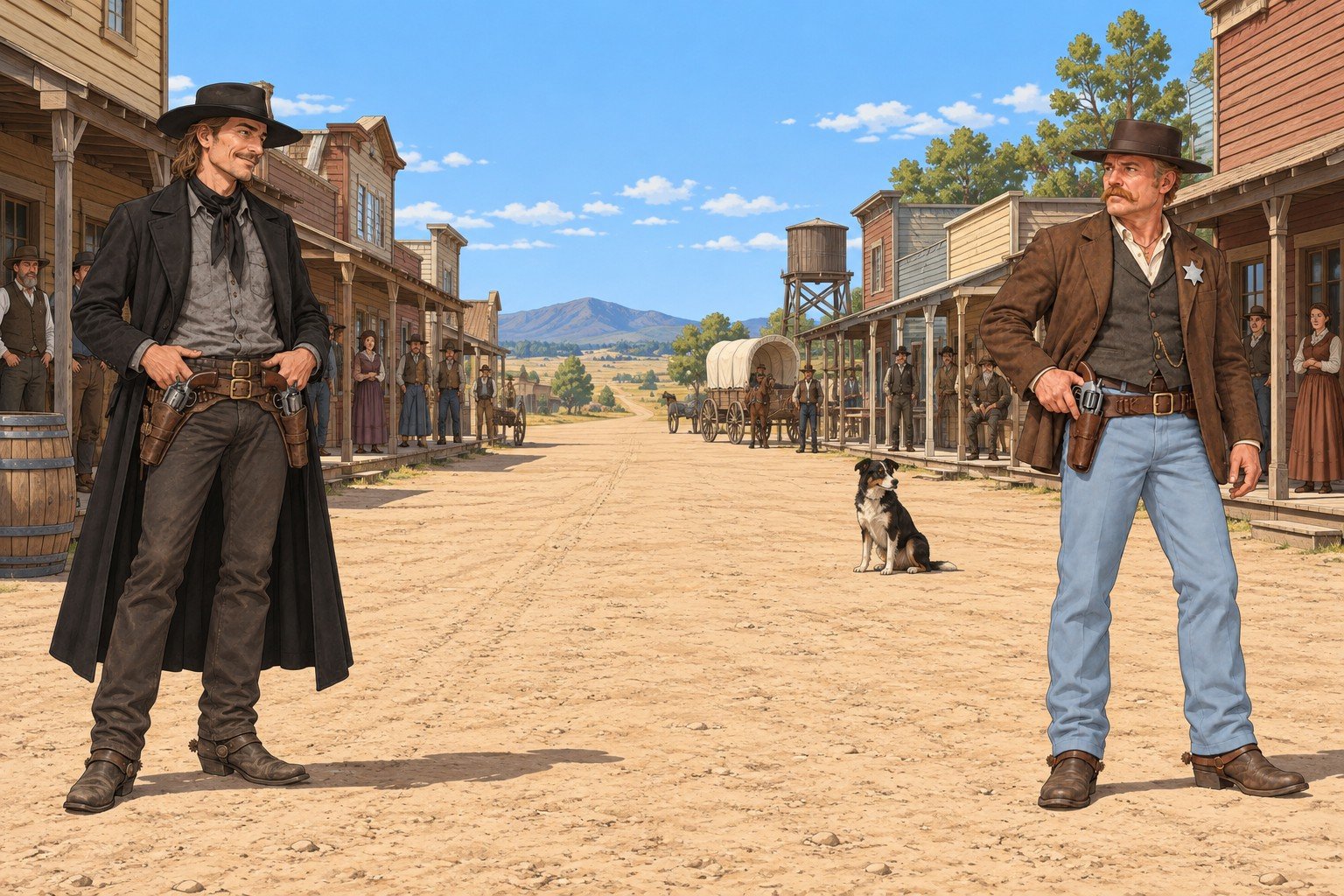
EXAMPLE: THE STREET IN FRONT OF THE LAND OFFICE
Deveney, a deputy U.S. marshal, carries a federal warrant for Wade Carrick: Army horses taken from the Fort Russell herd. He finds Carrick in the street at Medium range, both men's hands near their coats. Deveney names it, so Carrick is the defender and a tie would go to him.
Deveney rolls Willpower and Readiness with 1 Boon Die for the county deputy at his shoulder and 1 for the onlookers, who favor the badge (Welcome 1): 2 Boon Dice. Carrick has 1 Boon Die for a rider in a doorway and 1 Bane Die, because the crowd can see he is in the wrong. The roll leaves Deveney with 2 net Successes.
Carrick suffers 2 Strain. He chooses to Stand Down and surrenders his revolvers. He is Backed Down in Cheyenne until he wins a Showdown or leaves for a season.
Had Carrick chosen to Draw, Deveney's side would have taken the first slot of round one.
Notoriety and Bounty
Adds. A signature subsystem. It tracks how far a character's deeds are known, and gives lawmen, outlaws and bounty hunters a shared procedure.
TERMS: NOTORIETY
Notoriety is a rating from 0 to 5 that says how far a character's deeds are known. Every player character begins at 0 unless the Role says otherwise.
| Notoriety | Reach | Who knows the Name |
|---|---|---|
| 0 | None | Nobody |
| 1 | A town | People in one town, and the stage or rail connection it shares |
| 2 | A county | The county seat, its sheriff, its ranches |
| 3 | A territory | Wyoming or Colorado: the territorial press, the courts, the stock association |
| 4 | The corridor | Both territories and the railroad towns between them |
| 5 | The nation | Eastern newspapers, the Army, the express companies' and railroads' detectives |
Within its Reach, an audience that knows the Name treats it as a marker with an Attitude of half the Notoriety, rounded up, to a maximum of 2 (the Attitude table's Welcome 2 or Hostile 2; Closed 3 is never caused by a Name alone). The audience decides whether it is Welcome or Wary: a cattleman may welcome a feared gunhand and a magistrate may be Hostile to the same man. This uses the Attitude table in Prejudice and its cap of 3 Bane Dice on the total.
Earning Notoriety. The GM adds 1 Notoriety (maximum 1 a session; a player may spend a Fortune Point, or the GM a Peril Point, for a second gain in a session) when:
- A character wins a Showdown before five or more witnesses by 2 or more net Successes.
- A deed is reported in a newspaper or posted on a notice.
- A public trial ends in a conviction or an acquittal that the town talks about.
- A rescue, a capture, or an escape is witnessed by a crowd.
Losing Notoriety. Notoriety drops by 1 each season (three months) that the character stays out of the news. Leaving the Reach, changing name and appearance, or the talent Lie Low shortens that. A character at Notoriety 0 is unknown.
TERMS: BOUNTY
Posting. An authority posts a Bounty for a Serious or Grave offense reported to it, whatever the offender's Notoriety; for a Minor offense only at Notoriety 2 or higher. A Bounty on an unnamed offender ("the road agent of the Chugwater crossing") cannot be found by Name until the Name is known. Authorities that posted rewards included county commissioners, territorial governors, railroads and express companies, and stock associations. A Bounty names the person, the offense and the sum, and whether it is for the person alive or for proof of death.
| Offense | Reward |
|---|---|
| Minor: stock theft, assault, a claim jumped | $27 to $142 |
| Serious: robbery of a coach or a store, a killing in a fight, a rustling ring | $210 to $585 |
| Grave: the killing of an officer, a mail or express robbery | $730 to $2,150 |
The GM sets the sum in the range by the character's Notoriety: the top of the range at 4 or 5. A posted Bounty raises Notoriety by 1 (maximum 4); that gain counts as the character's gain for the session (Earning Notoriety) unless a Fortune Point or a Peril Point is spent for a second.
Wanted. A character with a posted Bounty is Wanted within the poster's Reach. A county's Reach is the county, a territory's the territory, a railroad's or express company's its line. When an NPC in that Reach identifies the character, the GM may spend a Calamity to have that NPC inform an officer or a hunter.
Taking a Bounty. The hunter:
- Finds the person: an extended Streetwise or Survival check, threshold 3 net Successes, Average, one roll a day; after five rolls the trail is cold until new word arrives.
- Identifies the person: Perception or Lore, Average.
- Takes the person: a Showdown, an ambush, or an arrest (Law in Play).
- Claims the reward: Negotiation, Average, with the posting authority. Payment follows within a month or at the end of the next session. Two Boons on the claim also win expenses. On a failure the authority pays after the trial or the conviction, which the notice may require, or pays the bottom of the band; the hunter may argue once more a week later. A Calamity means the authority disputes the identity, or another claimant has been paid first.
Ending a Bounty. A Bounty ends on a pardon, a trial, the person's death, or twelve months without a new offense. A character may also trade a service for a withdrawal: Negotiation, Hard.
EXAMPLE: THE NOTICE BOARD
Tolliver reads a notice in Cheyenne: the Laramie County commissioners offer $412 for Wade Carrick, delivered to the sheriff, for the robbery of a coach. Carrick's Notoriety is 3 (a territory).
Tolliver's player decides to take it. He makes the extended Streetwise check to find Carrick; the search reaches 3 net Successes over two days' rolls, because a livery man knows where Carrick's riders pasture. He identifies the man in a saloon yard with an Average Perception check. He calls a Showdown, wins, and Carrick stands down. Tolliver hauls him to the sheriff and claims the reward. The Negotiation check shows 1 Success and 2 Boons: the county pays, and adds $38 for expenses.
Tolliver now has Notoriety 1: the town of Cheyenne has heard what he did.
Stakes
Adds. A signature subsystem. It resolves any contest where each side has put something real on the table: a hand of cards, a horse race, a bid, a land claim argued before an official, a cattle sale. It is built on the Core Rules' opposed checks.
Do not use Stakes for treaty councils. A council or a negotiation between powers is a series of scenes, not a contest with a Pot.
TERMS: STAKES
1. Ante. Each side names its stake: cash, property (a horse, a claim, goods, valued in dollars by Gear and Prices), a favor owed, or a Name (1 Notoriety or a Backed Down mark). A Backed Down character may stake the mark: it is removed if the character wins and stays if not. The Pot is the total. The GM may refuse a stake the story cannot honor.
2. Exchanges. The sides make an opposed check each exchange. The winner of an exchange gains 1 Lead, or 2 Lead if the margin is 3 or more net Successes. The first side to 3 Lead takes the Pot. After five exchanges the side with more Lead wins; a tie splits the Pot.
| Contest | Pool for each exchange |
|---|---|
| Cards | Charisma and Deception to bluff, or Savvy and Perception to read, chosen each exchange |
| A horse race | Agility and Riding |
| A sale, a bid, a bargain | Charisma and Negotiation |
| A claim before an official | Intellect and Lore (Law or Land) |
| A foot race or a wrestling match | Might or Agility and Athletics |
3. Raise. Before any exchange a side may Raise: add cash of at least a quarter and at most the whole of the Pot's value and gain 1 Boon Die on that exchange. The other side must Call (match the Raise) or Fold. A side that Folds forfeits everything it has put in and the Raiser takes the Pot. A side may Raise twice a contest. A side that cannot match a Raise may borrow on Credit (Money and Credit), Fold, or Call short with everything it has: the contest goes on for the matched part and the excess returns to the Raiser.
More than two sides. At a card table or an auction, each exchange the side with the highest net Successes gains the Lead (2 if ahead of every other side by 3 or more); a Raise must be Called by every side that stays in; the Pot holds every ante.
4. Cheating. Before an exchange, a character may make a Hard Subterfuge check to cheat (marked cards, a weighted dice, a doctored brand, a forged paper). On a success the character adds 2 Boon Dice to that exchange. Any onlooker may make an opposed Perception check against the cheat's Subterfuge result; one who notices may object, and either principal may call a Showdown. A Calamity on the cheating check exposes the cheat at once.
5. After the last exchange. The winner takes the Pot. On the final exchange:
- Two Boons: the winner learns something about the loser (a secret, a motive, a debt).
- Two Banes on the winner's check: the loser's friends resent the win; the Attitude of one onlooker toward the winner moves one step toward Hostile.
- A Breakthrough: the winner takes the Pot and one more concession of the loser's.
- A Calamity: a third party intervenes (a claim jumper, an officer, a creditor).
EXAMPLE: THE HORSES AT THE RANCH GATE
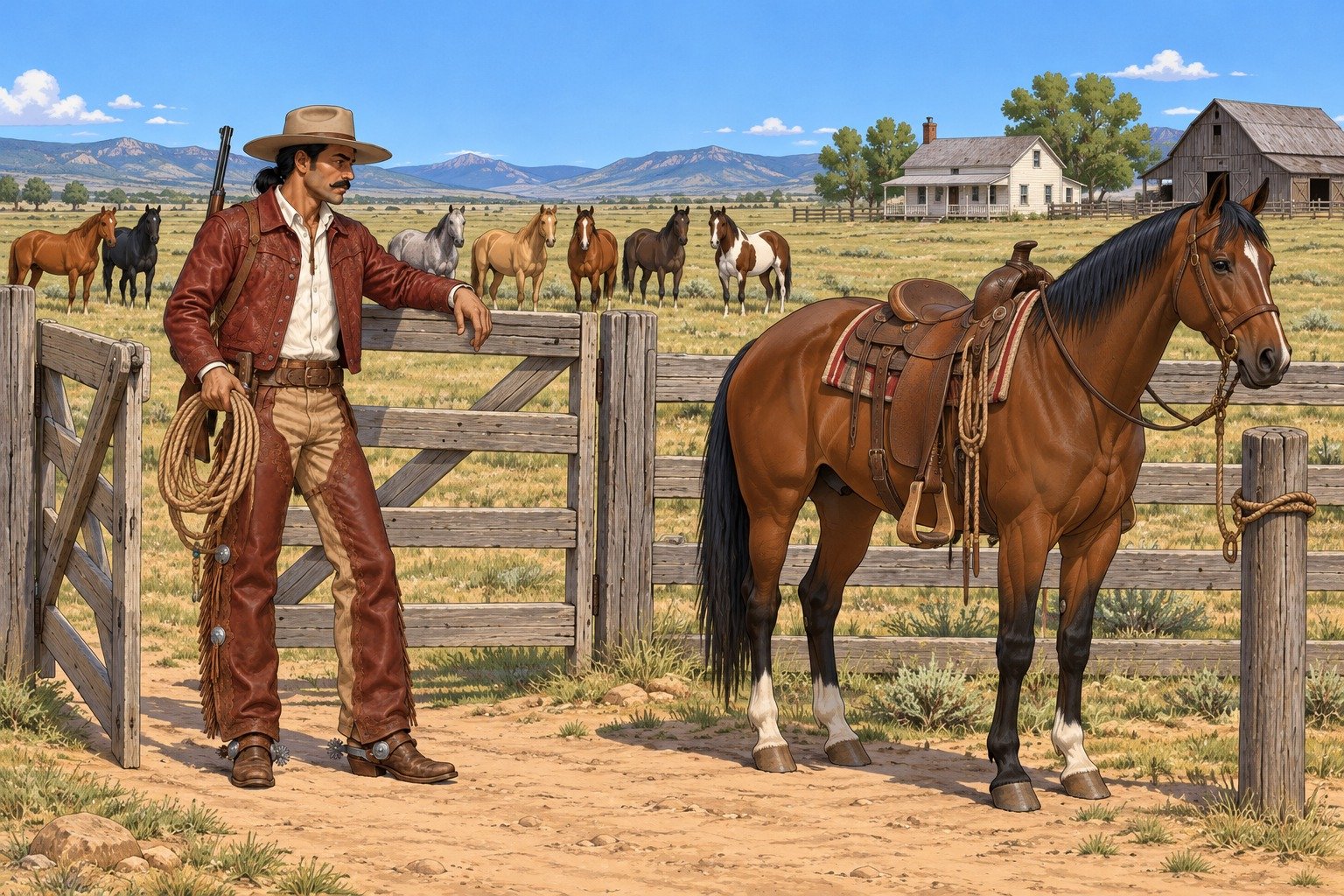
Anselmo Ybarra wants a small herd from a rancher who doubts his claim to break horses nobody else will. They agree to a contest of sale and skill. The rancher puts up three unbroken range horses, valued at $51. Ybarra stakes a month's wage, $34. The Pot is $85. The contest is a bargain, Charisma and Negotiation.
Exchange one: Ybarra wins by 3 net Successes. He has 2 Lead. Exchange two: the rancher wins narrowly and takes 1 Lead. Before exchange three the rancher Raises, adding $23 (at least a quarter of the Pot), and gains a Boon Die. Ybarra Calls with $23 of his own. He wins the exchange and reaches 3 Lead. Ybarra takes the Pot: the three head and $80 in cash, of which $57 is his own money back: his gain is the horses and $23. He rolled two Boons on that exchange, and learns the rancher is short of cash.
Law in Play
Adds. A table of who can act where, and three procedures: the warrant, the arrest and the posse. The Cheyenne and Denver chapters carry the dated local entries.
Who Acts Where
| Authority | Acts in | On what | Limit at the table |
|---|---|---|---|
| City marshal and police | The town | Town ordinances and crimes in the town | Beyond the town limits, no more power than a private citizen |
| County sheriff and deputies | The county (Denver is in Arapahoe County) | Territorial law, writs and warrants from justices and courts, holding prisoners | A warrant executed in another county needs that county's sheriff or an endorsement |
| United States Marshal and deputies | The whole territory (the judicial district) | Federal offenses and the federal business of the district court: the mail, Indian country and the trade acts, government property, the military reservations, the land office, the public timber, fraud by the mails | Federal law only. A deputy arresting for a territorial offense is Outside Jurisdiction (1 Bane Die) unless he also holds a county or town commission. His writ stops at the Colorado line; county and federal officers worked pursuits together |
| The Army | Military posts and reservations | Soldiers, and the post | Not a civil police. Called on to help civil authority only on request. It may remove trespassers from Indian country, but only on orders that come down through the department and the agent. The Posse Comitatus Act of 18 June 1878 is outside the play range |
| A Tribal Nation | Its own country and its own people | Its own law and its own councils and societies | A wrong between one of its people and a non-Indian in Indian country is a federal matter brought through the agent (Trade and Intercourse Act of 1834, s. 25; 1868 treaty, Article I, below), not a county one |
The 1868 Treaty of Fort Laramie, Article I (signed 29 April 1868, with later signatures on 25 May and 6 November 1868) sets the process for wrongs between the Lakota (the treaty says Sioux) and the United States: if a non-Indian wrongs a Lakota person, the United States is to arrest and punish the offender under its law after proof reaches the agent and the Commissioner of Indian Affairs, and to repay the victim; if a Lakota person wrongs a person at peace with the United States, the Lakota are to hand over the offender after proof and notice from the agent, or the victim is repaid from annuities. The parallel treaty with the Northern Cheyenne and Northern Arapaho was signed at Fort Laramie on 10 May 1868. Use it as a scene hook, not a rule: agents, proofs and delays are scenes.
Warrants and Arrests
TERMS: ARRESTS AND WARRANTS
Getting a warrant. A character swears a complaint before a justice of the peace or a judge: Lore (Law) or Negotiation, Average. On a failure the justice wants a witness or a sworn statement from the injured party first. A warrant names a person and an offense. It gives the officer a Boon Die on the arrest check.
Making an arrest. An arrest is an Action. The officer makes a Leadership or Intimidation check, Average. The difficulty rises one step if the subject has armed friends within Short range, and one step if the subject's Notoriety is 3 or higher within its Reach. Add 1 Bane Die if the officer is Outside Jurisdiction, which includes a federal deputy arresting for a territorial offense and a county officer in another county, and 2 if in another Tribal Nation's country or another sovereign's ground.
- On a success, the subject submits unless the subject chooses to call a Showdown.
- Two Boons: the subject names an accomplice or gives a location.
- On a failure, the subject refuses. The officer may call a Showdown or let the matter go.
- A Calamity means a crowd gathers or a friend of the subject fires.
Without a warrant. An officer may arrest for an offense committed in the officer's presence; any other arrest without a warrant adds 1 Bane Die.
Holding a prisoner. A prisoner stays in the town or county jail until a justice or a court hears the case. A crowd that wants the prisoner is a scene: Leadership, Hard, to hold the jail, or a Showdown at the door.
The Posse
TERMS: THE POSSE
A sheriff, deputy or marshal may call on able-bodied men present to help in a pursuit or an arrest. Before 1878 a marshal or deputy may ask a post commander for soldiers as a posse.
Calling a posse. A Leadership check, Average (Hard if the cause is unpopular or the audience Wary). The posse is a Minion group of 2 plus the net Successes, to a maximum of 8, using the Posse Rider (Minion) entry in Adversaries. The officer leads it. The county, or the marshal's account for a federal posse, pays a posse rider $2.00 a day (Gear and Prices).
Morale. When a posse has lost half its number or its leader is down, it makes a Willpower and Readiness check as a group, Average. On a failure it disbands.
Pursuit. A pursuit is a chase between mounts under The Stable, Riding, Chases. A posse pays no upkeep for three days (Keeping a Horse).
EXAMPLE: THE ARREST AT THE LIVERY
Deveney arrests a stock buyer on a federal warrant for receiving beef cattle stolen from the Red Cloud Agency contract herd, government property. The buyer has two hands standing behind him within Short range, so the difficulty rises one step to Hard. The warrant adds a Boon Die. Deveney makes a Leadership check: 2 Successes and 2 Boons. The buyer submits. Deveney spends the Boons to learn the name of the rider who delivered the herd.
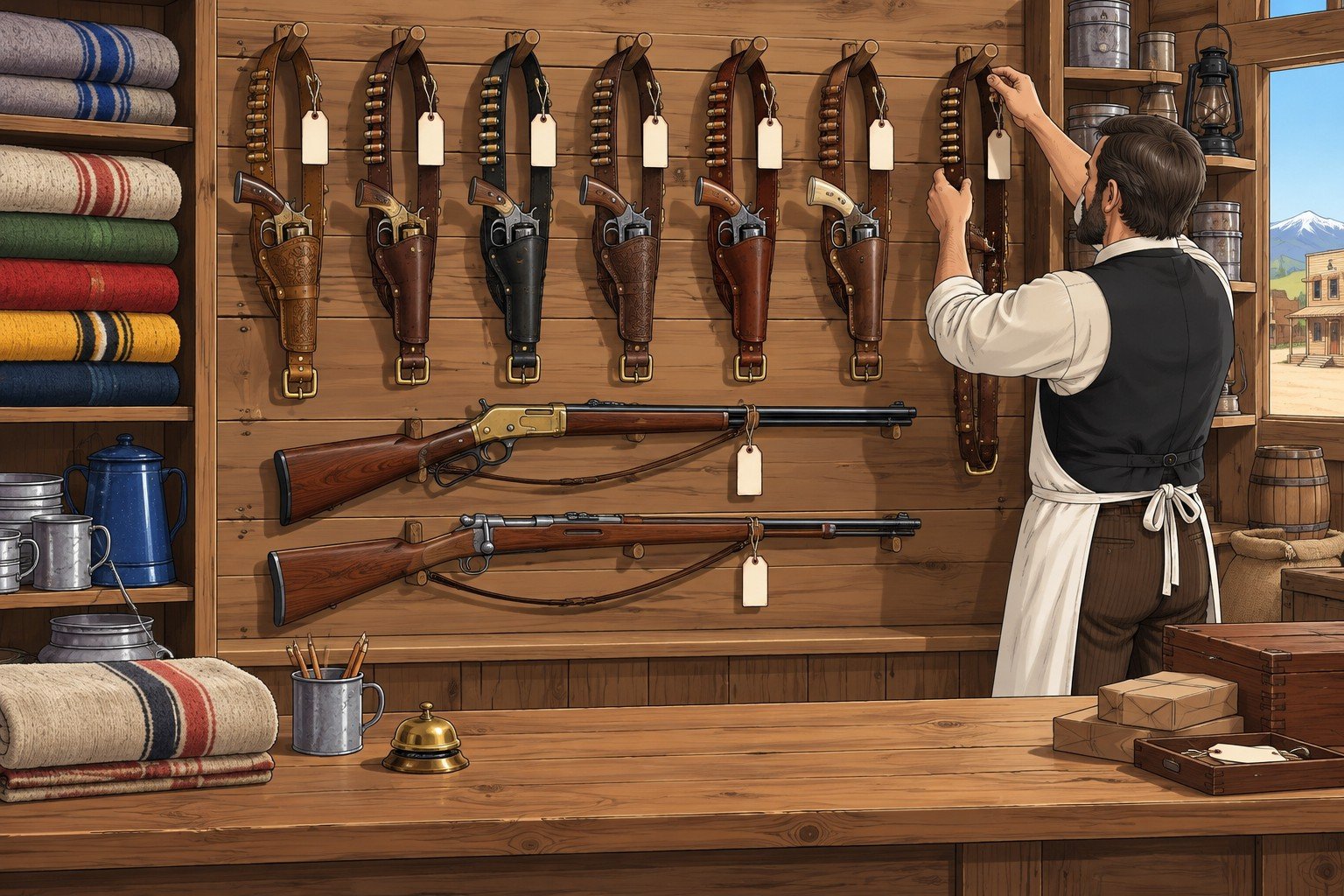
Arms in Town
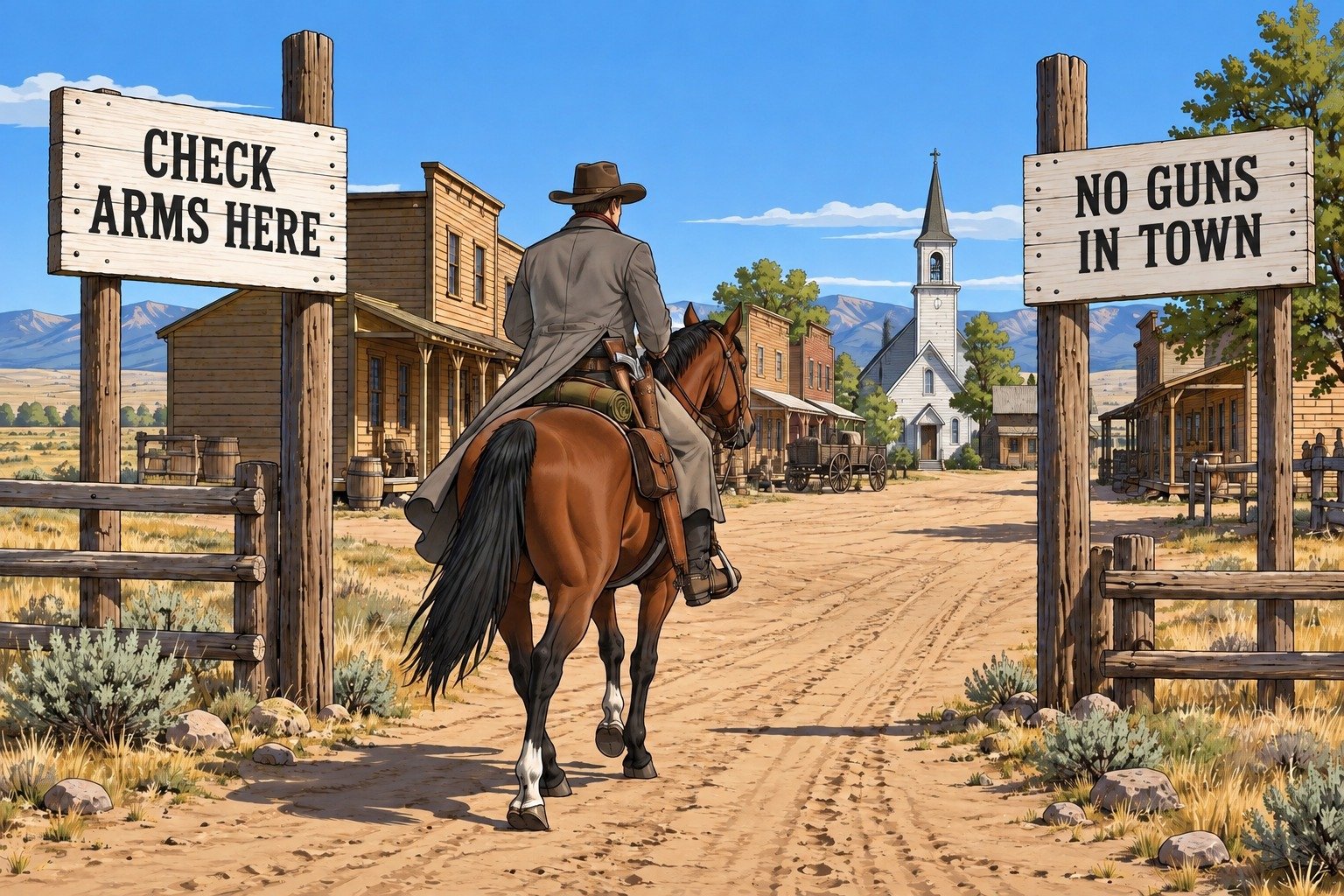
Adds. Cheyenne forbade carrying arms in town from 30 September 1867, and Wyoming Territory barred it in every city, town and village by its act of 1875 (fine $5 to $50). Colorado Territory's act of 1862 barred a concealed pistol, bowie knife, dagger or other deadly weapon in any city, town or village (fine $5 to $35) and said nothing of open carry; no Denver ordinance for the range is on record. Gear and Prices carries the record.
TERMS: ARMS IN TOWN
Where the GM says a town forbids arms:
- An officer who sees a stranger's weapon tells the stranger. The stranger has thirty minutes to leave it at a lodging, a store, or the marshal's office (the three places are a table convention).
- A character who is told and does not comply is subject to arrest (Law in Play). The Leadership check to arrest a character who refuses is Average.
- Hiding a weapon on the body is a Subterfuge check against the officer's Perception; the weapon's Concealable rating adds Bane Dice to the search.
- A character who is known and trusted by the marshal may be exempted by arrangement: Negotiation, Average.
Travel at the Table

Modifies The Stable, Riding, Travel: stage lines with relay stations use the courier's relay rule, and a rail journey is not tracked as a journey.
Journeys are narrated. A journey costs time, and the GM rolls at most one check, the hazard, for the whole trip.
TERMS: JOURNEYS
Overland. A mounted party travels at the Travel of its slowest animal, and a wagon or freight outfit at the Travel of its slowest team (The Stable, Riding, Travel and Teams). Country slows the day as that book says.
Rail. A journey between depots on the Union Pacific or the Denver Pacific takes the part of a day that the timetable allows and costs a fare. It is not tracked as a journey; Places and Campaign Tools (Rail Routes) gives the table times and the derived fares.
Stage. A stage line with changing stations doubles the team's Travel, as relay stations do in The Stable. A stage can be stopped, robbed or delayed.
The hazard. For any journey of a day or more, the GM sets one hazard: weather, a river, a breakdown, trouble on the road. The party makes one check: Survival, Operate or Riding. The difficulty is Average, Hard in winter or flood, with 1 Bane Die for a loaded wagon in a flood. A flood that is the whole scene uses the Flood hazard (Adversaries) in place of the Travel check. On a failure the party loses a day and takes one complication. A Calamity is the moment to expose a character to illness (Illness).
Unkept horses. Count days away from towns and stations for Keeping a Horse.
| Route | Distance | Notes |
|---|---|---|
| Cheyenne to Denver (Denver Pacific) | 106 miles | The first train ran on 24 June 1870 (Historical Reference). Fare $7 first class (Places and Campaign Tools, Rail Routes). The express takes about five hours (leaves Cheyenne ~3 p.m., arrives Denver ~8 p.m.). |
| Cheyenne to Laramie (Union Pacific) | 57 miles | A day; fare $3.40, derived, not quoted (Places and Campaign Tools, Rail Routes). Railroad hotel and 30-minute meal stop; the company's shops. |
| Cheyenne to Fort Laramie (road) | 89 miles | 6 / 3 / 5 days on foot, Riding Horse or wagon. Mail ambulance only until the stage line of March 1876; then a day to a day and a half, fare $4 third class to $7 first class, derived (Places and Campaign Tools, Road, Stage and Trail Routes). |
| Cheyenne to the Black Hills (Cheyenne and Black Hills stage) | About 300 miles to Deadwood | Three days in spring to Custer City on the first-class run; $20 first class, $15 second, $10 third, through tickets, 1876. The first stage reached Deadwood on 25 September 1876, after the play range closes on 1 August 1876; treat that run as an epilogue. Places and Campaign Tools owns the road figures. |
The Black Hills and the unceded country. Under Article XVI of the 1868 Treaty of Fort Laramie, the country north of the North Platte River and east of the Big Horn Mountains was unceded Indian territory: no white person was to settle in it or pass through it without the consent of the Lakota. The Black Hills themselves lie inside the Great Sioux Reservation (Article II); the road to them crosses both. A journey into either is a scene with a Tribal Nation, an Army column or a gold seeker, and not a hazard roll.
Money and Credit
Adds. Money in The Old West is dollars and cents. The book tracks cash on hand and nothing else.
TERMS: MONEY AND CREDIT
Dollars. Every price in this book is in dollars. The sourcebooks' price units are a cross-reference to their rows, not a rate; Gear and Prices owns the price of everything.
Keep. A working character's food and lodging are covered by the Role's Pay and are not tracked. A character out of work has no Keep and is Broke. A Broke character pays for meals and a bed in cash at Gear and Prices' rates or sleeps rough; a night rough is an exposure for Illness. A Broke character with an unpaid Debt cannot open a new account, and a creditor who learns of it may act a month early. Taking work, a paid job or a Stakes win that covers a month's Keep ends Broke.
Credit. A merchant who knows a character will sell on account. The Credit limit is twice the character's Starting Stake. One Negotiation check, Average, opens an account with a creditor; purchases up to the limit on that account then need no roll. The character records a Debt: creditor, sum, and a due date at the end of the next month. A Debt taken at creation (Character Creation and Roles, Creation Debt) is due at the end of the second month.
Unpaid Debt. After the due date, the character adds 1 Bane Die to social checks with the creditor and with merchants who hear of it, and no new account opens with a merchant who has heard. After a second month the creditor acts: a lawsuit, a sheriff's attachment of property, or a hire for a collector. A talent such as Good Credit raises the limit.
Lending. A character who lends money or goods records the Debt as its creditor: the borrower, the sum, the due date, and the interest, which is 2 percent a month unless the two set another rate in writing. (Colorado’s 1861 act and 1877 successor set a legal rate of 10 percent a year when no rate is agreed, and allowed any higher rate in writing; 2 percent a month is a common private rate on the corridor.) After the due date the creditor holds the levers above: the Bane Die, the closed accounts, and after a second month the suit, the attachment or the collector (a Bounty Hunter or a Hired Gun, Adversaries). Calling a Debt before it is due is a Negotiation check, Hard, or a sale of the note to someone who will; a borrower who cannot pay may buy a month with a Negotiation check, Average, at a month’s interest added to the sum. The corridor’s banks and the other lenders a character meets are in Factions and Powers, Banks and credit.
Paying in kind. A creditor who agrees to take goods against a Debt takes them at half their Gear and Prices price; a horse goes at its grade's price in full. Pawn. A pawnbroker, a trader or a post trader lends a third of an item's Gear and Prices price and holds the item. Redeem it within a month for the sum and a tenth more; after the month it is forfeit and goes on the shelf at its full price.
Stakes and Bounty pay in dollars.