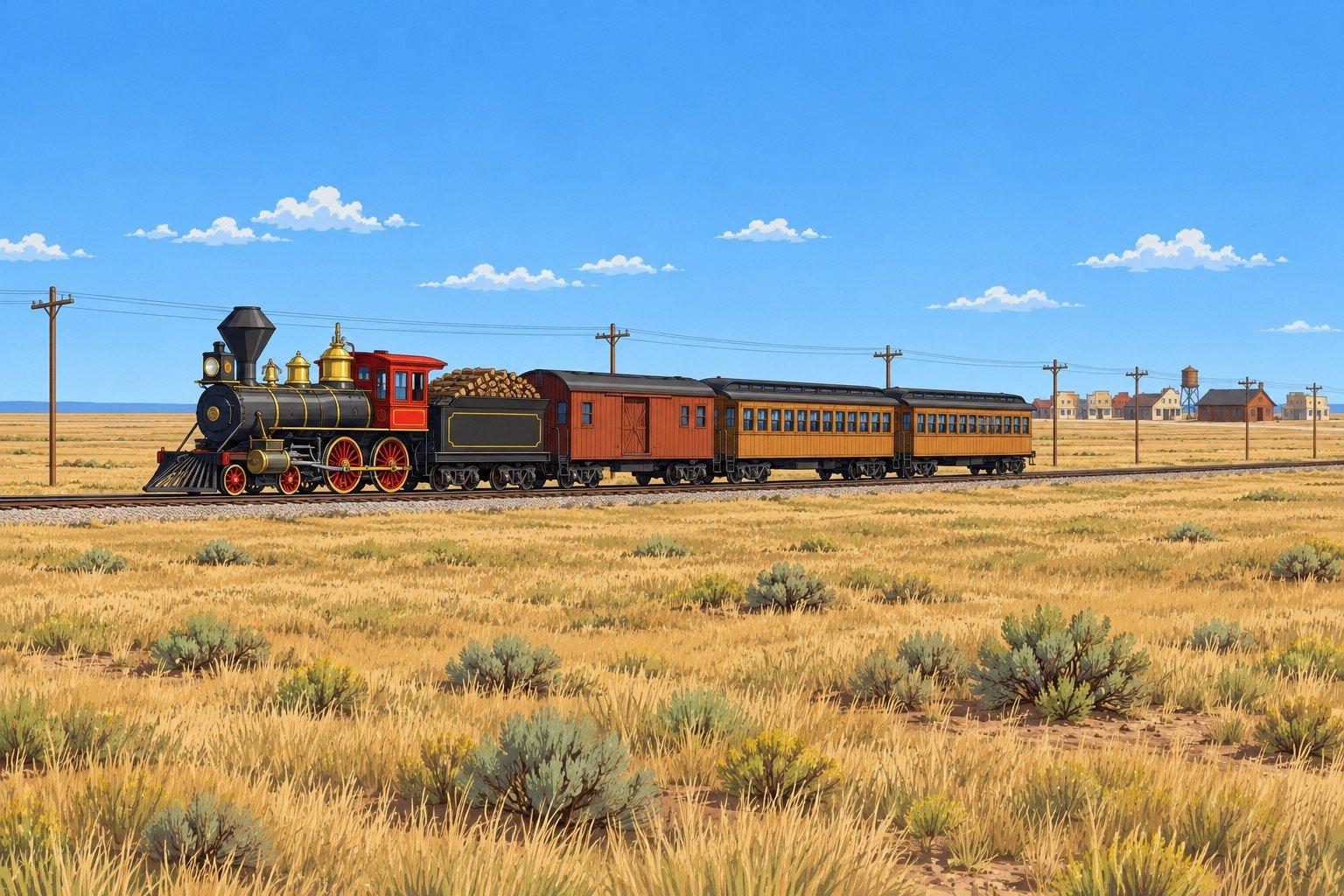
This chapter gives the dates and region, the period map, a dated timeline, and how people lived: who they were, what they earned, who held power, what they believed, and how they traveled, learned, healed and read the news. The rules for illness, horses and prejudice are in Era Rules. Tribal Nations and the Army have their own chapters (Tribal Nations; Factions and Powers); this chapter summarizes each in a paragraph.
The Era at a Glance
| Item | Statement |
|---|---|
| Region | The Wyoming and Colorado corridor along the Union Pacific and the Denver Pacific: Cheyenne and Laramie County, Fort D.A. Russell, Denver, the Front Range, the Platte and the plains east of it, and the country of the Lakota, Cheyenne and Arapaho to the north. |
| Play range | 1869 to 1876. It opens on 10 December 1869, when Wyoming Territory gives women the vote, and closes on 1 August 1876, when Colorado becomes a state. |
| History range | 1865 to 1880. The timeline and the Historical Reference run the whole span. |
| Map date | 1 September 1874. This dates the period map only; the text is not limited to one snapshot. |
| Governments | Both Wyoming and Colorado are territories for nearly all of the play range. Colorado Territory dates from 28 February 1861 and Wyoming Territory from 25 July 1868. Colorado is a state from 1 August 1876; Wyoming does not become one until 1890. |
How to Read the Dates
Three dates frame every entry in this book.
- Play range, 1869 to 1876. A character, adventure or rule can be set in any year of it. Material with a date in the play range is ready to use as written.
- History range, 1865 to 1880. Events before 1869 explain how the corridor got to its situation (the railroad, the treaties, the wars). Events after 1876 explain where it went. Use them as background, as rumor, or as a "what happens next" the players cannot yet know. In the timeline, entries outside the play range are printed in plain type.
- Map date, 1 September 1874. The period map shows borders, railroads, forts and treaty lands as they stood that day. If your session is set in another year, check the timeline for what changed. The Cheyenne to Black Hills stage (February 1876) and Colorado's statehood (1 August 1876) are not on the map because they come later.
Where accounts differ on a date, the entry gives both. The GM may pick either; nothing in the rules depends on the day.
The Period Map
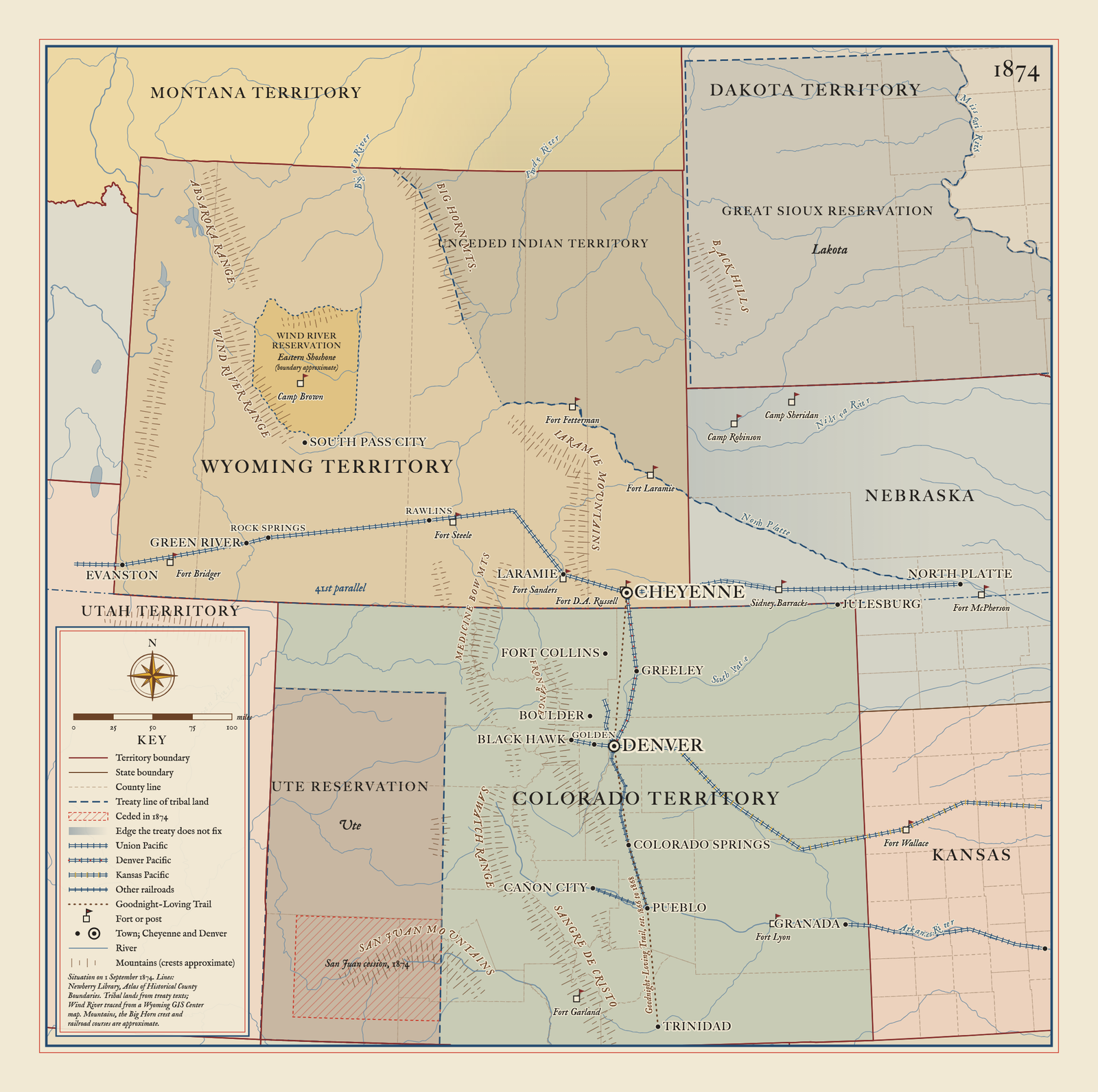
Map OW-MAP-01. The Wyoming and Colorado corridor on 1 September 1874 It is not a survey.
Reading the Key
| Feature | How it is drawn |
|---|---|
| Territory boundary | Solid deep-red line, with the territory's name in capitals |
| State boundary | Solid brown line |
| County line | Thin pale dashed line |
| Tribal land by treaty | Pale tint with a dashed blue edge; the nation's own name in italics |
| Edge the treaty does not fix | A faded edge (north and east sides of the Unceded Indian Territory) |
| Ceded in 1874 | Red hatching (the San Juan cession of the Ute Reservation) |
| Union Pacific, Denver Pacific, Kansas Pacific, other railroads | Double blue lines with ties; the Denver Pacific carries vermilion dots and the Kansas Pacific golden ticks |
| Goodnight-Loving Trail | Dotted brown line, labeled as established 1866 to 1868 |
| Fort or post | Small square with a flag |
| Town | Filled circle; a ringed circle for Cheyenne and Denver |
| River | Blue line |
| Mountains | Brown hachures (crests approximate) |
What the Map Shows at the Table
- The 41st parallel is the line between Wyoming Territory, where women vote, and Colorado Territory, where they do not. Cheyenne sits just north of it and Denver about a hundred miles south.
- Two railroads join the cities. The Denver Pacific runs from Cheyenne to Denver (1870). The Kansas Pacific reaches Denver from the east (1870).
- Three kinds of tribal land appear. The Great Sioux Reservation lies east of the 104th meridian in Dakota Territory. The Unceded Indian Territory lies north of the North Platte River and east of the summits of the Big Horn Mountains. The Wind River Reservation of the Eastern Shoshone and the Ute Reservation in western Colorado are drawn as they stood in 1874. These are the names the 1868 treaties give. Each nation's own name is printed in italics; the nations are described in Tribal Nations.
- Jurisdictions overlap. A single road can cross a municipality, a county, a territory, a military reservation and a treaty line in a day's ride. See Jurisdiction in this chapter and Factions and Powers.
Approximate Parts of the Map
These parts of the map are approximate and the key says so. Do not use them to settle a boundary dispute in play.
- Wind River Reservation. The outline is approximate and drawn with a dotted edge. The 1868 reservation was about 3.05 million acres; the 1872 cession (signed 26 September 1872, ratified 1874) took about 710,000 acres from the southern part.
- Big Horn crest. The west edge of the Unceded Indian Territory follows the summits of the Big Horn Mountains, which the treaty names, but the line is drawn from named peaks.
- Unceded Indian Territory. The treaty fixes the south edge (the North Platte) and the west edge (the Big Horn summits). It does not fix the north and east edges, so the map fades them.
- Mountain crests. All hachures are approximate to about 10 to 20 kilometers (6 to 12 miles).
- Railroad courses. Railroads are drawn station to station and appear straighter than they ran. Check the timeline for the date each line opened.
- Julesburg. The town is plotted at its modern site, not the several sites it occupied in the 1860s and 1870s.
- Goodnight-Loving Trail. The map shows when the trail was established (1866 to 1868). It does not claim that herds used it on 1 September 1874.
- Front Range label. The label is small; the range is the ridge west of Denver, Boulder and Fort Collins.
County lines and territory lines are as of 1 September 1874. Tribal lands follow the treaty texts.
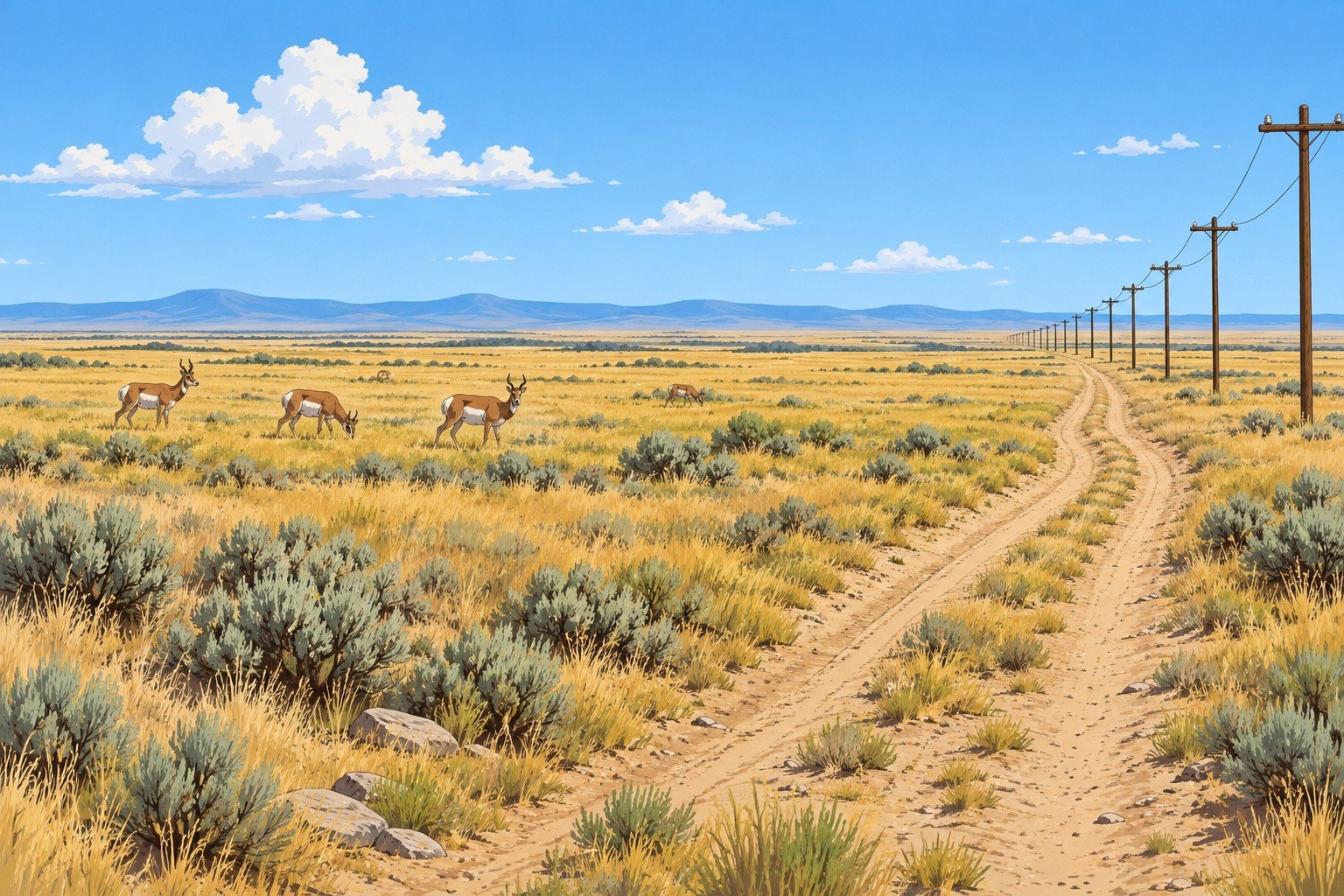
Timeline, 1865 to 1880
The play range is 1869 to 1876; earlier and later entries give background and aftermath.
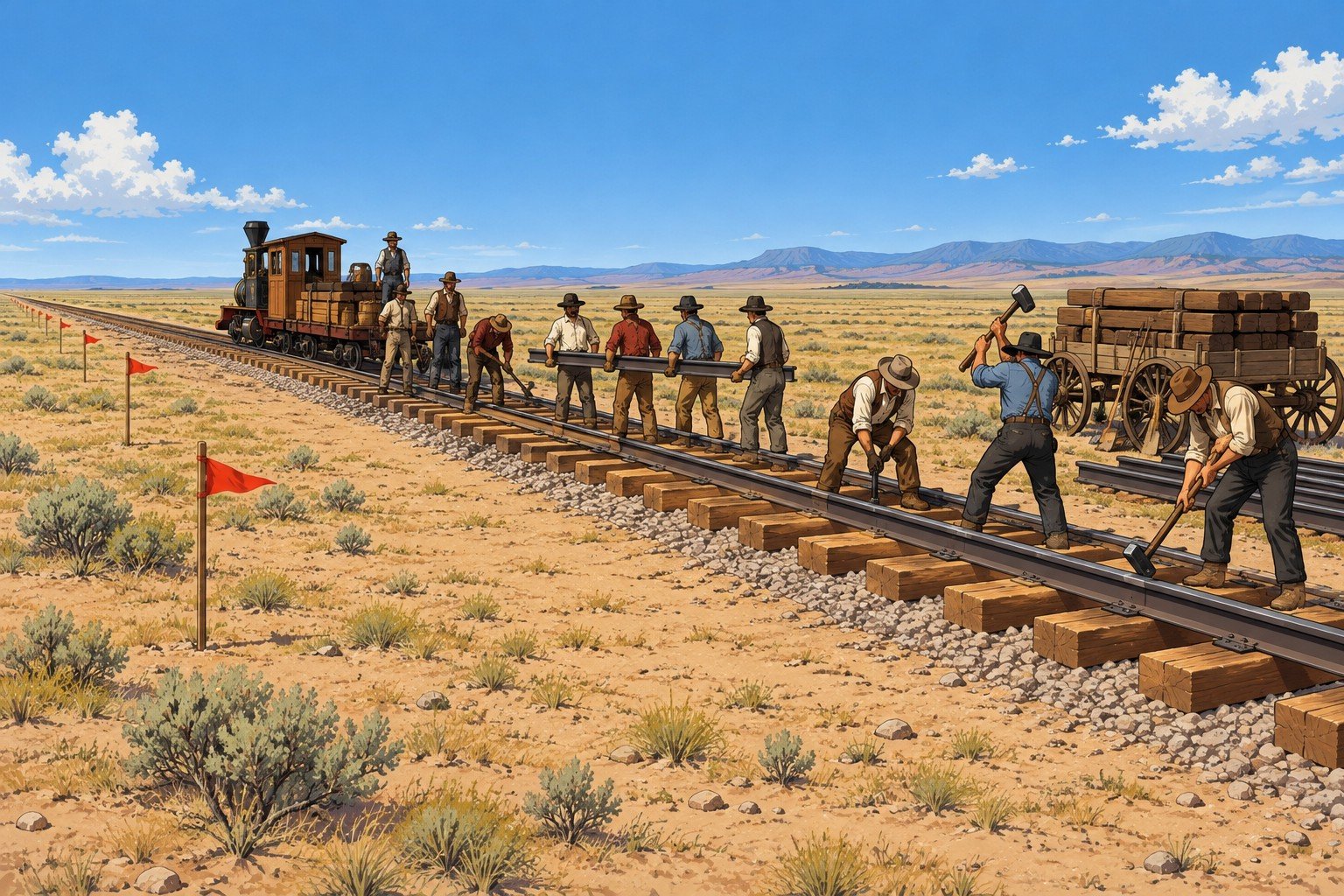
| Date | Event | Place |
|---|---|---|
| 7 Jan and 2 Feb 1865 | Raids on Julesburg after the Sand Creek massacre of 29 November 1864: stations and ranches along the South Platte are attacked and the town is burned on 2 February. | Julesburg, Colorado Territory |
| Summer 1865 | The Powder River Expedition under General Connor campaigns against the northern plains nations; it fails to bring peace. | Powder River country |
| 26 July 1865 | Platte Bridge fight; Lt. Caspar Collins is killed. The station is renamed Fort Caspar. | North Platte, Wyoming |
| 1866 | Fort Phil Kearny is built on the Bozeman Trail. A drover takes the first herd through Wyoming to Montana. Fort Sanders is built on the Overland Trail. The Goodnight-Loving Trail is established (1866 to 1868). | Wyoming; Colorado |
| 21 Dec 1866 | The Fetterman Fight: the garrison of Fort Phil Kearny loses 81 men, soldiers and two civilians, to a force of Lakota, Cheyenne and Arapaho. | Fort Phil Kearny |
| 4 July 1867 | The Union Pacific chooses the townsite at Crow Creek Crossing on 4 July 1867 and plats it on 5 July, naming it Cheyenne. | Cheyenne |
| 1867 | Fort D.A. Russell and Camp Carlin are established beside Cheyenne. Laramie County is created by the Dakota legislature. | Cheyenne |
| 2 Aug 1867 | The Wagon Box Fight, during Red Cloud's War. | Near Fort Phil Kearny |
| 19 Sep 1867 | First issue of the Cheyenne Leader, the first newspaper in Cheyenne and the first after the territory was created (a short-lived Fort Bridger sheet ran in 1863). | Cheyenne |
| 13 Nov 1867 | Union Pacific track reaches Cheyenne; the town is the end of track for about six months. | Cheyenne |
| Dec 1867 | The Colorado Territory legislature votes to move the capital from Golden City to Denver. | Denver |
| 29 Apr 1868 | The Fort Laramie Treaty is signed; the Brule sign that day, the Oglala on 25 May, and Red Cloud and others on 6 Nov 1868. | Fort Laramie |
| 18 May 1868 | Denver holds a public holiday to start the Denver Pacific. | Denver |
| 25 Jul 1868 | Wyoming Territory is created by Congress. | Washington |
| 1868 | A treaty sets aside the Wind River Reservation for the Eastern Shoshone. Denver's schools are segregated at the request of parents and a separate school for Black students opens. Cheyenne dedicates its first public school on 6 January. | Wyoming; Denver; Cheyenne |
| 1869 | The federal government announces its Peace Policy; from 1870 the agencies are parcelled out to church bodies. | Washington |
| 10 May 1869 | The Union Pacific and Central Pacific meet at Promontory Summit, Utah, completing the first transcontinental railroad. | Utah Territory |
| 19 May 1869 | Wyoming Territory is organized (Governor Campbell arrived 7 May) and Cheyenne is the temporary capital. | Cheyenne |
| 1869 | Chinese workers come to Wyoming to repair and maintain the Union Pacific. A fire burns part of Cheyenne (the larger fire of 11 January 1870 is in the Cheyenne chapter). The first territorial legislature creates the school system. | Wyoming Territory |
| 10 Dec 1869 | Governor Campbell signs the bill giving Wyoming women the vote and the right to hold office. | Cheyenne |
| 14 Feb 1870 | Esther Morris is appointed justice of the peace at South Pass City, the first woman to hold such office in the nation (accounts differ; one gives 17 February). | South Pass City |
| 7 Mar 1870 | A grand jury that includes women is sworn in at Laramie. | Laramie |
| 24 Jun 1870 | The Denver Pacific runs its first train from Cheyenne to Denver on 24 June 1870 (track finished 22 June). | Denver; Cheyenne |
| 15 Aug 1870 | The Kansas Pacific is completed to Denver, giving the city a second railroad. | Denver |
| 6 Sep 1870 | Louisa Swain of Laramie casts the first vote by a woman under the new law. | Laramie |
| 1871 | Wyoming's assembly passes a repeal of women's suffrage; the governor vetoes it and the override fails by one vote. Denver and Rio Grande track-laying starts at Denver (late July); Colorado Springs is founded. | Cheyenne; Colorado |
| 17 Dec 1871 | The Denver Horse Railroad opens the city's first rail transit. | Denver |
| 1871 (about) | Chin Lin Sou, a labor contractor, begins managing Chinese crews in the Black Hawk placers; he later becomes a Denver merchant. He is also credited with a crew on the Denver Pacific. | Black Hawk; Denver |
| 1872 | Barney Ford becomes the first Black man to serve on a federal grand jury in Colorado. | Denver |
| 1872 | The Denver and Rio Grande reaches Pueblo (15 or 19 June). Yellowstone is set aside as the first national park on 1 March 1872. Cheyenne builds a courthouse (1872 to 1873). | Colorado; Wyoming |
| 13 Sep 1873 | The Brunot Agreement is signed with the Ute bands. Congress approves it on 29 April 1874; it removes the San Juan Mountains from the Ute Reservation. | Los Pinos Agency; Washington |
| 29 Nov 1873 | Cattlemen organize the Laramie County stock association in Cheyenne (29 November 1873; the association dates its own origins to 1872), renamed the Wyoming Stock Growers Association in 1879. | Cheyenne |
| 1873 | Barney Ford's Inter-Ocean Hotel, the finest in Denver, opens on 29 October. The financial Panic of 1873 begins a long depression (it began on 18 September). | Denver; nation |
| 1874 | City Hall built in Cheyenne. Grasshoppers destroy crops across the Plains, including Colorado. Congress appropriates $180,000 for relief of people on the frontier (voted in February 1875). | Cheyenne; Colorado |
| 2 Jul 1874 | Custer's expedition leaves Fort Abraham Lincoln for the Black Hills; it reaches the hills on 22 July and sends word of gold to Fort Laramie in August. | Dakota Territory |
| 1 Sep 1874 | Map date. | The corridor |
| 24 Nov 1874 | Joseph Glidden is issued the patent for barbed wire. | Illinois |
| 1875 | The Newton-Jenney expedition confirms the gold. Black members of Cheyenne's Methodist church found their own congregation. | Black Hills; Cheyenne |
| 28 Sep 1875 | Denver's Jewish congregation dedicates its synagogue. (Incorporated 1874.) | Denver |
| Early Nov 1875 | Army commanders meet the President in Washington on the Black Hills and the nations who hold them. | Washington |
| 31 Jan 1876 | The deadline for the bands camped outside the agencies to report in. | Northern Plains |
| 3, 7 and 10 Feb 1876 | Three stage trips run from Cheyenne to Custer City by Yates and Brown; the line is sold on 12 February. | Cheyenne |
| 7 Mar 1876 | Alexander Graham Bell is issued the telephone patent. | Massachusetts |
| 17 Mar 1876 | The Army attacks a village on the Powder River; the Great Sioux War begins in earnest. | Powder River |
| 17 Jun 1876 | Battle of the Rosebud. | Montana |
| 25 to 26 Jun 1876 | Battle of the Little Bighorn. | Montana |
| 1 Aug 1876 | Colorado becomes a state. The play range ends. | Denver |
| 9 Sep 1876 | Battle of Slim Buttes. | Dakota Territory |
| 25 Sep 1876 | The first stage reaches Deadwood. | Black Hills |
| 25 Nov 1876 | The Dull Knife Fight against Northern Cheyenne. | Powder River country |
| 28 Feb 1877 | Congress enacts an agreement that takes the Black Hills from the Great Sioux Reservation. | Washington |
| 2 Oct 1877 | Colorado voters reject women's suffrage, 14,053 to 6,612. | Colorado |
| 24 Jan 1880 | The Denver Pacific merges into the Union Pacific. | Denver |
| 1880 | The Cheyenne Club opens. Denver counts 35,629 people; Cheyenne 3,456. | Cheyenne; Denver |
| 31 Oct 1880 | A mob destroys Denver's Chinatown (Hop Alley); one man dies. | Denver |
The West Was Connected
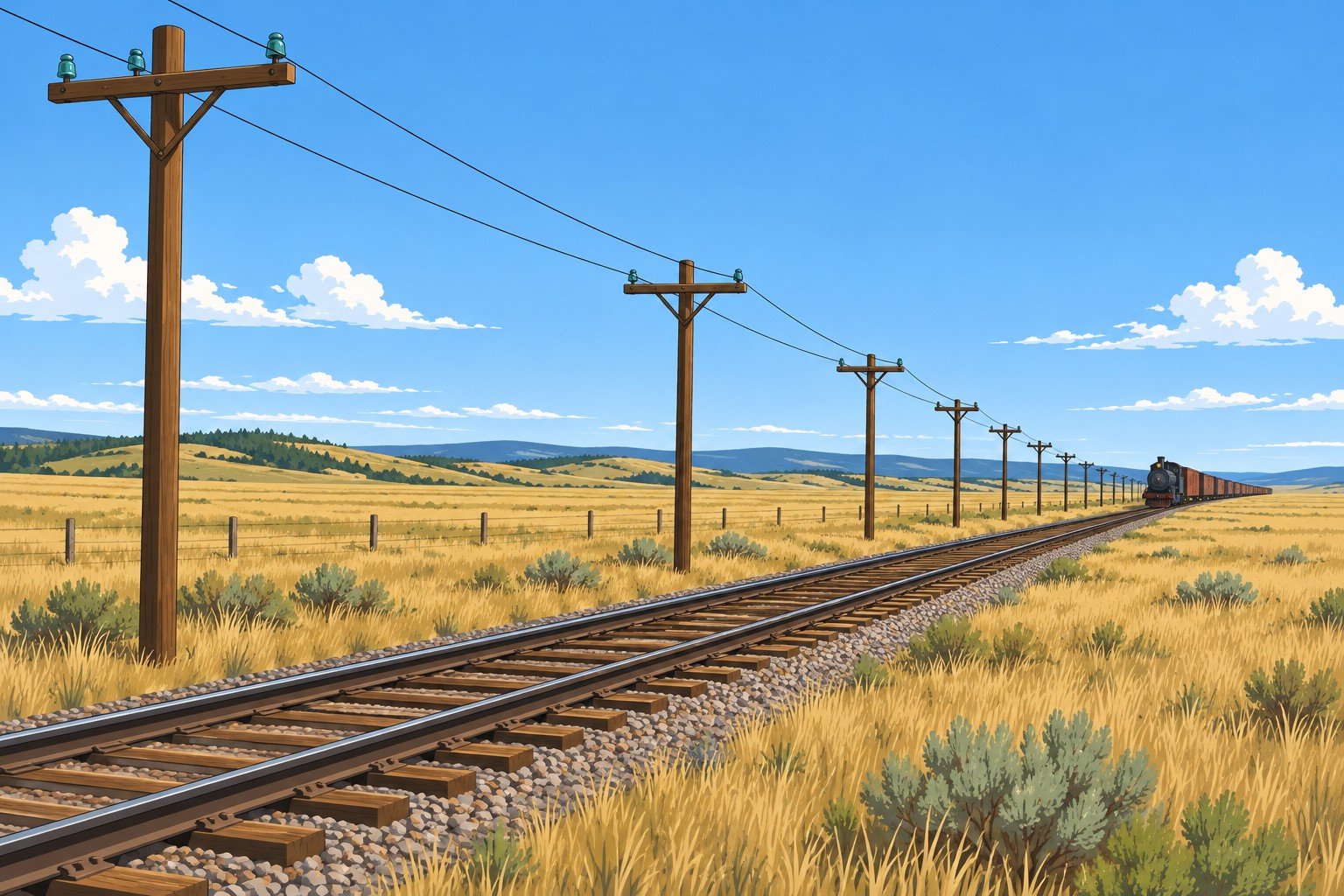
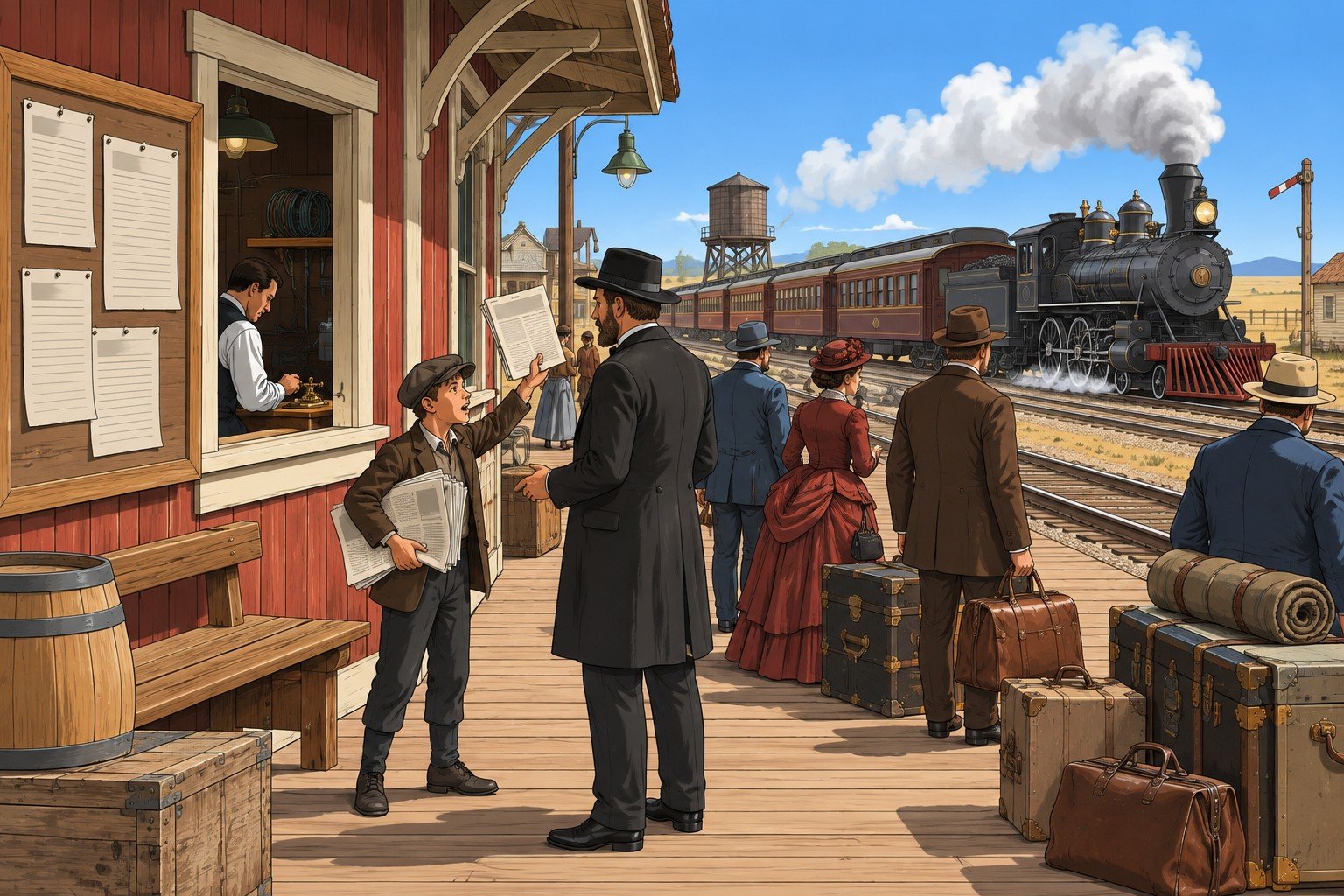
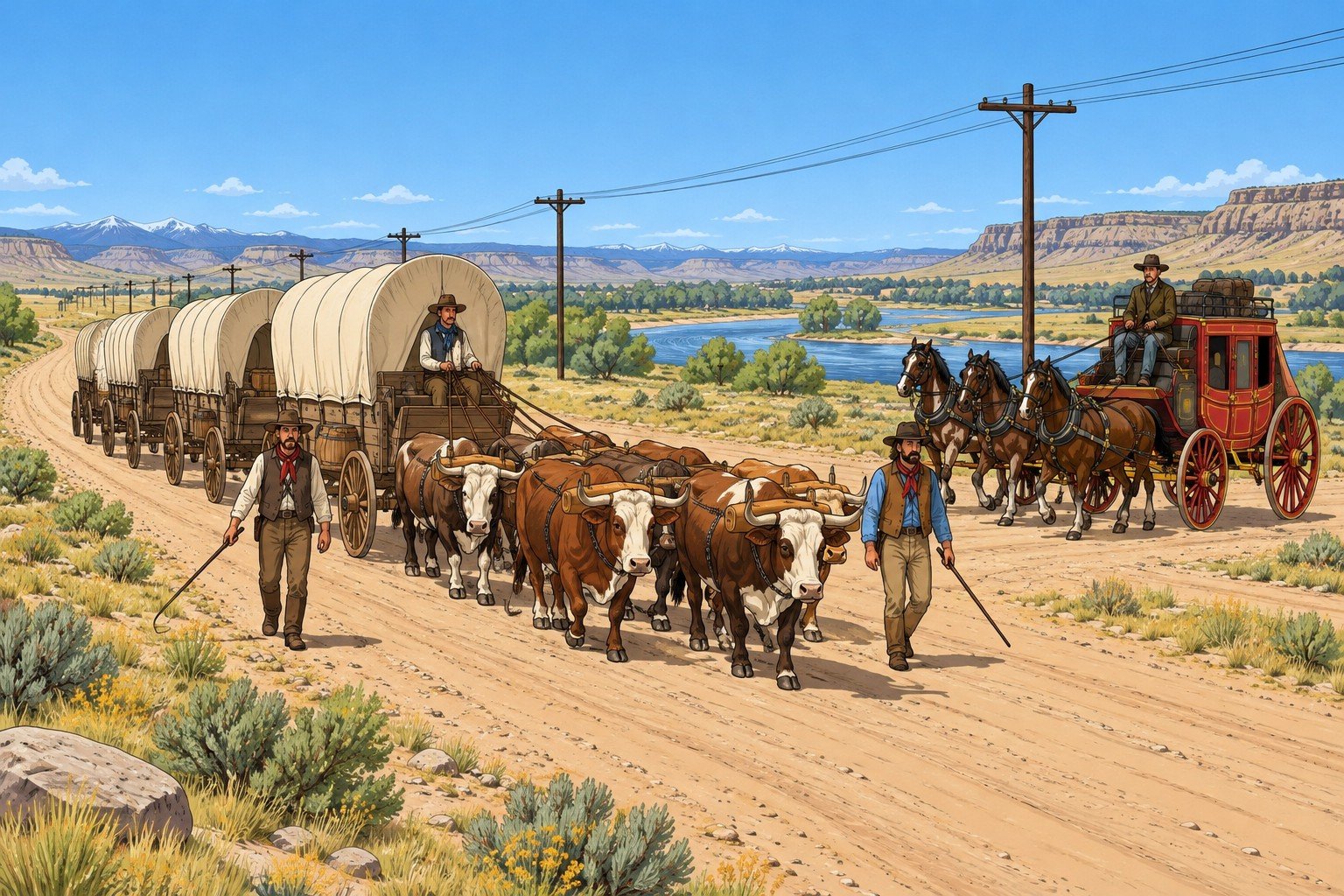
A character in Cheyenne in 1874 can buy goods shipped from the East, read eastern news, and wire a message to another city the same day. The Union Pacific ran through Cheyenne from 13 November 1867. A telegraph line from Denver to Cheyenne was complete on 31 December 1868, owned by the Denver Pacific Railway and Telegraph Company, and the Denver Pacific carried the cities' trains from June 1870. Mail rode the rails. A hundred miles of track joined the two capitals, and a traveler could cross it in a day. The two cities were the principal places on the plains to buy a new rifle, a bolt of cloth, a piano or a lawyer. The Union Pacific carried people and freight east to Omaha and west to Utah; stage lines and freight wagons ran where no rail did, a rider on a good horse covered the day's distances, and after the Black Hills rush the road north of Cheyenne was busy. Places and Campaign Tools owns the routes; a traveler who leaves the line leaves its schedule.
How People Lived
Society and Class
The corridor grew fast. Wyoming Territory counted 9,118 residents in 1870 (2,957 in Laramie County) and Denver 4,759; by 1880 Denver counted 35,629 and Cheyenne 3,456. Newcomers came by rail from the East, from Europe, and (in Colorado) from New Mexico.
| Level | Who | What it means in play |
|---|---|---|
| Capital and office | Cattle and mining investors, railroad officers, territorial officials, bankers, large merchants | Money and credit; they know the law and the governor |
| The respectable middle | Shopkeepers, clerks, lawyers, physicians, editors, ministers, teachers, craftspeople | Reputation matters more than cash; a ruined name closes doors |
| Wage labor | Cowhands, teamsters, railroad and mine hands, domestic workers, laundresses, soldiers | Steady pay, hard conditions, and the first to be hit by hard times |
| The margins | Gamblers, saloon and dance-hall workers, prostitutes, drifters | Tolerated until a town needs a reason to act |
| Tribal nations and their members | Citizens of their own nations | Governed by their own leaders and by treaty; see Tribal Nations |
A person's standing came from property, family, church or lodge, trade and character, and it could change fast. A Cheyenne storekeeper could lose a fortune in the Panic of 1873; a drover could buy land. Honor and reputation counted: a respectable woman, a widow or a boardinghouse keeper lived by what others said of her.
-
Marriage and family. Marriage was the norm and the way a woman (or a man) obtained property, protection and standing. Households took in boarders, relatives and hired help. Women commonly worked at home for pay: washing, sewing, boarding, cooking.
-
Women's work. Women worked as teachers, laundresses, seamstresses, milliners, nurses, cooks, domestic servants, shopkeepers and in the sporting trade. In Wyoming they also voted (see Women Voted in Wyoming).
-
Children. Children worked at home and on farms and herds; those in towns attended school when there was one.
-
Etiquette. Calling cards, introductions and separate spaces for men and women shaped town life. A woman alone in a saloon or dance hall damaged her name.

Work and Money
Gear and Prices owns the price lists and the full wage table. The table below gives wages for the corridor.
| Job | Pay |
|---|---|
| Cowhand | $25 to $40 a month with board, about $30 at Cheyenne in 1877; a top hand $45 to $75 and a trail boss about $100. Pay stayed about the same for thirty years after the Civil War |
| Ranch hands and herders; teamsters; laborers | $30, $28 and $25 a month with board (Cheyenne, 1877) |
| Carpenters; day laborers | $3 a day; $2 a day (Cheyenne, 1877 and 1879) |
| Salesmen and store clerks | $75 to $125 a month (Cheyenne, 1877) |
| Hard-rock miners | About $3 a day (Colorado, 1869 to 1876; estimated) |
| Teachers | $60 a month for a man, $50 for a woman, on average (Colorado, 1873 to 1875) |
| Army private | $13 a month from 1 July 1871 ($16 before) |
| Union Pacific construction crew | About $3 a day on average, 1869 |
| Chinese labor on the Denver Pacific and in the Black Hawk placers | Paid through a labor contractor; a Chinese section crew on the Union Pacific about $30 a month in 1870, self-boarding (one account gives $32.50 against $52 for white hands); a contractor could field crews of up to about 300 |
| Wyoming coal miner | Paid by the weight of coal (not by the hour): five cents a bushel at Rock Springs before the summer 1875 cut to four cents, a reduction the miners struck against and that brought in Chinese strikebreakers. The five-cent rate comes to roughly $1.25 a ton |
Kinds of work in the corridor.
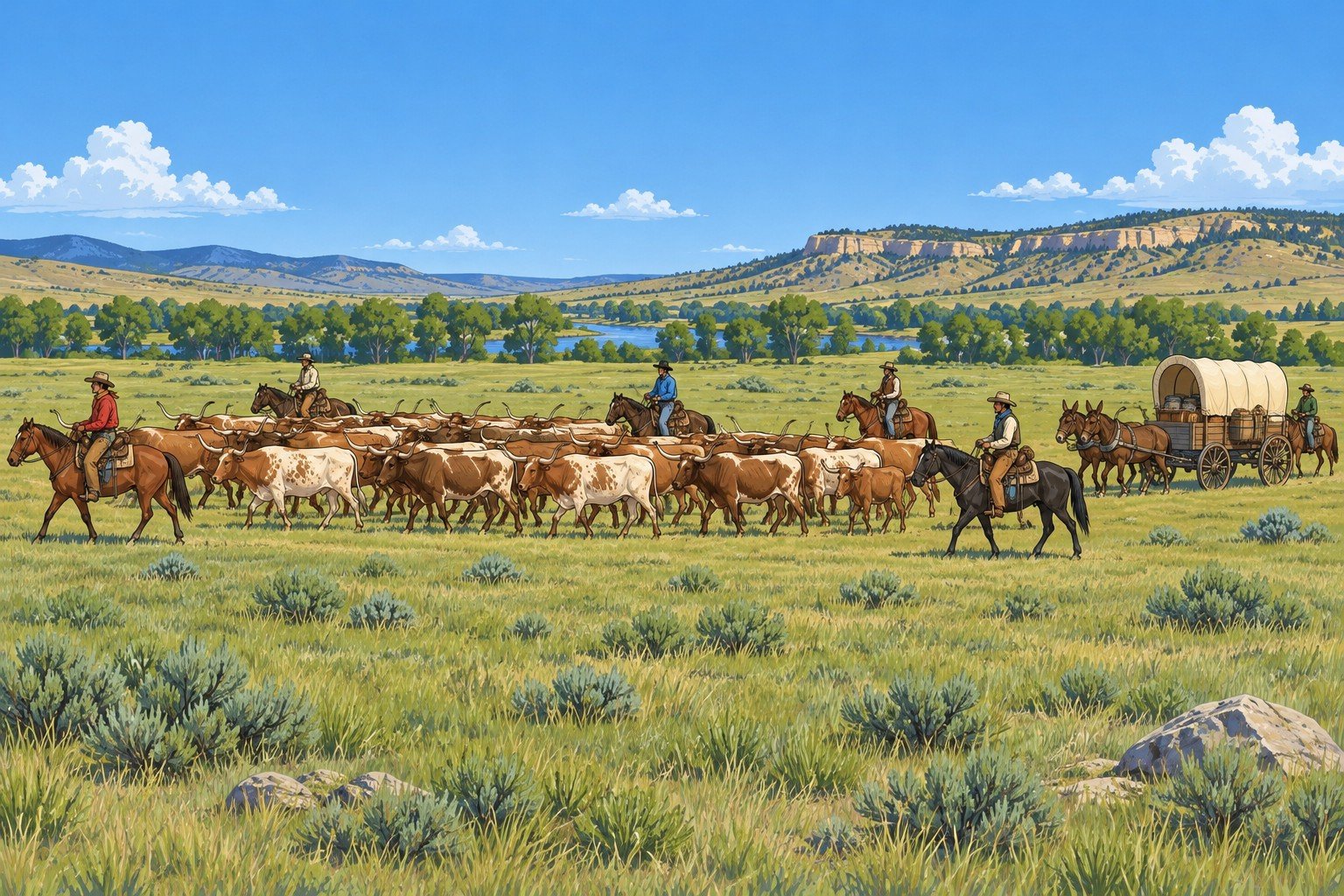
- Cattle. Ranchers and cowhands worked the grass. Texas herds came north from 1866; one drover took the first through Wyoming that year. Cattlemen were financiers as much as ranchers: the Laramie County stock association (29 November 1873; the association dates its own origins to 1872), renamed the Wyoming Stock Growers Association in 1879, paid detectives to catch rustlers. An earlier association (1871) had the governor as president and won the territory's first livestock law. Most cowhands were hired labor.
- Railroads. Construction crews, section hands, shop workers, conductors, telegraph operators and agents. The Union Pacific also owned the coal mines at Carbon, Rock Springs and Almy.
- Mining. Gold and silver in Colorado (Black Hawk, Central City, the San Juans), coal in Wyoming, and the smelting, assay and freight that went with them. The Boston and Colorado smelter opened at Black Hawk in 1868 using the Swansea process.
- Trades and services. Merchants, clerks, freighters, blacksmiths, hotel keepers, restaurants, laundries, barbers, tailors, printers, doctors, lawyers, bankers.
- Government work. Territorial and county offices, the Army and its civilian contractors (Camp Carlin supplied the posts around Cheyenne), the post offices, the courts.
Hard times. The Panic of 1873 began a long depression. In 1874 grasshoppers took crops in Colorado and across the Plains, and Congress voted $180,000 for relief of the frontier destitute.
Law and Who Holds Power
Factions and Powers owns the detail. In outline:
- City. A marshal or police force and a mayor and council enforce city ordinances.
- County. A sheriff, deputies, a county court and a justice of the peace handle local crime and civil disputes.
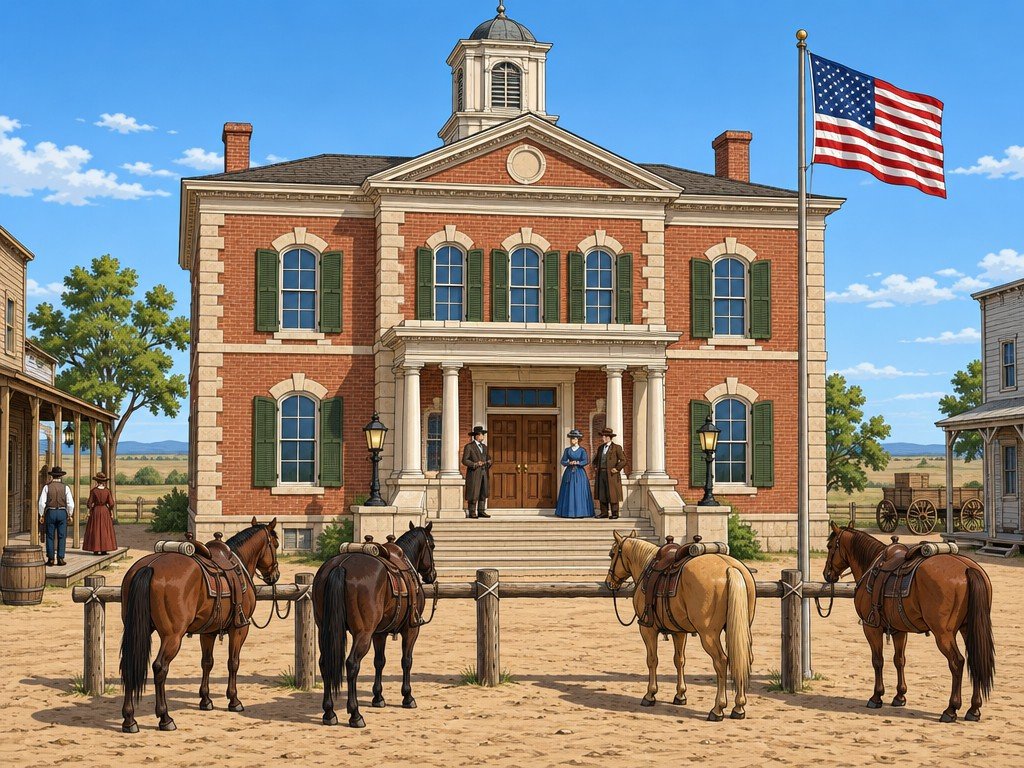
- Territory. A governor appointed by the President; judges appointed by the federal government; a legislature elected by voters; a non-voting delegate in Congress. Wyoming's legislature gave women the vote.
- Federal. U.S. marshals, federal courts, the Interior Department and the Indian agents who answer to it. Federal law governs the treaties.
- Army. Forts and posts, whose commanders answer to the War Department and, when called, support civil authority.
- Tribal governments. Each Tribal Nation governs its members under its own leaders and customs. Treaties set what the United States may do on their lands.
Land. Public land is federal until the General Land Office patents it. A settler takes title by homestead (Act of 20 May 1862: 160 acres for $14 in fees for a quarter section, patent after five years' residence or sooner at the minimum price), by pre-emption (Act of 1841: up to 160 acres at $1.25 an acre, $2.50 inside the railroad limits), by the Timber Culture Act of 3 March 1873 (160 acres for keeping 40 in trees), or by buying from the Union Pacific, which holds the odd-numbered sections along its line, ten a mile on each side, under the Pacific Railroad Acts of 1862 and 1864. A mining claim is held under the General Mining Act of 10 May 1872 and the district's rules (Factions and Powers, Mining Interests). A citizen or a declared intending citizen may file if 21 or the head of a family, a single woman or a widow included; Black men are citizens under the Civil Rights Act of 1866; a Chinese immigrant, whom the naturalization law bars, cannot; a member of a Tribal Nation cannot unless he has left his tribe, which an act of 3 March 1875 first allows. Treaty land, military reservations and the railroad's sections are closed to filing. Factions and Powers, The General Land Office and the Land Laws, has the offices and the procedure.
The written law and the enforced law differed. A sheriff might enforce a statute in the county seat and not on a distant ranch. A treaty line on a map did not stop a miner or a hunter crossing it.
Religion and Moral Life
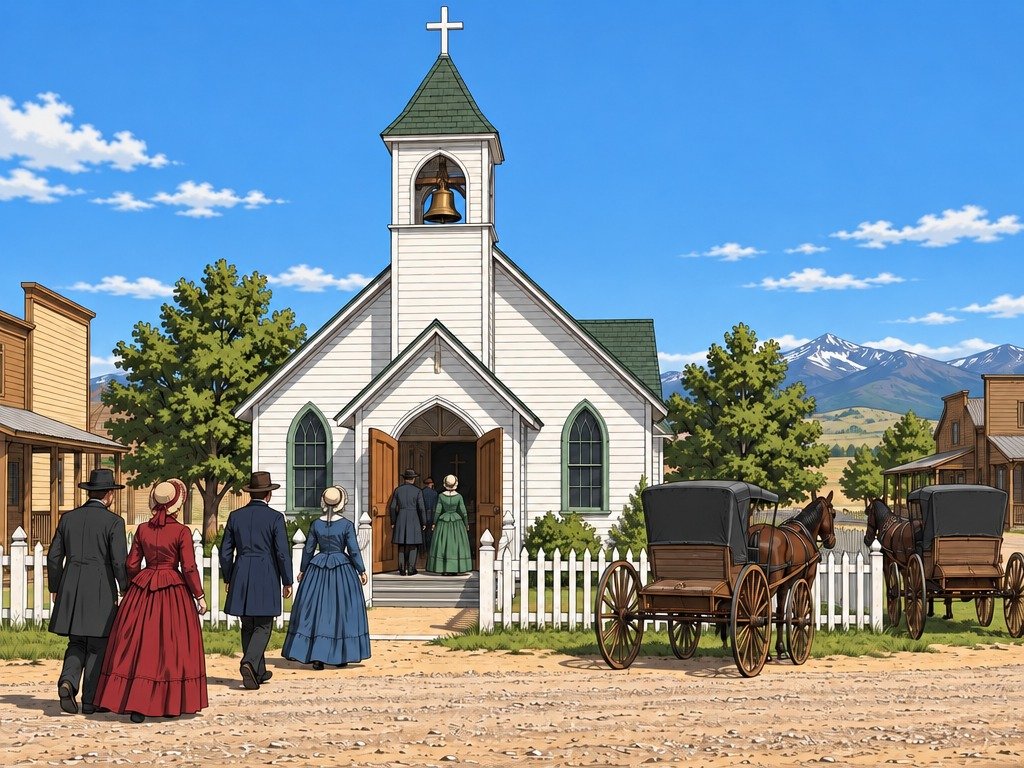
Congregations were among a town's first institutions. Denver had Episcopal and Catholic churches; Methodist, Episcopal and Catholic congregations formed in Cheyenne in its early years, though a historian notes that "church folk were not legion" at the end of track. Jewish merchants and families lived in both cities; Temple Emanuel in Denver was incorporated in 1874, dedicated its synagogue on 28 September 1875 and engaged its first full-time rabbi in early 1876. Black congregations formed in the cities; in 1875 the Black members of Cheyenne's Methodist church founded a church of their own. Welsh miners at Central City had a chapel of their own. Hispano communities in southern Colorado were Catholic; the Penitente brotherhood belongs to their religious life. Tribal religious practice is described in Tribal Nations, never as a single faith.
Churches ran schools, hospitals, relief and reform. The Sisters' hospital in Denver dates from 1873. Temperance, Sunday observance and moral reform were contested in the saloons and the dance halls. Churches did not make law; they influenced it through voters, newspapers and the women who ran charities. The federal Peace Policy (1869) handed the agencies to church groups; Factions and Powers covers it.
Vice and the sporting life. Gambling, drink and prostitution were open in both cities. Brothels and "parlor houses" operated where the authorities fined them, taxed them or ignored them; the practice varied by town and year. See Cheyenne and Denver for places.
Daily Life and Technology
| Subject | In the corridor |
|---|---|
| Housing | Cheyenne's first frame house went up on 25 July 1867; Hispano settlements in southern Colorado were built of adobe |
| Water | Denver's Big Ditch served the town from 1867 and the Denver City Water Company formed in November 1870 |
| Transport in town | Horse, wagon and foot; Denver's first horse-drawn rail line opened on 17 December 1871 |
| Tools and inventions | The telegraph (to Denver by October 1863); barbed wire (patent 24 November 1874); the telephone (patent 7 March 1876; Denver's first exchange opened in February 1879) |
Seasons and Weather
Cheyenne stands at about 6,100 feet and Denver at about 5,280, in dry, thin, windy air. At Cheyenne the last spring frost comes about 20 May and the first fall frost about the end of September; the first snow usually falls in October and can fall in September. The Army Signal Service opened a weather station in Cheyenne in October 1870.
| Season | Conditions | At the table |
|---|---|---|
| Winter (November to March) | Blizzards and drifting snow on the high plains. Snow blocked the Union Pacific in February and March 1869, and the company put up snow fences and sheds at the exposed points; the winter of 1871 to 1872 was one of unusual severity, and in January 1872 trains between Laramie and Cheyenne were held five days at a time while two hundred shovelers worked ahead of the plow. Chinook winds bring sudden thaws. Stock winters on cured grass without hay, and a hard winter turns that against the owner. | A winter journey is Hard (Era Rules, Travel at the Table). A storm that is the whole scene is the Blizzard hazard (Adversaries). A winter on the road or a night in wet bedding is an exposure for Illness, and poor winter grazing is the Keeping a Horse case (Era Rules). |
| Spring (April to June) | Mud. The Platte and its tributaries rise with snowmelt and rain, highest in May and June: Cherry Creek flooded Denver on 19 May 1864, and the South Platte in late May 1876 ran its highest since. The stock association's spring roundup (Factions and Powers). | A crossing is Hard in flood, with 1 Bane Die for a loaded wagon; a crossing that is the whole scene is the Flood hazard (Adversaries). |
| Summer (July to September) | Heat, hail and afternoon thunderstorms on the plains; dust; the Texas herds arrive; grasshoppers took the crops in 1874. | Travel at Average. A Calamity on the road is a storm or a Stampede (Adversaries). |
| Autumn (October) | The first snows, the shipping of cattle, the fall roundup. The Army's field season closes; the winter fights of 1876 (Powder River, 17 March; Dull Knife's village, 25 November) show what a campaign in snow cost both sides. | A late journey races the weather: the GM names the first storm as the hazard. |
The year's fixed dates. Wyoming's legislature sits at Cheyenne from 12 October to 10 December 1869 and then every second year: 7 November to 16 December 1871, 4 November to 12 December 1873, and 5 November to 1 December 1875. The district court sits in each county at the terms the legislature fixes (Factions and Powers). Annuity goods are due at the Sioux agencies by 1 August, and under the Shoshone and the Northern Cheyenne and Northern Arapaho treaties on 1 September (Tribal Nations). The Army campaigns from late spring to autumn; the stock association runs a spring and a fall roundup. Notoriety falls by one for each season a character stays out of the news, and a Debt falls due at the end of a month (Era Rules), so a session can be set against any of these dates.
Schooling
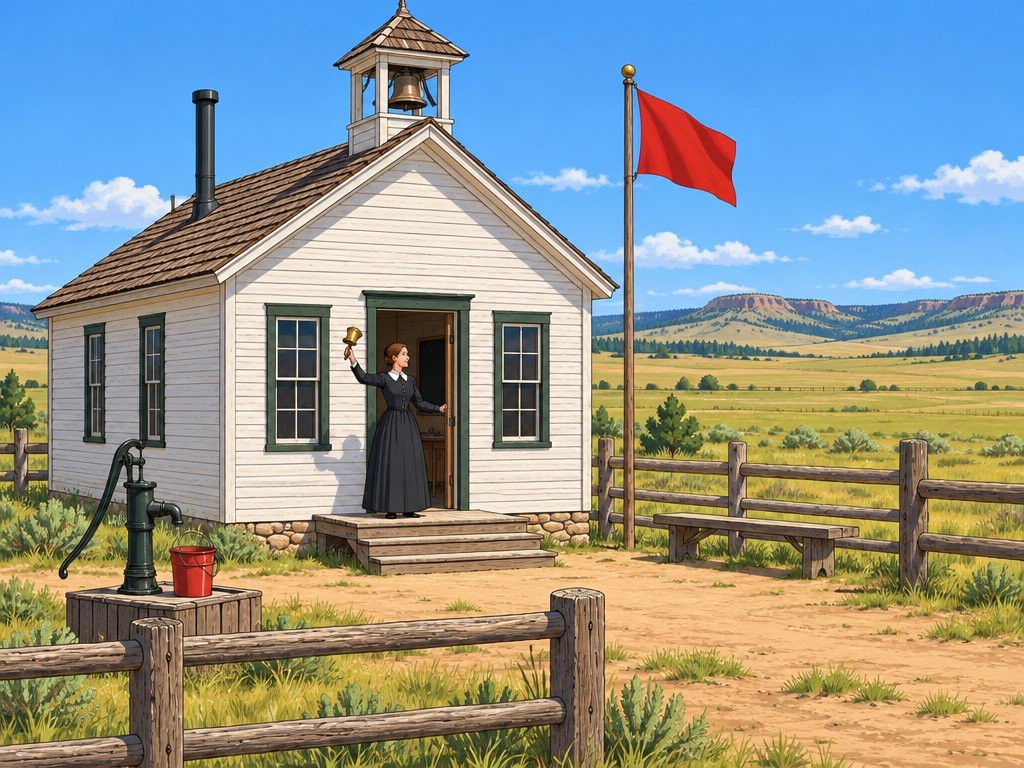
- Wyoming. The first territorial legislature created the school system in 1869. Cheyenne's first public school was dedicated on 6 January 1868; Laramie's opened on 15 February 1869.
- Denver. The public schools of 1868 were segregated at parents' request, and a separate school for Black students opened at 16th and Market Streets. East High School grew out of the Arapahoe School (built 1872 to 1873); it opened in 1875 and graduated its first class in 1877.
Medicine
Denver's Sisters' hospital opened in 1873. Doctors did not yet know that tuberculosis was contagious (the germ was identified in 1882), so doctors prescribed Colorado's dry air for it; a later estimate puts a third of Colorado Springs's residents in the 1880s there for their health, and the share in the 1870s corridor is unknown. A physician's book promoting Denver's air appeared in 1877. Illness in play is handled by the Era Rules: a Calamity can bring it on, a Willpower check resists it and Medicine helps.
Newspapers
Papers shaped opinion and reputation. Denver's Rocky Mountain News began on 23 April 1859. The Cheyenne Leader printed its first issue on 19 September 1867 and was the first newspaper in Cheyenne and the first after the territory was created (a short-lived Fort Bridger sheet ran in 1863). Other Cheyenne papers came and went; the Cheyenne Daily Sun dates from March 1876. Papers carried telegraph dispatches, local business and politics.
Women Voted in Wyoming
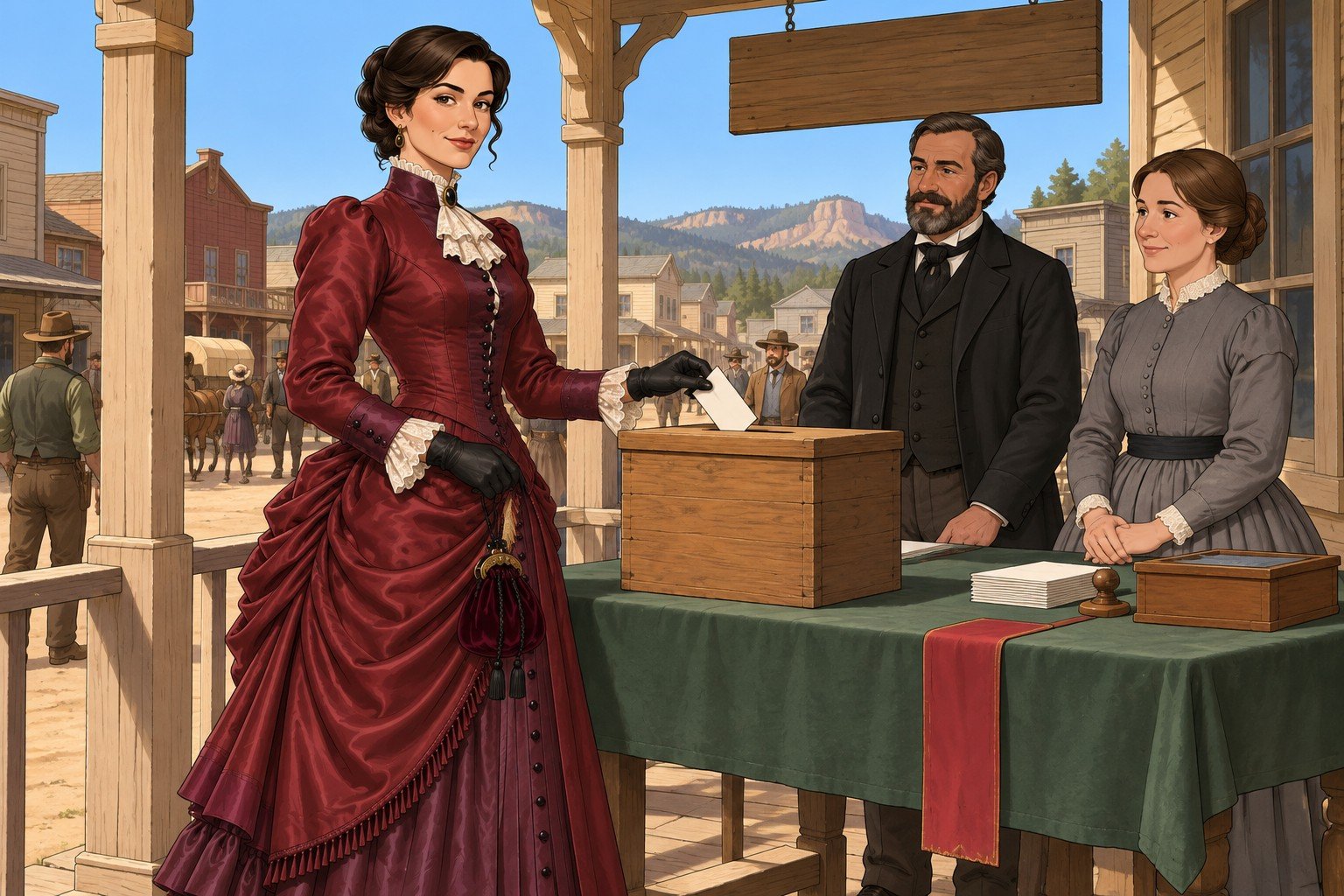
Wyoming Territory gave women the vote on 10 December 1869 and the right to hold office. The first woman to vote under it did so in Laramie on 6 September 1870. The legislature voted for the bill for mixed reasons, among them party politics and publicity. Women sat on a grand jury in Laramie from 7 March 1870 and on other juries in 1871, and jury service then lapsed. In 1871 the assembly voted to repeal; the governor vetoed it and the override failed by one vote.
The vote was not universal. Tribal women were not citizens and could not vote. Chinese women, nearly all foreign-born and not citizens, were unlikely to qualify. A judge later wrote that Black women hotel servants in Cheyenne rode to the polls and voted without trouble; the 1870 census shows about thirty Black women of voting age in the territory, half of them in Cheyenne. Colorado Territory did not follow; Colorado's voters rejected the vote for women on 2 October 1877. Odette Marchand, a parlor house keeper and voter, is a cast member who lives under this law.
Immigration, Communities and Prejudice
The corridor's workforce was mixed. These communities made it up.
| Community | Where and how | Notes |
|---|---|---|
| Irish | Union Pacific grading and track crews; Army enlistment; mining camps | Anti-Irish and anti-Catholic prejudice existed |
| German | Merchants, brewers, farmers, miners; in 1870 about 31% of Wyoming's foreign-born were German | |
| English, Welsh and Cornish | Mining, smelting, investment | Cornish miners and a Cornish metallurgist at Black Hawk; the smelter used the Welsh Swansea process |
| Black communities | Cities (a Black-owned hotel in Denver, see the timeline), railroad and hotel work | Congress barred limits on male suffrage in the territories in 1867. Denver's schools were segregated in 1868 |
| Tejano and Hispano | Tejano vaqueros on the trail; Hispano settlers from New Mexico in the San Luis Valley and the Purgatoire Valley (Trinidad); about 7,000 on the Conejos and San Antonio rivers by one estimate | Land-grant communities |
| Chinese | See below | |
| Jewish | Merchants in both cities; Temple Emanuel in Denver | |
| Tribal Nations | On their own lands | See Tribal Nations |
Chinese workers and families. Chinese laborers came to Wyoming in 1869 to maintain the Union Pacific, and later worked its coal mines in Carbon, Sweetwater and Uinta counties. In 1875 the Union Pacific brought more Chinese miners to Rock Springs after a strike, to work at the company's rate, which the strikers had refused. In Colorado, labor contractors ran Chinese crews in the Black Hawk placers from about 1871, and a contractor later became a Denver merchant (see the timeline). Denver's Chinatown grew on Wazee Street from 1869; Denver counted 238 Chinese residents in 1880. The 1870 census counted five Chinese women in Wyoming. Chinese immigrants of this time could not become citizens (the 1870 naturalization act; In re Ah Yup, 1878). Chinese residents worked as laborers, contractors, merchants, cooks and laundry owners and kept their own organizations. A mob destroyed Denver's Chinatown on 31 October 1880. A massacre of Chinese miners at Rock Springs in September 1885 falls after this book's range. No Chinese community is recorded in Cheyenne before 1876; Chinese travelers passed through the town for the Black Hills by stage from early 1876 (see Cheyenne).
Prejudice as a situational condition. Prejudice against Irish, Black, Hispano and Tejano, Chinese and Tribal Nations people was real, differed by town and by employer, and could rise or fall within a year. No Origin or Role has a built-in penalty. Era Rules describes how a prejudiced crowd, jury or employer affects a social encounter, the same way for every group.
Backgrounds. These backgrounds fill the roles the Adversaries chapter stats.
- Lawmen and posses. Union and Confederate veterans, Irish-, German- and Welsh-born townsmen, Tejano and Mexican riders sworn in on a drive, and Black veterans in a county seat all held badges or rode posse somewhere on the plains.
- Army. Irish- and German-born enlisted men filled many of the regular companies; Black regiments served on the plains and in Texas; Tribal scouts enlisted at posts (Eastern Shoshone scouts at Camp Brown and Pawnee Scouts along the Union Pacific; see Tribal Nations).
- Outlaws. Missouri and Texas ex-guerrillas, Union veterans, Irish and German immigrants, Tejano and Mexican stock thieves, Black and white cowhands gone wrong, and Tribal horse raiders working against another nation's herds all appear.
- Companies and trades. Land agents, detectives, foremen and saloon keepers came from the East, the British Isles, Germany and France; Chinese merchants and labor bosses held leases and contracts in mining and rail towns (a contractor ran crews in the Black Hawk placers from about 1871; see the timeline).
Tribal Nations and the Army
Tribal Nations. The 1868 Fort Laramie Treaty set aside the Great Sioux Reservation, including the Black Hills, kept hunting rights north of the North Platte and on the Republican River while buffalo remained, required three-fourths of adult men to approve any cession, and closed the "unceded Indian Territory" north of the Platte and east of the Big Horn summits to settlement; the Eastern Shoshone held Wind River from 1868, the Ute a reservation in western Colorado reduced by the San Juan cession in 1874, and the Northern Cheyenne and Northern Arapaho no reservation of their own in 1874, drawing rations at the Red Cloud and other agencies (the Arapaho reached Wind River in the spring of 1878 under an arrangement made in October 1877). The Black Hills gold rush and the Great Sioux War of 1876 put the treaty under strain; each nation's leaders, government and position are in Tribal Nations, and its dealings with the United States in Factions and Powers.
The Army. Fort D.A. Russell and Camp Carlin were established in 1867 beside Cheyenne. Fort Laramie, Fort Fetterman, Fort Sanders, Fort Steele, Fort Bridger and Camp Brown stood on the map in 1874. A private earned $13 a month from 1 July 1871 ($16 before); about a third of enlisted men deserted in the twenty-five years after the war, by the Army's own count. Laundresses lived at the posts. From 18 June 1878 the Army took on no new laundresses; the women already at a post could stay out their husbands' enlistments. See Factions and Powers.