The Union Pacific chose the Cheyenne townsite on 4 July 1867 and platted it on 5 July; by 1869 the town was the capital of Wyoming Territory. A hundred miles south, Denver was the capital of Colorado Territory; the Denver Pacific joined it to the Union Pacific at Cheyenne in June 1870. Around the two cities lay cattle outfits, Army posts, land offices, stage lines, mining camps and the country of the Lakota, Cheyenne, Arapaho, Shoshone and Ute, whose nations had signed treaties with the United States. The railroad, gold seekers and the Army were testing those treaties.
On 10 December 1869 Wyoming Territory gave women the vote. On 1 August 1876 Colorado became a state. Between those dates a deputy marshal, a surveyor, a drover, a horse breaker, a warrior, an interpreter and a parlor house keeper all had business in the same two cities, and each bargained with someone else over land, water, grass, cattle, a contract or a right of way.
The Old West is an Exodus NDS Era Book for that corridor, 1869 to 1876. It gives the places, governments and nations of the period, the Origins, Roles and rules to play ordinary people in them, and the adversaries, hooks and a starter adventure to run. Real people appear in the timeline in The Era and in the Historical Reference; every character and NPC in the book is fictional.
Getting Started
Four steps put a table in play.
- Pick a character. Choose a pregenerated character in Pregenerated Characters, or build one in about a page: the numbered steps at the start of Character Creation and Roles take a species (human), characteristics, an Origin and a Role, 110 experience points and a kit.
- Read three rules. Each player reads the Prejudice rule (its Attitude table) and the Showdown rule in Era Rules. The GM reads Notoriety and Bounty and Law in Play as well. Everything else is looked up when it arises.
- GM: read Running the Era. It covers pacing, scenes and the corridor's usual dangers.
- Run the Starter Adventure. Give the pregenerated characters to the players and begin. The Quick Reference holds the rules you will look up most.
Two reading paths. A player: Pregenerated Characters, then Character Creation and Roles, then Prejudice and the Showdown in Era Rules. A GM: this chapter, Running the Era, Part Three of Places and Campaign Tools, the Starter Adventure and Pregenerated Characters, then Era Rules.
A Short Play Example
EXAMPLE: A LINE OF CREDIT AND A STARE
This example uses Si Tolliver, a Cowhand (Standing: Wage), in Cheyenne, with the values on his sheet in Pregenerated Characters: Willpower 2, Readiness 1, Charisma 1 and Negotiation 0.
Standing. A Wage Standing carries a Starting Stake of $31 and a Credit limit of $62 (Character Creation and Roles, Standing and Starting Stake). Tolliver wants a Sharps rifle at $40 from a Cheyenne gun dealer and has $31 in cash, so he buys on account.
An ordinary skill check. Buying on account is a Negotiation check, Average (Era Rules, Money and Credit). The GM sets the dealer's Attitude for the scene: Wary 1 to hands who come without a reference. Tolliver shows a letter from his foreman, which introduces him to the dealer and is Cover, so the Attitude falls one step to Neutral and he adds no Bane Die . His Charisma 1 and Negotiation 0 give a pool of one Ability die against two Trial dice . He rolls 1 net and 1 . The check succeeds. Tolliver records a Debt of $40 to the dealer, due at the end of next month, and the Boon is spent on the dealer adding a box of cartridges to the sale.
A Showdown. In the street a rider from a stolen-stock outfit claims Tolliver's horse is his and names a Showdown. Both men are at Medium range, with weapons holstered. The two principals make an opposed Willpower and Readiness check, the Stare.
- Tolliver rolls one Mastery die and one Ability die (Willpower 2, Readiness 1), with 1 Boon Die for a deputy at the corner with a shotgun and 1 Boon Die for a crowd whose Attitude toward him is Welcome 1 (Era Rules, Prejudice).
- The rider rolls one Mastery die and one Ability die, with 1 Boon Die for a second rider in view and 1 Bane Die for being plainly in the wrong: no warrant and no provocation.
Tolliver wins by 2 net . The rider suffers 2 Strain and must choose. He Stands Down, hands over the claim and leaves. He is Backed Down before every witness. Five or more people saw Tolliver win by 2 or more net Successes, so the GM raises Tolliver's Notoriety to 1: Cheyenne has heard what he did.
Dates and Region
| Item | Statement |
|---|---|
| Region | The Wyoming and Colorado corridor along the Union Pacific and the Denver Pacific: Cheyenne, Laramie County and Fort D.A. Russell; Denver; the Front Range, the Platte and the plains east of it; and the country of the Lakota, Cheyenne and Arapaho to the north. |
| Play range | 10 December 1869 to 1 August 1876. Set a session in any year of it. |
| History range | 1865 to 1880. Earlier events explain how the corridor got where it is; later events are what the players cannot know yet. |
| Map date | 1 September 1874. This dates the period map only; the text is not limited to one year. |
The Era chapter gives the full timeline and explains how to read dates outside the play range.
Tone
The book plays as a historical Western. Most people in it are working: hauling, herding, grading, cooking, selling, healing, teaching, hunting, interpreting. Violence has consequences. Most confrontations in the record ended without a shot, and the Showdown rule lets yours end the same way. Food, lodging and daily gear take no special accounting (Era Rules, Money and Credit). Illness, horses, the road, prejudice, notoriety and debt each have a short rule in Era Rules. For tone, Lonesome Dove, True Grit, Deadwood and Hell on Wheels are the touchstones; where they differ from the record, the record wins.
What a Table Needs
The Exodus NDS Core Rules are the rules.
| You need | For |
|---|---|
| Exodus NDS Core Rules | Dice, checks, character creation, structured play, recovery, adversaries. |
| This book | Origins and Roles, Era talents, the Era Rules, the essential gear table, adversaries, the Starter Adventure, pregenerated characters and the quick reference. |
| The Black Powder Armory | Every firearm and powder weapon in the corridor. |
| The Stable | Horses, mules, tack, wagons and mounted play. |
| The Apothecary | Medicine, drugs and poisons. Disease is not in that book; the Era Rules carry the illness rule. |
| The Fantasy Armory, The Ranged Armory | Knives, axes, clubs, army sabers (the Fantasy Armory) and bows (the Ranged Armory). |
| The Armourer, The Heavy Armory | Rarely. The Armourer for leather and hide work, the Heavy Armory for Army field guns. Neither is needed to play. |
Gear and Prices reprints a short essential table so that a table can run the Starter Adventure with this book and the Core Rules alone. The owning sourcebook is canon for every stat line, and its Source Book Map says which entries are legal in 1869 to 1876. Gear that map marks out of range does not exist here.
How to Read the Book
| Chapters | What they give you | Use them when |
|---|---|---|
| 2. The Era | History 1865 to 1880, the period map, society, daily life, law, religion, communities. | You need the world, or a date. |
| 3. Tribal Nations; 4. Factions and Powers | One entry per nation, in its own name; one entry per power, from the Army and the territorial governments to the railroads, the cattle and mining interests, the churches and the press. | You portray a nation or a power, or need to know who wants what and who answers to whom. |
| 5. Cheyenne; 6. Denver | Each city: its districts, law, commerce, and fictional people with hooks. | The session is in or near either city. |
| 7. Character Creation and Roles; 8. Skills and Talents | Origins, Roles, Standing and Starting Stake, a worked example; skill changes for the era, languages, Era talents. | You build a character or spend experience points. |
| 9. Gear and Prices; 10. Era Rules | Money, wages, prices, the essential gear table, the Source Book Map; illness, keeping a horse, Prejudice and Attitude, the Showdown, Notoriety and Bounty, Stakes, law, travel, credit. | You price anything, or need a rule the Core Rules do not have. |
| 11. Adversaries; 12. Places and Campaign Tools; 13. Running the Era | Opponents of the period; locations, premises, hooks and tables; campaign modes, pacing, scenes and the corridor's usual dangers. | You prepare a threat, plan a campaign or run a session. |
| 14. Historical Reference | Dated entries for real people, events and institutions, and corrections of Western myths. | You need to check a fact. |
| 15. Starter Adventure; 16. Pregenerated Characters; 17. Quick Reference | The Line North, a five-scene adventure set in April and May 1874; seven ready-to-play characters, six of them from the Era Cast; the rules, characters and gear looked up most. | You want to play tonight. |
The back matter holds the Licensing chapter. A boxed instrument gives a rule or a worked example; the text around it describes the world. A fictional NPC carries "(fictional)" after the name.
The Era Cast
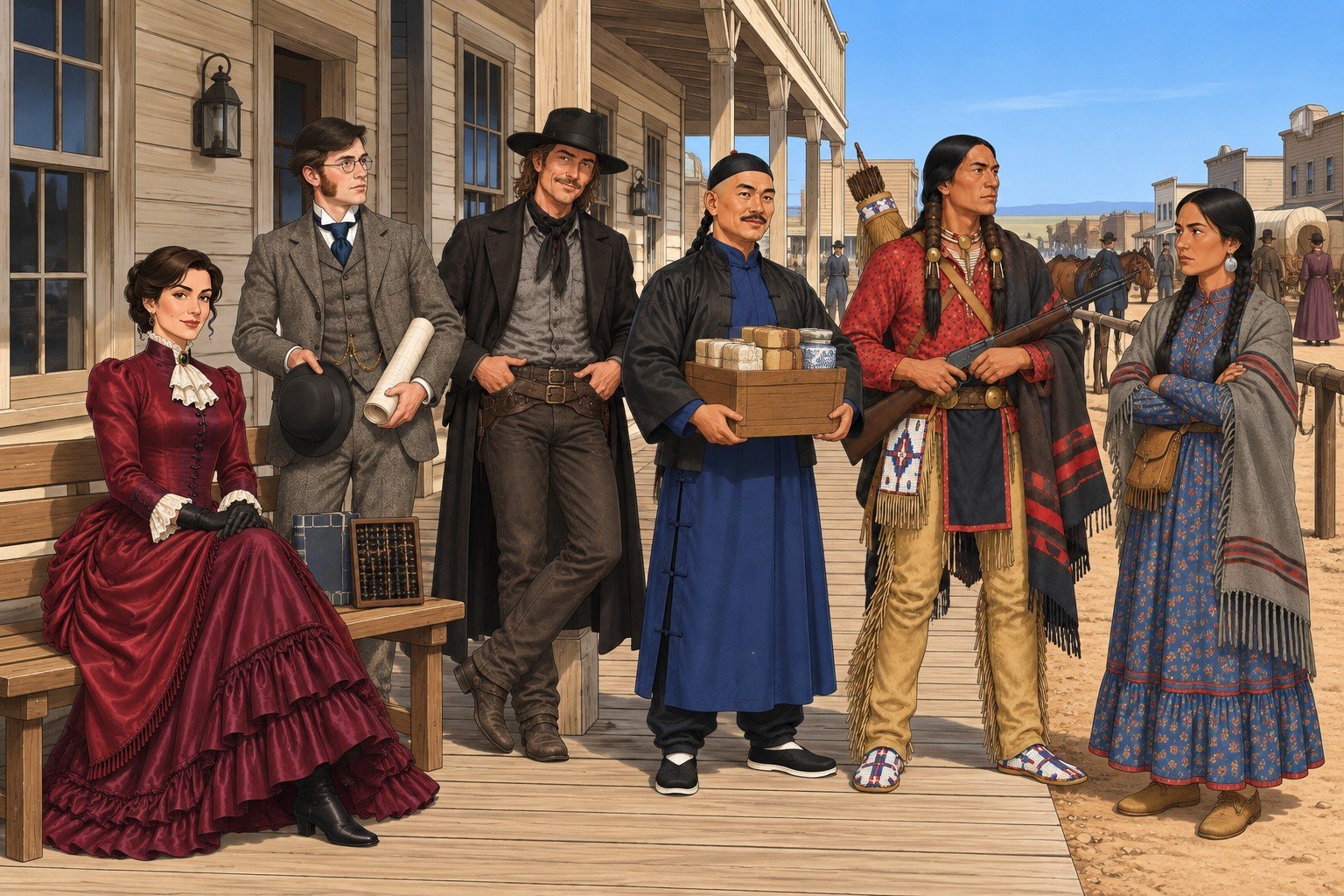
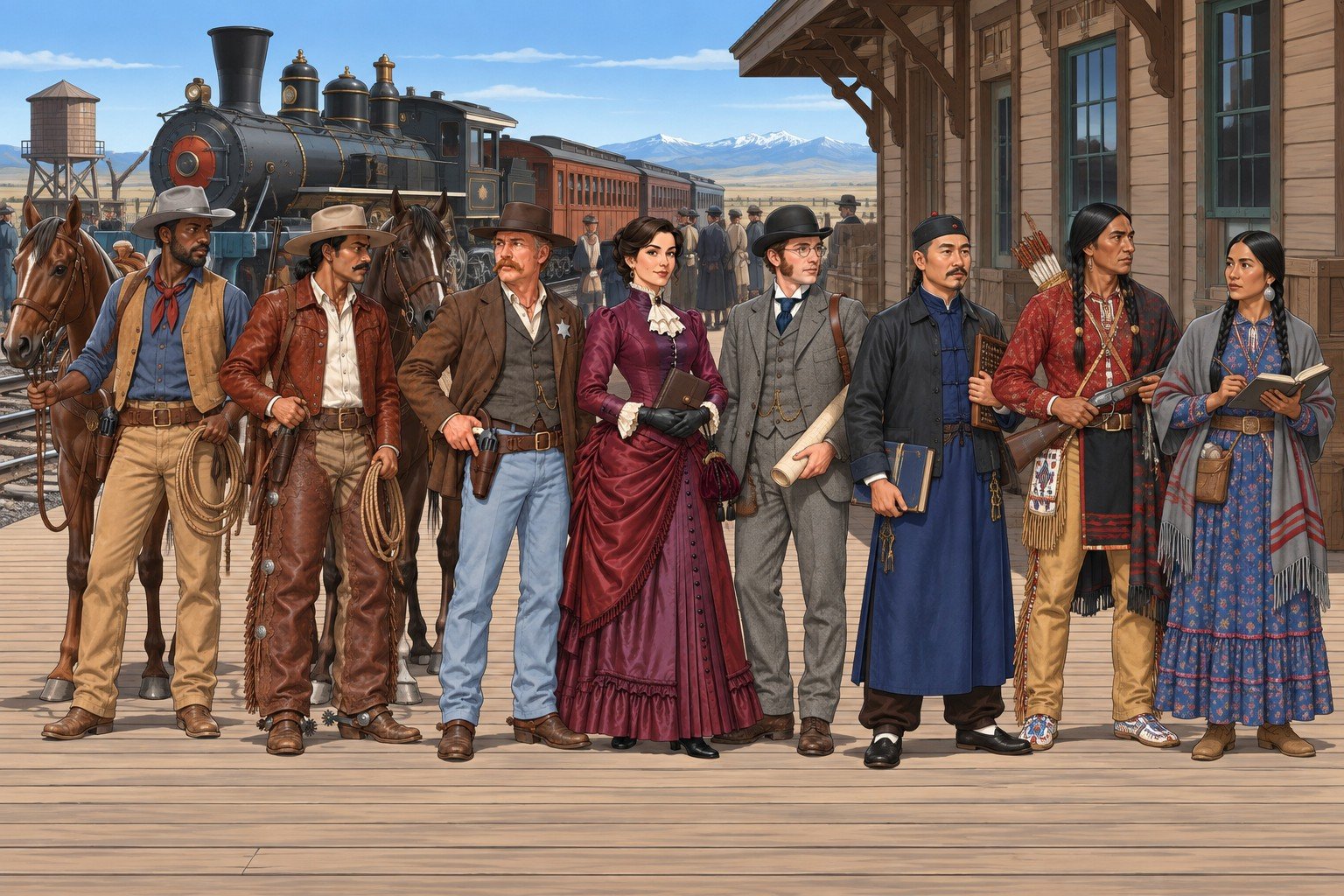
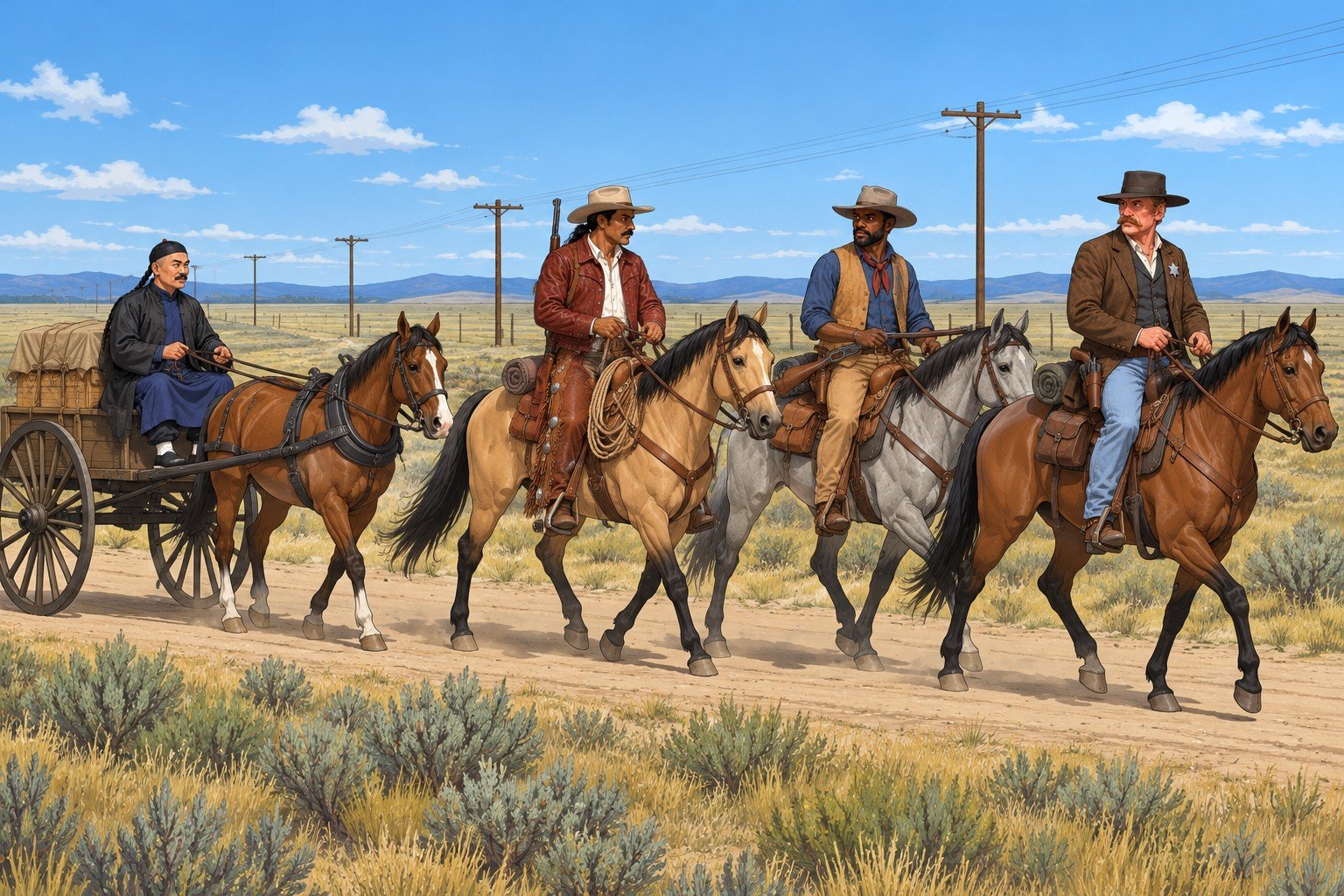
Nine fictional people carry the book's art and examples. They are ordinary people of the period, chosen to cover the law and the lawless, the powerful, the ordinary and the trade, and the peoples of the corridor. Six are playable and appear in Pregenerated Characters. Two are patrons a GM runs, and one is an adversary.
Michael Deveney, Deputy U.S. Marshal at Cheyenne (fictional)
Irish, born in County Mayo, about 41, a Union veteran and a Catholic. He carries a deputy's commission from the U.S. marshal for the territory, serves the federal court's papers from Cheyenne to Evanston, and is paid by the fee and the mile. He knows the Irish graders and soldiers in the county, and that is how he keeps the peace. In the book: a patron NPC.
Josiah "Si" Tolliver, Drover and Marksman (fictional)
About 29, born enslaved in Texas and free since 1865. He learned the trade on the drives north and is paid by the herd and by the day. He is a steady rifle shot and a reliable hand on the trail. In the book: a pregenerated character.
Anselmo Ybarra, Horse Breaker and Tracker (fictional)
A Tejano vaquero of about 34 from a south Texas ranch whose family worked cattle before there were Anglo cowboys. He reads a trail and breaks horses other hands have given up on. Outfit owners pay vaqueros less than they pay Anglo hands. In the book: a pregenerated character.
Odette Marchand, Parlor House Keeper (fictional)
A French-Louisianan Creole of about 36 whose New Orleans family lost its property in the war. She keeps a Cheyenne parlor house and votes in a territory where women do. Cattlemen, officers and politicians sit in her parlor, and she keeps track of what is said there. In the book: a patron NPC.
Edmund Harrow, Land Agent and Surveyor (fictional)
English-born and trained as an engineer, about 33, working for the Union Pacific's land department. He recommends which land the line should take, and he handles the grading crews' contracts and the railroad's land claims against the Tribal Nations' treaty rights. In the book: a pregenerated character.
Wong Yik Lun, Merchant and Labor Contractor (fictional)
About 41, from Taishan in Guangdong. He keeps the Wo Hing store on Wazee Street in Denver, supplies the cooks, laundries and section crews along the line on credit, contracts hands to outfits that ask, and is in Cheyenne a week in every month. In the book: a pregenerated character.
Elk Walks First, Warrior of the Oglala Lakota (fictional)
About 30, of the Payabya band of the Oglala, a warrior, hunter and scout of a people who signed the 1868 Fort Laramie Treaty and have watched the railroad, the gold seekers and the Army test it. He rides, hunts and speaks in council. In the book: a pregenerated character.
Marie Tessier, Interpreter of the Northern Cheyenne (fictional)
About 38, called Sweet Grass Woman by her mother's people, the daughter of a French-Canadian trader and a Northern Cheyenne mother of a Tsitsistas band that trades at Camp Robinson. She speaks Cheyenne, Lakota, French and English and carries messages neither side can carry for itself. The Army pays her, and the Lakota and Cheyenne leaders she works with rely on her to carry their words accurately. In the book: a pregenerated character.
Wade Carrick, Stock Thief and Road Agent (fictional)
About 38, a Missouri guerrilla in the war who never went home. He runs a stolen-stock outfit that works the Texas drives and, from 1876, the roads to the Black Hills. He sells stolen cattle to buyers in Cheyenne who do not ask where they came from. In the book: the adversary, with a stat block in Adversaries.