The Line North
The Line North is a five-scene adventure for the seven pregenerated characters (Pregenerated Characters), or for any party of three to six built with Character Creation and Roles. It runs in two to three sessions. It is set in April and May 1874, the spring the pregenerated kits assume, and it needs only the Core Rules and this book.
The places, the treaty, the railroad and the Army are as the record has them. The people, the company and the survey line are fictional.
What the table does. A surveyor's name is on a plat he did not draw, and the plat shows a railroad line crossing the North Platte into country the 1868 Fort Laramie Treaty reserves to the Lakota. The party rides from Cheyenne to Fort Laramie and across the river to pull the stakes before an Oglala Lakota band, the Army or a hired gun settles the matter another way, and returns to Cheyenne to answer the men who are selling shares in the line. One scene is an investigation and a sickbed, one is a negotiation with the Army, one is a parley with an Oglala Lakota band, and one is a public contest of paper. A fight is possible in two scenes and is not required.
GM Overview
The Premise
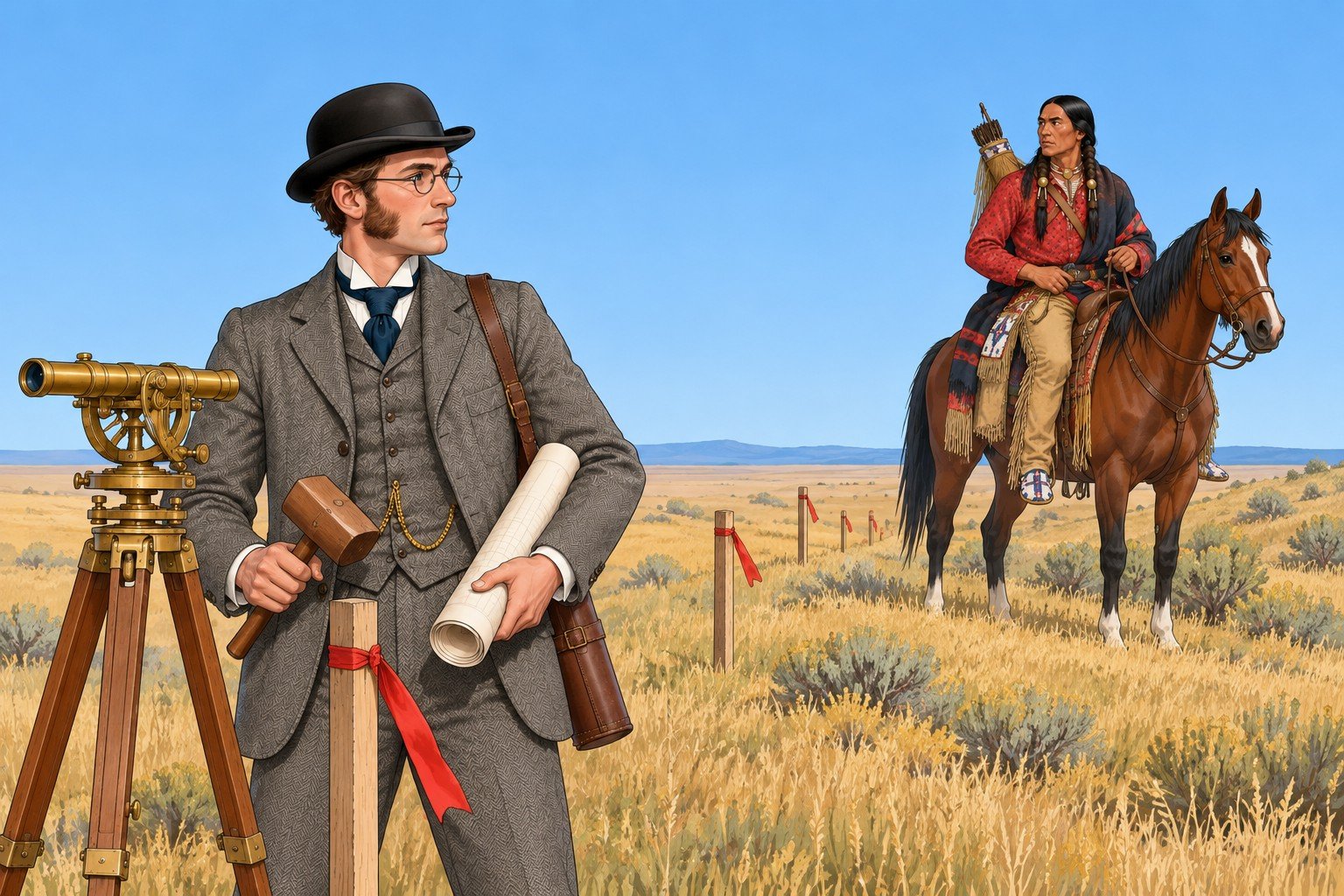
The Union Pacific's land department in the corridor sends Edmund Harrow to run a reconnaissance line north from the main line toward Fort Laramie. His advance party, under a party chief named Owen Pryce, was to stake the Laramie River road to the North Platte and stop. In April the party is two weeks overdue. One of its chainmen, Cormac Dunne, reaches Cheyenne on a freighter's wagon with a fever and a message: the party crossed the river on a letter in Harrow's name, the Oglala Lakota stopped it, and someone must come and take the stakes up.
Treaty text used. Article XVI of the Treaty of Fort Laramie (29 April 1868) declares the country north of the North Platte and east of the summits of the Big Horn Mountains unceded Indian territory, and says that no white person is to be permitted to settle upon or occupy any portion of it. It also provides that no one passes through it without the Indians' consent. Article XI keeps the Lakota's right to hunt north of the North Platte while buffalo remain, and binds them not to oppose military posts and roads then established south of the river. The adventure assumes the post commander wants the line removed. The Army's power to remove trespassers from Indian country, and its limits, are stated in Scene 3 under What Aldous wants.
What Is Really Happening
Silas Whitcomb, a former clerk of the land department who kept some company letter paper, has formed the Platte and Powder River Improvement Association (his own invention). He wants to sell shares in town lots, ferry rights and hay land at a river crossing on a railroad line that does not exist. A survey plat on railroad paper, showing the line crossing the North Platte and running to the Powder River country, is his selling point. He obtained copies of Harrow's field notes from a land office copyist, forged a letter ordering Pryce's party to carry the line across the river, and sent his hired gun, Roy Hale, to deliver it and to keep the party staking until the plat could be drawn.
Pryce crossed the North Platte on 13 April. North of the river is the unceded Indian territory of Article XVI of the 1868 treaty, closed to white settlement and to passing through without the Indians' consent. An Oglala Lakota band hunting there found the stakes on 15 April. Its young men pulled the stakes in one stretch, took the party's mules and chain as a pledge, held the crew in camp two nights and sent Dunne to Cheyenne with a demand: the man whose name is on the stakes is to come himself.
Whitcomb does not want the stakes pulled before the investors' meeting on Saturday 2 May. Hale's four riders camp with Pryce's crew to keep it staking. Neither man has thought through what the band will do when the stakes go back in the ground.
Timeline
Days of the week are those of 1874 (21 April 1874 was a Tuesday).
| Date | What happens |
|---|---|
| Mon 30 Mar | Pryce's party of seven leaves Cheyenne with Harrow's orders: stake the Laramie River road to the North Platte at Fort Laramie. Harrow stays behind. |
| Thu 9 Apr | Hale reaches the party with the forged letter. |
| Mon 13 Apr | The party crosses the North Platte and stakes north. |
| Wed 15 Apr | Oglala Lakota riders find the stakes. They hold the crew. |
| Thu 16 Apr | Dunne, sick, is sent south with Pryce's note. A freighter takes him to Cheyenne. |
| Tue 21 Apr | Dunne reaches Kearney's boarding house. The adventure begins. |
| Wed 22 Apr | Whitcomb's notice runs in the Cheyenne papers (Handout 3). |
| Fri 24 Apr | The latest the party can leave Cheyenne and still reach the line before Mark 3 of the clock. A party that leaves on the 23rd has a day in hand. |
| Sat 25 Apr | Whitcomb closes the first sales. Marchand's note falls due. |
| Sun 26 Apr | A party leaving on the 24th reaches Fort Laramie in the evening. |
| Mon 27 Apr | The audience with Lieutenant Aldous. |
| Tue 28 Apr | The party reaches the stake line in the afternoon, hours before Mark 3. |
| Wed 29 Apr | A party that leaves the line this morning reaches Fort Laramie that evening and Cheyenne on the afternoon of 2 May. |
| Sat 2 May | The investors' meeting, at eight in the evening. |
The Cast
Stat blocks are in Adversaries; this table says which block to use and what each person wants. The headman and the young man belong to the same band and disagree; see Scene 4.
| Person | Who | Wants | Block |
|---|---|---|---|
| Silas Whitcomb (male) | Former land department clerk; the promoter | Shares sold by 2 May, then to be gone | Land Agent (Elite), Notoriety 1 in Cheyenne ("the man selling the railroad lots"); raise to Corrupt Agent (Nemesis) for a campaign |
| Roy Hale (male) | Whitcomb's hired gun; a former Texas freighter | His pay; to avoid a fight he cannot win | Hired Gun (Elite) |
| Hale's riders (four) | Men hired by the week from the drives and freight yards: two Texans, a Missouri man, a discharged trooper | Pay, and to leave | Rustler (Minion), group of 4 |
| Owen Pryce (male) | Party chief; Welsh-born; honest and out of his depth | His crew safe; to be believed | Posse Rider (Minion) skills; no combat role |
| Cormac Dunne (male) | Chainman, nineteen; Irish; ill | To get home and be paid | None |
| Lyman Voss (male) | Land office clerk and copyist (Cheyenne) | To keep his post; he sold copies of Harrow's notes for a fee and does not know why they were wanted | Cheyenne, Fictional People |
| Bridget Kearney (female) | Boarding-house keeper near the yards | A quiet house and a paid bill | Cheyenne, Fictional People |
| Nell Ashby (female) | Telegraph operator | To keep her post; she reads everything | Cheyenne, Fictional People |
| Michael Deveney (male) | Deputy U.S. marshal at Cheyenne; patron | The Irish crews and the line quiet; no mob and no shooting; a federal charge he can stand behind | Deveney (Elite) |
| Odette Marchand (female) | Parlor house keeper; holds Whitcomb's note | Her note paid; to learn who is buying | Marchand (Nemesis) |
| Lieutenant Daniel Aldous (male) | Cavalry officer and post adjutant at Fort Laramie | No new trouble near the agencies after the February siege (Tribal Nations); to be seen to act | Town Marshal (Elite) with Leadership 4 and no Intimidation (Adversaries, Cavalry Officer) |
| Gray Buffalo, the headman (male) | Leader of the Oglala Lakota band north of the river | The stakes gone and not returned; the Army kept out of his camp; the band's name cleared | Band Leader and Council Speaker (Elite), with the Oglala Lakota Warrior's Aims |
| Sorrel Horse, a young man of the band (male) | Wants more than stakes gone | To be answered for the mules and the intrusion | Oglala Lakota Warrior (Elite) as a Minion (Reading a Stat Block) |
If the Party Does Nothing: The Line Clock
The clock has six marks. It runs whether or not the party acts; the party's actions hold a mark off or move events. Do not tell the players about the clock; describe each mark as it lands.
| Mark | Date | What happens |
|---|---|---|
| 1 | Wed 22 Apr | Whitcomb's notice runs. Cheyenne's cattlemen and merchants talk of a railroad to the Black Hills country. |
| 2 | Sat 25 Apr | The first sales close, about $2,000 in shares. Whitcomb pays Marchand and his debts, and hires two more riders. |
| 3 | Tue 28 Apr, night | If the party has not come, or after it has had its day at the line, the band's young men take up the remaining stakes and walk Pryce's crew to the river. Hale's riders stay in the camp with the transit. Lieutenant Aldous at Fort Laramie has heard a teamster's rumor and no report, and sends no patrol. |
| 4 | Wed 29 Apr, night | Hale's riders fire on young men who approach the camp. One young man of the band is killed. Two of Hale's riders are killed in return. The rest ride for Fort Laramie. |
| 5 | Fri 1 May | Aldous wires the department at Omaha and sends a patrol north. The Cheyenne papers print the riders' story as an attack on surveyors. The band breaks camp and moves north. |
| 6 | Sat 2 May | The meeting becomes a call for troops. Whitcomb sells the rest of the shares and leaves on the evening train. Pryce and Harrow are blamed for the line, and nobody can be found to pay for the dead. |
Reading the clock for the party. A party that leaves on the 24th reaches the line on the afternoon of the 28th, before Mark 3, and Scene 4 runs as written. A party that arrives on the 29th finds Mark 3 has happened: the stakes are up, the crew is at the river crossing under the band's eye, Hale's riders hold the camp and the transit, and the headman asks the man whose name was on the stakes to come to the crossing; run Scene 4 there. A party that arrives on or after the 30th finds Mark 4 has happened, and Scene 4 becomes a funeral council and a negotiation with a band that has a death to answer (see Scene 4, If the Shooting Has Happened).
The Hook
The adventure opens on Tuesday 21 April 1874 at Bridget Kearney's boarding house near the Cheyenne yards. The hook is Dunne, a stranger in a bed asking for "the Englishman with the spectacles." Each pregenerated character has a reason below to be in the room or to hear the news that morning.
| Character | Why this character is in it |
|---|---|
| Edmund Harrow | The plat is signed with his name; the line is his professional reputation. He hires the others. |
| Northern Cheyenne interpreter | Harrow's company pays her to explain a survey to a camp. She knows the band north of the river by reputation, and Dunne's account will not make sense without her. |
| Oglala Lakota warrior | A relative at Red Cloud Agency sent word that surveyors were staking the hunting ground north of the Platte. He has come to Cheyenne to learn whose stakes they are. His band and the band north of the river are not the same; the table decides if they are kin. |
| Josiah Tolliver | Harrow hires him as a chainman and guard at $2.00 a day and keep, the going posse rate (Gear and Prices). A rifle for the road. |
| Anselmo Ybarra | Harrow hires him as the party's horse man and tracker at $3.00 a day (a guide's rate). Amos Fenn at the livery owes him a favor and offers mounts at the livery rate. |
| Hedda Lund | Bridget Kearney sends for her to see the stranger in the bed, at $3.00 for the visit (Gear and Prices). Dunne's fever is her case before his message is anyone's business. |
| Wong Yik Lun | He sold Hale's outfit flour, canvas and wire on account two weeks ago, and Hale has not paid. His ledger shows how long an outfit Hale supplied for. A railroad official who owes him money is an acquaintance of Harrow's. |
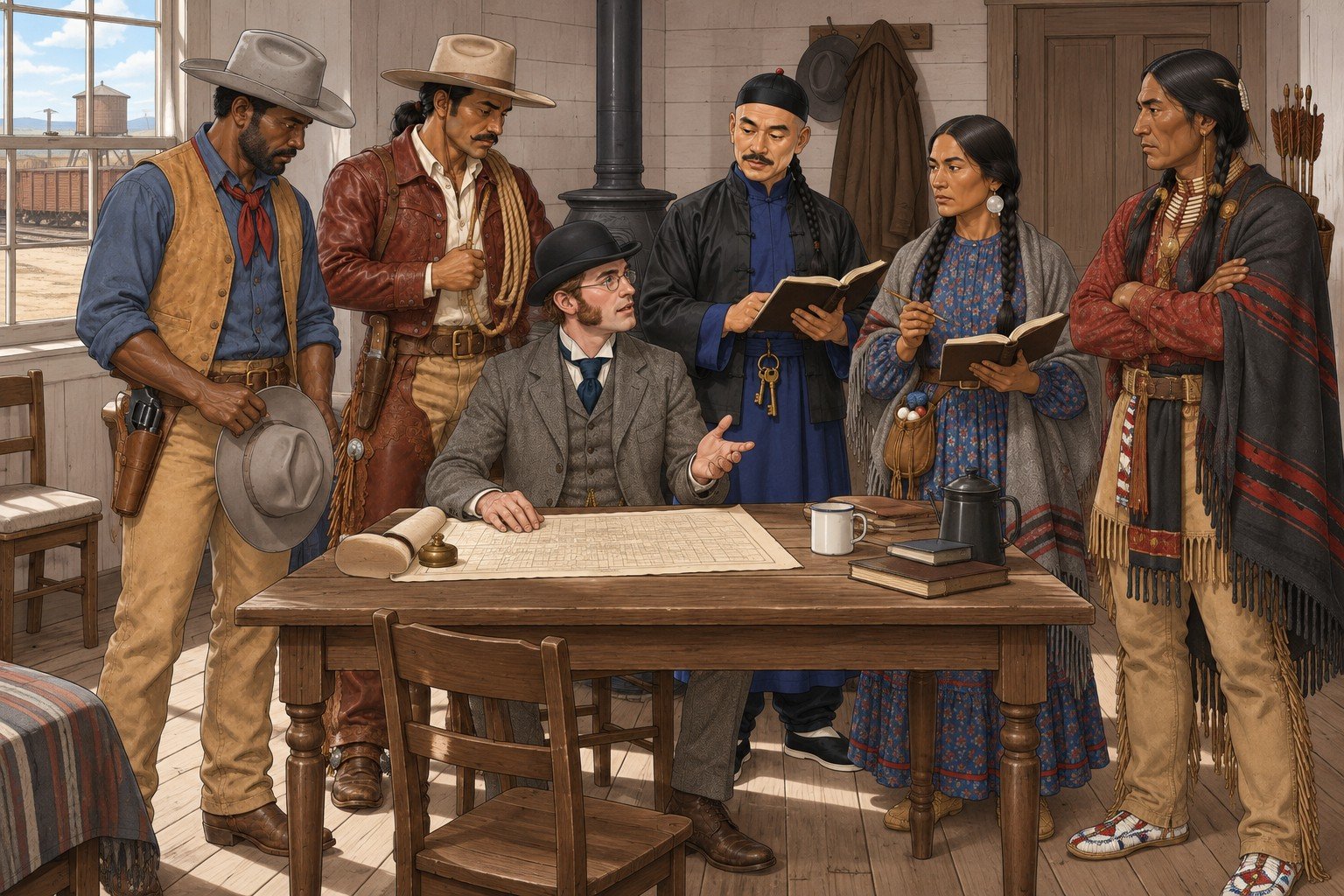
Harrow offers $25 to each hired hand on the party's return, over the day rate, if the stakes north of the river are out of the ground and the crew is safe.
If the party is built from other characters, tie them to Dunne's message in one sentence each: a cattleman's guard, a friend of the crew's, a debtor of Voss's. Any party of three or more can run the adventure, with Harrow or an equivalent surveyor the NPC who is signed to the plat.
Scene 1: The Fever at Kearney's
Place and time. Tuesday 21 April. Bridget Kearney's boarding house near the yards; the land office; the telegraph office at the depot; the marshal's office at Cheyenne, where Deveney works. Kind of scene: investigation, with an illness clock running. No combat.
Setup
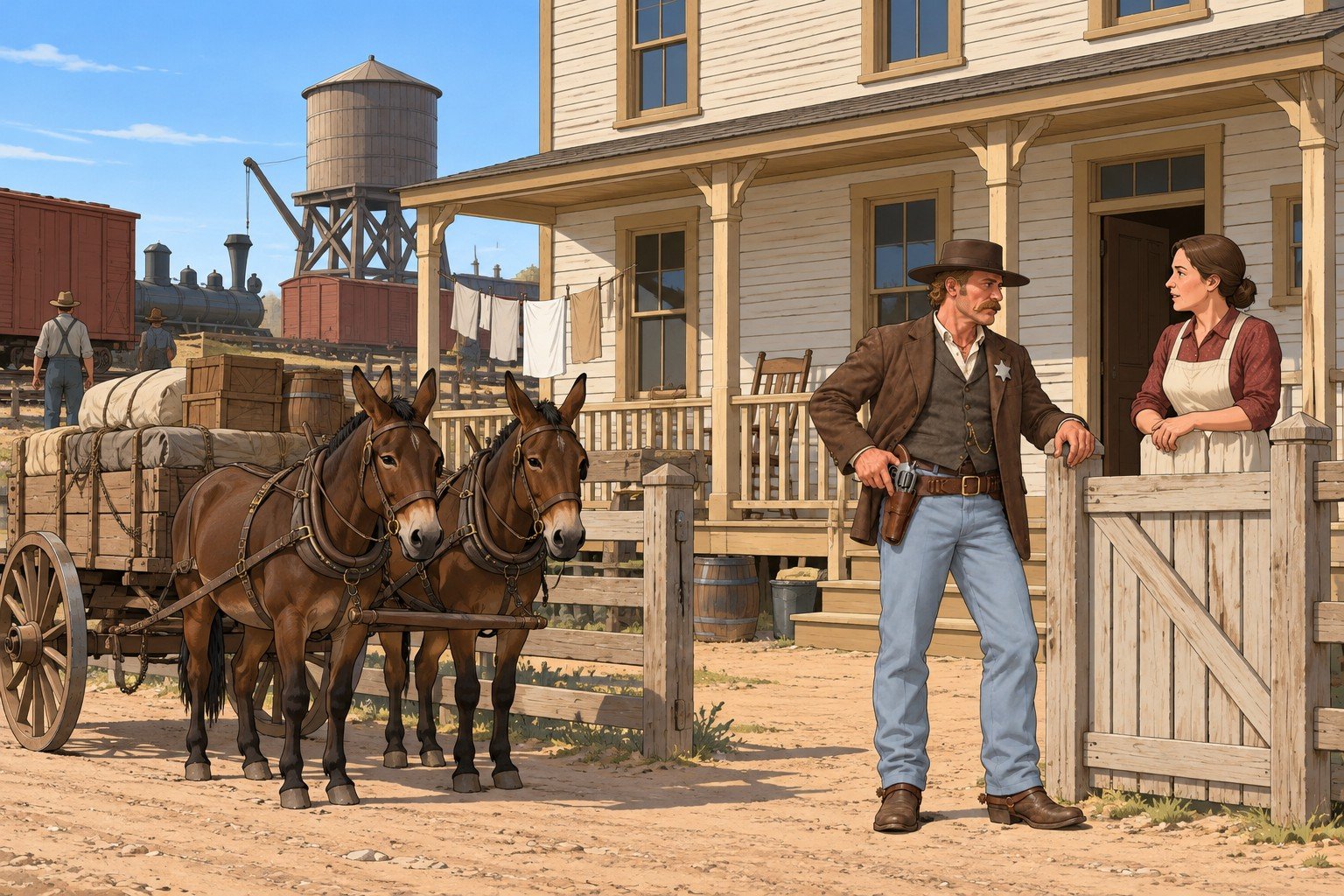
Kearney's has fourteen beds. Dunne is nineteen and Irish, a chainman with Pryce's party, and he reached Cheyenne last night on a freighter's wagon with a fever and a pencilled note. He is feverish and sleeps most of the time. Kearney wants him out of the house if he might infect her lodgers, and wants his board paid by whoever sent him.
The sickness. Dunne has a fever from bad water on the trail. Treat it as Serious (Era Rules, Illness; bad water is listed among the corridor's illnesses). He rolls Willpower at Average each morning, needing two successes within a Course of seven checks. A town doctor's visit is $3.00 by day ($5.00 at night) and a day of nursing is $1.50 (Gear and Prices). Care is an Average Medicine check with clean water, rest and supplies; Hard without. Hedda Lund (Pregenerated Characters) has Medicine 2 and Sickroom Skill and rolls the Care check. Without her, a caregiver rolls Intellect alone in Ability Dice (Core Rules, Building a Dice Pool), or pays the doctor; Harrow (Intellect 3) or Wong (Intellect 2) is the natural nurse.
Dunne's illness is checked each day, so the information comes out in order over three days (the first three rows of the table). The second day's clue comes when he has marked a success on his illness check, or early on two Boons on a Care check; the third day's clue the day after that. A party that leaves on the 24th without the third clue can take it from Voss, the telegraph office or Wong's ledger instead. The party can leave Cheyenne with him sick or well. If he is still ill on the 24th, Kearney keeps him if she is paid.
What the Players Can Do
| Action | Skill and difficulty | Result |
|---|---|---|
| Question Dunne on the first day (21 Apr) | Charm or Medicine for care, Average; he is feverish | He says the party crossed the North Platte on a letter "signed by Mr. Harrow," the Indians stopped the work on the third day, held the men two nights and sent him to fetch "the man who put the sticks in the ground." He gives Pryce's note (Handout 4) |
| Question Dunne on the second day (after a marked success on his illness check) | Charm, Average | He says the man who brought the letter was a hard rider named Hale, with four others, and that they are still with the crew |
| Question Dunne on the third day | Charm, Average | He remembers that the letter told Pryce to "report to Mr. Whitcomb," a name nobody in the crew knew |
| Care for Dunne | Medicine, or Intellect alone, Average | Each net Success adds 1 Boon Die to his next Willpower check, to 3 (Illness). Two Boons: Dunne is clear enough to give the next day's clue today |
| Calamity on the caregiver's check | The caregiver is exposed (Illness). The GM may start Serious fever in the caregiver, who feels it on the road in Scene 3 | |
| Read Handout 4 | Perception or Lore (Land), Average | Pryce writes that the riders "treated us fairly," that the man who brought the letter is still with the crew, and that he wants the stakes up before someone is hurt. The party now knows Hale and his friends are still north of the river |
| Harrow reads the plat (Handout 1) | Lore (Land) or Science, Average; automatic for Harrow's talent Plat and Section | The hand is a copyist's, not Harrow's; the ink is the land office's blue-black; the courses are in rods, which Harrow never uses; station 1 on the north bank is marked "Ferry and Town Lots." The plat is dated 9 April, four days before the line was staked; a surveyor draws a plat after the stakes. Harrow was in Cheyenne on that day. Two Boons: the paper is a copy of a better original; someone has a drawer of Harrow's notes |
| Ask at the land office | Charm, Average, with Lyman Voss; or Intimidation, Average | Voss admits he copied Harrow's field notes for a man named Whitcomb who paid him $10 and said they were wanted for a title search. He is frightened and will confirm in writing if Deveney asks |
| Ask at the telegraph office | Streetwise or Charm, Average; Hard if Nell Ashby is not paid or sponsored; Wong's credit with the depot is a Sponsor | A message went two days ago from Whitcomb to a name at Omaha: "Line staked to the Platte. Send the ten thousand." The Omaha name is a bank; no one at the land department sent it. She keeps the copy at a price. She will say no more without a request from the law |
| Check Wong's ledger | Lore (Trade), Average, or Perception | Hale's outfit bought flour, canvas, wire and powder for ten men for six weeks, on account, signed for by "Whitcomb & Co." The outfit was prepared for a long stay north of the river |
| Report to Deveney | Negotiation or Charm, Average | Deveney listens, says a plat in a drawer is no crime, and not a federal one unless Whitcomb is working it through the mails; he asks the party to bring him anything with Whitcomb's hand on it, posted or wired. He writes a short introduction to Lieutenant Aldous, a federal officer's note to a post adjutant (Scene 3) |
| Find Whitcomb | Streetwise, Average | He keeps a room above a Sixteenth Street office. He is at breakfast most mornings at a hotel on Sixteenth Street (the former Rollins House, recorded in 1868; Cheyenne, Hotels). He gives nothing away. Scene 2 begins here |
Attitudes
Kearney is Wary 1 to anyone who has not paid and Welcome 1 to Catholics and to Deveney's friends. Voss is Wary 1 to strangers and Welcome 1 to the land department. Ashby is Neutral. Set the others on their markers (Era Rules, Prejudice). The same Attitudes apply to every character who shows the marker.
Complications
- Voss does not tell. If the party pushes Voss in public, he is dismissed and Whitcomb is warned. The party should see the clerk alone.
- A caregiver falls ill. A caregiver exposed by a Calamity makes the daily Willpower check on the road in Scene 3; a night in a station bed gives a Boon Die (Illness).
- Rumor. Kearney's lodgers include graders and teamsters who have heard the line is coming. A rumor that Harrow is the railroad's man arrives before he does: set an Attitude toward him at the pay window next door.
Outcome
The scene succeeds when the party knows three things: Whitcomb is behind the plat, Harrow's name was forged, and the band north of the river wants the man whose name is on the stakes. If the players miss the forgery or the band's demand, Pryce's note (Handout 4) gives it to them; if they miss Whitcomb, his notice in the 22 April papers (Handout 3) names him and his office. The party should leave with Handouts 1, 2 and 4, a name, a deadline and the next stop, Whitcomb.
Scene 2: The Plat on the Table
Place and time. Wednesday 22 to Thursday 23 April. The Sixteenth Street hotel (the former Rollins House); a private room above a Sixteenth Street office; Odette Marchand's front parlor (nothing is shown inside). Kind of scene: social contest, Stakes, a Showdown that can be avoided.
Setup
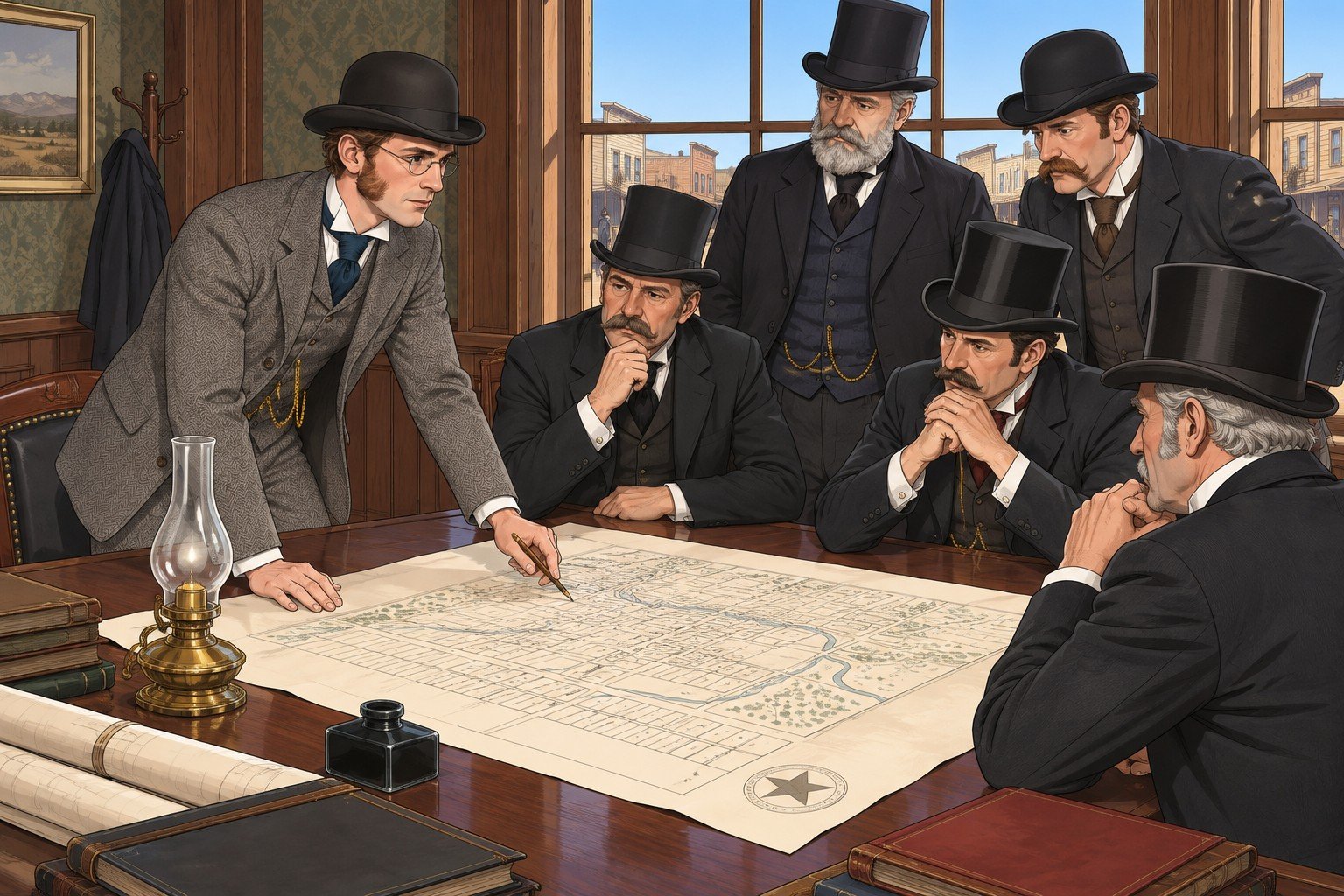
Whitcomb is a pleasant man of fifty who calls the railroad "the company," as a former employee would. He dines with cattlemen and merchants who might buy shares in the Platte and Powder River Improvement Association. His notice runs in the papers on the 22nd (Handout 3). His doorman, Tobe, is one of Hale's men. Hale is north of the river with the rest.
Marchand holds a note against Whitcomb for $140, due on Saturday 25 April. She will be paid by the sales whether or not the line is real. She is a patron who sells what she knows for a Debt, not for coin.
What the Players Can Do
| Action | Skill and difficulty | Result |
|---|---|---|
| Meet Whitcomb at the hotel | Charm or Negotiation, Average | He is courteous and shows the plat to anyone with money. He gives no ground. Two Boons: he lets slip that the crew "has the transit and chain in hand on the north bank" |
| Pose as an investor | Deception, Average (Hard for a character who has been seen with Harrow) | Whitcomb invites the party to the dinner. A false identity exposed turns the room Wary 1 |
| Go to Marchand | Negotiation, Average. She sells a fact for a Debt | She knows Whitcomb bought on credit and has no railroad letter. For a favor she says that the letter the party seeks was written by Whitcomb's own hand and that he keeps a copy; she gives the party a way into his rooms (a maid and an hour) |
| Buy the note | Negotiation, Average, with Marchand, using Wong's Credit limit ($429 with Good Credit) | Buying the $140 note gives the party Whitcomb's debt. A Debt is recorded (Era Rules, Money and Credit). He then owes the party, which changes his position at the meeting |
| Search Whitcomb's rooms | Subterfuge or Stealth, Average; Hard if the maid is not bribed | The copy of the forged letter, a half-drawn plat and a list of investors with the sums promised (Handout 2 is the letter) |
| Confront Whitcomb in private | Intimidation or Leadership, Hard | He denies everything, says the company's name is only a courtesy, and offers a share of the lots to keep Harrow quiet. A bribe is available: $200 and a lot at the crossing |
| Challenge him in public | See the Stakes contest below | Whitcomb answers with the weight of the room |
| Go to Deveney | Negotiation, Average | Deveney tells the party to bring a complaint sworn before a justice, with a witness (Law in Play); he cannot take the paper from a man's rooms without one. The party needs a witness: Voss or Pryce |
The Stakes Contest: A Claim Before the Room
If the party challenges Whitcomb before investors, run Stakes (Era Rules, Stakes), contest type A claim before an official, with the room of investors standing in for the official. Intellect and Lore (Land) for each exchange.
-
Ante. Whitcomb stakes his Name (his Notoriety 1 as the man selling the railroad lots). The challenger stakes cash or a Name. A challenger who stakes nothing is not taken seriously.
-
Evidence dice. The challenger adds 1 Boon Die to an exchange for each of these in hand, to a maximum of 3: the forged letter (Handout 2); Voss's statement; the telegram text (Ashby); Pryce's note (Handout 4); Harrow's own field book, which shows his actual course ending at the river.
-
Whitcomb's dice. He has the room's goodwill (Welcome 1 for a man who talks of a railroad: 1 Boon Die) and a plat that looks like the company's (1 Boon Die). Before the first exchange, a character who read the plat in Scene 1 may make a Hard Lore (Land) check; on a success Whitcomb loses the plat's Boon Die for the contest.
-
Raise. Whitcomb Raises once with cash and Folds rather than Call a second Raise.
-
If the party wins. The investors withdraw. Whitcomb loses the sales that would have closed on the 25th and his Name. He continues, in secret, to keep Hale and his riders in the camp, because he now needs the line to look real by the 2nd. [Mark 2 of the Line Clock does not land.]
-
If the party loses. The room believes Whitcomb. The challenger loses the stake. Whitcomb is warned and moves faster: Mark 2 lands a day early.
The Showdown That Can Be Avoided
Whitcomb's doorman, a tall man named Tobe, will put a hand on a gun if the party presses in the street. A Showdown (Era Rules, The Showdown) is available but not required. Tobe is a Rustler (Minion) acting as principal (Willpower 2, Readiness 1). No other lawman is nearby. Winning the Showdown before five witnesses by 2 or more net Successes earns Notoriety 1 (Era Rules, Notoriety and Bounty). A principal who Stands Down is Backed Down before the room (Era Rules, The Showdown).
Attitudes
The investors are Welcome 1 to the railroad (and to its apparent agents), Wary 1 to strangers without an introduction, and Hostile 2 to a stranger who calls the line false without proof. Cover and a Sponsor reduce Attitude by one step each: Deveney's written introduction is Cover (Era Rules, Prejudice), as is Harrow's letter on company paper if he carries one; the plat is neither. A Sponsor is a person in the room who vouches for the party: an investor already convinced, or Marchand if she chooses to.
Complications
- A sale already made. A merchant has already bought shares and will not listen. He becomes an ally only after the party shows the plat is forged.
- Marchand's price. A favor owed to Marchand is a Debt the party must repay; a failed Hard Negotiation sets one automatically (Adversaries, Marchand).
- Time. Every day in Cheyenne takes a day from the clock's margin.
Outcome
The party leaves Cheyenne on the 24th with some or all of: the forged letter, a witness, the note, a sworn complaint, or only Pryce's note. What they carry decides Scene 5.
Scene 3: The Road North and the Post
Place and time. Friday 24 to Monday 27 April (arrival at the post on Sunday evening, the 26th). The Cheyenne to Fort Laramie road, 89 miles; Fort Laramie. Kind of scene: a journey with one hazard, then a negotiation with the Army.
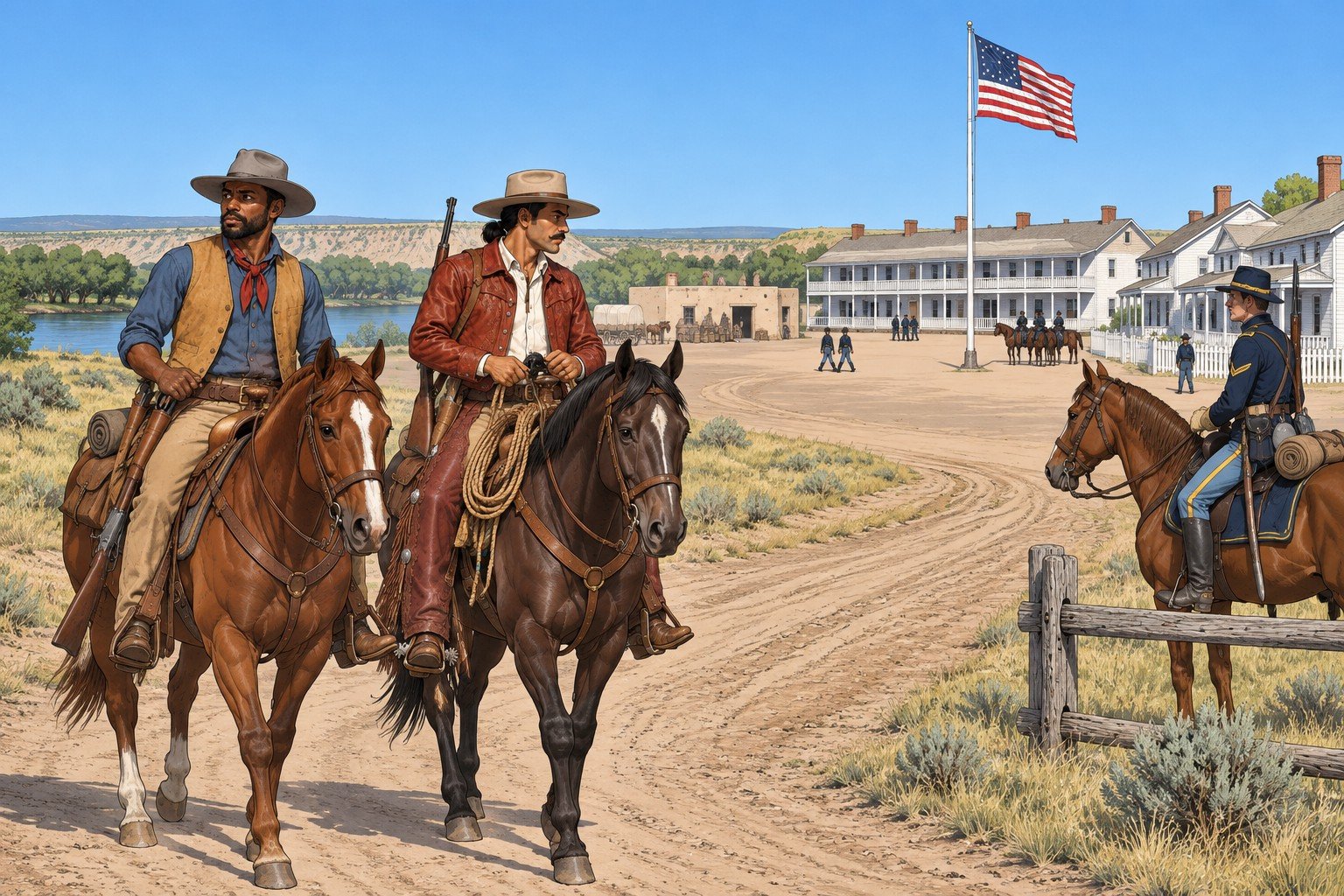
The Road
On horseback the ride is three days at Riding Horse Travel 30 (Places and Campaign Tools, A Day's Travel). Road ranches on the way (Keeping a Horse counts them as a ranch) are covered by living expenses, and the horses are kept there (Keeping a Horse). Make one hazard check for the journey (Era Rules, Travel at the Table): spring rain or wet snow on the high plains; Average, Hard if it turns to a blizzard (Adversaries, Hazards). A failure costs a day. A Calamity is the moment to expose a character to illness: a caregiver from Scene 1, or someone in wet bedding. Each day lost takes a day from the party's margin.
The road is quiet. Add one short encounter from Places and Campaign Tools (Encounters on the Road): a freighter's wagon with a broken axle, a government mail ambulance, a rancher's hand who has heard of the line.
The Post: Fort Laramie
Setup. Fort Laramie is an Army post on the Laramie River near the North Platte: an open parade ground ringed by barracks and officers' quarters, with no wall or gate. It is the nearest Army authority to the stake line. Lieutenant Daniel Aldous is the post adjutant when the party arrives; the commanding officer is at Fort D.A. Russell for a court. He has heard a teamster's rumor of surveyors north of the river and has no report. He does not know the treaty well enough to cite Article XVI. He is wary of any new trouble after the February 1874 siege of Red Cloud Agency, when the agent called for troops (Tribal Nations).
What Aldous wants. To avoid a new fight on the north bank, to be able to say he asked civilians to withdraw, and to avoid being the officer who sent cavalry across the river without orders. The law of 1874 let the Army remove trespassers from Indian country, but only on orders that came down from the department through the agent (Revised Statutes, secs. 2147 and 2150). Aldous has no such order and will not act without one; he can warn, escort to the south bank and report.
| Action | Skill and difficulty | Result |
|---|---|---|
| Get an audience | Charm or Negotiation, Average; Deveney's introduction, a federal officer's note to a post adjutant, is Cover (Era Rules, Prejudice) and lowers Aldous's Attitude one step; the post trader or the civilian guide, once won over, is a Sponsor at the post | Aldous receives the party. Without it, he is Wary 1 and keeps them waiting a day |
| Explain what is on the stakes | Lore (Land) or Science, Average, by Harrow; the interpreter's Plain Words helps the Army follow the treaty | Aldous learns the line crosses the unceded country. He had not seen the plat. Two Boons: he reads Article XVI (Handout 5) and understands the danger |
| Prove Harrow did not order the line | Lore (Law) or Negotiation, Average; Hard without Voss's statement or the forged letter | Aldous accepts that the surveyor is a victim of a fraud, not the author of it. Without proof, he is Wary 1 to Harrow and treats the party as trespassers |
| Persuade him to send troopers | Negotiation or Leadership, Hard | He sends a small escort to the river's south bank, not across. An escort across the river is an event for the clock: the band reads it as the Army following the stakes |
| Ask for a written pass | Charm, Average | A short written pass that lets the party cross the river on the post's authority. It is the most Aldous will give (Handout 5) |
| Ask the post for supplies | Negotiation, Average | A post trader sells at the going rates; the quartermaster does not |
| Seek a Fort Laramie guide | Streetwise or Charm, Average | A civilian scout, a guide at $3.00 a day, knows the north bank and will take the party for two days; he will not cross to the camp |
Complications
- Aldous's escort. If Aldous sends four troopers (Cavalry Trooper (Minion), group of 4, with a sergeant), the band's Attitude toward the party in Scene 4 goes up by one Hostile step. Sergeant is Cavalry Sergeant (Elite). The escort's presence is the stakes' fight in other form.
- A fever in the party. A caregiver exposed in Scene 1 makes a Willpower check each morning (Illness).
- A rumor from Red Cloud. The Oglala warrior's relative has sent a rider with word that the band north of the river holds Pryce's crew and does not want the Army. The warrior learns this at the post trader's; it is the first moment the table decides how far he will push his people.
Outcome
The party leaves the post with one of three things: a pass and the lieutenant's goodwill (best), an escort that raises the stakes (mixed), or nothing but a warning (worst). The next day, Tuesday 28 April, is the party's day at the line; Mark 3 lands that night.
Scene 4: The Stake
Place and time. Tuesday 28 April. North of the North Platte, about a day's ride from Fort Laramie, on the survey line. Kind of scene: a parley with a Tribal Nation as a power, with a possible fight.
Setup
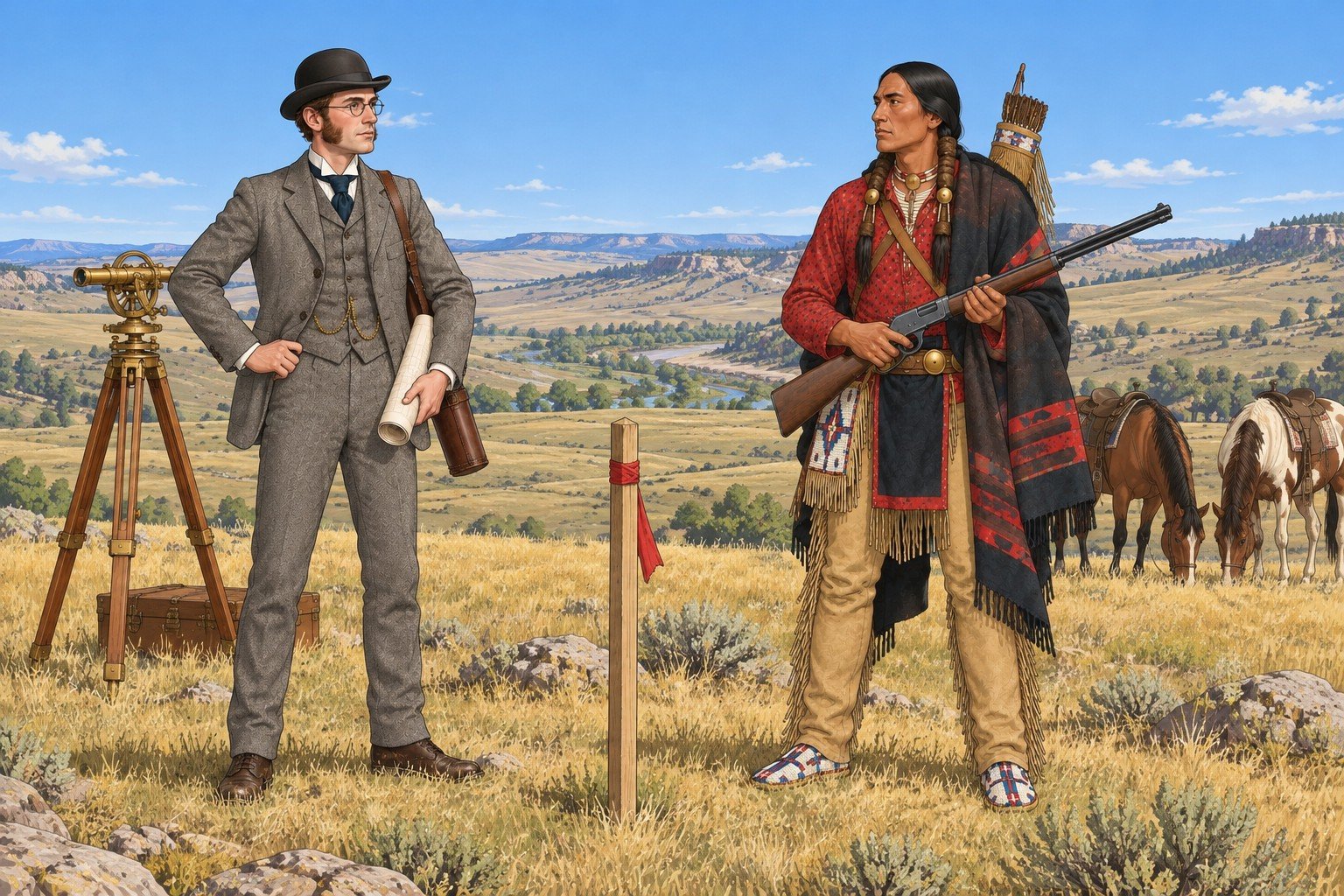
The line runs north from the river, marked with ash stakes with strips of red cloth. At the ninth stake, on a rise, stands the headman with six riders. He has waited there since the stakes first appeared; he has asked for the man whose name is on them. A short way off, in a creek bottom, is Pryce's camp: five tired crewmen and Hale's four riders, with Hale sitting on his horse watching both parties.
The ground at the stake line, 28 April 1874. The GM places the five parties by this table; it is a sketch for the GM, not a survey, and the distances follow Handout 1.
| Landmark | Where it is | Who is there |
|---|---|---|
| The North Platte | The south edge of the ground, running west to east. Fort Laramie lies off to the south-east on the Laramie River near its mouth, 89 miles from Cheyenne (Places and Campaign Tools) | Pryce's crew, if Mark 3 has landed, waits at the crossing under the band's eye |
| The old ford | On the river where Handout 1's plat begins, "south bank, opposite the old ford"; station 1, the "Ferry and Town Lots" mark, is 40 rods (an eighth of a mile) up the north bank | Nobody on the 28th; the party's way across |
| The stake line | From station 1 the line bears N 12° W, a little west of north, with stakes a mile apart, numbered 2 to 11, so stake 11 is about 10 miles from the river | One stretch of the line pulled by the band's young men on 15 April; the rest standing, the ninth stake among them |
| The rise at the ninth stake | About 8 miles north of the river on the line, a low rise that looks over the creek bottom | The headman and six riders |
| The creek bottom | About a quarter of a mile east of the ninth stake and below the rise, where the crew has water and grass | Pryce's camp: five crewmen, Hale's four riders, Hale mounted between the camp and the rise, the transit; the mules and chain are not here, the band holds them |
| The band's camp | Two to three miles north-west of the rise, out of sight of the line; after Mark 4 it moves north | The band's lodges, its horse herd, the mules and chain |
| The Powder River country | North along the projected line, "about 90 miles" by the plat, not surveyed | Nobody the adventure places |
Scale for play: the rise and the camp are within Long range of each other on foot and a few minutes' ride; the band's camp is an hour's ride; the river is a half day's ride south.
The band is Oglala Lakota and acts for its own aims. It hunts north of the North Platte by the right Article XI keeps. Its aims (Adversaries, Rules for Using the Tribal Nations as Opposition):
- The stakes out of the ground, by the hands of the people who put them in.
- The crew and the mules returned, which the band holds as a pledge.
- The Army kept out of the camp, because an Army patrol brings the agency's trouble into the hunting ground.
- A statement the band's name is clear. Whatever Whitcomb says in Cheyenne about "Indian outrages," the band wants it known that it stopped a trespass and hurt no one.
A split. The headman wants the matter settled without a death. The young man wants an answer for the mules and the stakes beyond a speech. The headman holds the band; the young man holds the riders' attention. Both are Oglala.
If the Oglala warrior is a player character, he is a stranger from another band, with kin at the agency, and a speaker's duty to his own people more than to the headman. The table decides how far he is trusted. His strength (once per session) adds to Survival, Riding, Charm or Negotiation in his nation's own country; the GM decides if this band's country counts.
The Parley: Three Questions
The headman, through his own interpreter or through the Northern Cheyenne interpreter, asks the man whose name is on the stakes three questions. Run it as an Extended Negotiation check, threshold 4 net Successes, with a limit of three failures (Core Rules, Extended Checks). The character who speaks for the party to the headman makes the Negotiation check; Harrow assists with his field book (Core Rules, Assisted Checks). If Harrow speaks for himself, the Attitude the party has earned applies to his own pool. The Plain Words talent (Skills and Talents) removes a language Bane Die or gives a Boon Die. Each answer is an exchange.
Set the Attitude before the first roll (Era Rules, Prejudice). Markers: surveyors and the railroad are Hostile 2; strangers with arms are Wary 1; anyone introduced by a go-between the band respects is lowered one step (the interpreter is the lever); a respected relative of the band is Welcome 1. A party that arrives with Army troopers has all Attitudes one step worse. Each piece of evidence the party shows (Handout 2, Pryce's note, Aldous's pass) removes one Bane Die or, at Neutral, adds one Boon Die, to a maximum of 2.
| Question | What the headman asks | Honest answer | What helps |
|---|---|---|---|
| 1. Whose stakes are these? | "You signed this." | The line ended at the river. The letter and the plat were made in Harrow's name by another man. Harrow shows his own field book | Handout 2 and Pryce's note. A Hard Deception check to lie turns the Attitude Hostile 2 |
| 2. What will you do? | The stakes pulled by the crew's own hands, the chain and mules returned, the plat withdrawn | Harrow can pull the stakes and burn the plat's northern sheet before the band. He cannot promise what Whitcomb will do in Cheyenne; he can promise to say in writing that the line north of the river is false | A Name stake: Harrow puts his professional name on the statement (Scene 5) |
| 3. Who will hear it? | The band does not want the Army or the cattlemen to say it made trouble | Aldous's pass shows the post knows. The party can carry the band's statement to the Cheyenne papers | A written pass from Aldous (Handout 5); Deveney's word |
Result. At 4 net Successes the headman accepts. The stakes are pulled in his sight by Harrow, Pryce and the crew; the mules and chain are returned; the band's riders ride away north. At three failures the headman ends the talk. The band leaves the pledge where it is and withdraws; the stakes remain, and the party must pull them without a settlement.
Spending the Boons and Banes.
- Two Boons: the headman tells the party why the band came south (a hunt, kin who live in the region) and what the band wants Cheyenne to hear; the GM names the specifics.
- Two Banes: the young man says the party's words are those of the people who put the stakes there. The headman holds the band, but the riders' Attitude goes one step toward Hostile.
- A Breakthrough: the headman offers a kindness: a guide back to the river and a message to the Army that the band made peace. The band's Trust (below) goes up.
- A Calamity: Hale's riders see the parley, a rifle goes off, or a horse bolts. See below.
Hale
Hale watches. He is paid to keep the crew staking, not to fight a band. When the party arrives he rides up to the stake line and says the crew is working under the company's orders. He is the Hired Gun (Elite).
- If the party has evidence. Hale reads it, sees the investors' money gone and the Army coming, and Stands Down. He lets the crew go for a share of what the party pays, or for his horse. The Showdown is available (Era Rules, The Showdown): Hale's Stare per his entry, with Boon Dice for four riders in view (maximum 2). A win by 2 or more net Successes before the crew and the band earns Notoriety 1.
- If the party has no evidence. Hale calls the party trespassers on the company's line. He cannot easily draw with a band of Oglala riders on the rise above him; he calls the Showdown on the party's marksman, Tolliver, or on Harrow. No starting character is likely to win that Stare; the honest choices are to Stand Down and be Backed Down before the crew, or to Draw with Hale's side taking the first slot. The Oglala do not answer a street custom; they watch.
- If Hale Draws. Hale's four riders (Rustler, Minion group of 4) and Hale fight. The band does not fight for either side: it rides between the camp and the crew to take the crew out of the line of fire, and any shot that strikes a rider of the band ends the parley. Hale and four riders against the party is a Hard encounter for a party of four (Adversaries, Sizing an Encounter). A death among the band's riders ends the parley, and the party must take its case to the Army and the papers.
Complications
- The young man. He rides at the camp to take back the mules. A Leadership or Negotiation check by anyone the band respects, Hard, turns him; failing it makes the headman act, with a cost to his authority.
- The cold. Rain or wet snow. A night in the open uses the Blizzard rules (Adversaries, Hazards) only on a Calamity.
- Pryce. He is relieved to see Harrow and is ready to be blamed. He will give evidence.
- Horses. The party is a day from Fort Laramie. The horses are kept for three days from the 28th (Keeping a Horse); a delay past the 30th puts them on Bane Dice.
If the Shooting Has Happened (the Party Arrives After 29 April)
If Mark 4 has landed, the camp holds the body of a young man and two of Hale's dead; Hale is gone with the rest. The band has moved camp to be clear of the Army. The headman will meet the party only if the interpreter or the warrior brings the party in. The questions change: the band asks who will answer for the death and what the Army will do. The parley is Hard, the threshold is 5, and the failures allowed are two. Success here keeps the band from striking at the post and the road.
The Band's Trust
Track the band's attitude toward the party as Trust, 0 to 3. It starts at 0.
| Event | Trust |
|---|---|
| The party reaches the line before any shot | +1 |
| The parley reaches 4 net Successes | +1 |
| The stakes come out in the band's sight | +1 |
| The party arrives with troopers | −1 |
| A death among the band | −1 |
| The party lies and is caught | −2 |
At Trust 2 or more the band remembers the party in later play and gives a Boon Die to Negotiation and Survival with this band and its kin. At Trust 0 or less the party has made an enemy of a band that hunts across the corridor.
Scene 5: What the Plat Is Worth
Place and time. Wednesday 29 April to Saturday 2 May. The ride back; Cheyenne; the investors' meeting at the Sixteenth Street hotel (the former Rollins House) on Saturday 2 May. Kind of scene: a public contest of paper, an arrest, a decision.

Setup
The party rides south with Pryce, his crew and Dunne's account, or without them. They reach Cheyenne on the afternoon of Saturday 2 May, hours before the meeting, if they leave the stake line on the morning of the 29th. A forced march (The Stable, Riding, Travel; Tolliver's Long Rider makes the check Easy) gains a day and brings them in on Friday 1 May. A party that lingers a day arrives after the meeting has begun. Whitcomb's meeting is held in a hotel room before a roomful of investors. He has a revised plat; he has not heard of the stakes coming out. If Hale's riders carried the news, he has heard.
The Meeting
The party chooses how to end the matter. Three ways:
1. Expose him at the meeting. Run a second Stakes contest (Scene 2, A Claim Before the Room). The challenger now holds more evidence: Pryce in the room is a witness who saw Hale's riders and the forged letter; Voss's statement, if taken; Aldous's pass, which shows the Army knows. Each piece adds a Boon Die, to a maximum of 4. Pryce speaking in the room takes Whitcomb's Welcome 1 Boon Die away. Whitcomb Raises once with his last cash and Folds rather than Call a second Raise. If he loses, the room turns on him (Attitude Hostile 2 to Whitcomb) and the shares are withdrawn.
2. Swear a complaint. Any investor, Pryce or Harrow swears a complaint before a justice of the peace (Law in Play, Warrants and Arrests): Lore (Law) or Negotiation, Average. The charge is federal: a scheme to defraud carried on by the mails (the notice posted to subscribers and the wire to Omaha), which is why Deveney, a deputy U.S. marshal, is the arresting officer. Use "fraud by the mails" at the table. He needs the complaint, a witness and a copy of the notice or the wire. The arrest is a Leadership or Intimidation check, Average; Hard if Whitcomb's friends are near. Whitcomb surrenders unless the party has driven him to Draw. Whitcomb goes to the county jail at the marshal's expense to wait for the commissioner's hearing. If the table prefers the territorial charge (shares sold on a forged plat), the county sheriff's deputy makes the arrest with Deveney present as the party's patron, or Deveney takes an Outside Jurisdiction Bane Die (Law in Play) and relies on Color of Law and the warrant.
3. Buy him off. Whitcomb offers shares or cash to keep quiet. If the party takes it, the plat circulates, the band is blamed, and Harrow is ruined.
If Whitcomb has fled. On the evening of the 2nd, or earlier if Mark 6 has landed, Whitcomb takes the evening train east with the money (rail, not tracked; Era Rules, Travel at the Table). The party can send a wire (Nell Ashby holds it for a price) or follow by train to Omaha. That is a hook for later play, not a scene.
Hale
If Hale lived, he is in Cheyenne or on the road. He may try to take Whitcomb's money before Whitcomb leaves, or run. A bounty on him is a hook (Notoriety and Bounty).
Outcome
At the end of Scene 5, score the Four Results:
| Result | Achieved when |
|---|---|
| The line is out. | The stakes north of the river are pulled and the plat's northern sheet withdrawn |
| No one died. | No death of an Oglala Lakota, a crew member or a rider |
| The paper is cleared. | Whitcomb is exposed, arrested or driven out, and Harrow's name is cleared in writing |
| The band's name is clear. | The band's statement (Scene 4) reaches Aldous and the papers |
| Results achieved | Outcome |
|---|---|
| 4 | Clean. Harrow keeps his post and gains a note of thanks from the land department. The band's Trust is 2 or higher. Deveney owes the party a favor. Each character earns Notoriety 1 in Cheyenne |
| 3 | Mostly. One thing is left open: a rider is hurt, a share is sold, or the band's statement is unread. Harrow keeps his post |
| 2 | Muddy. A death, a fled promoter or a stained name. Harrow is reassigned from the corridor. The band moves north |
| 0 to 1 | The Clock. The line clock has run. Cheyenne believes the Oglala killed surveyors. Harrow is blamed. The Army has a patrol north. The party is not wanted on the Fort Laramie road |
Award XP by the Core Rules at the end of each session; the Clean outcome is worth a full award.
Consequences and Follow-up Hooks
| Hook | What it is |
|---|---|
| Hale's riders. | Two of them ride for Wade Carrick on the side. Carrick buys the stock they steal in the Black Hills country (Outlaws and Vigilance, Factions and Powers). A rider in custody names the buyer |
| Marchand's Debt. | A favor owed to Odette Marchand, if the party bought information from her, is called in a season. She asks the party to guard a political meeting (Cheyenne, A Fair Hearing at Marchand's) |
| The Black Hills. | The Custer expedition leaves Fort Abraham Lincoln on 2 July 1874 for the Black Hills (Factions and Powers, Relations in 1874). A band the party dealt with carries the word of the party's honesty, or dishonesty, to the agency. The warrior's relative asks what the party knows of the soldiers' march |
| The next survey. | Harrow's superiors want a line to the Powder River by a lawful route. The land department sends a new party, and the band wants someone to ride ahead and explain it. This starts a campaign |
| Pryce's crew. | A crew member who was hit or frightened at the camp wants pay, or a place on the next party |
| Dunne. | If he lived and was nursed, he is a loyal friend. If he died, his family writes to Kearney and Deveney |
| The papers. | The Cheyenne papers print a version; set the party's Notoriety accordingly (Era Rules). A Leader reporter wants a statement from Harrow |
Running It for Fewer or More Players
- Three players. Cut Scene 2's search of the rooms; Marchand gives the letter's whereabouts for a Debt. Run Hale's riders as a Minion group of 2.
- Five or six players. Add two to Hale's riders. Add a second voice to the band, a headman's relative who wants the party out.
- No Oglala Lakota character. The headman's own interpreter speaks for the band; the party has no Plain Words unless a character has the talent, so the Attitude stays at Hostile 2 to surveyors until a Sponsor is found.
- No surveyor. Pryce is the name on the stakes. Whitcomb forged Pryce's name instead; the interpreter's company wage is paid by the land department.
- A shorter session. Run Scenes 1 and 3 in a few exchanges, and play Scene 4 and Scene 5 in full.
Handouts
Copy these for the players. Each handout is printed as a document beside its text. Click a handout image for the full-size file to print.
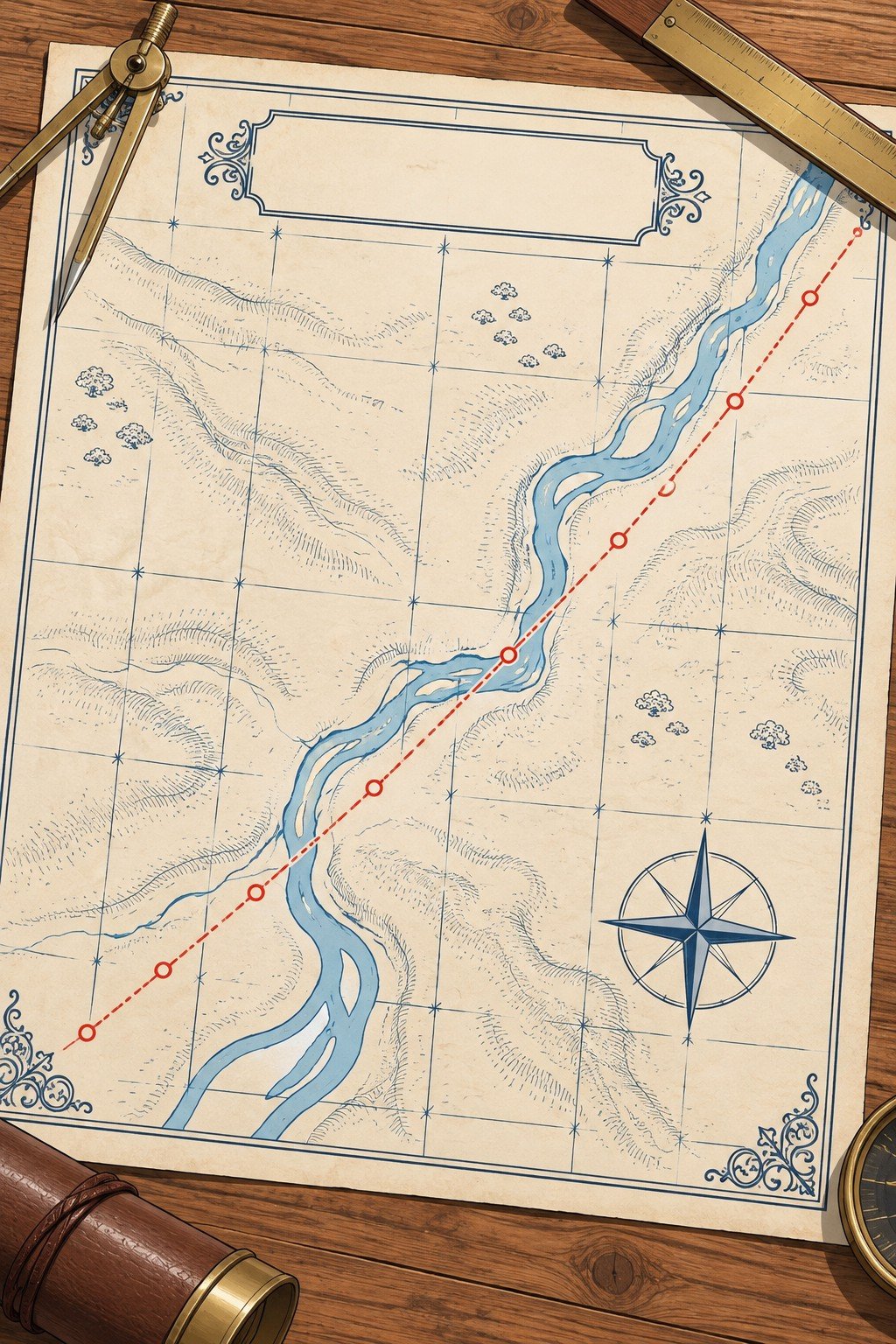
HANDOUT 1: PLAT OF A PROPOSED LINE
PLAT OF A PROPOSED BRANCH LINE, FORT LARAMIE TO THE POWDER RIVER COUNTRY Surveyed under direction of E. Harrow, Land Dept. Dated 9 April 1874.
| Station | Course | Distance | Note |
|---|---|---|---|
| 0 | Beginning at the south bank of the North Platte, opposite the old ford | ||
| 1 | N 12° W | 40 rods | Ferry and Town Lots, north bank |
| 2 to 11 | N 12° W | 10 stations of 1 mile | Hay land, one section each side |
| Beyond | N 12° W, projected | About 90 miles | Dotted line to the Powder River; not surveyed |
Gamemaster's tell: the courses are in rods, a unit Harrow never uses. The plat calls mile marks "stations" (a railroad station is 100 feet) and shortens the distance to the Powder River by a third; no railroad surveyor drew it. Every station from 1 north lies in the unceded country. The plat is dated four days before the line was staked. The ink is blue-black (the land office's), the hand is a copyist's, and the signature has a loop Harrow's does not.
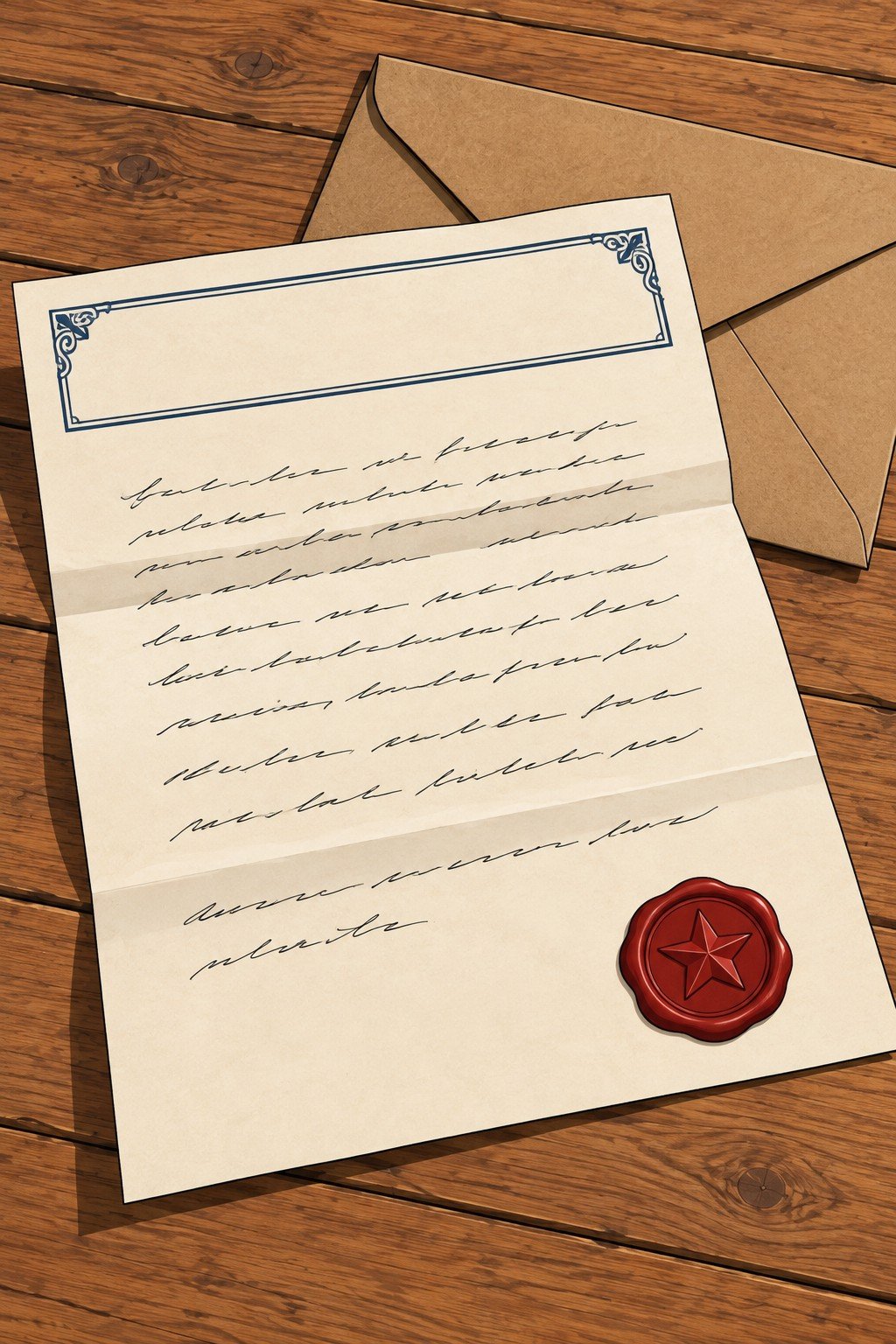
HANDOUT 2: THE FORGED LETTER
Land Department, Cheyenne. 5 April 1874. To O. Pryce, Esq., chief of party.
Sir: By direction of the Superintendent you are to carry the preliminary line across the North Platte at Fort Laramie, and to run it north on a course of twelve degrees west for not less than ten miles, setting stakes of ash at each station. The bearer, Mr. Hale, is authorized to supply you with provisions and an escort. You will report to Mr. Whitcomb at Cheyenne. This is the company's urgent wish.
(signed) E. Harrow
Gamemaster's tell: the letter is dated 5 April. The land department's letter book shows nothing sent to Pryce that week, and Harrow's own copy press has no impression of it. The signature is traced (compare Handout 1), and the chief of party is told to report to Whitcomb, who holds no company office.

HANDOUT 3: THE NOTICE
TO CAPITALISTS AND STOCK OWNERS OF LARAMIE COUNTY
The Platte and Powder River Improvement Association gives notice that its lines are surveyed and its plat is on view. Town lots, ferry rights and hay lands at the crossing of the North Platte are offered in shares of $50, in advance of the Railroad. Subscribers are invited to a meeting at the hotel on Sixteenth Street, Cheyenne, on Saturday, 2 May, at eight in the evening. Plats may be seen at the office on Sixteenth Street.
S. WHITCOMB, Secretary
Gamemaster's tell: the notice names no railroad and no officer of the company. "In advance of the Railroad" admits that the line is not built.
HANDOUT 4: PRYCE'S NOTE
Harrow: We crossed the Platte on the 13th, on a letter signed in your name. I thought it queer and said so. On the 15th riders came and took up the stakes, and the mules. They held us two nights and treated us fairly; none of us was hurt. The man who rode in with the letter is still here with his friends and says to stake on. The headman wants to speak to the man whose name is on the paper. Come yourself, and quick. Take up the stakes before someone is hurt. Dunne is sick; see to him. O.P.
Gamemaster's tell: Pryce writes fairly of the band and asks Harrow to come himself.
HANDOUT 5: THE TREATY AND THE PASS
From the Treaty of Fort Laramie, 29 April 1868, Article XVI (paraphrased): The United States agrees that the country north of the North Platte and east of the Big Horn summits is unceded Indian territory. No white person is to be permitted to settle on or occupy any part of it, and no one is to pass through it without the Indians' consent.
From Article XI (paraphrased): The Lakota keep the right to hunt north of the North Platte while buffalo range there in numbers that justify the chase, and agree not to oppose the military posts and roads then established south of the river.
Post pass, Fort Laramie, 27 April 1874. The bearers, civilians, are permitted to cross the North Platte to carry a message to the survey party under Mr. Pryce and to bring that party back. By order of the Post Commander. D. Aldous, 1st Lieut., Post Adjutant.
Gamemaster's tell: the pass gives the party no authority over anyone; it shows the post knows.