
Use this chapter to count travel days, set scenes between destinations and build a campaign from 58 to 44 BC. Rome, Alexandria and Gaul and the Provinces cover the major places. For the journey itself, see Era Rules, Travel.
Part One: Distances and Travel Times
Read the tables in Roman miles, about 1.48 km apiece. Days follow the rates in Era Rules, Travel (By Road and By Sea). A tilde (~) marks a map estimate based on the direct distance plus an allowance for turns or a ship's course. Use recorded lengths where they survive. Strabo gives Rome to Brundisium as about 360 miles and cites Polybius for the 267-mile Via Egnatia. He also records Ocriculum to Ariminum on the Via Flaminia and Aquae Sextiae to Narbo. Only the short approaches from Rome and Massilia are measured on those routes. The allowance on other legs follows the Brundisium figure. It undercounts mountain roads.
The lower end of each range uses the faster rate. Both ends round to whole days. Use the courier column for news sent with the fastest rider the sender can afford.
By Road
| Leg | Road | Roman miles | Foot or cart | Hired carriage | Courier on relays |
|---|---|---|---|---|---|
| Rome to Ostia | The Ostian road | ~17 | 1 | 1 | 1 |
| Rome to Capua | Via Appia | ~130 | 6 to 9 | 3 to 5 | 3 |
| Capua to Puteoli | ~23 | 1 to 2 | 1 | 1 | |
| Rome to Puteoli, by Capua | Via Appia | ~155 | 8 to 10 | 4 to 6 | 3 |
| Capua to Brundisium | Via Appia | ~240 | 12 to 16 | 6 to 10 | 5 |
| Rome to Brundisium | Via Appia | about 360 | 18 to 24 | 9 to 14 | 7 |
| Rome to Ariminum | Via Flaminia, over the Apennines | ~215 | 11 to 14 | 5 to 9 | 4 |
| Massilia to Narbo | By Aquae Sextiae, then the Via Domitia from the Rhône at Tarusco | ~160 | 8 to 11 | 4 to 6 | 3 |
| Bibracte to Alesia | Gallic tracks | ~60 | 3 to 4 | 2 | 1 |
| Dyrrachium or Apollonia to Thessalonica | Via Egnatia | 267 | 13 to 18 | 7 to 11 | 5 |
By River
Use the foot-or-cart rate for a river boat towed or poled upstream. Downstream, use the hired-carriage rate.
| Leg | River | Roman miles | Upstream | Downstream |
|---|---|---|---|---|
| Ostia and Rome | The Tiber, by barge | ~17 | 1 | 1 |
| Massilia and Bibracte | The Rhône and the Arar (Saône) to the Aedui's river landing, the last stage by road | ~370 | 18 to 25 | 9 to 15 |
| Alexandria and Memphis | The Nile | ~150 | 8 to 10 | 4 to 6 |
By Sea
In a fair wind, count 100 to 150 miles a day (Era Rules, Travel, By Sea). For a leg sailed in the closed season by the sun, make the check given there.
| Leg | Roman miles | Days |
|---|---|---|
| Ostia to Puteoli | ~145 | 1 |
| Brundisium to Dyrrachium | ~115 | 1 |
| Puteoli to Syracuse | ~335 | 2 to 3 |
| Athens to Ephesus | ~245 | 2 |
| Ostia to Utica, for Africa | ~430 | 3 to 4 |
| Ostia to Massilia | ~460 | 3 to 5 |
| Ephesus to Alexandria | ~610 | 4 to 6 |
| Puteoli to Alexandria | ~1,380 | 9 to 14 |
Part Two: Places Between the Great Places
Each entry gives a kind of place the party may meet on the road and an example from the record. Use the example or set it at the next town.
A Road Inn on the Via Appia
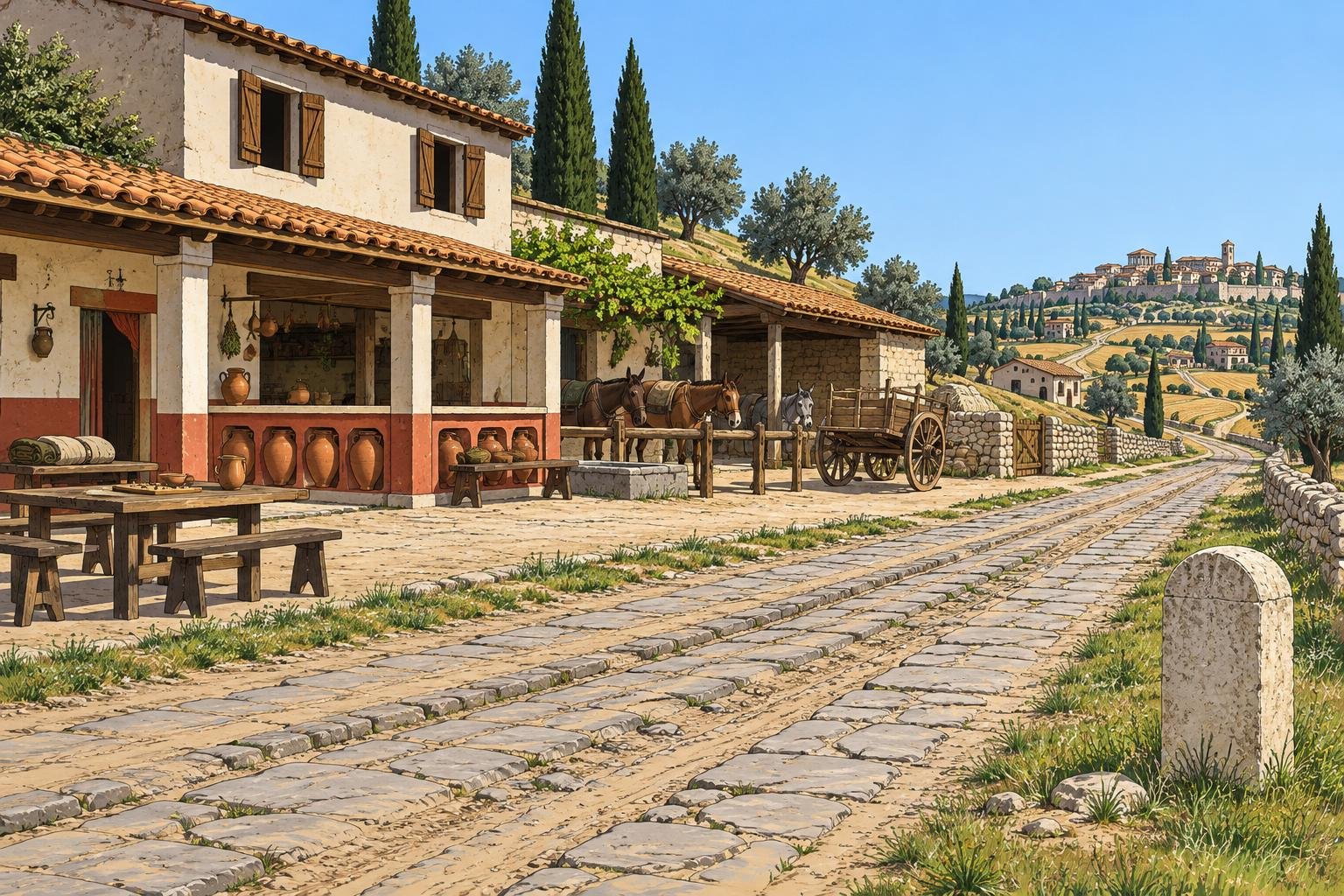
Roadside tombs mark the town's edge. The inn among them has rubble-and-plaster walls, a tile roof and a counter with jars set into it. The innkeeper's slaves serve travelers at benches by the hearth. Behind it, mules, donkeys and two-wheeled carts crowd the stable yard. Upstairs the windows have wooden shutters and no glass. Guests supply their bedding. A milestone out front gives the distance from the city in Roman miles. For a traveler's complaints about cost, dirt, water and company, see Horace on the road to Brundisium (Satires 1.5).
From Bovillae, where Clodius died in 52 BC, the Via Appia leads to Capua and Brundisium. Its inns see senators bound for their villas on the Bay of Naples and envoys fresh off ships at Brundisium or Puteoli. Rome has no state post (The Era, Travel at a Glance).
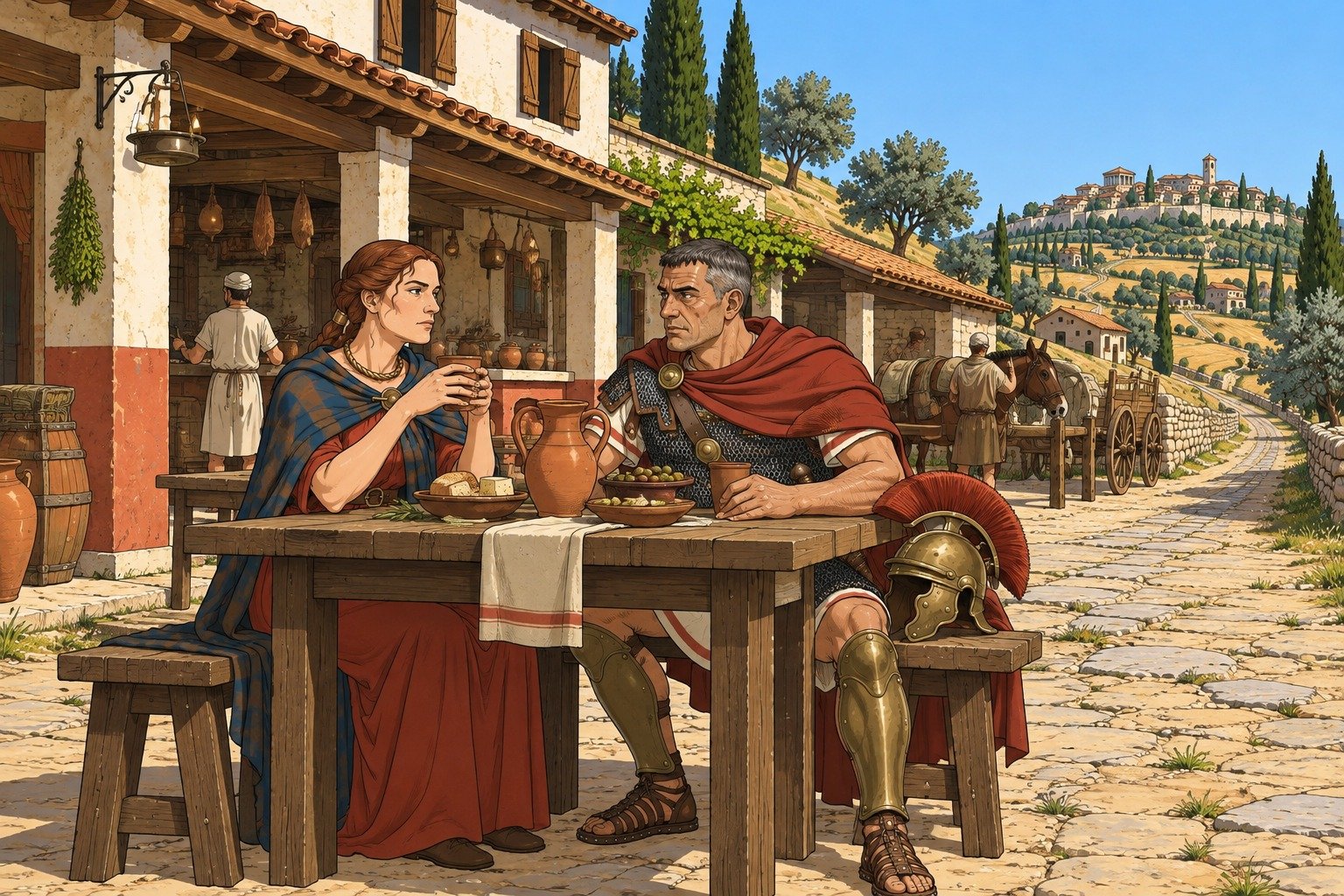
At the Table: The Road Inn
Who. The innkeeper and his slaves, a groom, carters and muleteers, letter-carriers, soldiers on leave, a senator's baggage train halting for the night. Costs. Poor keep (Gear and Prices, Living Costs); stabling and fodder at the GM's price. Danger. Theft in the night; brigands on the hill stretches; a fever caught on the road (Era Rules, Medicine and Illness). Hook. A letter-carrier asleep upstairs carries a sealed letter for a consul; the man at the next table has paid the innkeeper to wake him when the carrier leaves.
A Villa and Its Farm
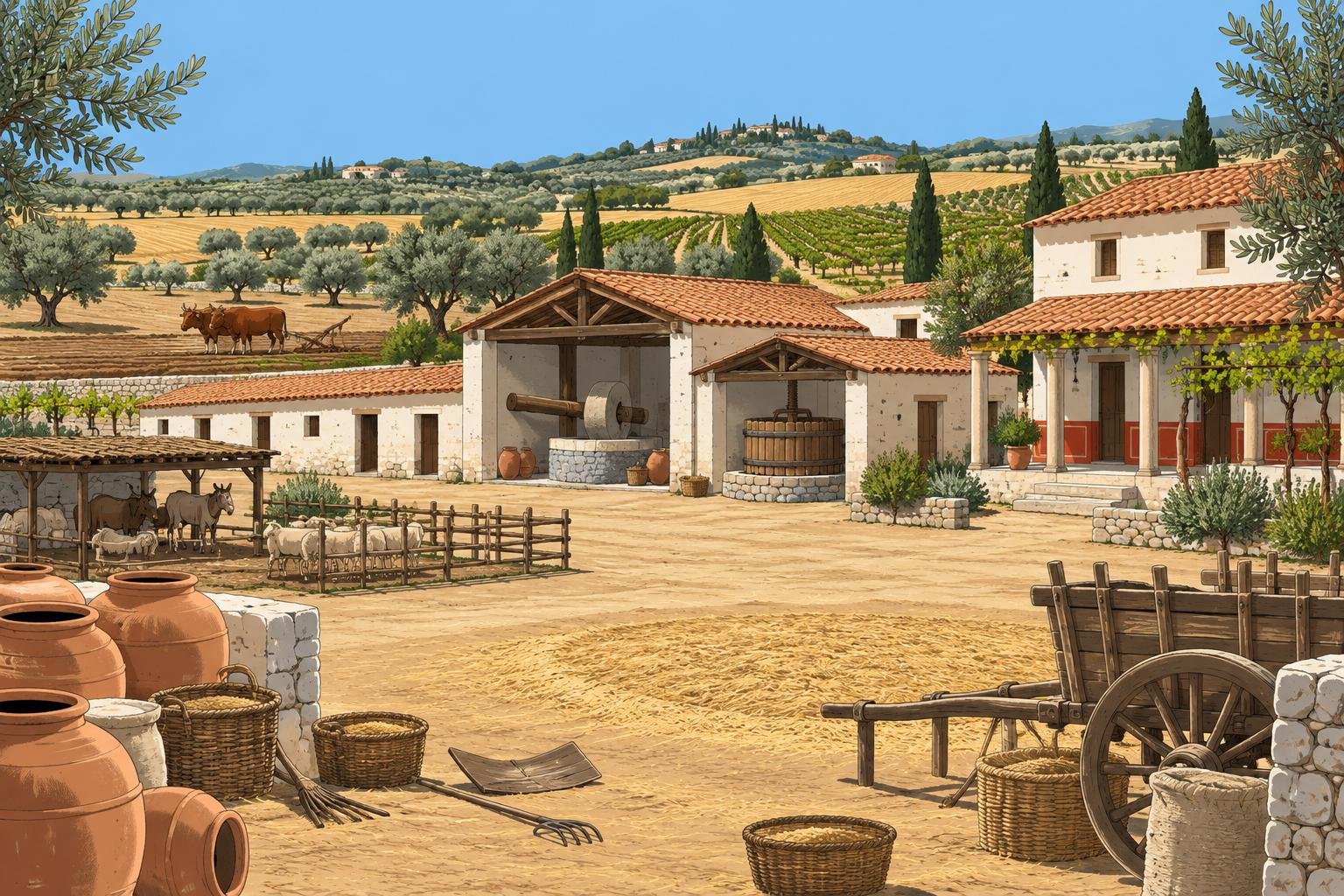
Cato and Varro describe the farm villa. Whitewashed rubble walls and tiled roofs stand among gray-green olives and vines trained on trees. Painted rooms fill the owner's pars urbana. The pars rustica has a kitchen, beam presses for oil and wine, a threshing floor, barns, jars sunk in the ground and livestock pens. Enslaved workers sleep in a dormitory. Those kept in chains sleep in cells (ergastulum). Oxen pull the plow. Wealth buys another sort of villa on the Bay of Naples, with a peristyle, terraces, fish ponds, a library and Greek statues.
The bailiff (vilicus) directs the enslaved workers and is usually enslaved himself. His wife (vilica) keeps the house and the Lar's shrine (Gods and Religion, Household Religion). The owner comes at vintage or in summer to look over the accounts. Fabia's family holds an estate like this.
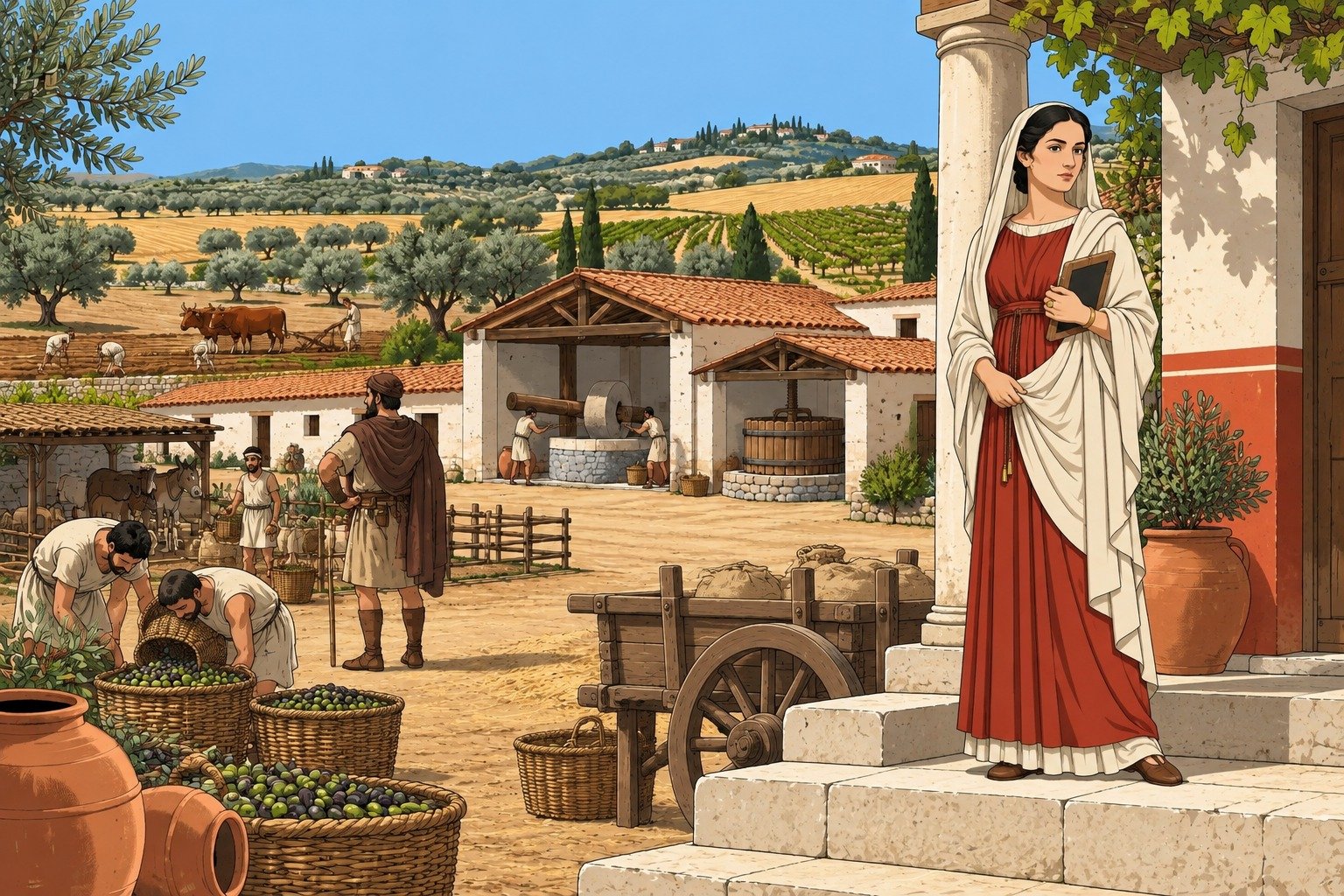
At the Table: The Villa
Who. The bailiff and his wife; field hands, shepherds and press-men; a steward from the town house; the owner's guests. Costs. A villa's worth and the price of its fittings are in Gear and Prices, What the Record Gives; the people on it are property under Era Rules, Slavery. Danger. A slave in flight and the men sent after him (Era Rules, Slavery, The Owner's Power and Flight); a bailiff who has been robbing his master; a neighbor's armed slaves on a boundary. Hook. The bailiff's count of hands does not match the owner's ledger by eleven, and a dealer's ship at Puteoli sails on the next fair wind.
The Ports: Puteoli and Ostia
Italy's great port is Puteoli. Ostia is a small colony at the mouth of the Tiber, where barges take goods upriver to Rome. See Rome, The Sea Gate for the quays, ships and workers. To get away, find a master sailing your way, settle a fare and wait for the wind. Come autumn, watch the sailing season.
At the Table: The Port
Who. Shipmasters and their agents, porters, customs men of the tax companies, grain factors, dealers in people with captives from Gaul. Costs. Fares and freight in Gear and Prices; keep while waiting for a wind. Danger. The last ship of the season (Era Rules, Travel, By Sea); a cargo seized for debt at the quay. Hook. A shipmaster bound for Alexandria will take passengers only if they also take a crate he will not open in front of the customs man.
A Gallic Road
Beyond the old province, Gallic tracks follow rivers between oppida. Farms, sacred groves and fords mark the way through country without Roman roads or towns. The army draws the traffic. Allied grain and escorted tribute go to the troops, wine goes to the nobles, and dealers drive captives south (Gaul and the Provinces, Trade and the Roads). In 50 BC the legions winter among the conquered peoples. The roads between camps are quiet and watched.
At the Table: The Gallic Road
Who. A grain convoy and its cohort; an Aeduan noble riding with his armed followers; a Roman wine trader and his slaves; a Gallic guide paid by the day. Costs. A guide and an escort at the GM's price; supply on the march is in Legion Battles, Ground, Numbers and Supply. Danger. A people that has not forgotten 52 BC; a ford in flood; a guide who serves two masters. Hook. A convoy of the Aedui's grain is a day late to a winter camp, and its escort's centurion wants to know whether the Aedui sent it late on purpose.
A Wayside Shrine and the Tombs
Tombs line the roads out of Roman towns. At a country crossroads, the district keeps a shrine to the Lares Compitales and holds its festival (Gods and Religion, The Crossroads). A traveler can leave wine or a cake. The dead have their names cut where passersby can read them. Their families come at Parentalia.
At the Table: The Shrine
Who. Country people at the festival; a family at its tomb; travelers who stop to pray; men who sleep among the tombs at night. Costs. An offering, a few asses. Danger. Robbers who use the tombs for cover at night. Hook. A family's tomb on the Via Appia has been opened and something taken from the urn; the heir wants it back before the Parentalia, and quietly.
A Greek City's Agora: Ephesus
In Ephesus, the great temple of Artemis and a theater cut into the hill look over a rich Greek city in the province of Asia. The river silts up its harbor and Rome's tax companies collect a heavy tax. Colonnades, temples and law courts in blue, red and gold line the agora. Governors pass through on their way to their provinces. Cicero did in 51 BC. See Gaul and the Provinces, Athens and the Greek Cities for the other Greek cities.
At the Table: The Greek City
Who. The city's council and its leading men; agents of the tax companies; Greek moneylenders and their Roman partners; priests of Artemis; envoys of kings; philosophers and students. Costs. Keep at Gear and Prices, Living Costs. Danger. A city in debt to a Roman lender at a ruinous rate; a council that sees every Roman as a tax collector. Hook. The council of Ephesus wants a Roman of standing to carry its complaint against a tax company's agent to the governor, and the agent has friends in Rome.
A Ludus at Capua
In Capua, recruits with wooden swords work at the palus in a raked sand yard. Around it stand small stone cells with plank doors, a portico, kitchen and well. A guard watches the gate. Caesar keeps a school here, and in 73 BC Spartacus escaped from the school of Lentulus Batiatus (The Era). In 50 BC Capua also holds the two legions taken from Caesar for the Parthian war (Powers of the Republic, The Last Year Before the War). For rules, the lanista's price and the fighter's ledger, see The Arena and the Games, The Ludus and the Lanista.
At the Table: The Ludus
Who. The lanista and his trainers; six to twelve fighters at drill; guards at the gate; a physician; an editor's agent come to hire pairs for a show. Costs. Hiring and buying gladiators are in The Arena and the Games, The Editor. Danger. Armed men in a town full of soldiers; a fighter planning flight. Hook. An agent hires four pairs for a munus in a country town and pays half in advance; the lanista suspects the heir who is giving the show means to have one of his men killed in the ring.
A Crossroads Market
On the eighth day, farmers bring oil, wine, cheese, wool and livestock into town (Rome, A Day in the City). Magistrates check weights and hear disputes in the forum. A dealer puts people on a platform for sale with a placard at each neck. Rome's news arrives a day or two late on somebody's feet.
At the Table: The Market
Who. Farmers and their bailiffs, a moneylender at a table, a slave dealer, a town magistrate, a candidate's agent shaking hands. Costs. Goods at Gear and Prices; people at Gear and Prices, Purchased People. Danger. Short weight; a stolen animal with a brand someone knows; a dealer's lie about where a captive came from. Hook. A candidate in Rome needs the voters of this town in the city on election day, and their landlord wants a favor for every one of them who walks.
A River Crossing: The Rubicon
At an unbridged river, look for a ford or a ferry. A ferryman runs his flat boat along a rope and names his fare. In spring the water can stop traffic altogether. The Rubicon, north of Ariminum, is a small river between Caesar's Cisalpine Gaul and Italy. A governor's command of his army ends at the edge of his province. In 50 BC every courier between Caesar and Rome crosses that frontier.
At the Table: The Crossing
Who. The ferryman or the men who know the ford; travelers waiting on the bank; Caesar's officers watching the road south; agents of the consuls watching it north. Costs. A ferry fare of a few asses; more when the river is high. Danger. A crossing in flood; a pack animal lost with its load. Hook. A courier riding north to Caesar has been turned back at the river by a man with a forged order, and he needs proof of the forgery before his next ride.
Part Three: Campaign Tools
The Campaign Frame
Pick one of three frames for play between 58 and 44 BC, with 50 BC as the default. Dates marked record come from the timeline in The Era. Set dates marked choice as GM. Use Running the Era, The Approach of the Civil War if the table wants to depart from the historical record.
| Frame | Years | The characters | Their problem |
|---|---|---|---|
| The Gallic Command | 58 to 51 BC | A century, an officer's staff, a trader or an Aeduan house in Gaul | Eight years of war in Gaul, and a city that votes on the general's command while he is away (Gaul and the Provinces; Legion Battles) |
| The Last Year | 50 BC | Clients, freedmen, a gladiator, a priest and an envoy in Rome and Italy | Every house must choose between Caesar and his enemies before the year ends (Powers of the Republic, The Last Year Before the War). The Starter Adventure opens it |
| The War | 49 to 44 BC | Any of the above, on one side or the other | Italy, Greece, Egypt, Africa and Spain at war; then a dictator in Rome and the Ides of March |
How the Year Moves
| When | What moves | Record or choice | Use it |
|---|---|---|---|
| 1 January | New consuls take office | Record | Every client attends; a new patron or an old one loses his power |
| Spring | Armies leave winter quarters; the sea opens (by the sun) | Record (season); the day is choice | A legion marches; an envoy sails; a governor sets out |
| The months before the elections | The canvass (Era Rules, Patronage and Rank, Elections) | Record (usual practice); the election day is choice, and a presiding magistrate can delay it | Three or four months of canvass, bribes and street work |
| Quintilis (usual) | Elections in the Campus Martius | Record (usual); day is choice | The vote; then the bribery trials (Era Rules, Law and Courts) |
| The festival days | Games and festivals (Gods and Religion, The Roman Year; The Arena and the Games) | Record (the days); who gives the games is choice | A crowd, a show, a magistrate's reputation |
| Autumn | Armies go into winter quarters; the sea closes (by the sun) | Record (season); day is choice | News stops; envoys are stranded; a winter in a strange city |
| 10 December | New tribunes take office | Record | A veto changes hands |
| Any month | A trial, a death, a will, a funeral munus | Choice | The incident that starts a session |
THE COMMAND YEAR BY YEAR
I 58 to 56 BC (record). Caesar's command in Gaul begins, and after the meeting at Luca (56 BC) it is renewed by law in 55 BC; Clodius's gangs hold the streets; Cicero is exiled and recalled (The Era). Play: the characters choose a patron while the patrons are still allies.
II 55 to 53 BC (record). Pompey and Crassus are consuls; Crassus goes east and dies at Carrhae; Julia dies and the tie between Pompey and Caesar loosens. Play: a death in a great house sets every client loose.
III 52 to 51 BC (record). Clodius is killed and the Curia burns; Pompey is sole consul; Gaul rises and falls at Alesia; the first motions to recall Caesar. Play: violence in the street, war in Gaul, law in the courts.
IV 50 BC (record). The dispute over Caesar's command fills the year (Powers of the Republic, The Last Year Before the War). Play: every Favor called in is a vote for one side.
V 49 to 44 BC (record). The Rubicon, the war, Pharsalus, Alexandria, the dictatorship and the Ides (The Era, The Record Beyond the Map Year; whether the table may change it is in Running the Era, The Approach of the Civil War). Play: the patrons the characters chose now stand on opposite sides of a battlefield.
The Seasons and the Year 50 BC
Read the month by the Roman calendar (Gods and Religion, The Roman Year). The season is five to seven weeks behind by the sun. Use it for weather, harvests, campaigning and sailing. The chapters named give the festivals and events. The table puts them to work.
| Month (Roman) | Season by the sun, about | In the city | On the roads and the sea | Prompt |
|---|---|---|---|---|
| January | Late autumn into winter | New consuls (Powers of the Republic) | Sea closed; legions in winter quarters | A new consul's first sitting; who sits beside whom |
| February | Midwinter | Parentalia; Lupercalia | Sea closed | Business stops; a family can be found at its tomb |
| March | Winter | 1 March, the question of Caesar's successor (Powers of the Republic); the Salii | Sea closed | Curio's veto; clients asked to cheer it or hiss it |
| April | Late winter into spring | Megalesia; Cerealia; Floralia begins | The sea opens late in the month | The first ships of the year are hired; theater crowds are read |
| May | Early spring | Floralia ends; Lemuria | The sea is open; the season proper begins late in the month | Envoys and governors set out; the canvass begins |
| June | Spring | 7 to 15: the store of Vesta open; 9: Vestalia | Sailing season | A rite of the Vestals in the city; a voyage east |
| Quintilis | Late spring | Ludi Apollinares; 30 Quintilis, Cicero leaves Cilicia | Sailing season; armies in the field | A governor's staff and freedmen on the roads east |
| Sextilis | Early summer | Consualia; Vulcanalia | Sailing season | A summer in the villas on the bay; fire weather in the city |
| September | High summer; harvest | Ludi Romani | Sailing season | The year's great crowd; a candidate's reputation made or broken |
| October | Late summer | October Horse | Sailing season | A last campaign in Gaul before winter quarters |
| November | Autumn; the vintage | Ludi Plebeii; 24 November, Cicero lands at Brundisium | The last weeks of the sailing season | Every ship in port wants to sail now |
| December | Late autumn | 1 December, the Senate's vote; 10 December, new tribunes; Saturnalia | The season ends; the sea closes late in the month | Two vetoes in Caesar's hands; a household turned about |
The Favor Ledger Across Sessions
Use these ledger practices across sessions. The rules are in Era Rules, Patronage and Rank (The Petition and Calling In).
- One line per patron, on the GM's sheet. Record his name, Favors owed, Credits held and his latest request. Have players copy their own lines onto their sheets.
- The call comes at the start of the session. Pick something the patron needs this month. Ask for a vote during the canvass, an escort on a festival day or a letter carried when the sea opens.
- A patron away is a patron by letter. If he's with the army or in his province, send Petitions and calls by letter. Count the days on the road from Part One.
- Between sessions. If months have passed, a patron can call in a job the character did during the gap. Ask how it went and make any check then.
- When a patron falls. Stop his calls if he is exiled, condemned or killed. Decide whether an heir or a faction claims the debt. If the character refuses, apply the cost from the rules.
- In the war years. From 49 BC a patron may call in a Favor by asking a character to take his side. Use the same ledger.
A LEDGER LINE
| Patron | Favors owed | Credits held | Last call | Note |
|---|---|---|---|---|
| Fabia's father | 2 | 0 | Escort to the Campus on election day | Standing for praetor; asks for votes |
| Eros (as lender) | 0 | 1 | Owes the character for the warning about the Ephesus agent |
Factions and Their Tracks
Give each track six boxes. Mark one when its trigger occurs or when a calendar month passes without the characters intervening. At three, the faction acts in the open. At six, it gets its way. An end marked record follows history by default (Running the Era, The Approach of the Civil War).
| Faction | Fills a box | At three | At six |
|---|---|---|---|
| Caesar's Command (Caesar, Curio, Antony) | A veto holds; a senator is bought or won; a legion stays loyal | Caesar's agents ask openly for Favors in Rome; his letters reach the Senate | Record: Caesar marches into Italy (The Era, The Record Beyond the Map Year) |
| The Hard Line (Cato, the Marcelli, and Pompey as he joins them) | A motion against Caesar is carried; a Caesarian is prosecuted; Pompey is seen with the consuls | The consul hands Pompey the legions at Capua | Record: the Senate's emergency decree, and the tribunes flee |
| The Crossroads (Papirius and the street colleges) | A meeting broken up; a shrine taken; a trial witness frightened off | The Forum cannot be used on a voting day without a gang | Choice: the street boss's patron wins an election by force, or the boss is prosecuted and his men scatter |
| The Creditors (moneylenders, tax companies, the lenders to Egypt's crown) | A debt falls due; a province's tax contract changes hands; a debtor of rank is pressed | A senator in debt votes as his creditors tell him | Choice: a great house is sold up, or a law cancels debts and ruins the lenders |
| The Quiet in Gaul (the Aedui and the conquered peoples) | A hostage is not returned; a tribute is raised; a Roman trader is killed | A people refuses grain to a winter camp | Choice: a rising in one district, or a settlement carried to Rome by its envoys |
Hook Generator
Roll two different-colored six-sided dice. Use the first die to find a row in the first column and the second die for the other column. Combine the results. Take checks and Difficulty from the rules each table names.
| d6 | Rumors: it is said that... | ...and the truth is |
|---|---|---|
| 1 | Caesar's agents are buying senators with Gallic gold | it is true, and one man can prove it |
| 2 | Pompey is ill at his villa | it was true last month and is not now |
| 3 | A tax company is about to fail | it is a lie spread by a rival |
| 4 | Egypt will pay its debts to Rome in grain | it is half true, and the false half is the dangerous one |
| 5 | The legions at Capua will not march against their old general | it is true, and the man who tells it is paid to spread it |
| 6 | A senator on the censors' list has bribed a clerk | it is false, but enough people believe it to make it true within a month |
| d6 | Patrons' asks: the patron calls in a Favor to... | ...but |
|---|---|---|
| 1 | Cast a vote or bring a block of voters to the Campus | a rival patron asks the same of the character the same day |
| 2 | Escort him or his son to the Forum | it needs money the character does not have |
| 3 | Testify at a trial | it is not quite lawful |
| 4 | Carry a letter to his friend in a province | someone else wants it to fail and is watching |
| 5 | Watch a man and report who visits him | the person it touches is the character's friend |
| 6 | Collect a debt | the person it touches outranks the character |
Use Calling In (Era Rules, Patronage and Rank) for these calls. Roll Average by default.
| d6 | Complications: where... | ...what goes wrong |
|---|---|---|
| 1 | On the road | an animal goes lame or a cart breaks, and help is a day away |
| 2 | At the port | nothing moves until a sacrifice goes well |
| 3 | In the Forum | a bad sign is announced and the business stops |
| 4 | In a great house | a slave has overheard everything |
| 5 | In the camp | a man in authority wants a share |
| 6 | In the market | a creditor of the character's is there |
| d6 | Travelers: on the road the party meets... | ...who wants |
|---|---|---|
| 1 | A senator's letter-carrier, alone | company to the next town, because the road is dangerous |
| 2 | A returning governor's baggage train | a witness who will swear the accounts are honest |
| 3 | Soldiers invalided home from Gaul | news of the land law |
| 4 | A dealer driving captives south | to sell something here, cheap, with no questions asked |
| 5 | A band of the Great Mother's Galli | alms and a safe night |
| 6 | A tax company's agent with a strongbox | an escort, and pays well |
| d6 | Omens: someone sees... | ...and it is read as |
|---|---|---|
| 1 | Thunder and lightning during an assembly | a sign from Jupiter that stops the business of the day |
| 2 | Birds flying the wrong way at an auspice | the gods' refusal of a magistrate's plan |
| 3 | A flaw in the liver of a victim | a vow that must be paid again |
| 4 | A statue that seems to sweat | a prodigy for the Senate to expiate |
| 5 | A dream of a dead father | a warning to a son |
| 6 | A swarm of bees on a standard | a disaster for the army, by the soldiers' reckoning |
An omen changes how people act because they believe it. For taking signs, reading them and setting Attitude as GM, see Gods and Religion, Signs, Omens and the Auspices.
More Hooks
| Hook | Who | The offer |
|---|---|---|
| The Ashes | Septimius | A man of his century died in Gaul; his ashes and his savings must reach his mother in a town on the Via Flaminia, and his heir in the century wants the savings to arrive lighter |
| The Bailiff's Accounts | Fabia | Her father's villa reports a poor vintage; Fabia wants to know why the bailiff has bought land in the next valley |
| The Hired Pair | Bithys | His lanista hires him to a funeral munus in a country town; the heir giving it has paid someone to make sure Bithys does not walk out |
| Before the Sea Closes | Kallias | He must sail for Alexandria this autumn; by the calendar window the sea closed weeks ago, by the sun a few weeks remain (Era Rules, Travel), and the only master willing to sail reads the sun |
| The Voters' Road | Papirius | His patron needs two hundred voters walked in from the country towns for election day, fed and kept sober, past a rival's gang on the road |
| The Fever at the Inn | Chryseis | A senator's son lies sick at an inn on the Via Appia; Chryseis is lent to treat him, and his father's enemy has an interest in his dying |
| The River Landing | Banona | Aeduan grain for the winter camps is held at the river landing; a Roman trader holds the boats for a debt, and her people will be blamed for the delay |
| The Letter at Ariminum | Eros | A loan to one of Caesar's officers falls due; the officer is in Cisalpine Gaul and pays only by letter carried across the Rubicon |