
Build the battle around the player characters' unit. Field one to six units a side, with 80 men to a century or 480 to a cohort. In each Clash, roll one Core Opposed Check per engaged pair. Your checks can give your unit dice, and its losses can deal you hits. Expect four or five Clashes. Use the Core Rules for characters and this subsystem for units. See Era Rules, Patronage and Rank, for Favors and Dignitas. Keep Dignitas dice out of unit checks.
| Rule | What it settles | Type |
|---|---|---|
| Units | A unit's Quality, Strength and Discipline | Adds |
| The Clash | One round of the battle between two units | Adds; uses Core Opposed Checks |
| Ground, Numbers and Supply | The dice the field and the commissariat give | Adds |
| Characters in the Line | Your Action each Clash, your hits, the break, the losses | Adds; uses Core Assisted Checks and Critical Injuries |
| The Pilum | The legionary's javelin and the enemy's shield | Scopes the Javelin of The Fantasy Armory; Modifies Core Combat Boon Spends |
| Camp and Siege Works | The nightly camp and the works of a siege | Adds; uses Core Group Checks and Extended Checks |
| Horse Archers and Locked Shields | Mounted archers who will not close | Scopes the Clash |
Units
Adds. Rate a unit as one body, as you would a Core Minion group (Core Rules, Adversaries, Minions). Use Strength steps in place of Wound Points and roll Quality in place of skills. If you play out a fight between individuals within the battle, use the Core adversaries in Adversaries.
TERMS: UNITS
I A unit has three ratings.
| Rating | Values |
|---|---|
| Quality | Raw: 2 Mastery Dice . Trained: 3 Mastery Dice. Veteran: 3 Mastery Dice and 1 Boon Die . |
| Strength | Four steps: Full, Worn, Half, Shattered. A Shattered unit breaks. |
| Discipline | 0 to 6. Starts at 2 (Raw), 3 (Trained) or 4 (Veteran). At 5 or 6 the unit adds 1 Boon Die to its Clash; at 1 or less it adds 1 Bane Die . At 0 the unit breaks. |
II Who is what. Rate a Gallic War century or cohort Veteran or Trained. Rate a new legion Trained at Discipline 2. A Gallic or German tribal levy is Raw and a Gallic noble's mailed following is Trained.
III Leaders. Choose one leader to roll Discipline: a centurion for a century, a senior centurion or tribune for a cohort. If a player character commands the unit, use that character.
EXAMPLE: SEPTIMIUS'S CENTURY
The second century of Septimius's cohort has been in Gaul since 58 BC. The GM rates it Veteran, starting at Full Strength and Discipline 4 with a pool of 3 Mastery Dice and 1 Boon Die. Its commander Septimius rolls Discipline with his Charisma and Leadership. At Alesia he faces a Raw Gallic levy at Discipline 2.
The Clash
Adds a Clash between units (Core Rules, Types of Checks, Opposed Checks). Neither side adds Trial Dice for the other. Modifies the check to count net Successes alone. The GM may narrate other results without effect. Leave Story Points out of unit rolls.
TERMS: THE CLASH
I The roll. Both engaged units roll Quality with applicable Boon and Bane Dice. More net Successes wins. Subtract the lower net Success count from the higher for the margin. On a tie the unit holding ground holds, or both hold if both advanced. Change nothing.
II The loss. Drop one Strength step when beaten by 1 or 2. Lose 1 Discipline as well if the margin is at least 3.
III The Discipline test. Before each Clash, the leader of a unit at Half or worse rolls Average Charisma + Leadership. Add 1 Boon Die at Discipline 5 or 6, or 1 Bane Die at 2 or less. On failure, lose 1 Discipline. On success with at least 2 net Boons , regain 1.
IV The pilum and the sword. Add 1 Boon Die for pila in the first Clash. Win it by 2 or more and the loser drops an extra step, throwing away pinned shields. Use swords and shields in later Clashes.
V The relief. The first time a unit in a line of cohorts drops a step, fresh men advance through the gaps. Regain 1 Discipline and add 1 Boon Die for the rest of the battle. Do this once per battle. Gallic or German hosts, nobles' followings and horse-archer screens lack a line of cohorts and get no relief.
VI Several units. Each Clash, pair every engaged unit with the enemy unit it faces and roll one Opposed Check for each pair. A unit attacked by two units rolls a separate Opposed Check against each. The second attacker takes the Flank row if it comes at the flank or rear, or else the Numbers row for the two attackers together (Ground, Numbers and Supply). However many of those checks it loses, the defender drops at most one Strength step and loses at most 1 Discipline from them in one Clash; the pilum's second step (IV) still applies in the first Clash. Each attacker that loses its check to the defender takes its losses as usual. In a battle too wide to run whole, run the stretch the player characters stand in and roll one Clash for each other stretch in play.
| Step | What happens |
|---|---|
| 1. Discipline tests | Each unit at Half or worse tests (III) |
| 2. Characters act | Each player character in a unit takes one Action (Characters in the Line) |
| 3. The roll | Each pair of engaged units makes the Opposed Check (I) |
| 4. Results | Steps and Discipline lost (II, IV); the relief (V); hits in the press; units at Shattered or Discipline 0 break |
EXAMPLE: SEPTIMIUS ON THE OUTER LINE AT ALESIA, 52 BC
At the outer works, Septimius holds a stretch with his Veteran century, Discipline 4 and pila. The finished line gives it 2 Boon Dice. A Raw relief levy, Discipline 2, comes on at four to one and gets 2 Boon Dice for numbers.
Clash 1. Neither unit needs a test because both are above Half. Septimius fights in the front rank with Might 3 and Melee 2: 2 Mastery Dice and 1 Ability Die against Average, 63.8 successes in 100. He succeeds and adds 1 Boon Die to his next Clash. His century rolls 3 Mastery Dice and 4 Boon Dice (1 Veteran, 2 works, 1 pila). The levy rolls 2 Mastery Dice and 2 Boon Dice. The century wins by 2. The levy drops one step for the margin and another for the pila, to Half.
Clash 2. At Half the levy tests. Its leader fails at Average with 1 Bane Die for Discipline 2. The levy falls to Discipline 1 and adds 1 Bane Die to the Clash. The century rolls 3 Mastery Dice and 4 Boon Dice (1 Veteran, 2 works, 1 Septimius). It wins by 3. The levy loses 1 Discipline, falls to Shattered and breaks. No one in the century's front rank takes a hit because it lost no step.
The relief army pressed the fourteen-mile outer works at several points. At any one, a Veteran century on finished works holds against a Raw levy at four to one 98.3 times in 100. Across many stretches and assaults a breach is likely. Send the player characters' century to that breach next.
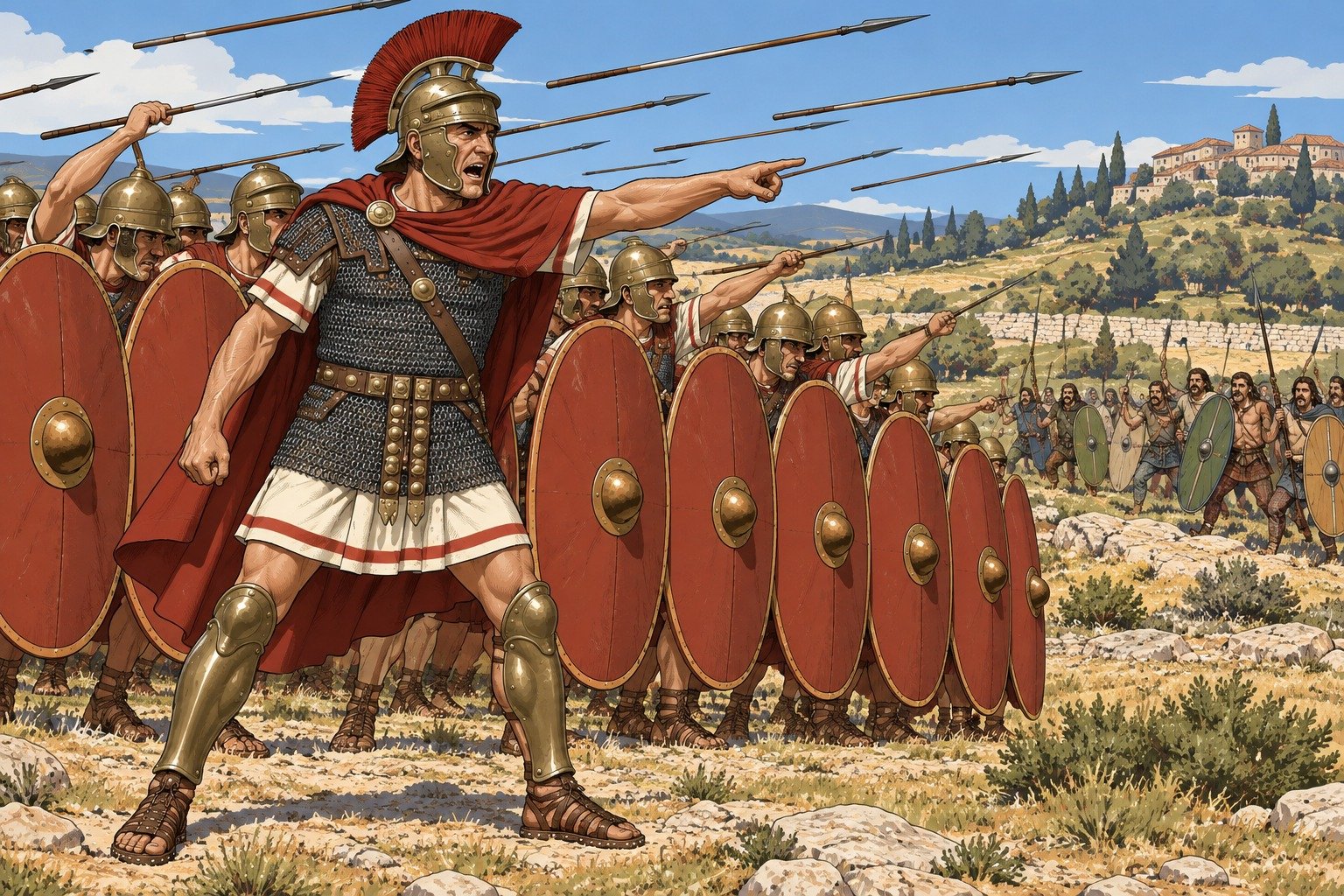
Ground, Numbers and Supply
Adds situational dice to a Clash (Core Rules, Building a Dice Pool, Adding Situational Dice). Use all matching rows.
TERMS: GROUND AND NUMBERS
| Condition | Effect on the Clash |
|---|---|
| High ground or a river bank | +1 Boon Die to the holder |
| A fortified line (a camp rampart, siege works) | +2 Boon Dice to the defender |
| Numbers 2 to 1 | +1 Boon Die to the larger side |
| Numbers 4 to 1 | +2 Boon Dice to the larger side |
| A flank or rear attack | +1 Boon Die to the attacker, +1 Bane Die to the defender |
| Supply Short | +1 Bane Die; the unit starts the battle with 1 less Discipline |
| Supply Starving | +2 Bane Dice; the unit starts the battle with 2 less Discipline |
TERMS: SUPPLY
I Start a campaign Supplied. As stores dwindle, go to Short and then Starving.
II The weekly check. Once a week, the quaestor or a player character rolls Average Negotiation to requisition from allies or Average Survival to forage. A failure worsens supply by one step. A success with at least 2 net Boons improves it by one. Spend Credits with an allied chief for requisition Boon Dice (Era Rules, Patronage and Rank).
EXAMPLE: BANONA AND THE AEDUAN GRAIN
In the spring of 52 BC the Gauls burn their own grain to starve the legions, and the army Septimius marches with falls to Short. Banona, an Aeduan noblewoman serving as an envoy to the general, asks her own people for grain: an Average Negotiation check. She has Charisma 3 and Negotiation 2, and her Dignitas 3 among the Aedui adds 1 Boon Die (Era Rules, Patronage and Rank, Dignitas III): she succeeds 70.6 times in 100. She rolls 1 net Success and 2 net Boons, and the army moves back to Supplied. Had she failed, the army would have fallen to Starving: every unit would roll 2 Bane Dice and start its next battle 2 Discipline down. A Trained unit on Short supply beats an equal enemy 32.3 times in 100; Starving, 13.7.
Characters in the Line
Adds ways to assist your unit with an individual check (Core Rules, Types of Checks, Assisted Checks). Use the Core Critical Injury rules as printed.
TERMS: YOUR ROUND
I Before the Clash roll, take one Action per player character in the unit (Core Rules, Structured Play, Actions):
- Fight in the front rank. Roll Average Melee (Core Rules, Structured Play, Attack Difficulty). On success, give your unit 1 Boon Die for the next Clash.
- Rally. Roll Average Charisma + Leadership. On success, immediately restore 1 Discipline. Regain at most 1 per unit per Clash from Rallies.
- Read the field. Roll Average Savvy + Perception. If you succeed, learn which enemy unit moves next and give your unit 1 Boon Die for its next Clash.
II The limit. Add up to 2 Boon Dice from player characters to one unit's Clash, the usual Core cap for help.
TERMS: HITS, THE BREAK AND LOSSES
I Hits in the press. When your unit drops a Strength step, take one hit if you fought in the front rank this Clash. Damage is 5 plus the loss margin, less Resistance. If your own check this Clash shows Calamity, take a Critical Injury as well (Era Rules, Calamity results).
II The break. If your unit breaks, roll Average Athletics to fall back in order, or Hard if enemy horse give chase. Fail and you're cut off. The GM chooses whether you're captured, left incapacitated among the fallen or carried off by your own men. Use only the Core Critical Injury rules for player-character death.
III Losses. Count roughly one man lost in ten for a unit that ends Worn, one in four at Half and one in three at Shattered. Most other men are wounded or scattered and return over the next few days.
IV After the battle. Raise Dignitas for a decoration or public victory (Era Rules, Patronage and Rank).
TERMS: TALENTS IN THE LINE
I Use the full talent entries in Skills and Talents. The table gives their effects in battle.
| Talent | In a Legion Battle |
|---|---|
| Vine Stick | Its Boon Die applies to the Discipline tests and Rallies of the unit you lead. |
| Marcher | A marching camp you help build is never unfinished at dark: treat 3 or more net Banes on its Group Check as low works. |
| Front Rank | Once per battle, when the unit you stand in loses a Clash, it regains 1 Discipline, to at most 6, before the loss costs any Discipline. It still drops the Strength step. |
| Tribune's Commission | You lead a cohort or a wing, and add 1 Boon Die to its Discipline tests. |
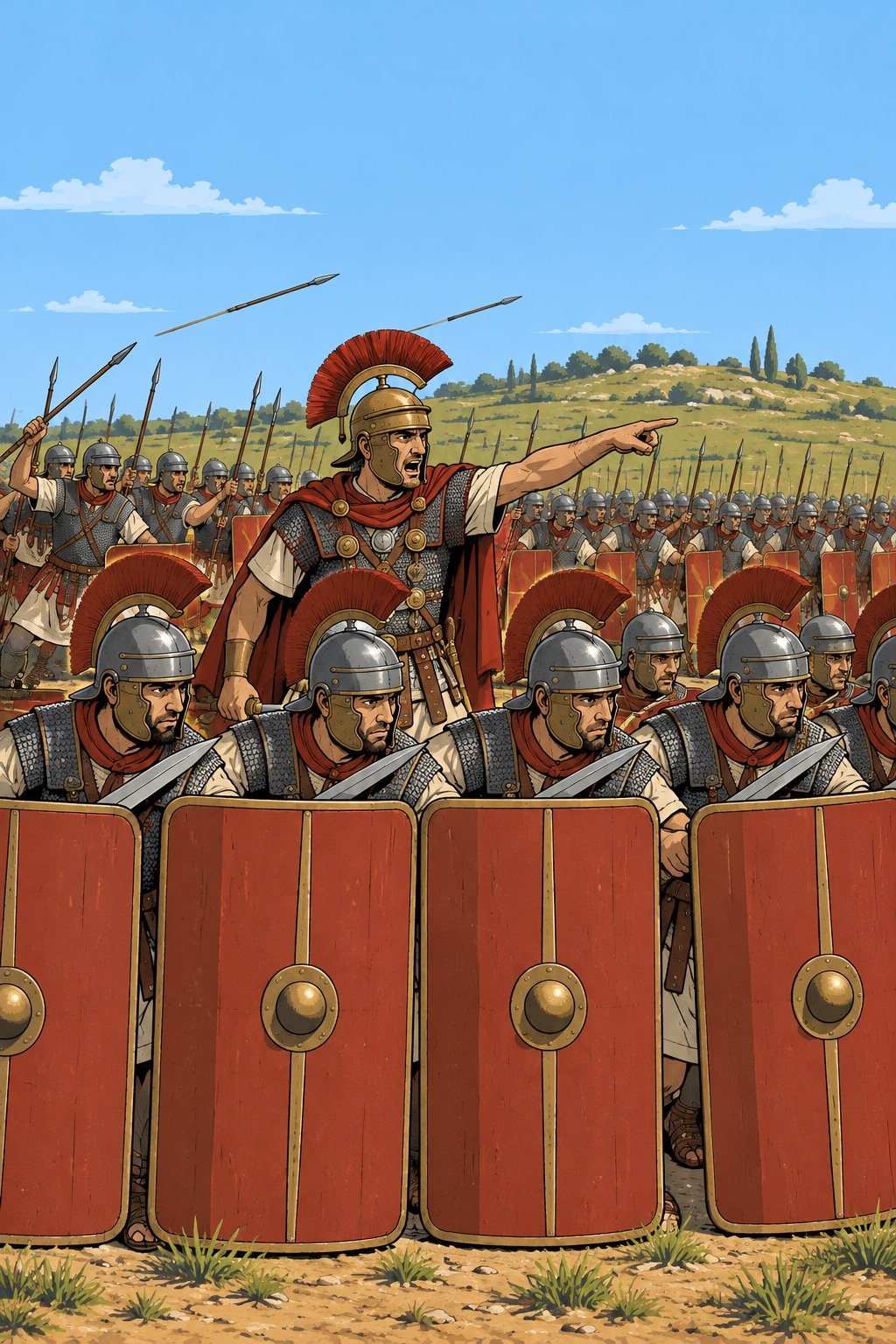
EXAMPLE: SEPTIMIUS AGAINST THE MAILED NOBLES
Septimius's century, Trained this time, Discipline 3 and carrying pila, stands in a line of cohorts against a Gallic noble's mailed following (Trained, Discipline 3) at two to one. Septimius has Might 3, Melee 2, Athletics 1, Charisma 3, Leadership 2 and Vine Stick, and wears a Mail Shirt: Resistance 4 (half his Might, rounded up, and the mail's 2), Wound Points 13.
Clash 1. Septimius fights in the front rank and fails. The century rolls 3 Mastery Dice and 1 Boon Die (pila); the nobles roll 3 Mastery Dice and 1 Boon Die (two to one). The nobles win by 1. The century drops to Worn, and Septimius takes damage 6 (5 plus the margin of 1), less Resistance 4: 2 Wounds. It is the century's first lost step in a line of cohorts, so the relief comes through: 1 Boon Die for the rest of the battle, and Discipline rises to 4.
Clash 2. Septimius fights and succeeds. The nobles win by 3: the century drops to Half and loses 1 Discipline, to 3. Septimius takes damage 8, less 4: 4 Wounds, 6 in all.
Clash 3. The century is at Half and tests. Septimius rolls Charisma + Leadership, Average, with 1 Boon Die from Vine Stick, and succeeds with no Boons to spare: Discipline holds at 3. For his Action he rallies, with the same pool, 70.6 times in 100. He succeeds, and Discipline rises to 4. The century rolls 3 Mastery Dice and 2 Boon Dice (the relief, and his fighting in Clash 2) and wins by 2: the nobles drop to Worn.
Clash 4. The test passes again. Septimius fights in the front rank and fails. The nobles win by 1, and the century drops to Shattered and breaks. Septimius takes 2 more Wounds (8 of 13) and makes his Average Athletics check to fall back, 58.4 times in 100. He fails. The GM chooses: his own men carry him off. After the battle the century has lost about one man in three; most of the rest come back to the standard over the next days.
A Trained century in this fight wins 54.3 times in 100. With a player character who wins his round about 60 times in 100, it wins 61.4.
The Pilum
Scopes the Javelin line in The Fantasy Armory to the pilum, with stats as printed. Modifies Core Rules, Structured Play, Combat Boon Spends, by adding the spend below. At unit scale, use The Clash, IV.
TERMS: THE PILUM
I Binding the shield. On a pilum hit against a shield bearer, spend 2 Boons to foul the shield. It loses Defensive and Deflection until the bearer cuts the pilum free with a Maneuver or drops the shield.
EXAMPLE: THE PILUM AT CLOSE RANGE
Septimius throws his pilum at a Gallic noble at Short range. At Agility 2 and no Ranged, roll 2 Ability Dice at Easy, with 2 Bane Dice for the oval shield's Deflection 2. He hits with 1 net Success and 2 net Boons. He spends both Boons to bind the shield. It adds no Bane Dice against him until the Gaul cuts the pilum free with a Maneuver.
Camp and Siege Works
Adds a Group Check for the nightly camp and an Extended Check for siege works (Core Rules, Types of Checks).
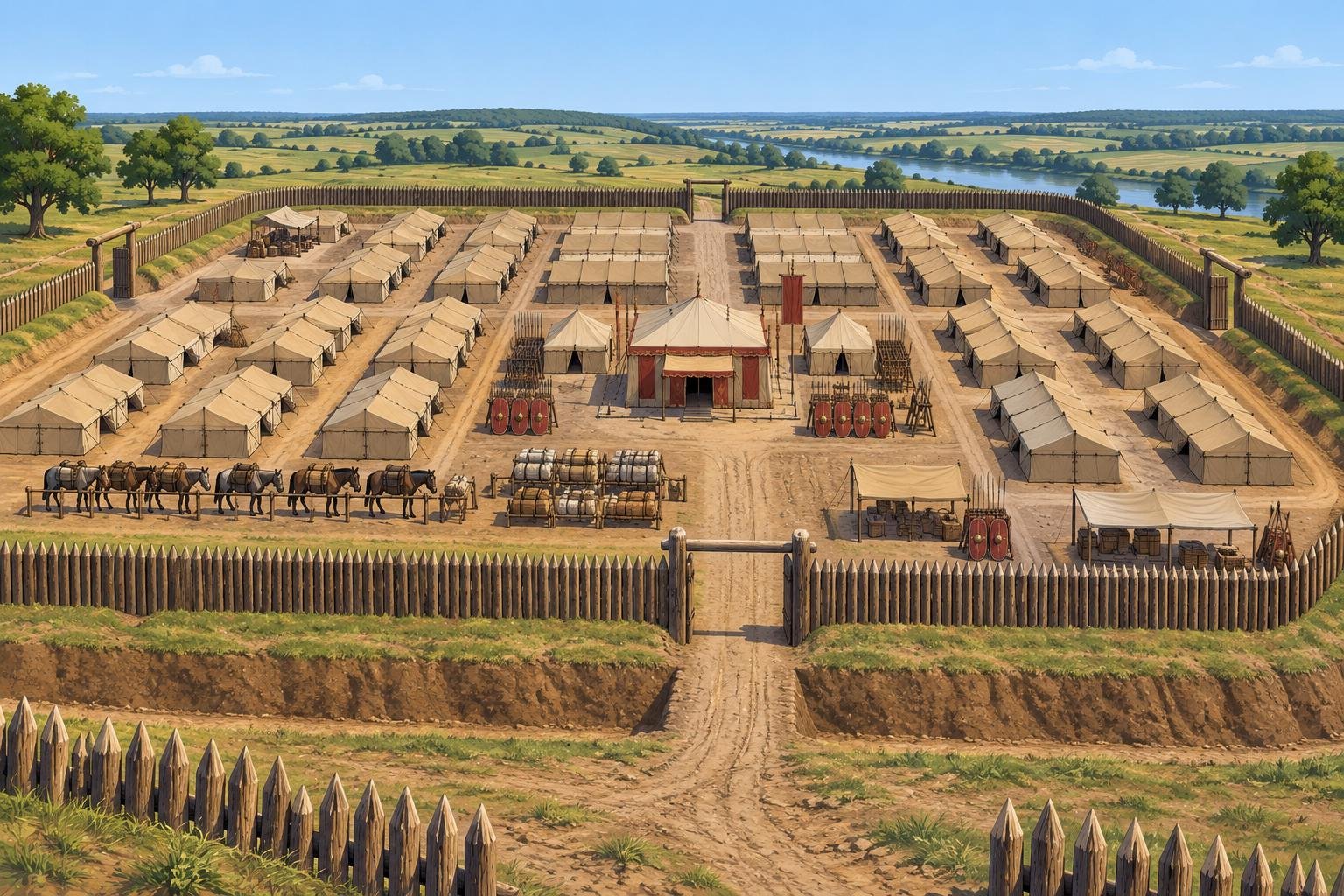
TERMS: THE MARCHING CAMP
I Each evening on campaign, dig a ditch, raise a rampart and drive stakes. The best-placed character rolls an Average Might + Athletics Group Check.
Apply three or more net Banes first, whether the roll succeeds or fails (IV). Otherwise use Success (II) or Failure (III).
II Success. Defend the camp as a fortified line with +2 Boon Dice. If your unit breaks within reach of the camp, rally inside at Discipline 1 instead of routing.
III Failure. The works are low: +1 Boon Die to defend them.
IV Three or more net Banes. Leave the works unfinished at dark. If attacked that night, defend with +1 Bane Die while still digging.
TERMS: SIEGE WORKS
I To build siege works, the engineer rolls a Hard Intellect + Craft Extended Check. Add 2 Boon Dice if a legion supplies the labor.
| Work | Threshold | Time per roll |
|---|---|---|
| A ramp against a Gallic wall | 6 | 5 days |
| A line of ditch, rampart and towers round a hill-town (each line) | 8 | 1 week |
II Sallies. On each roll, the besieged can sally and fight one Clash against the guards of the works.
III Finished works are a fortified line against attack from the side they face.
IV Engines. Use Ranged to shoot the scorpio, catapulta or stone-throwing ballista from the works. Their lines are Scorpion, Ballista and Onager (The Heavy Armory; Skills and Talents, Melee and Ranged).
EXAMPLE: THE CAMP AND THE LINES
The camp. On the march to Alesia, Septimius performs his century's Group Check: Might 3 and Athletics 1, Average, a success 58.4 times in 100. Digging is raw effort, so the GM compares Might in place of skill rank (Core Rules, Types of Checks, Group Checks); the century's diggers are as strong as Septimius, so no Bane Dice are added. He succeeds: a fortified line for the night. Had he rolled 3 net Banes, his Marcher talent would have turned the result into low works.
The lines. At Alesia the legion's chief engineer (Intellect 3, Craft 3) rolls Hard with 2 Boon Dice for the legion's labor, one roll a week, toward a threshold of 8 for each line. The two lines take 5.8 weeks each on average. In the third week the town sallies against the stretch Septimius's century guards: one Clash, which the century wins, and the work goes on. A ramp against a Gallic wall needs 4.5 rolls on average, about 23 days; the ramp at Avaricum took 25.
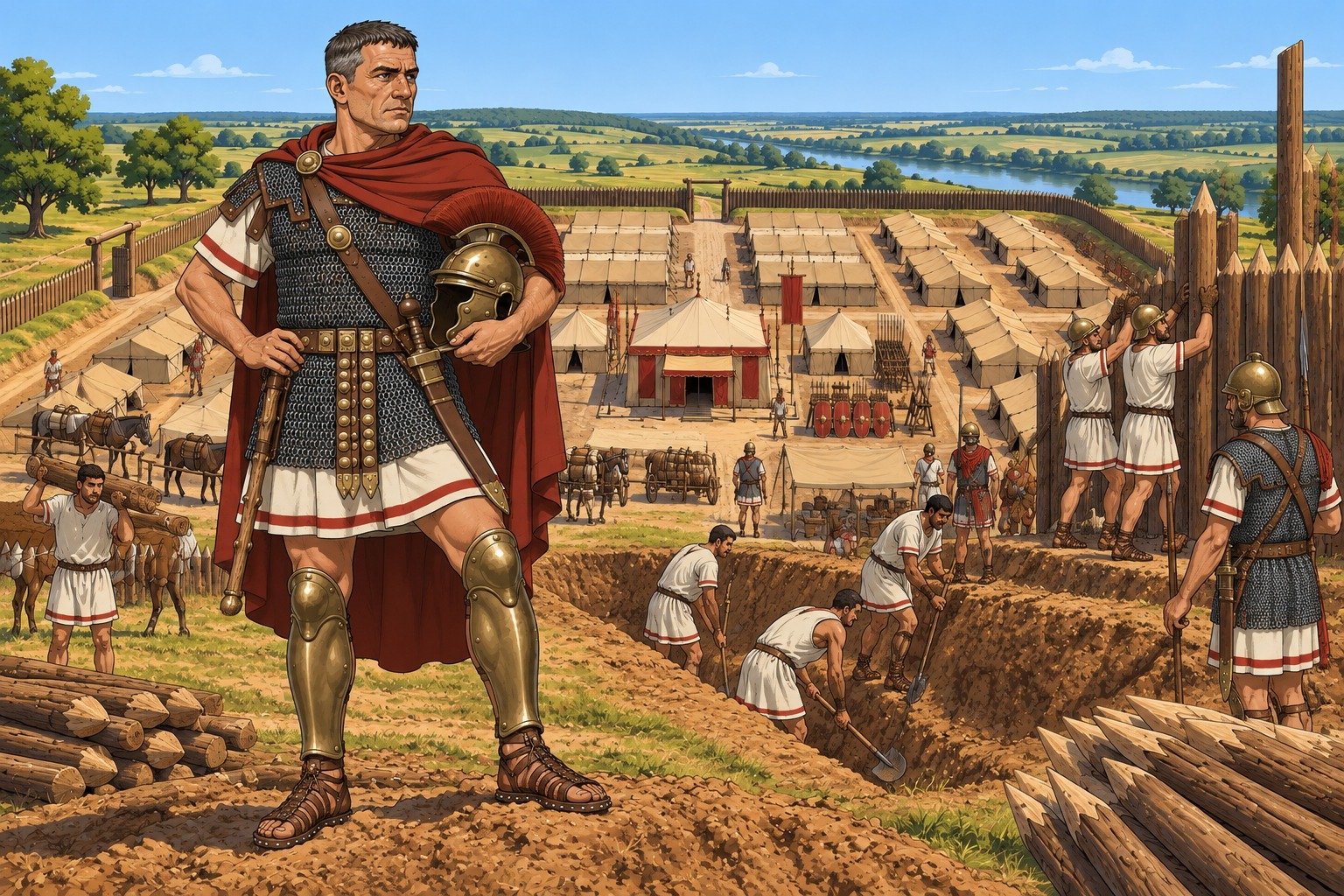
LEGEND: ONE IN TEN
Crassus revives an old punishment when his men run from Spartacus in 72 BC. Plutarch says he takes 500 of the first to flee and groups them by tens. The men in each group club one of their own to death. Appian tells of a whole army decimated and one version with 4,000 dead. Romans remember it as their grandfathers' punishment.
Horse Archers and Locked Shields
Scopes the Clash to mounted archers who keep their distance, such as the Parthians at Carrhae. Use the limits below.
TERMS: THE SCREEN
I The screen. Roll Clashes as usual for mounted archers who refuse to close. On a loss they ride away without taking losses. On a win, the infantry lose steps normally.
II Arrows. Give the screen 4 Clashes of arrows unless camels carry more in a supply train. When arrows run out, close and fight normally or withdraw.
III Locked shields. Choose to lock shields. The screen adds 2 Bane Dice against you while you hold formation, and you cannot advance.
EXAMPLE: A CARRHAE SCREEN, 53 BC
In a game set in Crassus's army, the player characters' cohort (Veteran, Discipline 4) stands in the square against a screen of Parthian horse archers (Trained) with a camel train behind it.
Clash 1. The cohort wins by 2; the archers ride off and lose nothing. Clash 2. The archers win by 1, and the cohort drops to Worn. Clash 3. The archers win by 2, and the cohort drops to Half; the front-rank player characters take their hits each time. The centurion orders shields locked. From Clash 4 on, the archers roll 2 Bane Dice, but the cohort cannot advance, and the camels keep the quivers full.
A Veteran cohort against a screen with a camel train breaks 63.5 times in 100; in the rest it is still standing after 12 Clashes. In locked shields it breaks 33.8 times in 100. Without the camel train the screen's arrows run out after 4 Clashes and it breaks the cohort only 5.0 times in 100. A Trained cohort on Short supply breaks 94.6 times in 100. If the player characters' horsemen break the camel train's guard in a Clash of their own, the screen has 4 Clashes of arrows left.
Battle Odds
Each row simulates 10,000 to 200,000 battles of one unit a side. Both leaders use Charisma 3 and Leadership 2. The first unit named is Roman, and so is the enemy unless marked Gallic. Romans have pila and relief from the line of cohorts (The Clash, V). Gallic units have neither.
| Match | Roman unit wins | Enemy wins | Clashes, average |
|---|---|---|---|
| Trained against Trained | 49.7 | 50.3 | 4.7 |
| Veteran against Trained | 69.7 | 30.3 | 4.6 |
| Veteran, Discipline 6, against Trained | 77.8 | 22.1 | 4.3 |
| Veteran against a Raw levy, equal numbers | 99.2 | 0.8 | 3.3 |
| Veteran against a Raw levy at 4 to 1 | 92.7 | 7.3 | 4.0 |
| Veteran on finished works against a Raw levy at 4 to 1 | 98.3 | 1.7 | 3.3 |
| Trained against Gallic nobles (Trained) at 2 to 1 | 54.3 | 45.7 | 4.9 |
| Trained with a player character who wins his round about 60 times in 100, against Trained | 56.9 | 43.0 | 4.7 |
| Trained, Discipline 1, against Trained, Discipline 3 | 33.5 | 66.5 | 4.4 |
| Trained on Short supply against Trained | 32.3 | 67.6 | 4.5 |
| Trained, Starving, against Trained | 13.7 | 86.1 | 3.9 |
Discipline tests. A leader with Charisma 3 and Leadership 2 fails an Average Discipline test 29.4 times in 100 at Discipline 6, 36.2 at Discipline 4 and 44.6 at Discipline 2. A green centurion (Charisma 2, Leadership 1) fails 48.7, 57.9 and 66.1 times in 100. A chief centurion (Charisma 3, Leadership 3) fails 25.0, 31.1 and 39.4.
Failure States
- A Strength step lost: hits on every player character who fought in the front rank that Clash.
- Discipline lost: at 1 or less a Bane Die on every Clash; at 0 the unit breaks.
- The break: an Athletics check to fall back; on a failure, capture, incapacity among the fallen, or rescue by your own men.
- Supply Short or Starving: Bane Dice in every Clash and less Discipline at the start of the next battle.
- A camp unfinished at dark: a night attack catches the unit digging.
- Against a screen: steps lost with no step taken back, until the arrows run out or the camel train falls.