A Roman who comes ashore in Alexandria answers to the king's officers. His citizenship has no standing here. The Ptolemies rule Egypt from a Greek-speaking capital, the Mediterranean's second city. Rome holds their late king's debts and the guardianship of his will. The troops that restored him are still in Egypt. From Alexandria come grain, linen, papyrus and books. A campaign might send characters to collect a debt, buy cargo, copy a book or carry letters between courts. A man beyond the reach of a Roman court might decide to stay the season.
Everything below is the city in 50 BC.
The Harbors and the Pharos
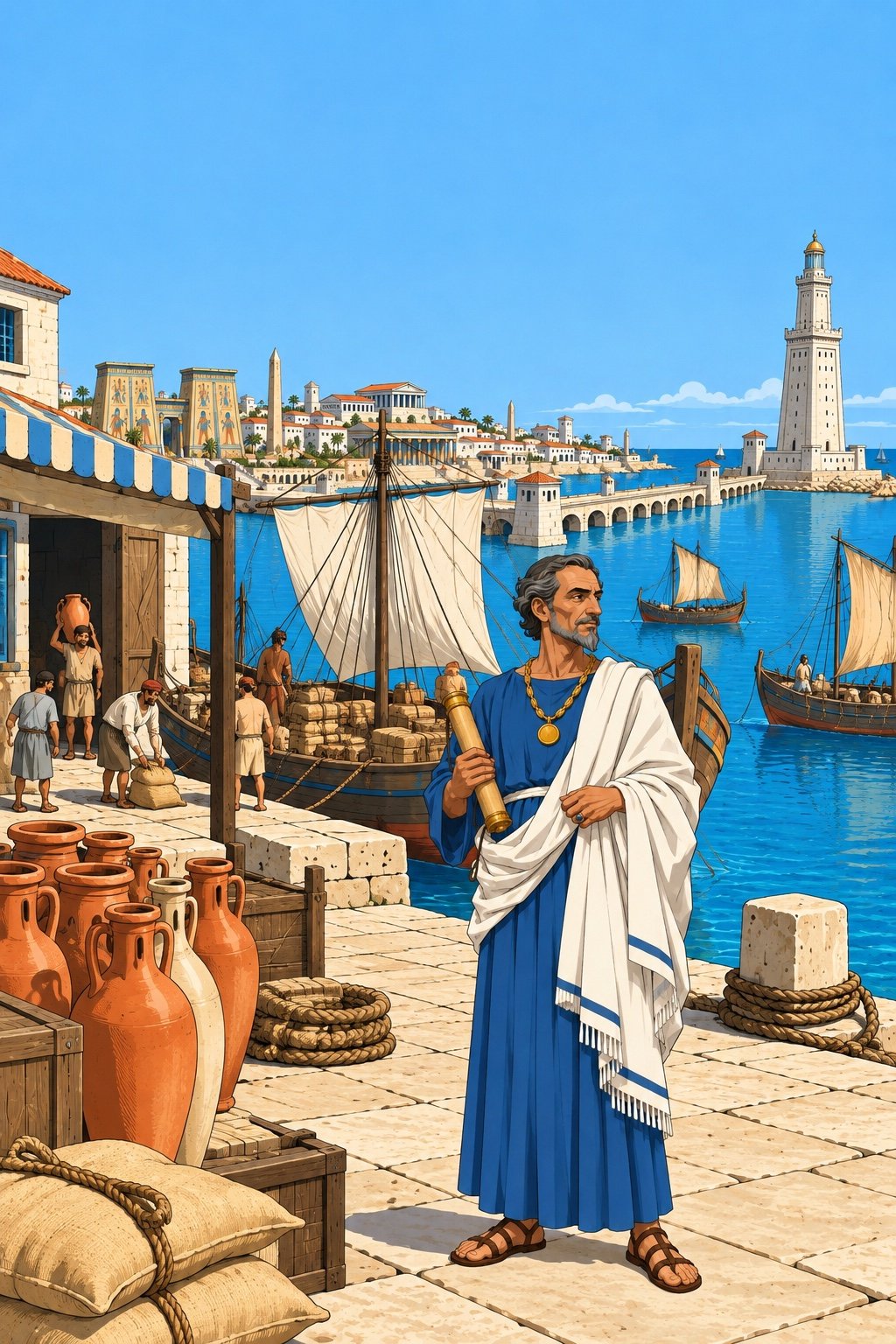
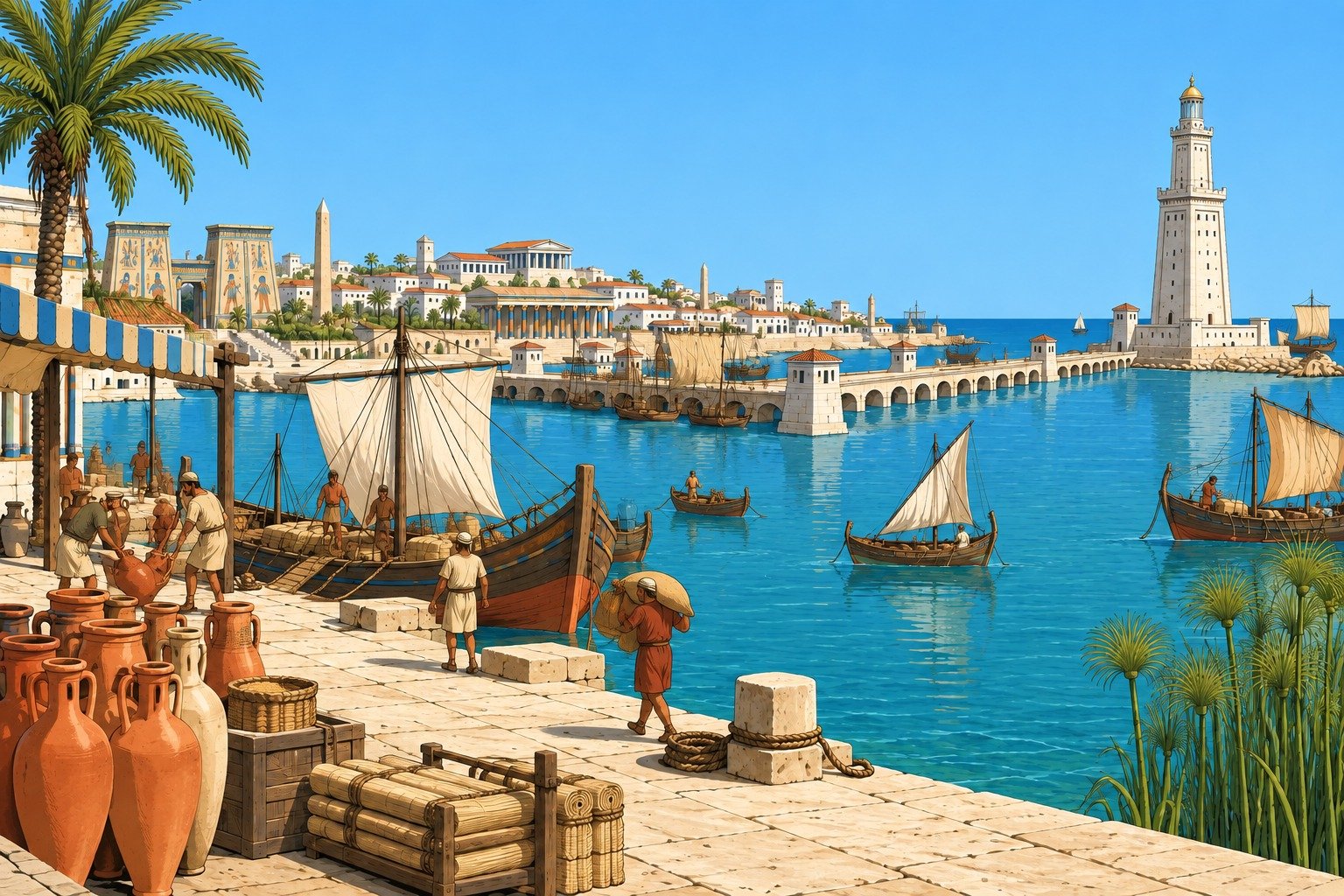
The city occupies the narrow strip between the sea and Lake Mareotis. Offshore lies Pharos. The Heptastadion, a causeway of seven stades (about 1.2 km), joins the island to Alexandria and splits the sheltered waters in two. East of the causeway the palaces overlook the Great Harbor. The Eunostos harbor lies west.
Envoys, royal ships and vessels from Italy come in at the Great Harbor. Porters, scribes and royal guards crowd its pale limestone quays alongside grain ships and single-sailed harbor boats. Date palms and papyrus grow at the water's edge.
The first two Ptolemies built the Pharos, the lighthouse on the island at the harbor mouth, about 300 to 280 BC. Strabo describes a white stone tower of many stories. Its dedication, by Sostratus of Cnidus, is "to the Savior Gods". According to Josephus, the fire could be seen from 300 stades out.
LEGEND
The familiar square, octagonal and round stages, and the estimate of 100 to 140 meters, come from descriptions under Arab rule centuries later and from modern reconstruction. A fire may or may not have burned at the top from the start. The record of the day describes a tall white stone tower.

The City
The Canopic Way crosses the city's grid from west to east. When Diodorus visited about 60 BC, he heard a count of more than 300,000 free inhabitants. That leaves out the enslaved. Striped awnings shade the shop streets. White limestone and blue and gold stucco line the city, and Egyptian temple gates are painted in bright colors. In the poorer west the buildings give way to mud brick.
Greeks, Egyptians and Judeans live alongside traders, sailors and soldiers from all over the Mediterranean. At court and around town, business is in Greek.

The Royal Quarter
On the Great Harbor, the Brucheion takes up a quarter to a third of Alexandria. Its Greek colonnades belong to the royal palaces. The rulers live here with their ministers, guard and chancery clerks. Some clerkly families have served the Ptolemies for generations, including Kallias's.
Scholars at the Mouseion read, copy and teach in a royal institution with a library, shared dining hall and lecture rooms. The great Library is part of it and still stands in 50 BC, though no reliable count of the rolls survives for that year. Alexander's tomb is nearby in the Soma.
Herophilus and Erasistratus dissected the dead here in the third century BC. Greek-trained physicians around the Mediterranean still learn from Alexandria's schools (Era Rules, Medicine and Illness). A Roman after a copy of a book or training for a physician needs an introduction at the Mouseion.
LEGEND: HALF A MILLION ROLLS
The Letter of Aristeas, written in Alexandria probably in the century before this one, says Demetrius of Phalerum told the second Ptolemy he held 200,000 rolls and meant to reach 500,000, and that seventy-two Judean elders translated the Law into Greek for the Library. Later writers tell that ships in the harbor had their books copied and kept.
Entry to the Brucheion is by the court's leave. A visitor without a letter stops at the guard.
Rhakotis and the Serapeum
In the western quarter of Rhakotis, workshops and temple servants occupy streets of mud brick. The Serapeum, Sarapis's temple, sits above them. A stair climbs to its colonnaded enclosure. Ptolemy III's name is on the foundation plaques from the third century BC. The first Ptolemies promoted Sarapis, a Greek form of Osiris and the Apis bull, as the dynasty's god. He and Isis have worshippers in Italy, where the Senate has pulled down their altars more than once (Gods and Religion).
LEGEND
Later Christian writers speak of a "daughter library" at the Serapeum, an overflow of the great Library. No source of the day confirms it.
The Delta District
The Judean community of Alexandria lives in the Delta district, one of the city's quarters, and keeps its own assemblies there. A Judean character of Alexandria starts among them (Character Creation and Roles, Origins).
The Public Buildings
The Theater, the Gymnasium, the Paneion, a shrine of Pan, and the Hippodrome for chariot racing are Alexandria's public places. The Gymnasium is the meeting ground of the city's Greek families; a man who wants their opinion goes there.
| Place | Who is there | What they want |
|---|---|---|
| The Great Harbor quays | Shipmasters, porters, royal clerks, the palace guard | Cargo recorded and taxed; a ship out before the closed sea |
| The palaces of the Brucheion | The rulers, their ministers, the guard, the chancery | Rome kept friendly and far away; the debts not called |
| The Mouseion and Library | Scholars, copyists, physicians | Rolls to copy, patrons, peace to work |
| The Soma | Priests and keepers of Alexander's tomb | Visitors who pay respect, and gifts |
| The Serapeum, Rhakotis | Priests of Sarapis, worshippers, temple workers | Offerings, and the god honored by every visitor |
| The Delta district | Judean merchants, elders, teachers | Their assemblies and their trade left alone |
| The Gymnasium | The Greek citizen families | Rank kept; a say in the city's mood |
Who Rules
Ptolemy XII Auletes ("the flute-player") died before 22 March 51 BC. His will named his elder daughter, Cleopatra VII, and his elder son, Ptolemy XIII, joint rulers and entrusted the will to the Roman people. Both reign in 50 BC. Some documents bear Cleopatra's name alone as early as August 51 BC.
LEGEND: THE QUEEN'S TONGUES
Cleopatra, in Plutarch's account, could speak to Ethiopians, Hebrews, Arabs, Syrians, Medes and Parthians without an interpreter. He says she was the first of her line to learn Egyptian. He wrote a century and a half after her day. Friends and enemies alike had reason to play up her gifts.
Around the boy king stand the men who govern for him. Pothinus is his chief minister, Achillas his general and Theodotus his tutor. All three appear only as historical figures, without game statistics. Their party drives Cleopatra from Alexandria in 49 BC (The Era). The break is a year away, but a visitor in 50 BC already deals with two parties at court.
The court wants to keep Egypt independent, sell its grain on its own terms and occupy as little of Rome's attention as possible. Its officers judge Roman visitors accordingly. See Powers of the Republic for Egypt's army, income and aims abroad.
Rome in Egypt
Rome has no governor here, but it is never absent.
- The restoration. Gabinius brought Roman soldiers to Egypt and restored Auletes in 55 BC. The previous year Rome had asked the Sibylline Books what to do. Their reported answer allowed Rome to offer friendship if the king asked for help, but forbade sending an army.
- The debts. When Auletes died he owed a fortune to Roman bankers, including Rabirius Postumus. The men holding his bonds want them paid and have friends in the Senate.
- The Gabiniani. Men Gabinius left behind settled, married and went into the king's service. They answer to Egypt. Caesar puts Achillas's force in 48 BC at about 20,000 men and 2,000 horse. Most were Gabiniani. Brigands from Syria and Cilicia, exiles and runaway slaves made up the rest (Caesar, Civil War 3.110). Gabinius also left Gallic and German horsemen as the king's guard (Civil War 3.4).
- The sons of Bibulus. The governor of Syria sent his two sons to Alexandria in 50 BC, apparently to summon the Gabiniani against Parthia (Gaul and the Provinces, Syria). The soldiers killed both (Caesar, Civil War 3.110).
- Cyprus. The island the Ptolemies lost to Rome is governed with Cilicia; its annexation is in The Era, The Timeline, 133 to 50 BC.
- Pompey's grain command. Pompey's grain command of 57 BC (Rome, The Grain Dole), if it still runs, gives him an interest in every grain port, Alexandria's among them.
LEGEND: THE SONS OF BIBULUS
Valerius Maximus, writing under Tiberius, says the queen sent the killers of Bibulus's sons to him in Syria, and that Bibulus sent them back unharmed: their punishment, he said, belonged to the Senate, not to a grieving father. Seneca says he mourned one day and went back to work.
Pompey's and Caesar's quarrel reaches Alexandria in 48 BC, when Pompey flees here after Pharsalus and is killed at Pelusium by the boy king's court (The Era).
Trade and Money
Alexandria sells grain, linen, which Rome buys from Egypt and Spain, and papyrus, the reed of the delta made into the rolls on which books and letters are written.
No price for any of these survives for Alexandria in 50 BC. Use Gear and Prices: a roll of papyrus is about 10 HS. Alexandria reckons in drachmae and talents. For Roman accounts, a drachma counts as a denarius and a talent as 24,000 HS (Era Rules, Money and Credit).
Ships sail from about April to October. A voyage to Italy in the closed season is a risk the master takes on a check (Era Rules, Travel). A merchant who arrives late may winter in the city.
The Roman Visitor
A Roman stands as a Peregrine in Alexandria. He answers to the king's officers. There is no Roman magistrate or court to hear his case and no citizen's appeal (Era Rules, Law and Courts). His best protection is a letter from someone the court respects.
Diodorus was in Egypt between 60 and 56 BC. He saw a crowd kill a Roman for accidentally killing a cat, an animal the Egyptians held sacred. Even the king's fear of Rome could not save the man.
At the table, use Attitude (Era Rules, Patronage and Rank). Suggested markers:
| Audience | Suggested markers |
|---|---|
| A royal clerk at the harbor | Roman: Wary 1; creditor's agent: Hostile 2 |
| A Greek crowd at the Gymnasium | Roman: Wary 1; Greek: Welcome 1 |
| An Egyptian crowd in Rhakotis | Roman: Wary 1; Roman who harmed a sacred animal: Hostile 2 |
| A scholar of the Mouseion | Lettered man with an introduction: Welcome 1 |
| The palace gate | Anyone without a letter: Hostile 2 |
An audience in Alexandria takes a letter or seal from the court as a patron's word. A Roman patron's letter carries weight with Romans. Here a local character such as Kallias uses the Dignitas he has among his own people (Era Rules, Patronage and Rank, Dignitas II).
Law and Language
Greek is the working tongue of Alexandria and of the court (Skills and Talents, Tongues). Egyptian is the tongue of the temples and of the countryside. An Egyptian may carry a Greek name, an Egyptian name or both, in the same document. A character who speaks only Latin needs an interpreter for everything past the harbor.
The Envoy's Trade
The court's envoy carries the rulers' letters to Rome, speaks for them before senators and other powerful men, and brings word of what Rome intends. Gifts and dinners keep friends close enough to tell him which creditors are about to call in debts. His job is to buy time. He needs a Roman patron to get him before the Senate when it hears embassies, and the court in Alexandria needs to trust he still works for them. See Character Creation and Roles, Envoy and Interpreter for the Role and kit.
Kallias of Alexandria, Envoy of the Court (fictional)
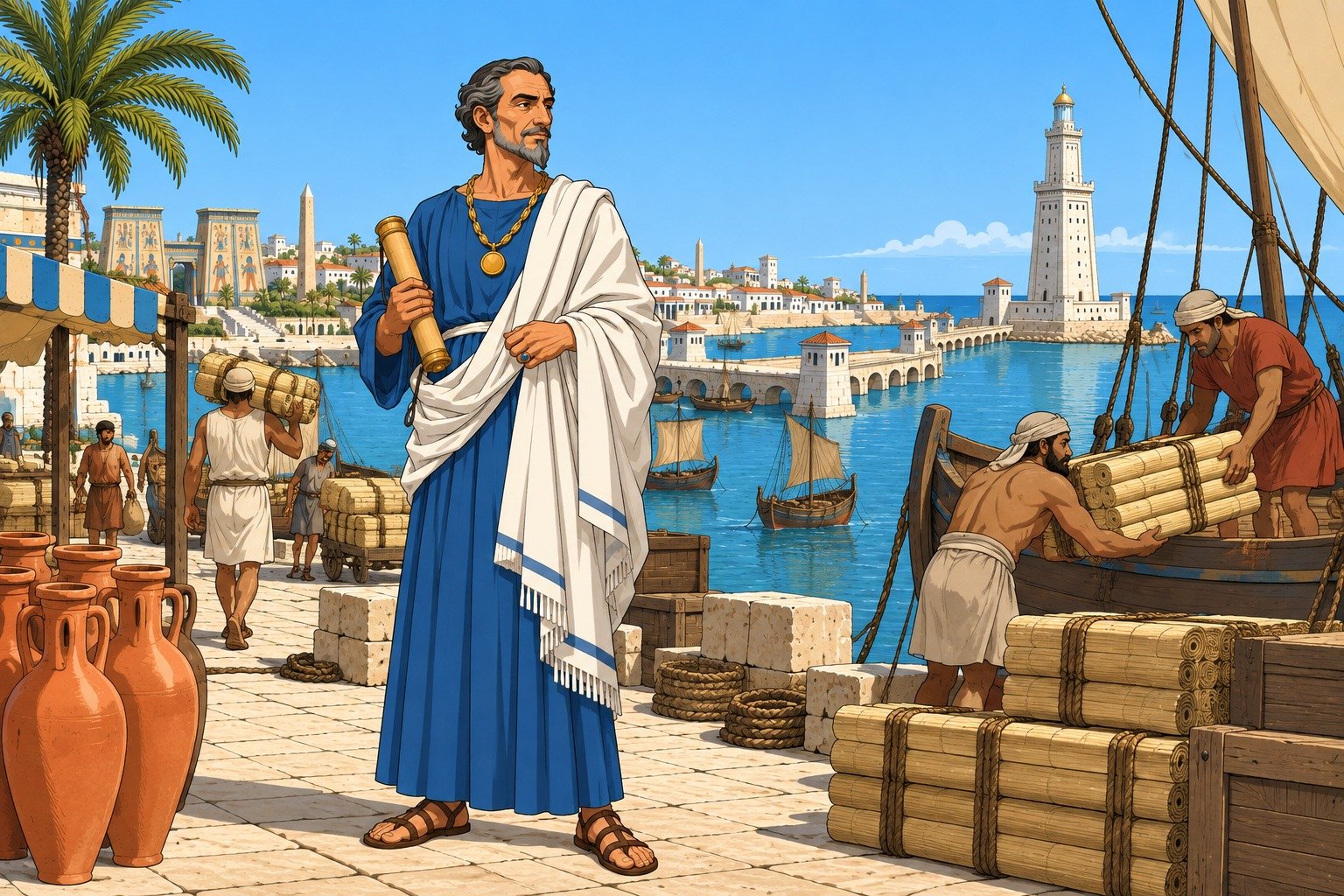
About 52. A long olive face, a pointed gray beard, a chiton of fine linen in Egyptian blue under a white himation, and a gold chain of office.
Kallias comes from an Alexandrian family of royal clerks. He has served three Ptolemies, all in debt to Rome, and his job is to keep creditors from calling those debts in. In Rome he lives on the court's purse, waits on the Senate and dines with the men who want paying. He speaks four tongues and knows what each court wants to hear. He is a Peregrine with Dignitas 1 among Romans. His family's service gives him 3 at home, where he can get a visitor into the chancery or persuade a harbor clerk to look away. Use him as a player character, patron or rival. His sheet is in Pregenerated Characters.
The Nile and the Countryside
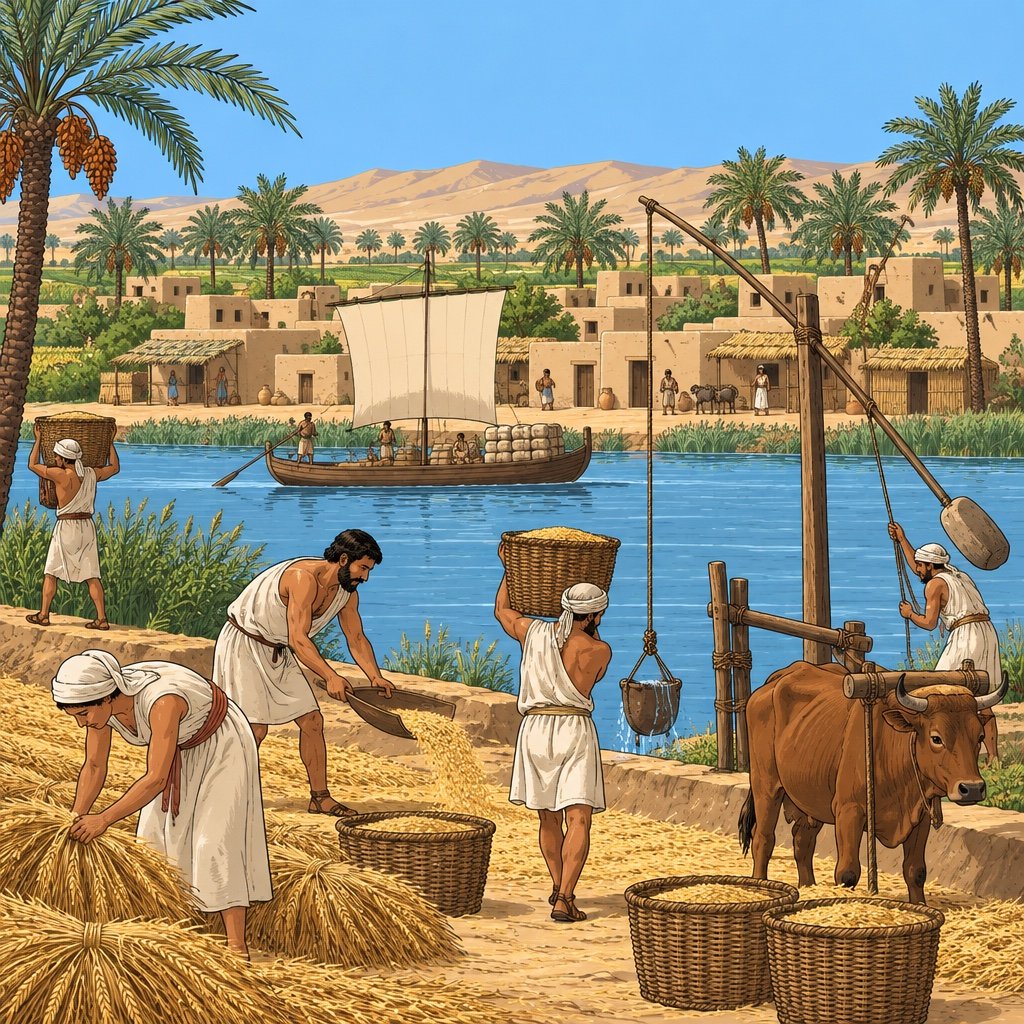
Beyond the city, Egypt is the Nile valley and its delta, and the temples there keep the old gods: Isis, mother and protector; Osiris, the dead king; Horus, the falcon king, at Edfu; Amun at Thebes and Karnak; Ptah, god of craftsmen, at Memphis, with the sacred Apis bull; Hathor at Dendera; Sobek, the crocodile, at Kom Ombo and in the Fayum; and Thoth, god of writing, at Hermopolis. Their worship is told in Gods and Religion.
The kings still build for these gods. The temple of Horus at Edfu, begun in 237 BC, was finished in 57 BC under Auletes. The temple of Hathor at Dendera was begun in 54 BC; in 50 BC it is a building site of quarried stone, scaffolding and masons. Sacred animals are honored, and a man who kills one may face the crowd (The Roman Visitor).
Memphis, the old capital, is the seat of Ptah and the Apis bull. Pelusium stands at the eastern edge of the delta, on the way to Judea and Syria.
Hooks
| Hook | Who | The offer |
|---|---|---|
| The Royal Bond | A Roman banker's freedman agent | He holds a bond sealed by Auletes and needs a chancery clerk to acknowledge it before the court decides the dead king's debts are not the new rulers' |
| Two Seals | A clerk of the chancery | A letter for Rome is drafted twice, once in the queen's name alone and once in both rulers' names; he wants to know which one Rome will read, and pays for the answer |
| The Old Soldier | A Gabinianus veteran with an Egyptian wife | He wants a letter carried to his family in Italy, and he wants to know whether Rome still counts him a deserter |
| The Cat | A crowd in Rhakotis | A sailor of the party's ship has killed a cat by accident; the crowd is gathering, and the guard has not come |
| The Copy | A senator's freedman in Rome | His patron wants a roll the Mouseion holds copied, and the keepers lend only to a copyist they trust |
| The King's Wheat | A shipmaster of Puteoli | He has no cargo and three weeks before the closed sea; the crown's granary officer will sell wheat for the right gift |
| The Temple Gift | An elder of the Delta district | The community's gift for the Temple at Jerusalem must go overland by Pelusium, and the road is not safe for gold |
| The Building at Dendera | A priest of Hathor | The temple's masons' pay is coming upriver from Alexandria, and the boat needs guards |