
Use this chapter for rank and obligation, courts, illness, travel, slavery and money in 50 BC. For arena bouts or battles between armies, see The Arena and the Games or Legion Battles. For other rules use the Exodus NDS Core Rules and the cited sourcebooks.
How Era Rules Relate to the Core Rules
Start with the Core Rules and work down this list. If two rules conflict, use the one farther down.
- The Exodus NDS Core Rules.
- The cited sourcebooks. Use their rules as written, with the Roman names and exclusions in Gear and Prices.
- The Era Rules. These are in this chapter, The Arena and the Games, and Legion Battles.
- Scoped exceptions. If a talent, Role, item or adversary states an exception in its own chapter, apply it within the stated limits.
The label at the start of each rule tells you how it works with the rules above. Adds supplies a rule the Core Rules don't cover. Modifies changes the specified part of a rule and leaves the rest in force. Replaces sets a rule aside for this era. Scopes keeps a rule as written and limits where it applies. For Modifies, Replaces and Scopes, look for the book and heading named in the entry.
Calamity results. Roll Calamity only on a Crisis Die . Use a Calamity result when the rule puts a Crisis Die in the difficulty (closed sea or inside line), when the GM spends a Peril Point to upgrade a Trial Die to Crisis, or when the GM spends one to activate a Calamity effect (Core Rules, Story Points, Spending Peril Points). The printed odds exclude Crisis Dice unless the rule calls for one.
| Rule | Kind | Type | Chapter |
|---|---|---|---|
| Patronage and Rank | Signature subsystem | Adds | Era Rules |
| The Arena and the Games | Signature subsystem | Adds; Modifies; Scopes | The Arena and the Games |
| Legion Battles | Signature subsystem | Adds; Modifies; Scopes | Legion Battles |
| Law and Courts | Short rule | Adds; Modifies Core Ties Fail | Era Rules |
| Medicine and Illness | Short rule | Adds; Modifies Core recovery | Era Rules |
| Travel | Short rule | Adds | Era Rules |
| Slavery | Short rule | Adds | Era Rules |
| Money and Credit | Short rule | Adds | Era Rules |
Patronage and Rank
Adds. Record your legal rank (Ordo), public standing (Dignitas) and a Favor ledger for each patron and client. Ask the powerful for help at their morning greeting, the salutatio, and repay it with service. Use the ledger in elections and bribery. Add Dignitas and Credit Boon Dice as situational dice (Core Rules, Building a Dice Pool, Adding Situational Dice). Run elections as Extended Checks (Core Rules, Types of Checks, Extended Checks).
TERMS: ORDO
I Record one Ordo: Senatorial, Equestrian, Citizen, Freedman, Peregrine or Enslaved. Use your Origin's Status unless your Role is Senator's House (Senatorial), Equestrian House and Publicanus (Equestrian) or Officer (your family's Ordo). A Peregrine is free and lacks Roman citizenship, as do Gauls, Egyptians, Syrians or Greeks from a city without the grant. Count Parthians as Peregrines here.
II Change Ordo only through play. Manumission moves you from Enslaved to Freedman. A citizenship grant moves you from Peregrine to Citizen. Once you hold the property, enrollment by the censors moves you from Citizen to Equestrian. Election as quaestor makes you Senatorial. Censors' expulsion or a court's condemnation can also change Ordo.
TERMS: DIGNITAS
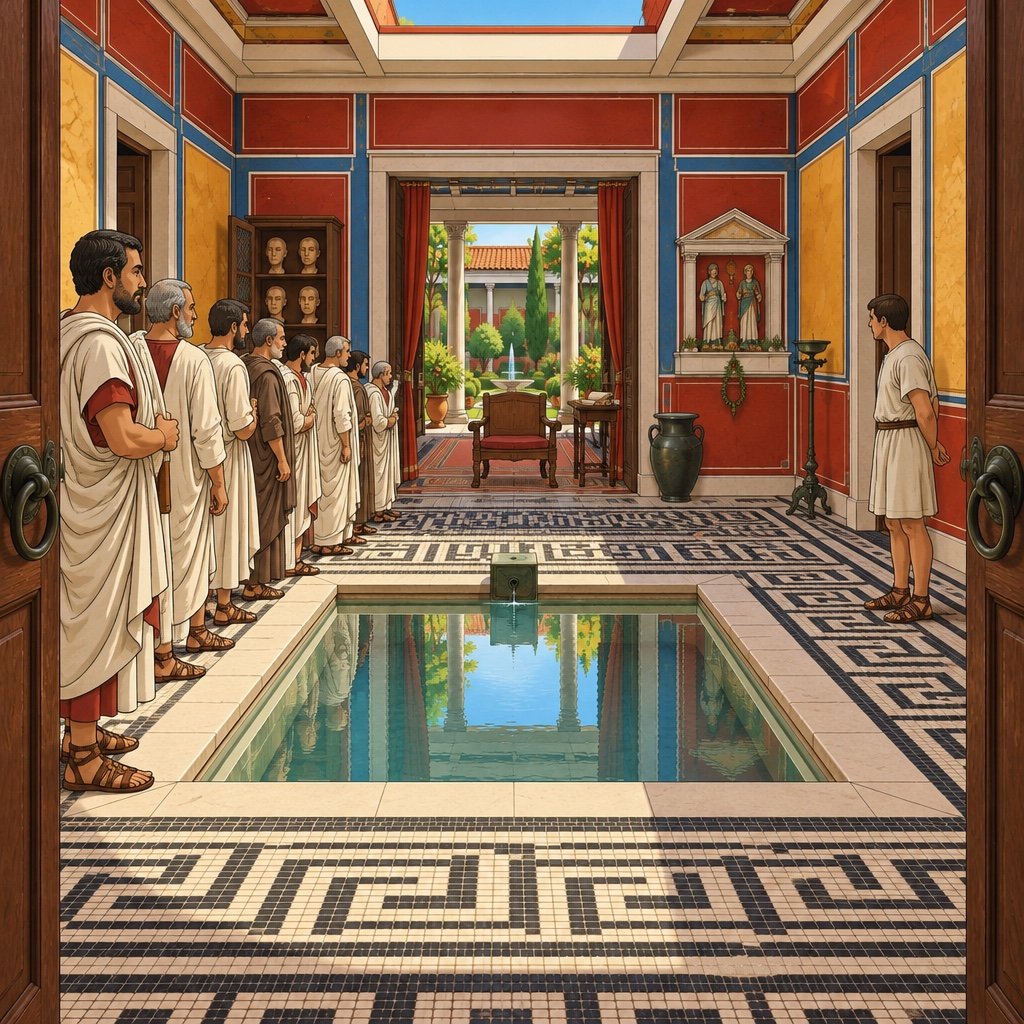
I Use your Ordo to find your starting value and cap for Dignitas, public standing on a scale of 0 to 5.
| Ordo | Starting Dignitas | Highest Dignitas |
|---|---|---|
| Senatorial | 3 | 5 |
| Equestrian | 2 | 4 |
| Citizen | 1 | 3 |
| Freedman | 1 | 3 |
| Peregrine | 1 among Romans | 3 among Romans |
| Enslaved | 0 | 1 |
II If you are a gladiator, lanista, actor or brothel-keeper, you are infamis. Cap Dignitas at 1 in any Ordo. As a Peregrine, keep a separate Dignitas from 0 to 5 for dealings with your own people only. Set it at creation (Character Creation and Roles, Ordo, Standing and Dignitas).
III Using Dignitas. If you act openly as yourself and the other side knows who you are, add 1 Boon Die at Dignitas 2 or 3, or 2 at Dignitas 4 or 5, to Charm, Negotiation, Leadership, Deception or Intimidation. Leave Dignitas out of unit Discipline tests and Rallies (Legion Battles).
IV Reaching up. When you petition someone at least two Ordines above you, raise the difficulty one step unless that person is your patron or owner or your patron has introduced you. Cap the Ask at Severe, including any increase for sending a letter (The Petition, I).
V Gaining Dignitas. Gain 1 no more than once a session. Qualifying deeds are a trial or election win, a decoration, a public victory, games you give, or a service to a man of higher Ordo witnessed by the whole city. At gladiator games, the winner must finish at Crowd Favor 6 (The Arena and the Games).
VI Losing Dignitas. Deduct 1 if you refuse a patron's call for a Favor, lose an election after exposure for bribery, roll Calamity on a public social check (Calamity results, How Era Rules Relate to the Core Rules) or suffer public shame. Set Dignitas to 0 if a court condemns you.
TERMS: ATTITUDE
I Identify the audience that decides the scene: a doorkeeper, clerk, Forum crowd, jury or voting tribe. The GM names up to three markers that matter to it, such as an Ordo, people, faith, trade, legal status, sex, faction or deed. Any group in this book can serve, including any group a player character belongs to.
II The GM sets an Attitude for each marker.
| Attitude | Effect on social checks with that audience |
|---|---|
| Welcome 2 | Add 2 Boon Dice |
| Welcome 1 | Add 1 Boon Die |
| Neutral | None |
| Wary 1 | Add 1 Bane Die |
| Hostile 2 | Add 2 Bane Dice; no loan or Favor without a patron's word |
| Closed 3 | The door is shut. Use it only where the law closes it: a freedman in the Senate, a Peregrine at the vote, a man at the hearth of Vesta |
III Apply Attitude to Charm, Negotiation, Leadership, Deception and Intimidation with this audience and to any check to get service, work, pay, a hearing or entry. Cap Attitude at 3 Boon Dice or 3 Bane Dice. Stack it with Dignitas. Use the dice specified for the canvass and verdict instead (Elections III, Law and Courts, The Trial II). Leave attacks, damage, Wounds, characteristics, skills and the character sheet unchanged.
IV A patron's word. When a respected patron sends a letter or seal or speaks through a client, shift one marker one step toward Neutral. Welcome and Closed stay fixed. Each house can move a marker once per scene, regardless of how many people speak for it.
V Reading the Room. Learn one audience's Attitudes with an Average Savvy + Perception check.
TERMS: THE PETITION
I Asking. Petition at your patron's salutatio or write him a letter, one step harder. Roll Charisma + Charm to appeal with warmth, gratitude or flattery, or Charisma + Negotiation to bargain, at the Ask's difficulty.
| Ask | Difficulty | Examples |
|---|---|---|
| Small | Easy | A meal, a word at the right door, a letter of introduction |
| Ordinary | Average | A loan, a recommendation, a seat at a dinner, a slave lent for a task |
| Great | Hard | A post on a governor's staff, a block of votes, his defense in court |
| Very great | Severe | Backing for an office, a pardon, a grant of citizenship, freedom |
Add your Dignitas Boon Dice (Dignitas III) and up to 2 Boon Dice from Credits you spend with him, one die per Credit.
II Results. With a success, the patron grants the Ask and you owe 1 Favor. With 2 or more net Banes on that success, he names a price and you owe 2 instead. On a failure, he refuses and you owe nothing. If you fail with at least 3 net Banes, or roll a Calamity, he takes offense. Do him a service before he'll hear you again.
III The limit. At 3 Favors owed, your patron refuses any Ask without a roll.
TERMS: CALLING IN
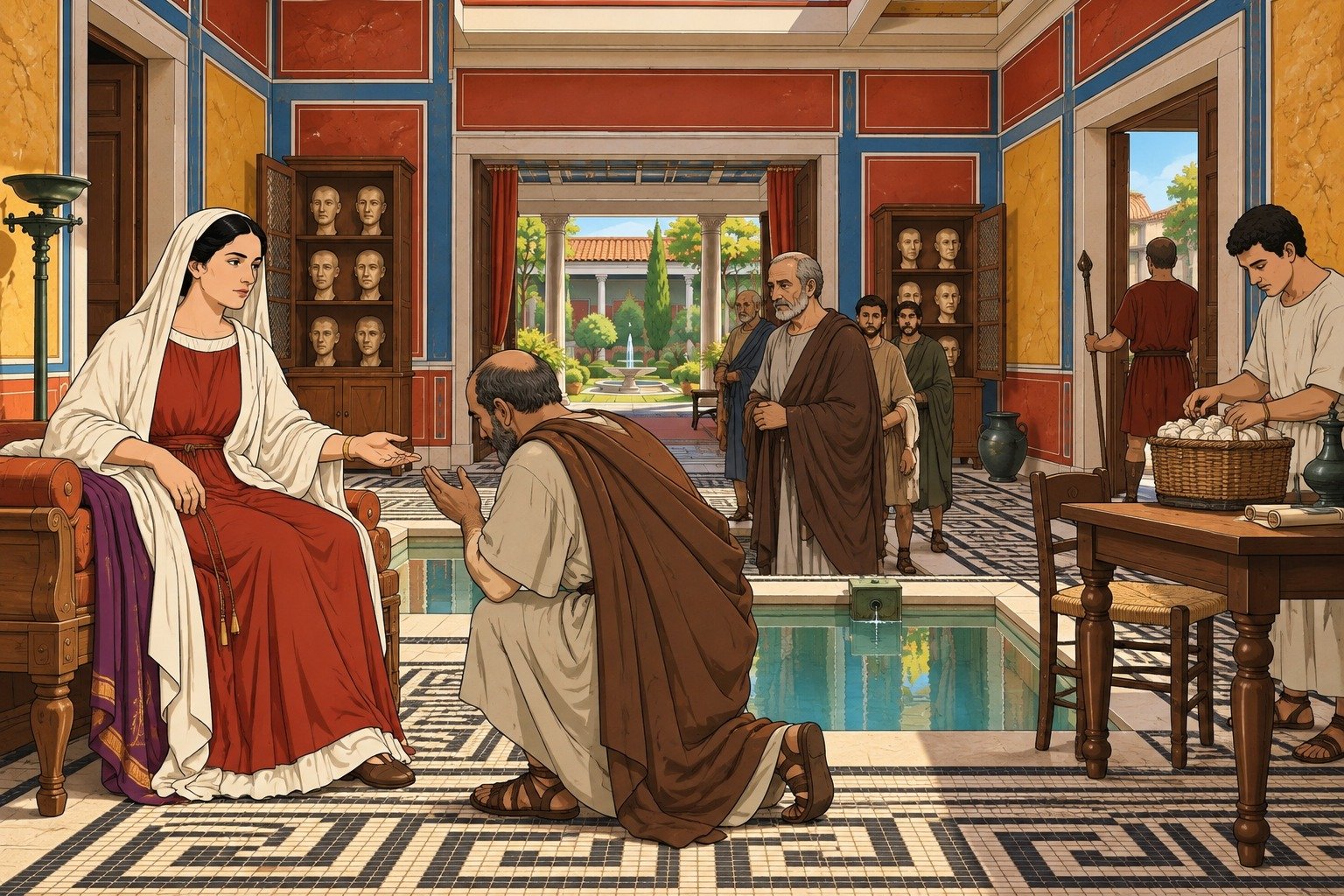
I The call. If you owe your patron 1 Favor or more at the start of a session, the GM calls in one. You might carry a letter, escort him to the Forum, vote, testify, watch a man, collect a debt or do another job. Complete it to clear 1 Favor. If it takes a roll, the GM sets the difficulty, usually Average. Fail and the Favor remains. The GM may call it in again next session.
II Refusing a called Favor costs 1 Dignitas, and the Favor stands.
III Credits. Earn 1 Credit by helping someone unasked while you owe him nothing. It represents a service, not coin. A client, a man whose life you saved or anyone else can owe one. Keep up to 3 per person. Spend a Credit to add 1 Boon Die to a check he can help with, including a Petition to him. Spend at most 2 per check (Core Rules, Types of Checks, Assisted Checks).
IV Support. If you owe at most 2 Favors, your patron feeds you on days you attend his salutatio. Skip those days' living costs (Gear and Prices).
V Your own clients. Keep a ledger for each of your clients. They petition you and you call in their Favors. The GM plays them.
TERMS: THE ENSLAVED, THE FREED AND THE PEREGRINE
I If you are enslaved, use your owner as patron. Petition him as a client and let him call in Favors as patron. A gladiator's owner is his lanista (The Arena and the Games).
II Acting for the house. If you are enslaved and openly doing the owner's business with his seal or letter, use your owner's Dignitas for Boon Dice (Dignitas III). This can give a steward, physician, secretary or agent far from Rome the authority of the house.
III A freed character keeps at least 1 Favor owed to the former owner, now patron. Skip that standing Favor for calls at session start (Calling In, I). The patron can call it in as a story event, but doing it clears nothing. For Credits, count a freedman who owes only that standing Favor as owing nothing.
IV A Peregrine petitions a Roman patron under the usual rules, using Dignitas among Romans. Use the other Dignitas with your own people. A Roman patron cannot move an audience of your people, and their word carries no weight with a Roman audience.
EXAMPLE: EROS ASKS FOR A LETTER
Eros (Charisma 3, Negotiation 2, Dignitas 1) owes his patron, the head of the house that freed him, the standing 1 Favor of a freedman. He wants a letter of recommendation to the governor of Asia, so that the tax companies leave his agents in Ephesus alone. That is an Ordinary Ask, so the check is Average.
He attends the salutatio and rolls Charisma + Negotiation, 2 Mastery Dice and 1 Ability Die , against 2 Trial Dice ; his Dignitas 1 adds no die, and he keeps his Origin's once-a-session Boon Die for later: 63.8 chances in 100. He rolls 2 net Successes and 2 net Banes. The letter is granted and the patron names a price, so Eros now owes 3 Favors, the limit, and the patron will hear no further Ask until one is paid.
At the start of the next session the GM calls one in: an interest-free loan to the patron's son, who is canvassing for quaestor. No check is needed; Eros pays the loan and owes 2. The session after, the call is harder: find out which of the son's rivals is buying votes. The GM sets an Average Streetwise check, Eros fails it, and the Favor stands. Had he refused the job, he would have dropped to Dignitas 0.
TERMS: ELECTIONS
I Who stands. To stand, you must be a free-born Roman citizen and male, meet the office's age requirement (quaestor 30, praetor 39, consul 42, for example) and be neither condemned nor infamis. Only a plebeian can stand for tribune of the plebs. Freedmen and women cannot stand. Anyone can work on a campaign.
II The canvass. Roll one Hard Extended Check each month with the candidate's Charisma + Charm, or Charisma + Leadership if his voters are soldiers. Count net Successes toward the threshold. A Calamity (Calamity results) is a scandal. Deduct 1 accumulated Success, to a minimum of 0, and take 1 Dignitas from the candidate (Dignitas VI).
| Office | Places a year | Threshold | Months |
|---|---|---|---|
| Quaestor | 20 | 4 | 3 |
| Tribune of the plebs | 10 | 5 | 3 |
| Aedile | 4 | 6 | 3 |
| Praetor | 8 | 7 | 4 |
| Consul | 2 | 8 | 4 |
III Boon Dice each month. Add up to 2 from the candidate's Dignitas, up to 2 in total from called Favors and Credits and others' campaign work, and 2 for bribery (Bribery). Apply no other dice, including Attitude.
IV Losing. Lose if the months run out before you meet the threshold. You may run next year. The Favors you spent stay spent.
TERMS: BRIBERY
I Add 2 Boon Dice for a canvass month when you pay bribes (Gear and Prices gives the sum by office) or hire a gang to hold the voting enclosure.
II Exposure. Any net Bane on a bribed roll gives a rival a witness. Whether you win or lose, face prosecution for bribery (ambitus) after the vote (Law and Courts).
EXAMPLE: A PRAETORSHIP WITH A GANG IN IT
Fabia's father (Charisma 3, Charm 2, Dignitas 4) stands for praetor: threshold 7 in four months, each roll Hard. Dignitas 4 gives him 2 Boon Dice; Fabia has no Credits left with the men who matter. Unbribed, he wins 34.5 times in 100.
In the first month he pays bribes through his agents, and in the second he hires Papirius's men to hold the voting enclosures: 2 more Boon Dice in each of those months. His chance rises to 49.3 in 100, with 14.4 in 100 that a bribe comes to light. The second month's roll shows 1 net Bane, and one of Papirius's men talks in a wine shop. The father reaches the threshold in the fourth month and wins the praetorship. The week after, a rival's client prosecutes him for ambitus (Law and Courts).
Failure states. Debt at the limit: no Ask is heard until a service is done. A called Favor failed: the debt stands and the next call comes next session. A Favor refused: 1 Dignitas lost. An offended patron: no Ask until a service is done. An election lost; a bribe exposed: a prosecution, and on conviction ten years' exile and Dignitas 0.
Law and Courts
Adds. Prepare a criminal case in play, then roll once for the verdict. Use Core Charm (Core Rules, Skills and Talents, Social Skills) and Dignitas (Patronage and Rank). Modifies Core Rules, Resolving Checks, Ties Fail, for the verdict alone. At 0 net Successes the jury divides instead of failing (The Trial, III).
TERMS: THE COURT
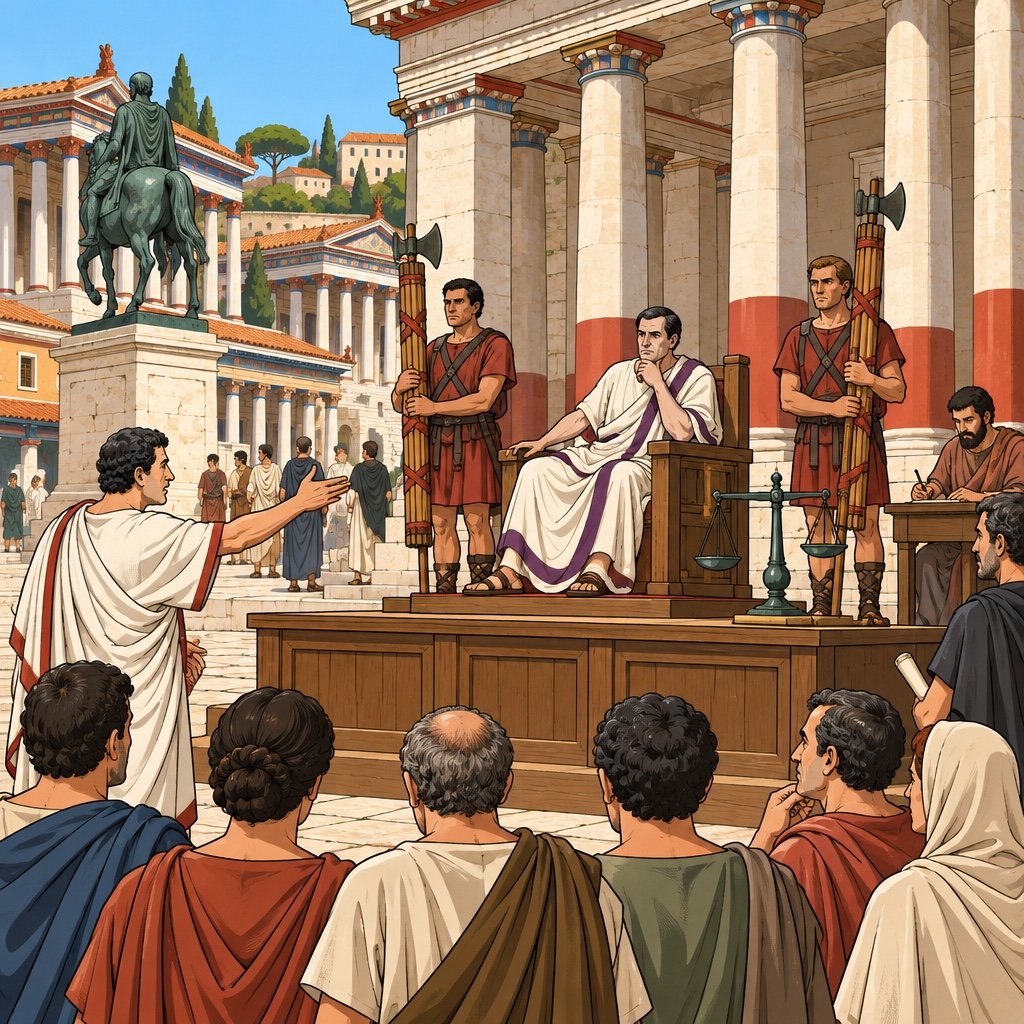
I Try bribery, extortion, violence, treason or murder in a standing jury court chaired by a praetor. Draw jurors in equal numbers from senators, equestrians and tribuni aerarii.
II Choose the court's temper as GM. Use Friendly for an Average verdict check, Fair for Hard or Hostile for Severe.
TERMS: THE TRIAL
I Preparation. Gather documents, witnesses and character testimony before trial. For each successful Lore, Streetwise, Perception or Negotiation check the GM accepts as useful, add 1 Boon Die to the defense, up to 2.
II The verdict. The advocate rolls Charisma + Charm once against the court. He serves a client as patron or a friend as friend, out of duty and without a fee. Add up to 2 Boon Dice from his Dignitas, plus up to 2 total from preparation and Credits with jurors' patrons (Core limit on help). Use the court's temper, with no dice for the jury's Attitude.
III A success acquits. At 0 net Successes with no Calamity (Calamity results), the jury divides. Try the case again next session, and acquit if it divides again. Condemn the defendant if there are more Failures than Successes, or if a Calamity accompanies 0 net Successes.
IV Penalties. For bribery, impose ten years' exile and set Dignitas to 0. For violence or treason, forbid fire and water in Italy and set Dignitas to 0. For extortion, require restitution and remove rank. Many convicted governors go into exile. If the verdict has a Calamity, the GM chooses a second penalty, such as confiscation or a client turning witness.
V Who has rights. As a citizen you can appeal summary punishment by a magistrate. Peregrines and enslaved people cannot. Magistrates can summarily punish slaves and rebels, including by crucifixion.
EXAMPLE: THE PRAETOR-ELECT IN THE DOCK
Fabia's father, newly elected praetor, is prosecuted for ambitus before a Fair court, so the verdict is Hard. His advocate is an orator of his faction (Charisma 3, Charm 3, Dignitas 4). Fabia works the case before the trial: an Average Streetwise check finds the witness's own debts, and an Average Lore (Law) check finds the bribe was paid before the canvass opened. Both succeed, for 2 Boon Dice; the orator's Dignitas gives 2 more.
With 4 Boon Dice the father is condemned 11.4 times in 100, counting retrials. Without Fabia's work it would be 18.9. An ordinary advocate (Charm 1) with no help and no standing would see him condemned 41.4 times in 100.
| Court | Orator (Charm 3): 0 / 2 / 4 Boon Dice | Ordinary advocate (Charm 1): 0 / 2 / 4 |
|---|---|---|
| Friendly | 15.2 / 8.3 / 4.5 | 23.8 / 13.5 / 7.5 |
| Fair | 30.4 / 18.9 / 11.4 | 41.4 / 26.9 / 16.8 |
| Hostile | 46.9 / 32.4 / 21.5 | 57.8 / 41.9 / 28.9 |
Chances in 100 of condemnation after any retrial, for an advocate with Charisma 3. The 4-die column is Dignitas 2 with 2 from preparation and Credits together.
Failure states. Condemnation: exile and Dignitas 0, or restitution; a Calamity's second penalty; a retrial that keeps the defendant in Rome and in danger for another session.
Medicine and Illness
Adds the illness clock, using Fortitude and Medicine as printed (Core Rules, Skills and Talents). Modifies Core Rules, Recovery, Recovering Strain: keep illness Strain until the illness ends. Modifies Core Rules, Resolving Checks, Reading the Results, for daily illness checks: a Breakthrough ends the illness and cancels the cost of a failed check. Adds a Critical Injury trigger when you fail a daily check while incapacitated by Strain from a Grave illness (Core Rules, Structured Play, Critical Injuries).
TERMS: THE ILLNESS CLOCK
I Exposure. Start an illness and set its Severity as GM. A summer night in the low country can bring fever, bad water or a siege can bring flux, and a Critical Injury untreated for a day can bring Serious wound fever.
| Severity | Daily check | Strain on a failure | Bane Dice, at most | Course |
|---|---|---|---|---|
| Mild | Easy | 2 | 1 | 4 days |
| Serious | Average | 3 | 2 | 7 days |
| Grave | Hard | 4 | 3 | 10 days |
II The daily check. Each morning, roll Might + Fortitude against Severity. Mark 1 for each success. End the illness at 2 marks or when the Course runs out. On a Breakthrough, mark both even if the roll failed. Take no Strain or Bane Die for that check. On a failure without a Breakthrough, take the listed Strain and add 1 Bane Die to all checks until the illness ends, up to the limit.
III Keep illness Strain until the illness ends. Rest, Catch Breath and the end of an encounter leave it in place. Recover normally once the illness ends.
IV Only Grave illness can kill. If you are incapacitated by Strain, the next failed check for a Grave illness inflicts a Critical Injury instead of Strain. A Grave illness inflicts at most one. Mild illness never incapacitates.
TERMS: CARE
I Each day the physician can roll Medicine before the patient's daily check. Roll Average with food, rest and clean water, or Hard on campaign or without them. The patient adds 1 Boon Die that day for each net Success, up to 2.
II A physician follows Greek practice, using food, rest, rubbing, walking, baths, herbs and simple drugs to balance the humors. See Gear and Prices for remedies.
EXAMPLE: FEVER ON THE APPIAN WAY
Banona (Might 2, Fortitude 1, Strain Points 12) travels the Appian Way through the Pomptine marshes in July and sleeps a night at an inn at Forum Appii in the low country. The GM starts the tertian fever at Serious: each morning an Average Might + Fortitude check, 3 Strain on a failure.
Untreated, she is incapacitated 31.9 times in 100. She reaches Rome, and the Fabii lend her their physician. Chryseis (Intellect 4, Medicine 2) treats her in the house, with rest, clean water and food, so the Medicine check is Average. With that care Banona is incapacitated 18.8 times in 100, and the fever lasts 3.5 days on average.
| Case | No care | A physician at the bedside (Average) | A physician on campaign (Hard) |
|---|---|---|---|
| Serious, Might 2, Fortitude 1 | 31.9 / 0 | 18.8 / 0 | 21.7 / 0 |
| Serious, Might 3, Fortitude 2 | 6.7 / 0 | 3.4 / 0 | 3.4 / 0 |
| Grave, Might 2, Fortitude 1 | 58.2 / 49.7 | 45.2 / 36.0 | 47.6 / 38.7 |
| Grave, Might 3, Fortitude 2 | 24.7 / 16.4 | 16.3 / 9.6 | 18.3 / 11.5 |
Chances in 100 of incapacity / a Critical Injury, for a patient with Strain Points 12 and a physician with Intellect 4, Medicine 2.
Failure states. Strain that does not recover; Bane Dice on every check; incapacity; for a Grave illness, one Critical Injury.
Travel
Adds. Use the travel tables to find how long a letter, army or envoy takes to arrive. For a voyage out of season, roll as directed below and upgrade one Trial Die to a Crisis Die (Core Rules, Resolving Checks, Assigning Difficulty). Use The Stable for mounts and care.
TERMS: BY ROAD
I Travel by road is counted in Roman miles a day.
| Traveler | Roman miles a day |
|---|---|
| On foot, or with a cart | 15 to 20 |
| A legion on the march | 15 to 20 |
| A legion on a forced march | 25 to 30 |
| A hired carriage | 25 to 40 |
| A courier on relays | about 50 (an estimate) |
II Rome to Brundisium, about 360 miles, takes one to two weeks. Plutarch says Caesar reached the Rhone from Rome in seven days in 58 BC, a pace no one else matches.

TERMS: BY SEA
I The sailing season runs from about April to October. A ship makes about 100 to 150 miles a day with a fair wind.
II The closed sea. The old sailors' rule closes open water from about 11 November to 10 March by the sun. In 50 BC the civil calendar runs five to seven weeks fast, so use late December to late April on the calendar (The Era, The Day and the Year; Places and Campaign Tools, The Seasons and the Year 50 BC). The GM can use 11 November to 10 March on the calendar instead.
Example: by the sun, a master asked to sail from Puteoli on 20 November of the calendar finds the sea open, because the season is still autumn; on 5 Ianuarius it is closed.
III Out of season. On each leg in the closed season, the master rolls Hard Agility + Operate (Sail). Upgrade one Trial Die to a Crisis Die . A failure brings a storm, doubles the leg's time and costs everyone aboard 3 Strain. A Calamity wrecks the ship on a coast. Each person aboard rolls Average Athletics or takes a Critical Injury.
EXAMPLE: A LATE PASSAGE FROM ALEXANDRIA
Kallias must reach Rome from Alexandria before the Senate meets on Egypt's debts, and the only master willing to sail leaves in late November by the sun. The master (Agility 3, Operate 2) rolls 2 Mastery Dice and 1 Ability Die against 2 Trial Dice and 1 Crisis Die : 45.5 chances in 100 to make the leg on time, and 8.3 in 100 of a wreck. Kallias pays the fare and boards.
Failure states. Delay; 3 Strain to everyone aboard; shipwreck and Critical Injuries.
Slavery
Adds. Use these rules for enslaved characters, sale, freedom and owners' powers. For Favors and an enslaved character's use of the owner's Dignitas, see Patronage and Rank, The Enslaved, the Freed and the Peregrine.
TERMS: STATUS
I If you are enslaved, the law counts you as property. Your Ordo is Enslaved and Dignitas cannot exceed 1. You cannot own property, marry lawfully or sue. A court takes your evidence under torture. The GM uses these limits in court, sales and punishments without adding dice penalties to the sheet.
II The peculium. If you are enslaved, you can trade and save money and goods in your peculium, though the owner owns it in law. Use it to buy freedom. Record Peculium Standing (Money and Credit). You cannot borrow in your own name. A loan to you goes to the owner.
TERMS: BUYING AND SELLING
I Purchase. If you can pay, buy from a dealer's stand or another household. Use Gear and Prices for prices by age, skill and trade and the evidence for each. The seller declares illness, past flight or theft.
II A person, not an item. The GM runs a purchased person as an NPC with a name, tongue, skills and aims. As buyer, you are the owner and patron on the ledger (Patronage and Rank). Take any household provided by a Role, such as a senator's or steward's, without purchase.
III Selling. As owner, you can sell an enslaved person for the listed price (Gear and Prices) minus the dealer's cut. End the ledger between you on sale.
TERMS: FREEDOM
I Manumission comes by one of four routes:
- Purchase: pay the owner's price from the peculium. The owner's price starts from the price for that person's skill in Gear and Prices. The owner may refuse; refusing a fair price costs him 1 Dignitas if it becomes known.
- Petition: a Severe Ask to the owner (Patronage and Rank, The Petition), usually with Credits earned by service.
- By will: on the owner's death, if the will says so.
- For a deed: the GM may grant it for a service that saves the owner's life, house or honor.
II The tax. When a person is freed, the treasury takes 5 in 100 of that person's value. Whoever buys the freedom pays the tax.
III The freed. Freed formally by a citizen (before a magistrate, at the census or by will), the character becomes a citizen and his Ordo becomes Freedman; a freedom given informally makes no citizen. He takes his owner's first two names and keeps his own name as a surname, and his former owner becomes his patron (Patronage and Rank, The Enslaved, the Freed and the Peregrine). He keeps every skill and talent. His children born after his freedom are free-born.
TERMS: THE OWNER'S POWER AND FLIGHT
I The owner's power. The owner can sell, punish or move an enslaved character without going to court. As GM, resolve punishment as Strain, Wounds, peculium lost or sale away from the house. Keep the act off the page.
II Flight. If you flee, play as a fugitive hunted by your owner and the men he hires. If caught, you face whatever punishment the owner chooses, often followed by sale. The law allows crucifixion.
EXAMPLE: CHRYSEIS ASKS FOR HER FREEDOM
Chryseis (Charisma 3, Negotiation 1) has delivered three children of the Fabii and sat with the dying son. Over the campaign she has earned 2 Credits with her owner, Fabia's father. She asks him for her freedom: a Severe Ask, with 2 Boon Dice from the Credits. Her chance is 45.1 in 100; without the Credits it would be 31.2.
If he refuses, she still has the purchase route. Her peculium holds the fees grateful patients have pressed on her, and the price of a physician of her skill, with the 5 in 100 tax on top, is the sum she must save.
Failure states. A refused petition, and an offended owner on 3 or more net Banes; a price not yet saved; recapture after flight.
LEGEND: HOW MANY FOLLOWED SPARTACUS
About seventy gladiators broke out of Batiatus's school at Capua in 73 BC; Livy's epitome says seventy-four, Plutarch seventy-eight. How many joined them is a guess the ancients made for us. Appian gives 70,000 after the first recruiting and 120,000 foot on the march toward Rome; Orosius gives far fewer. No one counted. What is certain is the end: 6,000 crosses on the road from Capua to Rome.
Money and Credit
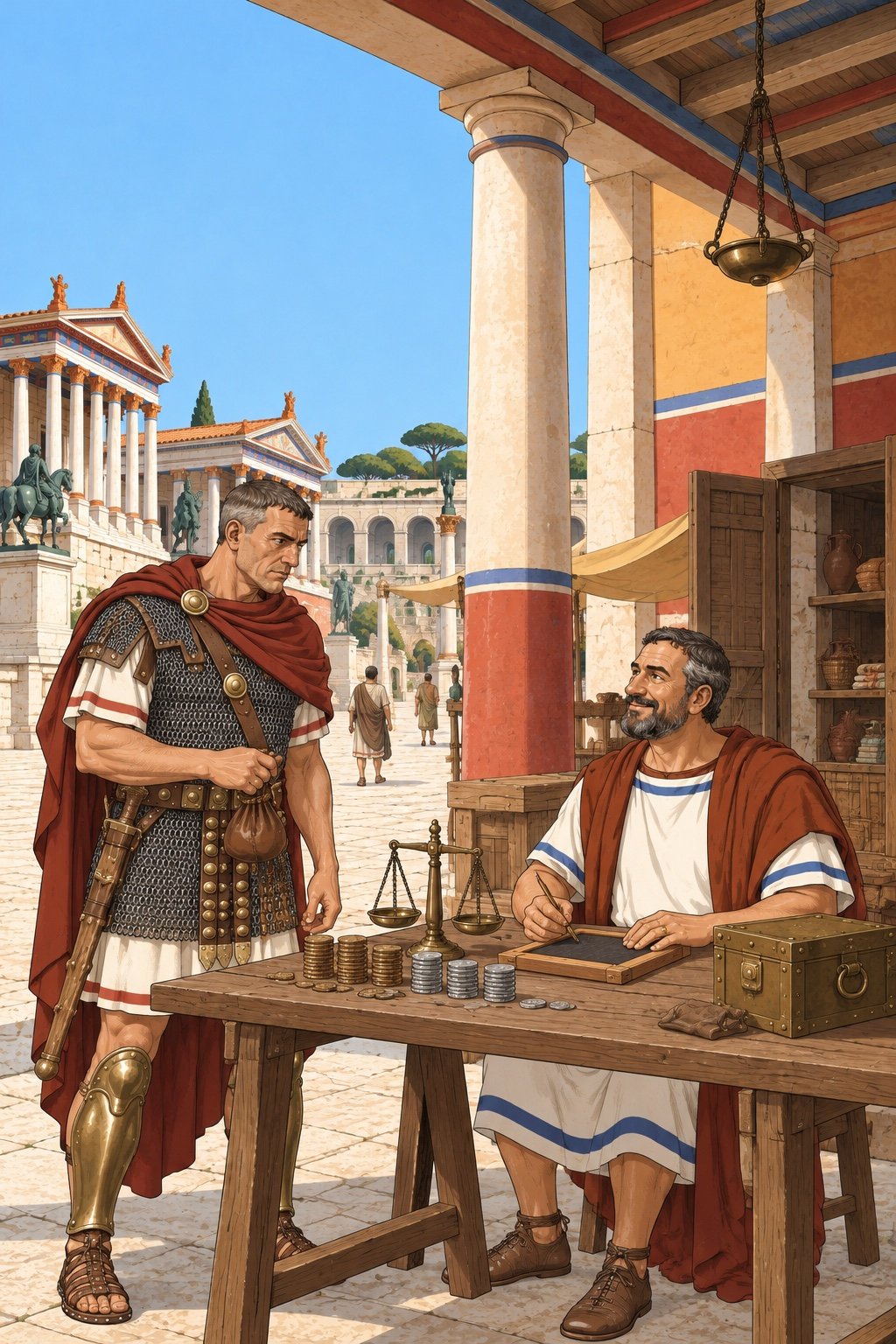
Adds. Count money in sestertii (HS). Use asses for change and denarii for silver in hand. See Gear and Prices for wages, rents, other prices and sourcebook conversion.
THE MONEYCHANGER'S TABLE
| Coin or sum | Worth |
|---|---|
| quadrans | a quarter of an as; the price of a bath |
| as (bronze) | 4 quadrantes; a quarter of a sestertius |
| sestertius (HS) | 4 asses; the unit of account, seldom struck |
| denarius (silver) | 4 sestertii or 16 asses |
| aureus (gold) | no fixed rate; reckon about 100 HS as bullion |
| talent (a sum, not a coin) | 6,000 denarii or 24,000 sestertii |
TERMS: STAKES
I Take your Role's kit free and record your Standing's Stake in cash. Find Standing under your Role (Character Creation and Roles), or use Peculium if you are enslaved.
| Standing | Starting Stake | Credit limit | Creation Debt |
|---|---|---|---|
| Peculium | 25 HS | none | none |
| Wage | 75 HS | 150 HS | none |
| Trade | 225 HS | 450 HS | none |
| Professional | 675 HS | 1,350 HS | none |
| Equestrian | 4,000 HS | 8,000 HS | 2,000 HS |
| Senatorial | 12,000 HS | 24,000 HS | 6,000 HS |
II Creation Debt. If your Standing is Equestrian or Senatorial, owe half your Stake to a named moneylender, relative, political ally or tax company. Pay this Debt at the end of the second month. Any character can take a creation Debt on the same terms for a named asset such as a lease, ship share or house. The GM sets its value from Gear and Prices.
III Keep. Use your Role's pay for untracked living costs. Keep it out of your monthly Stake. A Wage Stake buys a month's keep and a basic tool or knife. Add cash only when paid in play, such as a soldier's gift, fee, purse, sale or debt called in.
TERMS: CREDIT AND DEBT
I Credit limit. Borrow from a shopkeeper, moneylender or patron up to your limit. Enslaved characters cannot borrow. An owner's credit stays with the owner.
II Interest. A moneylender usually charges the ceiling of 1 in 100 a month, compounded yearly. Pay 4 in 100 a year to a patron or high-ranking friend and owe a Favor (Patronage and Rank). Beyond your credit limit or with a lender like Scaptius, pay 4 in 100 a month and take that lender as an antagonist from day one.
III An unpaid Debt. After the due date, add 1 Bane Die to Negotiation and Charm with anyone who knows. Keep the die until you pay or settle by Favor. The creditor is an antagonist.
IV Default. The law seizes and sells a citizen debtor's property, and can enslave a Peregrine for debt. A debtor of rank who cannot pay keeps his legal freedom while his creditors control his vote, letters and a daughter's marriage.
EXAMPLE: SEPTIMIUS BORROWS FROM EROS
Septimius's Standing is Professional: a Stake of 675 HS and a credit limit of 1,350 HS. On leave in Rome he needs 1,000 HS to buy a share in a farm near Cremona, where he means to settle. Eros lends it at the customary ceiling, 1 in 100 a month, compounded yearly.
At the end of the first year Septimius owes 1,120 HS; at the end of the second, 1,254. Had he borrowed 1,500 HS he would have passed his credit limit, and Eros's terms would have been 4 in 100 a month. Had his patron lent the 1,000 at 4 in 100 a year, he would owe 1,040 after a year, and a Favor.
Failure states. A Debt unpaid at its day: a Bane Die with everyone who knows, and a creditor who is an antagonist; property seized; for a Peregrine, enslavement for debt.
Era Rules Summary
| Rule | Kind | Relationship to the Core Rules | Core heading named | Where it lives |
|---|---|---|---|---|
| Calamity results | Reading rule | Scopes the Core rule, unchanged, to these chapters: a Calamity needs a Crisis Die or a Peril Point | Resolving Checks, Assigning Difficulty; Story Points, Spending Peril Points | Era Rules, How Era Rules Relate to the Core Rules |
| Ordo and Dignitas | Signature subsystem | Adds; Dignitas gives situational Boon Dice | Building a Dice Pool, Adding Situational Dice | Era Rules, Patronage and Rank |
| Attitude | Part of Patronage and Rank | Adds; situational dice for an audience, at most 3 Boon or 3 Bane Dice, none on the canvass or the verdict | Building a Dice Pool, Adding Situational Dice; Dice Pool Limits | Era Rules, Patronage and Rank |
| The Petition and Calling In | Signature subsystem | Adds; Credits keep the two-die limit on help; a freedman's standing Favor is a story call that clears nothing | Skills and Talents, Social Skills; Types of Checks, Assisted Checks | Era Rules, Patronage and Rank |
| Elections and Bribery | Signature subsystem | Adds; the canvass is an Extended Check | Types of Checks, Extended Checks | Era Rules, Patronage and Rank |
| The Arena and the Games | Signature subsystem | Adds, including the matched arena kit (Resistance +1); Modifies the ending of a bout, the first Critical Injury, Combat Boon Spends (the flourish) and the chase (the chariot race); Scopes The Stable's Chariot, light, to the race and Replaces Vehicle Damage for the race; Scopes Recovery to the ludus and the sourcebook kit lines, unchanged, to the arena | Structured Play; Structured Play, Damage and Resistance; Structured Play, Critical Injuries; Structured Play, Combat Boon Spends; Types of Checks, Extended Checks; Recovery; Vehicles, Operating a Vehicle; Vehicles, Vehicle Damage. Sourcebooks: The Fantasy Armory (Shortsword, Buckler, Kite Shield), The Armourer (Open Helm, Mail Shirt), The Stable (Chariot, light) | The Arena and the Games |
| Legion Battles | Signature subsystem | Adds; the Clash is an Opposed Check; Modifies Opposed Checks (a Clash reads only net Successes) and Combat Boon Spends (binding the shield with a pilum); Scopes the Javelin to the pilum and the Clash to horse archers | Types of Checks, Opposed Checks, Assisted Checks, Group Checks, Extended Checks; Building a Dice Pool, Adding Situational Dice; Structured Play, Actions, Attack Difficulty, Combat Boon Spends, Critical Injuries. Sourcebook: The Fantasy Armory (Javelin) | Legion Battles |
| Law and Courts | Short rule | Adds; Modifies Ties Fail for the verdict only; preparation and Credits share the two-die limit on help | Skills and Talents, Social Skills; Resolving Checks, Ties Fail; Types of Checks, Assisted Checks | Era Rules, Law and Courts |
| Medicine and Illness | Short rule | Adds, including a Critical Injury trigger; Modifies Strain recovery while ill and the reading of a Breakthrough on the daily check | Recovery, Recovering Strain; Resolving Checks, Reading the Results; Structured Play, Critical Injuries | Era Rules, Medicine and Illness |
| Travel | Short rule | Adds; a Crisis Die out of season | Resolving Checks, Assigning Difficulty | Era Rules, Travel |
| Slavery | Short rule | Adds | None; builds on Patronage and Rank | Era Rules, Slavery |
| Money and Credit | Short rule | Adds | None | Era Rules, Money and Credit |