# Factions and Powers
*The Old West, An Exodus NDS Era Book, Wyoming and Colorado, 1869 to 1876. Source: https://oldwest.exodusnds.com/factions-and-powers*
Each power in this chapter has an entry giving what it is, who leads it, what it wants, what it can and cannot do, where it operates, how it treats the players, its resources, its internal splits, its allies and rivals, and two hooks. The entries run in four groups: government and force, the Tribal Nations, business and the press, and civic life. The chapter closes with a table of who answers to whom and a table of relations between the powers as they stood in 1874.
The Tribal Nations are powers in the same sense as the Army and the railroads: each has leaders, aims, rules of its own, and the means to act on them. For each nation's culture, history, roles and daily life, see **Tribal Nations** (chapter 3).
##### Reading the entries
**Dates.** Play runs 1869 to 1876. The map date is 1 September 1874. An entry says "in 1874" where the picture is fixed to the map and gives other years where something changed within the play range.
**Leaders.** Leadership lines name office-holders and recognized leaders as dated facts of the institution's history. They are not NPCs and have no stat blocks; the Historical Reference (chapter 14) holds the dated entries.
**Attitude.** "How it treats the players" is a starting stance that depends on what the players bring and how they behave. Where prejudice applies in a scene, it applies as the Era Rules describe, the same way for every group.
**Hooks.** Hooks are fictional scenarios built from ordinary people of the period.
## Part One: Government and Force
### The U.S. Army
**What it is.** The regular Army, organized in the West into geographic departments under divisions. Wyoming's posts fall under the Department of the Platte, headquartered at Omaha, Nebraska, which is part of the Military Division of the Missouri. Colorado's posts belong to the Department of the Missouri, headquartered at Fort Leavenworth, Kansas, under Brigadier General John Pope, in the same Military Division of the Missouri. A regiment is ten companies or troops; the work is done by companies, detachments and escorts, not by regiments.
**Who leads it.** In the Department of the Platte, Brigadier General Edward O. C. Ord from 18 November 1871; Brigadier General George Crook from 27 April 1875. Before Ord, General Christopher C. Augur from 23 January 1867. At a post, the commanding officer is the senior officer present; he commands the garrison, its
quartermaster, the post trader's license and the guardhouse. Rank is permanent rank; many officers hold a higher brevet rank from the Civil War, used in address but not in command.
**What it wants.** Peace along the railroad and the overland roads, quiet supply lines, the 1868 treaty kept on the Army's side of the line (the Army regularly expelled gold seekers from the Black Hills before 1874), and as few desertions, scandals and court-martials as it can manage. After July 1874, the Army also wants the Black Hills question answered, and it is divided about how.
**What it can do.** Garrison and escort; patrol the roads and the railroad; hold prisoners in a post guardhouse; supply agencies, posts and contractors; hire civilian scouts, interpreters, packers, teamsters, clerks and laundresses; use force against Tribal Nations when the department commander orders it; assist a marshal or sheriff who calls on it. Before 1878 it was common for marshals and sheriffs to call on the Army for help, and an 1854 Attorney General's opinion held that a posse could include soldiers. The Posse Comitatus Act that restricts this belongs to 1878 and is outside the play range.
**What it cannot do.** Act as a court, try a civilian, or hold one indefinitely. Take over a town government. Serve as an Indian agent: an act of 15 July 1870 barred Army officers from holding civil office, so officers could no longer serve as agents; the churches nominated agents instead. Arrest a civilian on its own authority far from its own ground and outside Indian country; that is a gray area with no flat rule. See **Who answers to whom** below.
#### **Where it operates.**
| Post | What the Army was doing there | Dates and notes |
|:--|:--|:--|
| Fort D.A. Russell | Garrison on Crow Creek, outside Cheyenne; guards the Union Pacific and the Denver road | Begun in August 1867 by 30th Infantry units; Company H, 2nd Cavalry, was the first cavalry unit, in September 1867; named by Department of the Platte General Order No. 33 for Brigadier General David A. Russell, killed at Opequon in 1864 |
| Camp Carlin | The quartermaster depot beside Fort D.A. Russell, halfway between the fort and the town on Crow Creek; trains of 10 to 30 wagons, with pack mules, carry supplies to 12 army posts and Indian agencies | Site chosen in August 1867; receiving and issuing supplies from 10 December 1867; officially the Cheyenne Depot; named for Captain Elias B. Carling, its first quartermaster, the g dropped in local use; called the second-largest military supply depot in the country in later accounts |
| Fort Laramie | The old trading post on the North Platte, now an Army post; treaty ground, supply point and staging ground | Cavalry barracks built 1872 to 1874; a major staging point for 1876; closed in 1890 |
| Fort Fetterman | North Platte post near present Douglas, the jump-off for the roads north | Founded 1867; staging point for Crook's 1876 campaigns; active until 1882 |
| Fort Sanders | Union Pacific guard post near Laramie, first called Fort John Buford | Built 1866; active until 1882 |
| Fort Steele | Guards the Union Pacific crossing of the North Platte | Operated from 30 June 1868 to 1886; sources differ on 1868 and 1869 |
| Fort Bridger | Old trading post and military post in the southwest, near the Shoshone country | Army post from 1858 to 1890; abandoned in 1878 and regarrisoned in 1880 |
| Camp Brown | Post on the Wind River Reservation, beside the Eastern Shoshone | Camp Augur in 1869, Camp Brown in 1870 for Captain Frederick H. Brown, moved to its present site in 1871, renamed Fort Washakie in December 1878 |
| Camp Robinson | Tent camp set up in March 1874 beside the Red Cloud Agency in northwest Nebraska; moved in May to its present ground near Soldier Creek and the White River | Named for a lieutenant killed earlier in 1874; Fort D.A. Russell and Fort Laramie sent the first troops in February 1874 |
| Camp Sheridan | Post at the Spotted Tail Agency, established 12 March 1874 | Troops of the 8th Infantry and the 3rd Cavalry |
| Colorado posts | Fort Lyon near Las Animas (second fort, built after a flood in 1866, to 1897); Fort Garland in the San Luis Valley (1858, command held by Kit Carson from 1866; one list says to 1883); Fort Reynolds near Pueblo (1867 to 1872); Fort Sedgwick near Julesburg (1864 to 1871) | An 1870 directory notes a quartermaster stationed in Denver and reports "no hostile Indians in the Territory", so Colorado's troops were mostly on garrison and escort duty |
Camp Robinson and Camp Sheridan lie in Nebraska, outside the corridor, and are listed because they sit on the Lakota agencies the corridor's people deal with.
**How it treats the players.** Soldiers and officers deal with civilians by their business: contractors, freighters and scouts are paid and watched; drifters near the post are moved on; anyone known to sell whiskey or arms to a Tribal Nation is arrested or reported. A civilian with a letter from a department officer is received; one with a grievance goes to the post commander, who has no obligation to hear it.
**Resources.** Companies usually well below authorized strength (an act of 16 June 1874 cut the whole Army to 25,000 enlisted men); horses and mules; wagons from Camp Carlin; telegraph to Omaha; the post guardhouse; money for scouts and packers. Post life depends on civilians: laundresses, teamsters, clerks, a post trader, contractors for beef, forage and wood. Discipline is by court-martial and company punishment; desertion is a steady problem for every post .
**Internal splits.** Department commanders and the Peace Policy: the Army enforces the treaty line and also receives orders to ease off. Officers who think of agencies as ration stations and officers who think of them as the front line. Enlisted men, mostly immigrants and city recruits, against officers with Civil War brevets. Posts that hold Camp Carlin contracts against posts that must wait for them.
**Allies and rivals.** Allies: the Union Pacific (the Army guards it), territorial governors who want troops on the roads, merchants and freighters who sell to the posts, Eastern Shoshone scouts at Camp Brown. Rivals and tensions: the Bureau of Indian Affairs over who controls agencies; the Oglala Lakota, Northern Cheyenne and Northern Arapaho over the Black Hills and the roads north; miners who trespass; stockmen who want troops and do not want to pay for them.
##### Hooks: The U.S. Army
- **The short shipment.** A Camp Carlin freight train reaches an agency with a third of its flour missing. The agent blames the quartermaster, the quartermaster blames the contractor, and a teamster says the sacks were fine at the depot. The players find out whether it is theft, clerical error, a quiet diversion or a fraud that reaches an office.
- **The escort.** A civilian party is given a cavalry escort north from Fort Laramie. The lieutenant has orders he cannot show, the party wants to go somewhere the treaty forbids, and the players are the only ones who can interpret both sides.
### Wyoming Territory Government
**What it is.** The territorial government created by the Organic Act (signed 25 July 1868). It is a federal creation: Congress made the territory and the President appoints its governor, secretary, three supreme court justices, attorney and marshal, with Senate consent. Campbell arrived on 7 May 1869 and proclaimed the territory organized on 19 May; the first election was on 2 September 1869. The capital is Cheyenne. The 1870 census counted 9,118 people.
**Who leads it.** A governor appointed for four years: John A. Campbell (appointed 3 April 1869, in Cheyenne from 7 May; resigned 1 March 1875), then John M. Thayer. The governor is also commander of the militia and, under the Organic Act, superintendent of Indian affairs; after 1870 the Shoshone agency reported to Washington. The secretary carries out the governor's duties in his absence.
**What it wants.** Settlers, taxpayers, rail traffic and cattle money; the vote and the offices to stay in friendly hands; and, for most of its members, a state. The women's suffrage act of 1869 was passed in part to draw settlers.
**What it can do.** The legislative assembly (a council of 9, expandable to 13, and a house of 13, expandable to 27; sessions limited to 40 days, the first to 60) passes laws on any rightful subject, but the governor may veto, and two-thirds of both houses may override. The first legislature met from 12 October to 10 December 1869. It created counties (four at the start, Albany, Carbon, Carter, which later became Sweetwater, and Laramie; five by 1872, with Uinta), set the courts' sessions, and made the rules for juries, elections and offices. The governor appoints officers not otherwise provided for, with council consent. He also grants pardons for territorial offenses.
**What it cannot do.** Tax federal land, interfere with the primary disposal of the soil (that is the General Land Office's), pass a law that impairs the rights of Indians while those rights remain unextinguished by treaty, or abridge the vote on account of race, color or past servitude. It cannot hold a federal trial except through its district courts sitting as federal courts. It does not control the Army, the railroad's own lands, or the agencies.
**Where it operates.** The territory, with the seat at Cheyenne and the courts and county offices in the county seats. Laramie County was created by the Dakota legislature on 8 January 1867; its seat was moved to Cheyenne on 3 January 1868. Laramie County counted 2,665 people in 1869, 2,305 of them in Cheyenne.
**How it treats the players.** Most contact is through local officers. A citizen with business before the legislature or the governor goes through a friend; a stranger with a complaint goes to a justice of the peace. The governor's office is receptive to anyone who brings settlers, capital or votes.
**Resources.** A small salaried staff; a federal appropriation for the legislature and a small contingent fund; the territorial militia on paper, which the governor can call; county tax revenue; and the courts' fees.
**Internal splits.** The governor, appointed from Washington, against the legislature, elected in the territory. Cheyenne and the railroad towns against the mining towns of the south and west. Stockmen against sheepmen and farmers, and the stock association against both. Women's suffrage itself: an attempt to repeal it in December 1871 failed when the governor vetoed the repeal and the Council fell one vote short of an override.
**Allies and rivals.** Allies: the Union Pacific, the Army, the Wyoming Stock Growers Association, the Cheyenne Leader. Rivals: Congress, which can overrule; the Tribal Nations, whose treaty rights limit the territory's jurisdiction; Colorado, for the railroad trade and for population.
##### Hooks: Wyoming Territory
- **The vote.** An election is close in a county precinct. A foreman, a parlor-house keeper and a rancher's widow all vote, and each has been told by a different man how. Someone is paying for the ballots, and the sheriff's deputy has no authority to open the box.
- **The appointment.** A county office is vacant and the governor's secretary says it will go to whoever delivers a particular precinct. The players are asked to deliver it, or to stop it.
### Colorado Territory Government
**What it is.** The territorial government created by the Organic Act of 28 February 1861. It is older, larger and more settled than Wyoming's: 39,864 people in the 1870 census; the first legislature met on 9 September 1861. The capital was Denver City, then Colorado City, then Golden City, and settled at Denver on 9 December 1867. Statehood came on 1 August 1876, as the 38th state.
**Who leads it.** A governor appointed by the President: Alexander C. Hunt (8 May 1867 to 19 April 1869), Edward M. McCook (19 April 1869 to 17 April 1873), Samuel H. Elbert (17 April 1873 to about 19 June 1874; he still claimed the office in July), McCook again (19 June 1874 to 29 March 1875), and John L. Routt (29 March 1875 until statehood; elected the first state governor that November). In spring 1874, after President Grant removed Elbert and renamed McCook, Elbert and Territorial Secretary John W. Jenkins both signed as governor until the Senate confirmed McCook on 19 June 1874.
**What it wants.** Statehood, which it had sought since the mid-1860s and which failed in 1866 and 1867 over the vote for Black men; mining capital; rail connections; settlers; and to keep the Ute and Arapaho lands moving toward the settled map.
**What it can do.** Pass laws through a governor-and-legislature system like Wyoming's; create counties (17 in November 1861), schools (Denver's were segregated at parents' request from 1868; see Denver), courts' sessions and city charters; call the militia; set elections. The Organic Act limited the vote to white male residents over 21; Congress's Territorial Suffrage Act of 10 January 1867 removed the color bar in every territory, and the Fifteenth Amendment (ratified 1870) confirmed it. The legislature and mountain towns drove most decisions, and Denver was the political and commercial center only after the capital moved.
**What it cannot do.** Make treaties with Tribal Nations; since 1871 Congress has made agreements, not treaties. Control the federal land office, the Army or the agencies. Admit itself to statehood. It does not grant women the vote; Wyoming does.
**Where it operates.** The territory: Denver, Golden, the Front Range, the mining camps in the mountains, the plains to the east, and the Western Slope.
**How it treats the players.** More distant and more commercial than Wyoming's: the mining and railroad interests have the governor's ear, the legislature is slow, and most business goes through a county or a city.
**Resources.** Federal salaries for the governor, secretary, judges, attorney and marshal; county and city taxes; the mining counties' wealth; Denver's banks and rail connections.
**Internal splits.** Denver against Golden and the mountain towns; statehood men against territorial appointees; mining against farming and ranching; and the unresolved question of the Ute reservation.
**Allies and rivals.** Allies: Denver's businessmen and the Denver Pacific, the Kansas Pacific, the mining operators. Rivals: Washington (the President's appointees); the Ute leadership; Wyoming, as a neighbor with a woman voter and a railroad.
##### Hooks: Colorado Territory
- **Two governors.** In spring 1874 two men claim to be governor. A clerk in the secretary's office holds a document that decides which, and each side is willing to pay for it.
- **The petition.** A group of Black Denver businessmen is gathering signatures in a campaign that has been running for years. A rival group wants the signature list for its own purposes.
### Law Enforcement: Counties, Cities, Courts and Marshals
This section covers who holds the badge and the gavel in Wyoming and Colorado. The county and city offices are set out below.
**Offices.** Who each office answers to, where its authority runs and whether it may arrest are in **Who answers to whom** at the end of this chapter; the rule for play is in the Era Rules, Law in Play. The office-holders and limits a reader needs are these. The county sheriff serves the district court, runs the county jail, arrests under warrant and summons a posse; Laramie County's sheriff has two or three deputies, appointed by him to serve process and keep the peace; a deputy can arrest on a warrant and without one for a crime in his presence. Arapahoe County's sheriff covers Denver (Denver County dates from 1902); David J. Cook was Arapahoe County sheriff from 1869 to 1873, and city marshal of Denver from 1866 to 1869. Cheyenne elected a city marshal in August 1867; Denver had a city marshal from 1859 and set up a police department with a chief of police in April 1874 (see Denver). A justice of the peace is the lowest court: he hears small civil cases up to $100 and sits as examining magistrate, but cannot hear a matter in which title to land is in dispute. The district court is held by one of the territory's three supreme court justices sitting in his district, with chancery and common-law jurisdiction and the powers of a federal circuit and district court; the first six days of each term go to federal-law cases. The territorial supreme court is the chief justice and two associates, appointed for four years, as are the U.S. Marshal and the territorial attorney. Wyoming’s first marshal was Church Howe (April 1869). The marshal appoints deputies, who serve federal process anywhere in the territory and are paid by fee, not salary; a deputy has no deputies and no jail of his own. Michael Deveney (Era Cast) is a fictional deputy U.S. marshal stationed at Cheyenne. Stock association detectives are private men with no arrest power beyond a citizen's.
**How a criminal case runs.** The following sequence is the ordinary common-law one used in the territories.
1. **Complaint.** A victim or witness swears out a complaint before a justice of the peace, or the police act on the street.
2. **Warrant and arrest.** The justice issues a warrant. A constable, marshal, sheriff or deputy makes the arrest. An officer may arrest without a warrant for an offense in his presence.
3. **Examination.** The justice, sitting as examining magistrate, holds a hearing: discharge, bind over to the grand jury, or commit to jail. Bail is set at this point for most offenses.
4. **Jail.** Cheyenne's jail and the county jails hold prisoners awaiting the district court's term. A town may also have a city jail or calaboose.
5. **Grand jury.** The grand jury at the district court's term decides whether to indict. The first mixed-sex grand jury in Wyoming met in Laramie on 7 March 1870.
6. **Trial.** The district judge sits with a trial jury drawn by the county. Murder, robbery and stock theft are tried in the district court; small matters stay with the justice.
7. **Sentence and appeal.** The judge sentences; the sheriff executes the sentence. Appeals go to the territorial supreme court.
8. **Federal crimes.** An offense against federal law, such as robbing the mail, trading arms or liquor to a Tribal Nation, or crimes on a military reservation, is a federal case, tried in the same district court in its federal capacity and served by the U.S. Marshal and his deputies. A deputy marshal arrests for a federal offense on a warrant from a federal judge, a commissioner or a justice of the peace, or without one for a federal offense in his presence; for a territorial offense he is a citizen unless he also holds a county or town commission.
**Juries and elections.** Wyoming's suffrage act of 10 December 1869 gave women the vote and the right to hold office, and in Colorado only men voted; the dated entries (the act, the first election, the first women jurors, Campbell, Howe, Stewart and Post) are in the Historical Reference. A territorial law of 7 December 1869 limited jury duty to men, but women sat on Wyoming juries from March 1870 until Chief Justice Howe left the bench in October 1871, and generally not again until 1949.
**Practice against paper.** The law is written for a settled county. In 1874 a sheriff may have one or two deputies for a county the size of a state; a territorial judge visits a county twice a year; the Army and the railroad police their own property; and the Tribal Nations govern themselves under treaty. A stock thief can be across a boundary before a warrant is signed, and the same horse can be claimed by two owners in two jurisdictions. The Organic Acts, the Treaty of Fort Laramie and the Army's orders each define a different edge.
##### Hooks: The Courts
- **The wrong county.** A man arrested in Laramie County for a theft in Albany County is turned over by a deputy who then discovers the warrant names the wrong horse. The judge is a day away and the creditor who wants the horse is at the jail door.
- **The grand jury.** A grand jury is about to meet and one member has been offered money to vote against indicting a prominent stockman. Nobody can say which member.
##### EXAMPLE: THE WRONG COUNTY, COMPLAINT TO SENTENCE
The Wrong County hook (below) run through the eight steps. A Laramie County rancher's horse is stolen from his camp in Albany County; he names the man he saw ride off on it.
1. **Complaint.** The rancher swears before a Cheyenne justice of the peace: Lore (Law) or Negotiation, Average (Era Rules, Arrests and Warrants). The theft was in Albany County, so the justice sends him to Laramie on the morning train, or takes a complaint for the saddle the same man took from the Cheyenne yards.
2. **Warrant.** The Albany County justice issues it. The Laramie County sheriff's deputy holds the man on it, ordinarily on the Albany sheriff's endorsement.
3. **Arrest.** The warrant gives the deputy a Boon Die on the check (Era Rules, Law in Play). Deveney is a citizen here; if the horse carries the agency contractor's road brand it is government stock, the matter is federal and the arrest is his.
4. **Examination.** The justice binds the man over or discharges him and sets bail. The creditor who wants the horse has no standing until the district court sits.
5. **Jail.** The county jail until the term; a federal prisoner may sit in the same jail at federal expense.
6. **Grand jury.** At the term the grand jury indicts or does not. A Laramie County grand jury of 1871 could seat women (Cheyenne).
7. **Trial.** Horse theft is tried in the district court before a county jury. The brand book and the bill of sale are the evidence (Gear and Prices, Ownership); Attitudes at the hearing follow Prejudice.
8. **Sentence.** The penitentiary at Laramie, open from January 1873 (Places and Campaign Tools). Appeal lies to the territorial supreme court.
The calendar is the obstacle: a term twice a year in each county, so a man arrested in May sits in jail until the fall term, and a witness who leaves the territory before then is gone.
### City Governments: Cheyenne and Denver
The city chapters (**Cheyenne**, chapter 5, and **Denver**, chapter 6) own the detail: what each city government is, its charter, its resources and its splits. This entry gives only what the two city governments can and cannot do, and who held Cheyenne's mayoralty.
**Who leads them.** Cheyenne's mayors in the play range include Jervis Joslin (1871 to 1872), M. Sloan (1872), M. V. Boughton (1873 to 1874) and George Cassels (1874). Denver's mayor and council manage the city.
**What they can do.** Pass ordinances, license saloons and houses, tax, hire marshals and police, run jails, and decide how hard to enforce. The tolerated vice economy, including prostitution, runs on licensing and fines.
**What they cannot do.** Hold felony trials; the district court does that. Control the Army, the railroad's own police, or the county. Outside the city limits, the sheriff and the territory take over.
##### Hooks: City Governments
- **The licensing fight.** A council member wants a house closed for reasons that have nothing to do with morals. The keeper knows what is said in her parlor and has a list of who has been there.
- **The fire.** A fire destroys a block, and the insurer, the city and the owner each want it to have been someone else's fault.
### Bureau of Indian Affairs and the Peace Policy Agencies
**What it is.** The Bureau of Indian Affairs (also called the Office of Indian Affairs; part of the Interior Department) administers the reservations and the annuities promised in treaties through local agencies. Under President Grant's Peace Policy (from 1869), a Board of Indian Commissioners oversees the Bureau, and Christian denominations nominate agents and run agency missions and schools. The Peace Policy distributed management of reservations among denominations including Catholics, Methodists, Baptists and Quakers. Congress ended treaty-making with Tribal Nations in 1871; later arrangements, such as the 1873 Ute cession, are agreements.
**Who leads it.** The Commissioner of Indian Affairs in Washington; the Board of Indian Commissioners; at each agency, an agent. In 1874: John J. Saville at the Red Cloud Agency (agent from 1873 to December 1875, nominated by the Episcopal Church; investigated on fraud charges by a special commission appointed in July 1875, and resigned); John D. Miles at the Darlington Agency for the Southern Cheyenne and Arapaho (after Quaker agent Brinton Darlington, the first agent, died in 1872). The Commissioner's 1872 list assigns the Shoshone agency at Wind River, with Red Cloud and Whetstone (Spotted Tail), to the Protestant Episcopal Church, and the Los Pinos and White River agencies in Colorado to the Unitarians.
**What it wants.** Quiet agencies, annuities delivered on time, children in school, and a record that justifies its appropriation. For the agents' sponsors, converts. For both, a Tribal Nation that farms, stays put and does not need the Army.
**What it can do.** Issue rations and goods, hold the annuity list, license traders, expel unauthorized whites (the Army enforces), report to the Commissioner, and withhold rations. Under the 1868 Fort Laramie treaty, the agent must live at the agency, keep an office open, and forward complaints to the Commissioner. Clothing is due by 1 August each year, with cash and rations for specified periods.
**What it cannot do.** Make a Tribal Nation sign: the treaty requires the signatures of three-fourths of the adult men for any cession of the reservation (Article XII). Control the Army, or the miners who trespass. Choose a leader for a Tribal Nation, though it often tries.
**Where it operates.** At the agencies: the Red Cloud and Spotted Tail Agencies in northwest Nebraska, Wind River (Eastern Shoshone), the Ute agencies in Colorado, the Darlington Agency in Indian Territory. The Red Cloud Agency was set up in 1871 on the North Platte at the Nebraska line, moved in August 1873 to the White River in northwest Nebraska, and had Camp Robinson beside it from March 1874.
**How it treats the players.** An agent trades with the players on the Bureau's terms: licenses for traders, passes for visitors, and a standing suspicion of anyone who might sell whiskey or arms or encourage a faction. An interpreter or trader is useful; a prospector is a problem.
**Resources.** The annuity budget, which arrives late and short; agency staff (clerks, farmers, a physician, a teacher, a mission); the Army's help; and the power to hold rations.
**Internal splits.** The Bureau against the Army for control of the agencies; churches against each other for stations; honest agents against contractors who shortchange the goods. At Red Cloud Agency, the agent in 1874 reported that Old Man Afraid of His Horses was the legitimate head chief, while Red Cloud either refused to help or could not act in several crises (see the Oglala Lakota entry).
**Allies and rivals.** Allies: the churches, the Board, the Army when it supports the agent. Rivals: the traders, the contractors, the Tribal Nations' own leaders who dispute the agent's reading of them.
##### Hooks: The Agencies
- **The flagpole.** On 23 October 1874 Lakota men chop up the pole the agent meant to fly the flag from. The players arrive a few days later: the agent wants names, the Army wants soldiers sent, and the Oglala say the pole was not the agent's to raise.
- **The short annuity.** A shipment of blankets arrives with a count that does not match the invoice. A trader will swear to the count; an interpreter knows he has not been honest.
## Part Two: The Tribal Nations
The Tribal Nations are the sovereign peoples whose treaty lands, hunting grounds and homelands the corridor touches. For culture, history and roles, see **Tribal Nations** (chapter 3).
Three points apply to every entry below:
- Treaties are the Tribal Nations' strongest claim on the United States. The 1868 Treaty of Fort Laramie was signed on 29 April 1868 (the Oglala band's signing came in late May 1868), set aside the Great Sioux Reservation west of the Missouri River, kept the land north of the North Platte River and east of the Big Horn Mountains as unceded Indian territory where white settlement was barred, and kept hunting rights north of the North Platte and on the Republican Fork of the Smoky Hill River while buffalo remained.
- No leader speaks for a nation. Leadership is by council, by society, and by standing; an agreement with one man is not an agreement with the nation, and the Bureau and the Army often forget it.
- People drawing rations at an agency in 1874 may spend part of the year hunting on the plains.
### Oglala Lakota
**What it is.** The Oglala are one of the Lakota (Teton Sioux) peoples, in the Seven Council Fires of the Lakota, Dakota and Nakota. They signed the Fort Laramie treaty of 1868, after the Red Cloud War closed the Bozeman Trail forts, and are the people of the Red Cloud Agency. In 1874 many Oglala draw rations there; others hunt and live away from the agency.
**Who leads it.** Red Cloud is the best-known Oglala leader in Washington and at the agency. The agent in 1873 and 1874 treated Old Man Afraid of His Horses as the legitimate head chief. The Lakota are decentralized, and Red Cloud was a prominent Oglala leader, not leader of all the Sioux. Leadership is by bands and societies (Tribal Nations, chapter 3).
**What it wants.** The treaty kept: no miners, no soldiers, no roads in the reserved lands; the buffalo hunt; full, honest rations; and its own say in who sits at the agency. After July 1874 it wants the Black Hills left alone.
**What it can do.** Ride, hunt and fight as a military power the territory neither controls nor can ignore. Send delegations to Washington (Red Cloud went in 1870 and 1872; in May 1875 a Lakota delegation including Spotted Tail and Lone Horn went to ask that miners be stopped). Refuse a sale: in the 1875 talks the Lakota refused offers for the Black Hills. Decline to speak for people who are not theirs.
**What it cannot do.** Make the United States keep the treaty. Stop the railroad's influence, the Army's presence at its agencies, or a trader's whiskey. Feed itself on the agency alone.
**Where it operates.** The Red Cloud Agency on the White River in northwest Nebraska (moved there in August 1873), the Great Sioux Reservation, the hunting lands north of the North Platte, and the unceded territory east of the Big Horns.
**How it treats the players.** By conduct and by whom they travel with: traders, interpreters and visitors who deal fairly and bring useful goods are received; surveyors, miners and soldiers who cross treaty lines are not. Some leaders are willing to deal with Cheyenne's businessmen and the Army; others are not.
**Resources.** Horses and herds, hunting skill, rations drawn at the agency, trade goods, fighting men in societies, and kin among the other Lakota, the Cheyenne and the Arapaho.
**Internal splits.** Reservation leaders against non-agency bands; those who think the old life is finished against those who think it can be held; leaders the agent favors against those the people follow.
**Allies and rivals.** Allies: the Northern Cheyenne and Northern Arapaho (traditional allies of the Cheyenne and Sioux), the other Lakota bands. Rivals: the Army and the Bureau, the miners, and the Eastern Shoshone and Crow as old enemies.
##### Hooks: Oglala Lakota
- **The delegation.** An Oglala headman and an interpreter need an escort and a letter to reach a telegraph office. A man in Cheyenne wants the message delayed.
- **The survey line.** A railroad survey crew has run stakes toward the unceded territory. The players can bring the crew back, or the Oglala can.
### Other Lakota Bands
**What it is.** The Sicangu (Brule), Miniconjou, Hunkpapa, Sans Arc, Blackfeet (Sihasapa) and Two Kettle peoples are the other Lakota among the 1868 treaty's listed signers; the Yanktonai, Cuthead and Santee, who are Nakota and Dakota, are also listed. The Brule draw rations at the Spotted Tail Agency in northwest Nebraska, and Camp Sheridan was founded beside it on 12 March 1874. Other bands live and hunt away from the agencies.
**Who leads it.** Spotted Tail is the Brule leader best known to the Army and the Bureau. Sitting Bull (Hunkpapa) and Crazy Horse (Oglala) are the best-known leaders of the bands who live away from the agencies and who lead the 1876 war. Each band has its own councils.
**What it wants.** Hunting, trade, the Black Hills kept, and not to be told which treaty it has signed. The non-agency bands in particular want no agency at all.
**What it can do.** Hunt, fight, visit, trade, and decline to move. Some bands send delegations; others refuse. In 1875 the Allison commission's council opened on 20 September, attended by five thousand or more Lakota, Yankton, Santee, Cheyenne and Arapaho; the offers were rejected and the commission proposed to end subsistence rations if the Lakota refused to sell.
**What it cannot do.** Treat for the Oglala, or for each other.
**Where it operates.** The Great Sioux Reservation and the hunting lands; the Spotted Tail Agency; the Powder River and Yellowstone country beyond the agency lines.
**How it treats the players.** As the Oglala do: by conduct. A trader who has been honest is welcome; a man who carries survey chain is not.
**Resources.** Horses, herds, fighting men, kinship ties across bands, rations.
**Internal splits.** Agency and non-agency, young men and old, and bands that wanted treaty benefits against bands that wanted none.
**Allies and rivals.** The Oglala, the Northern Cheyenne and Arapaho; against the Army, the miners and the Bureau.
##### Hooks: Other Lakota Bands
- **The ration count.** An Army officer wants to count the people at the Spotted Tail Agency before issuing rations. The headmen say the count is wrong and the agent is hiding people.
- **The trader's wagon.** A trader's wagon crosses from the agency toward the Powder River. He says he carries calico; a teamster says whiskey.
### Northern Cheyenne
**What it is.** The Northern Cheyenne are the northern part of the Cheyenne people, living in the Powder River and Tongue River country, with a council and military societies of their own. They signed the 1868 treaty system (Dull Knife was among the signers in May 1868), and some of them draw rations at the Red Cloud Agency in 1874. A permanent Northern Cheyenne reservation dates only to 1884.
**Who leads it.** Dull Knife and Little Wolf led a delegation of Northern Cheyenne and Northern Arapaho chiefs to Washington in November 1873. They first met the Secretary of the Interior, then insisted on seeing President Grant; on 14 November they told him they had never given up their homelands and would not move south. The Council of Forty-Four and the soldier societies are described in Tribal Nations (chapter 3).
**What it wants.** To stay in the north, near the Powder River and the Black Hills; to keep its alliance with the Lakota; and to avoid being sent to Indian Territory, where the Southern Cheyenne live.
**What it can do.** Send delegations, trade, hunt, fight, and keep or withhold its consent. A band can act without the whole.
**What it cannot do.** Keep the Black Hills closed against the miners, or end the Army's presence at the agency. After 1874 the pressure to move south grows; the removal is a later event.
**Where it operates.** The Powder and Tongue River country, the Red Cloud Agency and the hunting grounds north of the North Platte.
**How it treats the players.** Through its interpreters, traders and kin. The Era Cast's Northern Cheyenne interpreter is the model: a go-between trusted about as far as she is useful to either side, and a person with her own interests.
**Resources.** Warriors and horses, kinship with the Lakota and Arapaho, hunting grounds, knowledge of the northern country.
**Internal splits.** Those who signed at Fort Laramie and those who did not; the leaders who go to Washington and the soldier societies who do not trust it; north versus south.
**Allies and rivals.** Allies: the Lakota and the Northern Arapaho. Rivals: the Army, the miners, the Eastern Shoshone and the Crow as old enemies. The Southern Cheyenne are kin, not subjects.
##### Hooks: Northern Cheyenne
- **The message from Washington.** A letter from the Commissioner of Indian Affairs reaches the agency. The interpreter reads it twice and says nothing to the agent. The players are asked to carry her answer.
- **The hide trade.** A trader in Cheyenne wants a Northern Cheyenne hunting party to sell him robes at a fixed price. The party wants rifles, and the trader will not carry them.
### Northern Arapaho
**What it is.** The Northern Arapaho, a people of the Powder River, Wind River and Platte country. They signed the 1868 Fort Laramie treaty, and in 1874 are allied with the Cheyenne and Lakota. The shared Wind River arrangement with the Eastern Shoshone dates from 1878.
**Who leads it.** Black Coal and Sharp Nose are Northern Arapaho leaders; Friday is a well-known interpreter for them. In 1874 Black Coal refused to join Lakota and Cheyenne attacks on the Shoshone in the Wind River Basin. The council and the age-graded societies are described in Tribal Nations (chapter 3).
**What it wants.** Its place in the Powder River and Wind River country; to stay out of a war it does not want; and a fair claim in whatever settlement comes.
**What it can do.** Choose its allies. Black Coal's refusal in 1874 shows an Arapaho leader declining an alliance's demand. Trade, hunt, and send interpreters.
**What it cannot do.** Escape suspicion. The Army at Camp Brown believed the Arapaho were allies of the Sioux, and on 4 July 1874 an Arapaho camp was struck at Bates Creek by Army troops and Shoshone scouts.
**Where it operates.** The Powder River country, the Wind River country, the Platte, and the agencies of the Lakota and Cheyenne.
**How it treats the players.** Through its leaders and interpreters, with a wariness of soldiers and Shoshone scouts.
**Resources.** Horses, kin among the Cheyenne and Lakota, interpreters, and the freedom to move between agencies.
**Internal splits.** War against accommodation, and the question of which agency to join.
**Allies and rivals.** Allies: the Northern Cheyenne, the Lakota. Rivals: the Eastern Shoshone, their traditional enemies, and the Army.
##### Hooks: Northern Arapaho
- **The wrong camp.** A cavalry patrol with Shoshone scouts is about to attack a camp it believes is hostile. A rider who knows the camp is Arapaho and peaceful has half a day to get ahead of it.
- **The interpreter's price.** An agency interpreter for the Arapaho is asked by the agent to report what a council said. The interpreter asks the players for advice.
### Eastern Shoshone
**What it is.** The Eastern Shoshone of the Wind River country. The Fort Bridger treaties of 1863 and 1868 recognized their country, and the 1868 treaty (signed 3 July 1868; ratified 16 February 1869, proclaimed 24 February 1869) created the Shoshone and Bannock Indian Agency and a reservation of about 3,050,000 acres in the Wind River country, on land selected by Washakie and his headmen. A cession of about 710,000 acres, agreed on 26 September 1872 and ratified in 1874, reduced it.
**Who leads it.** Washakie, treated by U.S. representatives as head of the Eastern Shoshone from 1851. Camp Brown, the Army post on the reservation, stands beside the agency.
**What it wants.** To keep the Wind River country, and to hold it against the Lakota, Cheyenne and Arapaho, who raid into the basin. To keep the Army's goodwill and the agency's rations.
**What it can do.** Make and keep treaties, supply scouts and horsemen to the Army (Washakie brought Shoshone riders to General Crook in July 1876), and defend its valley. In 1866 Washakie defeated the Crow leader Big Robber over rights in the Wind River Basin.
**What it cannot do.** Stop the 1872 reduction, or control how others use its treaty land.
**Where it operates.** The Wind River Valley, the agency and Camp Brown, and the country to Fort Bridger.
**How it treats the players.** As allies of the Army and guests of the Shoshone. Washakie is called on for scouts and Army business; a visitor who brings goods, news or a message from Fort Bridger or Cheyenne is welcome.
**Resources.** Horses, scouts and riders, a defined reservation, treaty annuities, and strong connections to the Army.
**Internal splits.** Over scouting for the Army, over the cession, and over the later arrival of the Arapaho.
**Allies and rivals.** Allies: the Army at Camp Brown and Fort Bridger. Rivals: the Lakota, Cheyenne and Arapaho; in 1866 the Crow.
##### Hooks: Eastern Shoshone
- **The raid.** Horses are taken from the agency herd. The agent blames Lakota raiders; a Shoshone elder suspects a white thief and wants the players to read the tracks.
- **The scouts' pay.** A quartermaster's clerk has been shorting the Shoshone scouts' pay. The scouts will not complain; the post surgeon will.
### Ute
**What it is.** The Ute are several peoples of the Colorado mountains and the Western Slope. The 1868 treaty set aside a large Western Slope reservation for the Colorado Utes and two agencies, one for the Northern Utes and one on the Los Pinos River for the Southern Utes. The seven bands named in the 1868 treaty and the 1873 agreement are the Tabeguache (Uncompahgre), Muache, Capote, Weeminuche, Yampa, Grand River (Parianuche) and Uintah (Tribal Nations, chapter 3).
**Who leads it.** The United States treated Ouray, a Tabeguache leader, as chief of all Utes, though he had no ultimate authority over the others. He was the main negotiator. Shavano, also Tabeguache, pressed boundary questions in the 1873 talks. Each band has its own headmen.
**What it wants.** To hold the reservation, to keep hunting rights, and to avoid a second cession after the first.
**What it can do.** Negotiate. In 1873 the Brunot Agreement ceded a piece of the San Juan Mountains, about 3.7 million acres (accounts give 3.45 to 4 million), in exchange for an annual $25,000 trust payment to the Ute, a $1,000 yearly salary to Ouray, and continued hunting rights. Because Congress had ended treaty-making in 1871, it was an agreement, not a treaty. The Ute tribal history describes it as a contested and coercive loss. The White River Utes' leaders had left the talks before they ended.
**What it cannot do.** Keep miners out of the San Juans, or prevent the next demand. The 1879 Meeker events and the 1881 removal belong after the play range.
**Where it operates.** The Western Slope reservation, the Los Pinos Agency, the White River Agency, and the San Juans.
**How it treats the players.** With caution about prospectors and surveyors, and with courtesy to traders and travelers who respect the agency.
**Resources.** Horses and herds, hunting grounds, the reservation, an annual payment, and negotiating skill.
**Internal splits.** Between bands that accepted the Brunot Agreement and those that did not; between the leader the government recognizes and the headmen it ignores; north against south.
**Allies and rivals.** Allies: none by treaty beyond the United States itself. Rivals: Colorado's miners and territorial government, the Arapaho (traditional enemies) and the Army at Colorado posts.
##### Hooks: Ute
- **The claim stake.** A prospector's stake sits on the wrong side of the Brunot line. The sheriff says the claim is good; the Ute headman says the line was misdrawn.
- **The left council.** The White River headmen walked out of the 1873 talks. A Denver newspaperman wants to know why, and an agent wants him not to ask.
### Southern Cheyenne and Southern Arapaho
**What it is.** Two nations, the southern parts of the Cheyenne and Arapaho peoples, who share the Cheyenne-Arapaho Agency (the Darlington Agency) on the North Fork of the Canadian River in Indian Territory, south of the corridor. Their history runs through Colorado: the Sand Creek attack of 29 November 1864 and the Medicine Lodge treaty of 1867 (Tribal Nations, chapter 3). They are kin of the northern nations, and in 1874 the Southern Cheyenne are at war while most of the Southern Arapaho stay at the agency.
**Who leads it.** Each nation by its own council and societies. Among the Southern Cheyenne, Little Robe, a signer at Medicine Lodge who went to Washington in 1871 and 1873 and argued for peace, and Stone Calf, who went with him, left the agency when the war came and surrendered with about 820 Cheyenne in March 1875. Among the Southern Arapaho, Little Raven, the principal chief, who signed at Fort Wise in 1861 and Medicine Lodge in 1867 and kept most of his people out of the 1874 war, and Powder Face, a war leader who held his men at the agency that year. The Dog Soldiers and the other societies act on their own judgment, as they did in 1874. Council structure is described in Tribal Nations (chapter 3).
**What it wants.** The buffalo hunt south of the Arkansas that Medicine Lodge promised, which the hide hunters are destroying; the rations due under the treaty, delivered in full; an accounting for Sand Creek and the Washita; and, for the Arapaho leadership, a peace that keeps the nation out of the Army's campaign.
**What it can do.** Fight, as in the Red River War, which began in 1874 as a U.S. Army campaign to displace the Comanche, Kiowa, Southern Cheyenne and Arapaho from the Southern Plains; most groups had surrendered by early 1875, and the last large group in mid-1875. Refuse to fight, as Little Raven's Arapaho did. Send delegations to Washington, as Little Robe and Stone Calf did. Send word north, and receive visitors from the Northern Cheyenne and Arapaho.
**What it cannot do.** Hold the Southern Plains against the Army or the hide hunters. Keep its young men at the agency when the rations fail. The Army set up Fort Reno near the Darlington Agency in 1874 at the agent's request.
**Where it operates.** The Cheyenne-Arapaho Agency in Indian Territory; the Southern Plains; sometimes Colorado's eastern plains.
**How it treats the players.** Rarely meets them, unless the players travel south or work for the Army. It is a presence in the news and in the northern nations' politics.
**Resources.** Horses and herds, the societies' fighting men, kin in the north, the treaty's hunting right and annuities, and an agency that issues rations.
**Internal splits.** Those who stayed at the agency and those who fought in 1874; the peace chiefs against the societies; Cheyenne against Arapaho over the war; the position of the northern kin who were asked to join them.
**Allies and rivals.** Allies: the Northern Cheyenne and Arapaho as kin; the Kiowa and Comanche in 1874. Rivals: the Army, the Bureau, and the Texas and Kansas settlers.
Map of tribal homelands on the northern and central Plains before the United States entered the area
##### Hooks: Southern Cheyenne and Arapaho
- **The northern visitor.** A rider from the south arrives at the Red Cloud Agency with news of the war and a request to the northern kin. The agent wants him held.
- **The newspaper.** A Denver paper reports a Southern Cheyenne raid that a trader says never happened.
## Part Three: Business and the Press
### The General Land Office and the Land Laws
**What it is.** The Interior Department bureau that surveys, sells and patents the public land. It works through district land offices, each with a register, who records entries, and a receiver, who takes the money, and through a Surveyor General for each territory, who lets survey contracts and approves plats: Wyoming has had its own since 1870 (Silas Reed, to 1875); Colorado's sits at Denver. The laws: the Homestead Act of 20 May 1862 (160 acres for five years' residence; $14 in fees for a quarter section); pre-emption under the act of 1841 (up to 160 acres at $1.25 an acre, $2.50 inside the railroad limits since 1868); the General Mining Act of 10 May 1872 (a lode claim 1,500 by 600 feet, held by $100 of work a year, patented at $5 an acre, placer at $2.50); the Timber Culture Act of 3 March 1873 (160 acres for 40 acres planted in trees); and the Pacific Railroad Acts of 1862 and 1864, which gave the Union Pacific the odd-numbered sections for twenty miles on each side of its line, sold at its own prices.
**Who leads it.** The Commissioner in Washington: Willis Drummond from February 1871, Samuel S. Burdett from July 1874 to June 1876. At each office a register and a receiver appointed from Washington.
**What it wants.** Entries recorded, fees collected, surveys closed, a tract book that matches the ground.
**What it can do.** Record an entry; issue the receipt a settler holds in place of title for five years; hear a contest between rival claimants, with witnesses; cancel an entry for fraud or abandonment; issue the patent; run the township lines that fix every description.
**What it cannot do.** Settle a title dispute after patent; that is the courts'. Sell land inside a treaty reservation, a military reservation or the railroad's sections. Send a survey crew where the treaty bars it. Move faster than its backlog, which is the ordinary condition.
**Where it operates.** Wyoming's one district office in the range is at Cheyenne, opened in 1870; the next, at Evanston, opens after the range. Colorado has offices at Denver (its early records were lost in the 1864 flood), Central City, Pueblo (from 1871) and Fairplay.
**How it treats the players.** By paper. A filing is an afternoon, a contest a hearing with witnesses, a patent years. A deputy surveyor's affidavit, a plat and a receipt decide everything.
**Resources.** The tract books, the plats, the fee schedule, the survey contracts, the power to cancel.
**Internal splits.** The register against the receiver, two patronage appointees in one room. The office against the railroad's land department over which sections are whose. Clerks against a backlog that invites a second filing on the same ground.
**Allies and rivals.** Allies: the railroads and the stock interests, which buy. Rivals: homesteaders against the outfits that run stock across their claims; the Tribal Nations whose treaty lines a survey crosses.
##### Hooks: The General Land Office
- **The double filing.** A quarter section near Cheyenne is entered twice, under two names and two dates (Lyman Voss, Cheyenne). The register stands behind the earlier receipt unless the later claimant proves the first entry abandoned, and the first claimant has not been seen since spring.
- **The contest hearing.** A widow's pre-emption is contested by a stockman's hired filer who swears he lived on the ground first. The hearing is in ten days; the witnesses who saw her cabin go up are a freight outfit on the road to Fort Laramie. Stakes, with the plat as the Pot (Era Rules).
### The Railroads
**What it is.** The railroads are the corridor's reason for existing. The Union Pacific chose the townsite on 4 July 1867 and platted it on 5 July; tracks reached Cheyenne on 13 November 1867, and the company made it a division point and the mountain district's headquarters. The Denver Pacific joined Denver to the Union Pacific at Cheyenne with its first train on 24 June 1870 (track finished 22 June). The Kansas Pacific met its eastern and Denver crews at Comanche Crossing on 15 August 1870 and began formal Kansas City to Denver service on 1 September 1870. The Colorado Central's standard-gauge line from Golden reached Jersey Junction north of Denver on 24 September 1870 (23 September in one source).
**Who leads it.** John Evans, the former territorial governor, was president of the Denver Pacific. The Union Pacific, Kansas Pacific and Colorado Central have their own boards, land departments and agents. In the book, Edmund Harrow (Era Cast) is a Union Pacific land agent and surveyor.
**What it wants.** Traffic, land sales, subsidies, and local governments that cooperate.
**What it can do.** Move people, goods, cattle and troops; hire thousands of workers, including Irish graders and, from 1869, Chinese workers sent to repair the Union Pacific (the 1880 census counted 914 Chinese residents in Wyoming); survey and sell land; make or break a town by where it puts the depot; run its own police and special agents; and shape the news.
**What it cannot do.** Control the Army or the Tribal Nations' treaty lands. Survey lines into the unceded territory conflict with the Oglala treaty rights.
**Where it operates.** The Union Pacific mainline across southern Wyoming, with the Cheyenne division point; the Denver Pacific between Cheyenne and Denver; the Kansas Pacific from Kansas City to Denver; the Colorado Central between Golden and Denver, with a branch to Longmont from April 1873; its line north from Longmont to the Union Pacific just west of Cheyenne opened on 7 November 1877, after the play range.
**How it treats the players.** As customers or as employees. A freighter, a drover or a stock owner depends on the shipping rates; an employee depends on the foreman. The land department treats a squatter as a problem and a buyer as a friend.
**Resources.** Money, trains, telegraph, land, lawyers, and the goodwill of the Army and the territorial government.
**Internal splits.** Between railroads (the Denver Pacific, Kansas Pacific and Union Pacific compete for Denver's trade), between the engineers and the owners, and between the workers (Irish, Chinese, native-born) and the bosses. Cheyenne's economy suffered after the Union Pacific crews left, and the Panic of 1873 hit credit.
**Allies and rivals.** Allies: the Army (which guards the line), the territorial governments, the cattle interests and the mining interests. Rivals: each other, and the Tribal Nations whose land the survey crosses.
##### Hooks: The Railroads
- **The stake line.** Harrow's survey crew has run a line across a treaty boundary. The foreman does not know the treaty; the Army lieutenant does.
- **The shipping rate.** A cattleman's herd is held at the Cheyenne yards until a rate is agreed. The agent offers to waive it for a favor.
**Stage lines, express and freighters.** Places and Campaign Tools owns the routes, days and fares. A stage line lives on its mail contract: the Post Office Department lets the star routes to the lowest bidder, usually for four years, so the contractor answers to Washington and the local postmaster. Wells Fargo and Company gave up staging when the rails met in 1869 and is an express company in the range; its express rides the Union Pacific through Cheyenne. The Cheyenne and Black Hills Stage and Express belongs to Gilmer, Salisbury and Patrick from 12 February 1876; before it, the mail north went by government ambulance (Cheyenne). Contract freighters haul for Camp Carlin by bull and mule train (the Army entry; Thaddeus Pruitt, Cheyenne). In Colorado, Barlow and Sanderson's Southern Overland Mail and Express took over the Denver and Santa Fe line in July 1870 and kept its headquarters at Denver until 1874; other lines run to Fairplay and the mountain camps.
A line can carry mail and express under bond, refuse a passenger, arm a messenger, and hire drivers, station keepers and stock tenders (Character Creation and Roles). It cannot police the road: the stage robber is in Adversaries, and a mail robbery is federal (Era Rules, Bounty). One hook: an express messenger's strongbox is light at the end of the run, and the way-bill was signed at every station.
### Cattle Interests
**What it is.** Stock raisers and their associations. Laramie County had about 36,000 head in 1867. Texas cattle began arriving in 1869, the first Wyoming-finished cattle shipped by rail in 1870, and by 1871 an estimated 60,000 to 80,000 head grazed within 100 miles of Cheyenne. The cattle business is financed by Eastern and British money and run by stockmen who are also businessmen and politicians.
**Who leads it.** The stock association came together in three steps: a Wyoming Stock Graziers' Association sponsored by Governor Campbell in May 1871; the association's own founding date of 1872; and the Laramie County Stock Association meeting of 29 November 1873, formed by many of the Graziers' former members, which became the nucleus of the body renamed the Wyoming Stock Growers Association in 1879. M. V. Boughton chaired the 1873 meeting and was president from 1874 to 1876; Alexander Hamilton Swan followed him in 1876. The Cheyenne Club (1880) at 17th Street and Warren Avenue belongs to the next decade.
**What it wants.** Open range, low costs, no thieves, and a government that does what the association tells it.
**What it can do.** Organize roundups, schedule shipments, record brands, and hire private detectives for stock theft: the association began paying for detectives in 1875 and had them on its payroll by 1877. It later became the de facto territorial government, and many of its rules became state law. The Maverick Law is 1884, outside the range.
**What it cannot do.** Make arrests as a private body beyond what any citizen can. Close the range to sheep and farmers by itself in 1874.
**Where it operates.** The plains around Cheyenne, the Laramie plains, and the roads from Texas to the Union Pacific.
**How it treats the players.** As hired hands, if they work; as suspects, if they own a branding iron they cannot explain. Hands are wage laborers; the best-paid are the foremen. Ybarra and Tolliver (Era Cast) are the type of hand who gets paid by the herd or the day. Outfits sometimes pay some hands less than others for the same work, as Ybarra's history shows, and the association is a body of owners.
**Resources.** Capital, cattle, range, the association's brand book, and friends in the legislature.
**Internal splits.** Large against small outfits, Eastern investors against local operators, and cattle against sheep (the Durbin brothers brought sheep to Laramie County in 1870).
**Allies and rivals.** Allies: the Union Pacific, the Cheyenne Leader, the Territorial government. Rivals: thieves like Wade Carrick (Era Cast), sheep raisers, Tribal Nations' claim to the land, and homesteaders.
##### Hooks: Cattle Interests
- **The brand.** A herd arrives at the yards with a brand that a stockman says is his, altered with a running iron. The man holding the herd has a bill of sale.
- **The buyer.** A Cheyenne buyer pays low and asks nothing about the cattle. A foreman wants the players to find out whose cattle they were.
- **The cattle paper.** A Cheyenne bank holds a stockman's note secured on a herd. The association's detective says the herd is not his.
**Banks and credit.** Denver has the older banks. The First National Bank of Denver was organized on 9 March 1865 out of Clark, Gruber and Company, with Jerome B. Chaffee as president and, from 1867, David H. Moffat as cashier. Kountze Brothers opened at Fifteenth and Blake Streets on 2 December 1862 and became the Colorado National Bank in June 1866; Denver had four banks in 1872. In Cheyenne, the First National Bank was organized on 29 December 1870 and chartered on 7 March 1871, and Stebbins, Post and Company, a private bank whose Post is Morton E. Post (Historical Reference, Amalia Post), is in business by 1876 (Cheyenne). Central City has the Rocky Mountain National Bank, chartered 7 June 1866, with Herman Kountze as its president from 1867.
A bank takes deposits, sells drafts on New York, buys gold dust at the assay rate (Gear and Prices, Money), discounts a note, lends on cattle and town lots and forecloses through the district court. It cannot issue notes beyond its national-bank circulation, and it lends to a stranger only on a Sponsor's word (Era Rules, Prejudice). Under Money and Credit a bank is a creditor with a lawyer; the pattern hooks are Odette's Debt (Denver) and the cattle paper above.
### Mining Interests
**What it is.** The mining companies, claim holders, mill owners and merchants who profit from ore. In Colorado, mining is the foundation of the Territory's economy, with the mountain counties and Denver's suppliers behind it. In Wyoming, mining at South Pass City dates from 1867 and the first woman justice of the peace in the nation served there in February 1870. Leadville's boom belongs to 1877 and is outside the range.
**Who leads it.** Local mining districts, company superintendents, and territorial officials who depend on the revenue. The Brunot Agreement of 1873 opened the San Juans to mining by cession from the Ute.
**What it wants.** Access to ore, labor, rail connections to Denver, and the land the treaties and agreements reserve.
**What it can do.** Hire, bring in capital, shape territorial law and press for cessions. In 1874 the Custer expedition into the Black Hills (2 July to 30 August) increased the pressure, and thousands of citizens entered the hills illegally in the next two years while the government withdrew its troops.
**What it cannot do.** Occupy the Black Hills lawfully. The Army expelled trespassers before 1874.
**Where it operates.** Colorado's mountain camps and the San Juans; Wyoming's South Pass district; the Black Hills (illegally).
**How it treats the players.** As labor, as customers or as claim jumpers. A claim is defended by the district's rules and by guns, and a stranger without papers gets a hearing at the miners' meeting.
**Resources.** Capital, labor (German, Welsh, Cornish, Irish), tools, mills, access to Denver's banks.
**Internal splits.** Capital against labor; large against small claims; the Colorado mining interests against the Ute and the Utah and Wyoming interests.
**Allies and rivals.** Allies: the Denver Pacific, the territorial government, merchants. Rivals: the Ute, the Lakota, and the Army when it enforces the treaties.
##### Hooks: Mining Interests
- **The jumped claim.** A claim is staked over another. The miners' meeting will rule at noon.
- **The Black Hills party.** A group in Cheyenne is outfitting for the Black Hills in 1875. The Army has orders to stop them, and a lieutenant wants help doing it quietly.
### Newspapers
**What it is.** The press. The Rocky Mountain News began in Denver on 23 April 1859; the Cheyenne Leader on 19 September 1867; the Colorado Tribune in Denver from 15 May 1867 to 19 January 1871 (see Denver). Telegraph service reached Denver in 1863. Newspapers print railroad news, market prices, political attacks and the telegraph.
**Who leads it.** Editors. In Cheyenne, Nathan Baker of the Leader opposed women jurors, arguing that "the feminine mind is too susceptible" to emotion.
**What it wants.** Subscribers, advertisers, public printing contracts, and a part in territorial politics.
**What it can do.** Print a rumor, a grievance, an advertisement, or a warning. It can help a stockman's case or sink a candidate. It sets the terms of a scandal.
**What it cannot do.** Prove what it prints. Papers are partisan and often wrong.
**Where it operates.** Cheyenne, Denver, and the railroad towns, with telegraph and exchange copy.
**How it treats the players.** Paper editors interview anyone with a story. A man with a grievance can pay for a notice.
**Resources.** Press, type, telegraph, correspondents, and public printing.
**Internal splits.** Republican against Democratic papers, railroad papers against independents, and rival papers in each town.
**Allies and rivals.** Allies: the party in power, merchants who advertise. Rivals: other papers, officials who resent exposure.
##### Hooks: Newspapers
- **The story.** An editor holds a story about a stock association officer and a land deal. He wants a second source before he prints it.
- **The false report.** A paper reports a raid on a survey camp that did not happen. The railroad's land agent profits from the scare.
## Part Four: Civic Life and Lawlessness
### Churches and Civic Organizations
**What it is.** The congregations, benevolent societies and orders that give a town its institutions. Denver has the older and denser set. St. Mary's Academy was founded by the Sisters of Loretto in 1864 and the Methodist Episcopal Church founded the Colorado Seminary the same year. Temple Emanuel incorporated in 1874, dedicated its synagogue on 28 September 1875 and had its first full-time rabbi in early 1876. Saint John's community (Episcopal) predates the map date and became a cathedral in 1879. St. Mary's was the earlier Catholic church in Denver. Cheyenne's congregations date from its first years: the Methodists (first service September 1867), St. Mark's Episcopal (organized January 1868, dedicated 23 August 1868) and First Presbyterian (1869).
**Who leads it.** Pastors, priests, rabbis, lay boards, lodges' officers, and women's committees.
**What it wants.** Members, a building, charity money, order, and a moral voice in local politics.
**What it can do.** Run schools and hospitals, feed and bury the poor, shape what is said in a parlor, and refuse a funeral. It can lobby for temperance or Sunday closing. Under the Peace Policy it nominates agents and sends missionaries.
**What it cannot do.** Make or enforce laws. A church cannot compel a jury.
**Where it operates.** Towns and the agencies.
**How it treats the players.** With charity to those in need, with suspicion to visitors of ill repute, and with respect for those who attend.
**Resources.** Buildings, schools, donors, volunteers, and (for lodges) a fraternal network that moves a man from town to town. Lodge membership (Masons, Odd Fellows) and veterans' posts matter as a network: Denver Lodge No. 5 dates from an 1859 dispensation, Cheyenne's Masonic lodge from 1868, and an 1870 directory lists Grand Army of the Republic posts in the principal Colorado towns.
**Internal splits.** Denominations against each other, reformers against the owners of saloons and houses, and congregations on the Peace Policy.
**Allies and rivals.** Allies: reformers, benevolent merchants, the Bureau. Rivals: saloon and house keepers, other churches, a bitter press.
##### Hooks: Churches and Civic Organizations
- **The relief fund.** Donors to a Denver relief fund want a say in who receives it. The congregation disagrees about charity and reputation.
- **The lodge debt.** A member of a lodge in Cheyenne has died owing money to a man outside it. The lodge must decide whether to pay.
### Communities and Mutual Aid
**What it is.** The churches, societies and contractors through which the Black, Chinese, Irish, German, Jewish and Hispano residents organize. In Denver: Zion Baptist Church (15 November 1865) and Shorter A.M.E. Church (1868); the Turnverein (1865); the Hebrew Benevolent Society (1871), a B'nai B'rith lodge (1872) and Congregation Emanuel (1874); St. Mary's for the Irish Catholics. In Cheyenne the Black Methodists form their own congregation in 1875. Chinese crews are hired through labor contractors, who stand behind their men's passage, pay and burial (Chin Lin Sou, Historical Reference), and the merchants have associations of their own . The Hispano villages of southern Colorado have their parishes and the Penitente brotherhood (The Era).
**What it wants.** The vote and the schools, a church, a hall, a cemetery, a contract. Barney L. Ford and other Black Denver men lobbied Congress against Colorado statehood without the vote for Black men in 1865 and 1866, and the Territorial Suffrage Act of 10 January 1867 followed; William J. Hardin, a Cheyenne barber and orator, is elected to the legislature in 1879 (Historical Reference).
**What it can do.** Lend money and passage, bury its dead, introduce a stranger, raise a petition with signatures, and deliver a block of votes; in Wyoming, Black men vote, and Black women with them from 6 September 1870 (Cheyenne).
**What it cannot do.** Act as one body or hold office as one; arrest; speak with one voice, which no community in the corridor does.
##### Hooks: Communities and Mutual Aid
- **The contractor's paper.** A Denver Pacific section crew is owed six weeks' pay. The railroad clerk will pay only the contractor, who holds the men's papers and has gone to Black Hawk.
- **The burial.** A member of a Cheyenne lodge dies at a Camp Carlin freight camp. The lodge, the county coroner and the man's congregation each claim the body and the trunk.
### Outlaws and Vigilance Committees
**What it is.** Cheyenne in 1867 was lawless enough that a vigilance committee formed; its January 1868 seizure of three accused thieves and the lynchings of 21 March 1868 are in the Historical Reference (Cheyenne lynching). Stock theft was a standing problem for stockmen; in the play range, theft of horses and cattle, and robbery on the roads, are the ordinary crimes of the Texas drives and the stage lines.
**Who leads it.** No one. Outlaws are individuals and small crews. Vigilance committees are secret and local. Wade Carrick (Era Cast) is a fictional adversary.
**What it wants.** Cash, cattle, horses, and a place to sell them. For vigilantes, order on their terms.
**What it can do.** Rob, steal, kill, and run. Vigilantes can hang without trial when the courts are absent.
**What it cannot do.** Replace the courts for long. By 1869 Wyoming had its courts, and the committee's work in Cheyenne faded.
**Where it operates.** Railroad towns, the Texas trail, the roads to the Black Hills from 1876, and the edge of any jurisdiction.
**How it treats the players.** Outlaws pay or kill; vigilantes demand a side.
**Resources.** Guns, horses, secrecy, and the customers who buy and ask nothing.
**Internal splits.** Betrayal and the reward; committees divided about who counts as guilty.
**Allies and rivals.** Allies: buyers of stolen stock. Rivals: the sheriff, the stock association, the Army.
##### Hooks: Outlaws and Vigilance
- **The committee's list.** A list of names circulates in a railroad town. Some have done nothing; one has.
- **The buyer.** A man in town buys stock with no questions. The players can find out who sells to him, or become the sellers.
## Who Answers to Whom
The table lists, for each actor, what it answers to, where its authority runs, and whether it may arrest a civilian. It is the political map; the rule for play is in the Era Rules, Law in Play (Who Acts Where).
| Actor | Answers to | Authority runs | May arrest a civilian? | Limits |
|:--|:--|:--|:--|:--|
| Town marshal or police | Mayor and city council | Within city limits | Yes, for ordinance and general crimes | Cannot hold a felony trial; sends cases to the district court |
| Constable | The justice of the peace | The township | Yes, on the justice's warrant | Limited to the justice's papers |
| County sheriff and deputies | The county and the district judge | The county | Yes, on warrant or for a crime in presence | A warrant executed in another county ordinarily needs that county's sheriff or an endorsement |
| Justice of the peace | The district court | The township | Orders arrest by warrant | Small civil cases only (up to $100); no title disputes |
| District judge | Territorial supreme court | The judicial district | Orders arrest; presides at trial | Sits in each county at terms |
| Territorial supreme court | U.S. Supreme Court (above $1,000) | The territory | Hears appeals; issues habeas corpus | No jury |
| U.S. Marshal and deputies | The marshal to the President and Attorney General; deputies to the marshal | The whole territory (the judicial district), for federal process; stops at the Colorado line | Yes, for federal offenses, on a federal warrant or in presence; for territorial offenses only as a citizen unless also commissioned by the county or town | Fees, not salary; no jail of their own; lodge prisoners in the county jail at federal expense; before 1878 may call on the Army as a posse |
| Governor | The President | The territory | No | Commissions, pardons, commands the militia |
| Army officer | The department commander | A post, a military reservation, Indian country, escort duty | On its own ground and as a posse for a marshal or sheriff; removal of trespassers from Indian country on orders through the department and the agent (Trade and Intercourse Act of 1834; 1868 treaty, Art. II) | No trial of civilians; not an Indian agent |
| Indian agent | The Commissioner of Indian Affairs | The agency | No power of arrest; asks the Army or a marshal | Must forward complaints to the Commissioner |
| Tribal councils and soldier societies | The nation | Their own people and their own camps | Within their own nation under their own rules | A crime between an Indian and a non-Indian in Indian country is a federal matter brought through the agent (1868 treaty, Art. I; Trade and Intercourse Act of 1834), not a county one |
| Railroad special agents | The railroad | Railroad property | As private citizens only | No public authority |
| Stock association detectives | The association | Wherever hired | As private citizens only | No public authority |
| Vigilance committee | No one | Wherever it acts | No legal authority | A murder if it kills |
**Quick rules of thumb.** A sheriff serves his own county; a warrant executed in another county ordinarily needs that county's sheriff or an endorsement. A territorial judge's writ runs across the territory. A marshal and his deputies handle federal crimes and the federal side of the district court's docket, anywhere in the territory; a deputy marshal arresting for a territorial crime is a citizen with a star unless the county has commissioned him too. The Army can hold a man on its own ground or help an officer who asks, and it can expel an intruder from Indian country, but it does not try him. An agent reports and requests; he does not arrest. A Tribal Nation governs its own people on its own land; a wrong between its people and others goes through the agent and the federal court, not the sheriff (Era Rules, Law in Play). Before 1878 the Army could be part of a posse; after the Posse Comitatus Act it could not, which is after 1876.
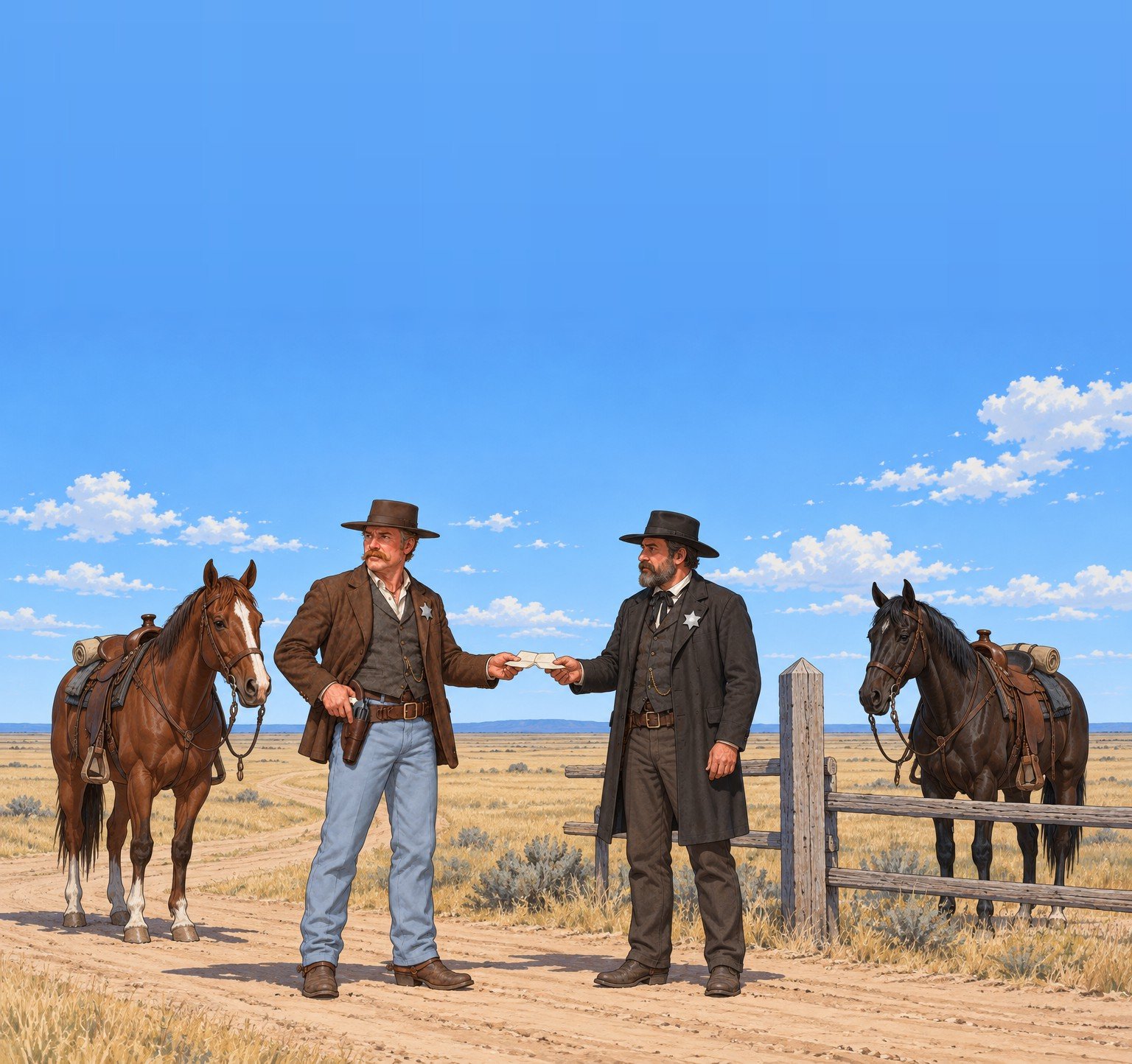
The deputy U.S. marshal hands a warrant to a county sheriff at a county-line post
## Relations in 1874
The table gives the state of the major powers on 1 September 1874. An alliance is a working relationship that can change; a tension is a live pressure that can break into violence.
| Power | Allied or working with | In tension with | The 1874 pressure |
|:--|:--|:--|:--|
| U.S. Army | Union Pacific, territorial governors, Shoshone scouts | Oglala, Northern Cheyenne, Northern Arapaho, miners, the Bureau | Camp Robinson and Camp Sheridan (March 1874); Custer's Black Hills expedition (2 July to 30 August); Red River War |
| Wyoming Territory | Union Pacific, stock association, Army | Tribal treaty rights, Congress | The stock association forming (29 November 1873); the Black Hills news from Custer's column; cattle boom |
| Colorado Territory | Denver railroads, mining interests | Ute, Washington appointees | Governor Elbert and Secretary Jenkins both signed as governor in spring 1874; statehood push |
| Cheyenne and Denver | Railroads, newspapers, territorial governments | Each other (trade); reformers | Denver's police department; Cheyenne's vice licensing |
| Bureau of Indian Affairs | Churches, Board of Indian Commissioners | Army, traders, Tribal leaders | Flagpole affair at Red Cloud Agency, 23 October 1874 |
| Railroads | Army, governments, cattle and mining interests | Tribal Nations, each other | Survey lines; Denver trade rivalry |
| Cattle interests | Railroads, Cheyenne press, Wyoming government | Rustlers, sheep raisers, Tribal claims | Stock association forming from the 1873 Laramie County group |
| Mining interests | Denver Pacific, Colorado government | Ute, Lakota, the Army | Brunot cession (1873); Black Hills rumors after the Custer expedition |
| Oglala Lakota | Other Lakota, Northern Cheyenne, Northern Arapaho | Army, miners, the agent's chosen leaders | Red Cloud and the agent; Black Hills |
| Other Lakota | Oglala, Cheyenne, Arapaho | Army, Bureau | Spotted Tail Agency opening, Camp Sheridan |
| Northern Cheyenne | Lakota, Northern Arapaho | Army, the Shoshone | Dull Knife and Little Wolf's Washington visit (Nov 1873); pressure to move south |
| Northern Arapaho | Cheyenne, Lakota | Eastern Shoshone, Army | Bates Creek, 4 July 1874; Black Coal's refusal to join the Wind River attacks |
| Eastern Shoshone | Army (Camp Brown, Fort Bridger) | Lakota, Cheyenne, Arapaho, Crow | Raids in the Wind River Basin |
| Ute | None formal | Colorado miners, Arapaho | Brunot Agreement implementation; two agencies |
| Southern Cheyenne and Arapaho | Northern kin, Kiowa and Comanche | Army, Texas settlers | Red River War, 1874 |
#### **Fault lines to use at the table.**
1. **The Black Hills.** The Custer expedition left Fort Abraham Lincoln on 2 July 1874, reached the hills on 22 July, and was ordered to return by 30 August. The treaty reserved the hills to the Lakota. In May 1875 a Lakota delegation went to Washington, and in September 1875 the Allison commission's offers were rejected. The corridor's merchants outfit the miners.
2. **The agencies.** The Bureau's agent against the leaders the people follow, with the Army camped at the agency.
3. **The railroad lines.** Surveys, stakes and depots against treaty boundaries.
4. **The Wind River.** Shoshone against Lakota, Cheyenne and Arapaho, with the Army at Camp Brown reading the Arapaho as hostile.
5. **The two capitals.** Cheyenne's women voters and cattlemen against Denver's mining wealth and statehood campaign. The Denver Pacific is the line between them.

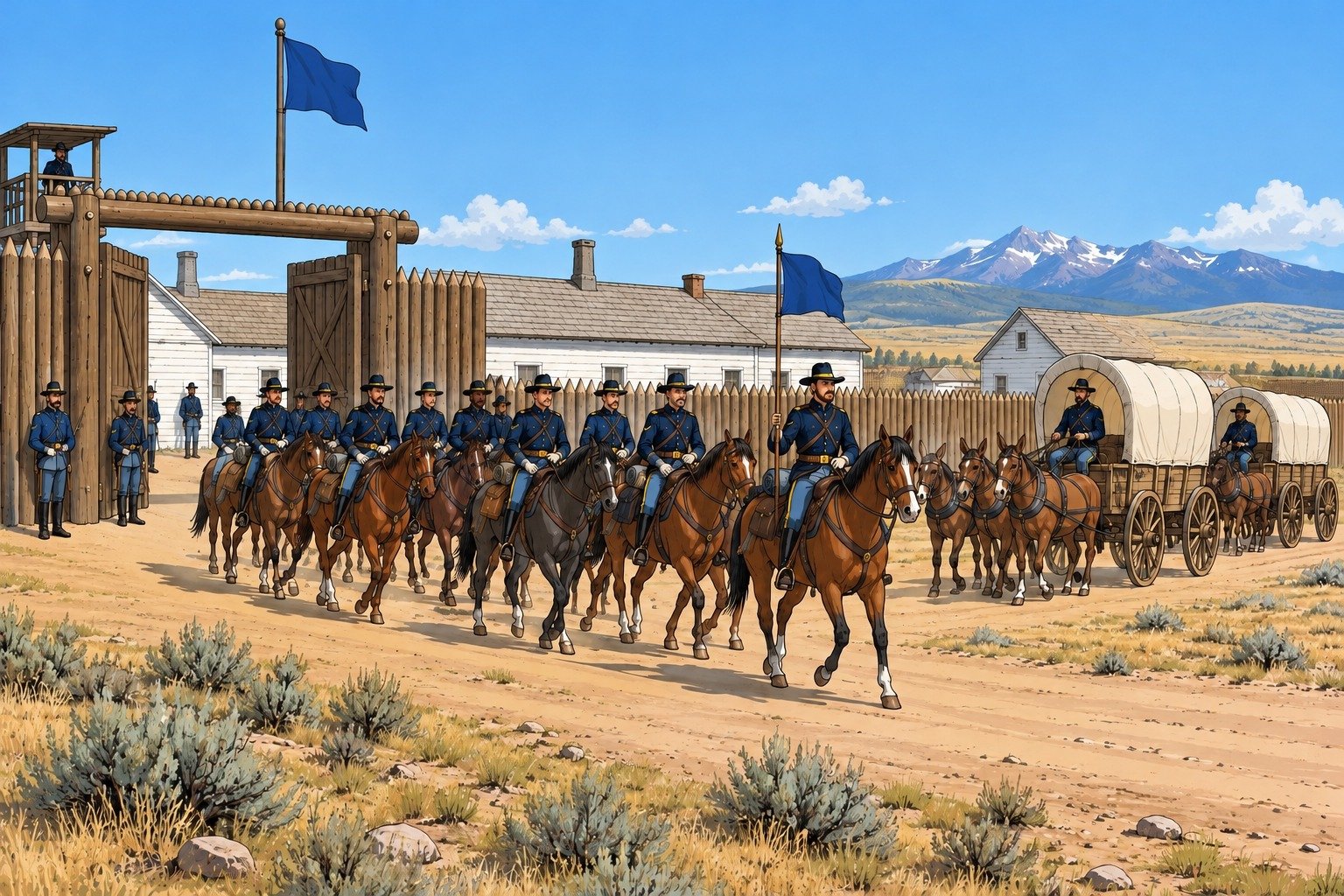 quartermaster, the post trader's license and the guardhouse. Rank is permanent rank; many officers hold a higher brevet rank from the Civil War, used in address but not in command.
**What it wants.** Peace along the railroad and the overland roads, quiet supply lines, the 1868 treaty kept on the Army's side of the line (the Army regularly expelled gold seekers from the Black Hills before 1874), and as few desertions, scandals and court-martials as it can manage. After July 1874, the Army also wants the Black Hills question answered, and it is divided about how.
**What it can do.** Garrison and escort; patrol the roads and the railroad; hold prisoners in a post guardhouse; supply agencies, posts and contractors; hire civilian scouts, interpreters, packers, teamsters, clerks and laundresses; use force against Tribal Nations when the department commander orders it; assist a marshal or sheriff who calls on it. Before 1878 it was common for marshals and sheriffs to call on the Army for help, and an 1854 Attorney General's opinion held that a posse could include soldiers. The Posse Comitatus Act that restricts this belongs to 1878 and is outside the play range.
**What it cannot do.** Act as a court, try a civilian, or hold one indefinitely. Take over a town government. Serve as an Indian agent: an act of 15 July 1870 barred Army officers from holding civil office, so officers could no longer serve as agents; the churches nominated agents instead. Arrest a civilian on its own authority far from its own ground and outside Indian country; that is a gray area with no flat rule. See **Who answers to whom** below.
#### **Where it operates.**
| Post | What the Army was doing there | Dates and notes |
|:--|:--|:--|
| Fort D.A. Russell | Garrison on Crow Creek, outside Cheyenne; guards the Union Pacific and the Denver road | Begun in August 1867 by 30th Infantry units; Company H, 2nd Cavalry, was the first cavalry unit, in September 1867; named by Department of the Platte General Order No. 33 for Brigadier General David A. Russell, killed at Opequon in 1864 |
| Camp Carlin | The quartermaster depot beside Fort D.A. Russell, halfway between the fort and the town on Crow Creek; trains of 10 to 30 wagons, with pack mules, carry supplies to 12 army posts and Indian agencies | Site chosen in August 1867; receiving and issuing supplies from 10 December 1867; officially the Cheyenne Depot; named for Captain Elias B. Carling, its first quartermaster, the g dropped in local use; called the second-largest military supply depot in the country in later accounts |
| Fort Laramie | The old trading post on the North Platte, now an Army post; treaty ground, supply point and staging ground | Cavalry barracks built 1872 to 1874; a major staging point for 1876; closed in 1890 |
| Fort Fetterman | North Platte post near present Douglas, the jump-off for the roads north | Founded 1867; staging point for Crook's 1876 campaigns; active until 1882 |
| Fort Sanders | Union Pacific guard post near Laramie, first called Fort John Buford | Built 1866; active until 1882 |
| Fort Steele | Guards the Union Pacific crossing of the North Platte | Operated from 30 June 1868 to 1886; sources differ on 1868 and 1869 |
| Fort Bridger | Old trading post and military post in the southwest, near the Shoshone country | Army post from 1858 to 1890; abandoned in 1878 and regarrisoned in 1880 |
| Camp Brown | Post on the Wind River Reservation, beside the Eastern Shoshone | Camp Augur in 1869, Camp Brown in 1870 for Captain Frederick H. Brown, moved to its present site in 1871, renamed Fort Washakie in December 1878 |
| Camp Robinson | Tent camp set up in March 1874 beside the Red Cloud Agency in northwest Nebraska; moved in May to its present ground near Soldier Creek and the White River | Named for a lieutenant killed earlier in 1874; Fort D.A. Russell and Fort Laramie sent the first troops in February 1874 |
| Camp Sheridan | Post at the Spotted Tail Agency, established 12 March 1874 | Troops of the 8th Infantry and the 3rd Cavalry |
| Colorado posts | Fort Lyon near Las Animas (second fort, built after a flood in 1866, to 1897); Fort Garland in the San Luis Valley (1858, command held by Kit Carson from 1866; one list says to 1883); Fort Reynolds near Pueblo (1867 to 1872); Fort Sedgwick near Julesburg (1864 to 1871) | An 1870 directory notes a quartermaster stationed in Denver and reports "no hostile Indians in the Territory", so Colorado's troops were mostly on garrison and escort duty |
Camp Robinson and Camp Sheridan lie in Nebraska, outside the corridor, and are listed because they sit on the Lakota agencies the corridor's people deal with.
 **How it treats the players.** Soldiers and officers deal with civilians by their business: contractors, freighters and scouts are paid and watched; drifters near the post are moved on; anyone known to sell whiskey or arms to a Tribal Nation is arrested or reported. A civilian with a letter from a department officer is received; one with a grievance goes to the post commander, who has no obligation to hear it.
**Resources.** Companies usually well below authorized strength (an act of 16 June 1874 cut the whole Army to 25,000 enlisted men); horses and mules; wagons from Camp Carlin; telegraph to Omaha; the post guardhouse; money for scouts and packers. Post life depends on civilians: laundresses, teamsters, clerks, a post trader, contractors for beef, forage and wood. Discipline is by court-martial and company punishment; desertion is a steady problem for every post .
**Internal splits.** Department commanders and the Peace Policy: the Army enforces the treaty line and also receives orders to ease off. Officers who think of agencies as ration stations and officers who think of them as the front line. Enlisted men, mostly immigrants and city recruits, against officers with Civil War brevets. Posts that hold Camp Carlin contracts against posts that must wait for them.
**Allies and rivals.** Allies: the Union Pacific (the Army guards it), territorial governors who want troops on the roads, merchants and freighters who sell to the posts, Eastern Shoshone scouts at Camp Brown. Rivals and tensions: the Bureau of Indian Affairs over who controls agencies; the Oglala Lakota, Northern Cheyenne and Northern Arapaho over the Black Hills and the roads north; miners who trespass; stockmen who want troops and do not want to pay for them.
 **Who leads it.** A governor appointed for four years: John A. Campbell (appointed 3 April 1869, in Cheyenne from 7 May; resigned 1 March 1875), then John M. Thayer. The governor is also commander of the militia and, under the Organic Act, superintendent of Indian affairs; after 1870 the Shoshone agency reported to Washington. The secretary carries out the governor's duties in his absence.
**What it wants.** Settlers, taxpayers, rail traffic and cattle money; the vote and the offices to stay in friendly hands; and, for most of its members, a state. The women's suffrage act of 1869 was passed in part to draw settlers.
**What it can do.** The legislative assembly (a council of 9, expandable to 13, and a house of 13, expandable to 27; sessions limited to 40 days, the first to 60) passes laws on any rightful subject, but the governor may veto, and two-thirds of both houses may override. The first legislature met from 12 October to 10 December 1869. It created counties (four at the start, Albany, Carbon, Carter, which later became Sweetwater, and Laramie; five by 1872, with Uinta), set the courts' sessions, and made the rules for juries, elections and offices. The governor appoints officers not otherwise provided for, with council consent. He also grants pardons for territorial offenses.
**What it cannot do.** Tax federal land, interfere with the primary disposal of the soil (that is the General Land Office's), pass a law that impairs the rights of Indians while those rights remain unextinguished by treaty, or abridge the vote on account of race, color or past servitude. It cannot hold a federal trial except through its district courts sitting as federal courts. It does not control the Army, the railroad's own lands, or the agencies.
**Where it operates.** The territory, with the seat at Cheyenne and the courts and county offices in the county seats. Laramie County was created by the Dakota legislature on 8 January 1867; its seat was moved to Cheyenne on 3 January 1868. Laramie County counted 2,665 people in 1869, 2,305 of them in Cheyenne.
**How it treats the players.** Most contact is through local officers. A citizen with business before the legislature or the governor goes through a friend; a stranger with a complaint goes to a justice of the peace. The governor's office is receptive to anyone who brings settlers, capital or votes.
**Resources.** A small salaried staff; a federal appropriation for the legislature and a small contingent fund; the territorial militia on paper, which the governor can call; county tax revenue; and the courts' fees.
**Internal splits.** The governor, appointed from Washington, against the legislature, elected in the territory. Cheyenne and the railroad towns against the mining towns of the south and west. Stockmen against sheepmen and farmers, and the stock association against both. Women's suffrage itself: an attempt to repeal it in December 1871 failed when the governor vetoed the repeal and the Council fell one vote short of an override.
**Allies and rivals.** Allies: the Union Pacific, the Army, the Wyoming Stock Growers Association, the Cheyenne Leader. Rivals: Congress, which can overrule; the Tribal Nations, whose treaty rights limit the territory's jurisdiction; Colorado, for the railroad trade and for population.
 **Who leads it.** A governor appointed by the President: Alexander C. Hunt (8 May 1867 to 19 April 1869), Edward M. McCook (19 April 1869 to 17 April 1873), Samuel H. Elbert (17 April 1873 to about 19 June 1874; he still claimed the office in July), McCook again (19 June 1874 to 29 March 1875), and John L. Routt (29 March 1875 until statehood; elected the first state governor that November). In spring 1874, after President Grant removed Elbert and renamed McCook, Elbert and Territorial Secretary John W. Jenkins both signed as governor until the Senate confirmed McCook on 19 June 1874.
**What it wants.** Statehood, which it had sought since the mid-1860s and which failed in 1866 and 1867 over the vote for Black men; mining capital; rail connections; settlers; and to keep the Ute and Arapaho lands moving toward the settled map.
**What it can do.** Pass laws through a governor-and-legislature system like Wyoming's; create counties (17 in November 1861), schools (Denver's were segregated at parents' request from 1868; see Denver), courts' sessions and city charters; call the militia; set elections. The Organic Act limited the vote to white male residents over 21; Congress's Territorial Suffrage Act of 10 January 1867 removed the color bar in every territory, and the Fifteenth Amendment (ratified 1870) confirmed it. The legislature and mountain towns drove most decisions, and Denver was the political and commercial center only after the capital moved.
**What it cannot do.** Make treaties with Tribal Nations; since 1871 Congress has made agreements, not treaties. Control the federal land office, the Army or the agencies. Admit itself to statehood. It does not grant women the vote; Wyoming does.
**Where it operates.** The territory: Denver, Golden, the Front Range, the mining camps in the mountains, the plains to the east, and the Western Slope.
**How it treats the players.** More distant and more commercial than Wyoming's: the mining and railroad interests have the governor's ear, the legislature is slow, and most business goes through a county or a city.
**Resources.** Federal salaries for the governor, secretary, judges, attorney and marshal; county and city taxes; the mining counties' wealth; Denver's banks and rail connections.
**Internal splits.** Denver against Golden and the mountain towns; statehood men against territorial appointees; mining against farming and ranching; and the unresolved question of the Ute reservation.
**Allies and rivals.** Allies: Denver's businessmen and the Denver Pacific, the Kansas Pacific, the mining operators. Rivals: Washington (the President's appointees); the Ute leadership; Wyoming, as a neighbor with a woman voter and a railroad.
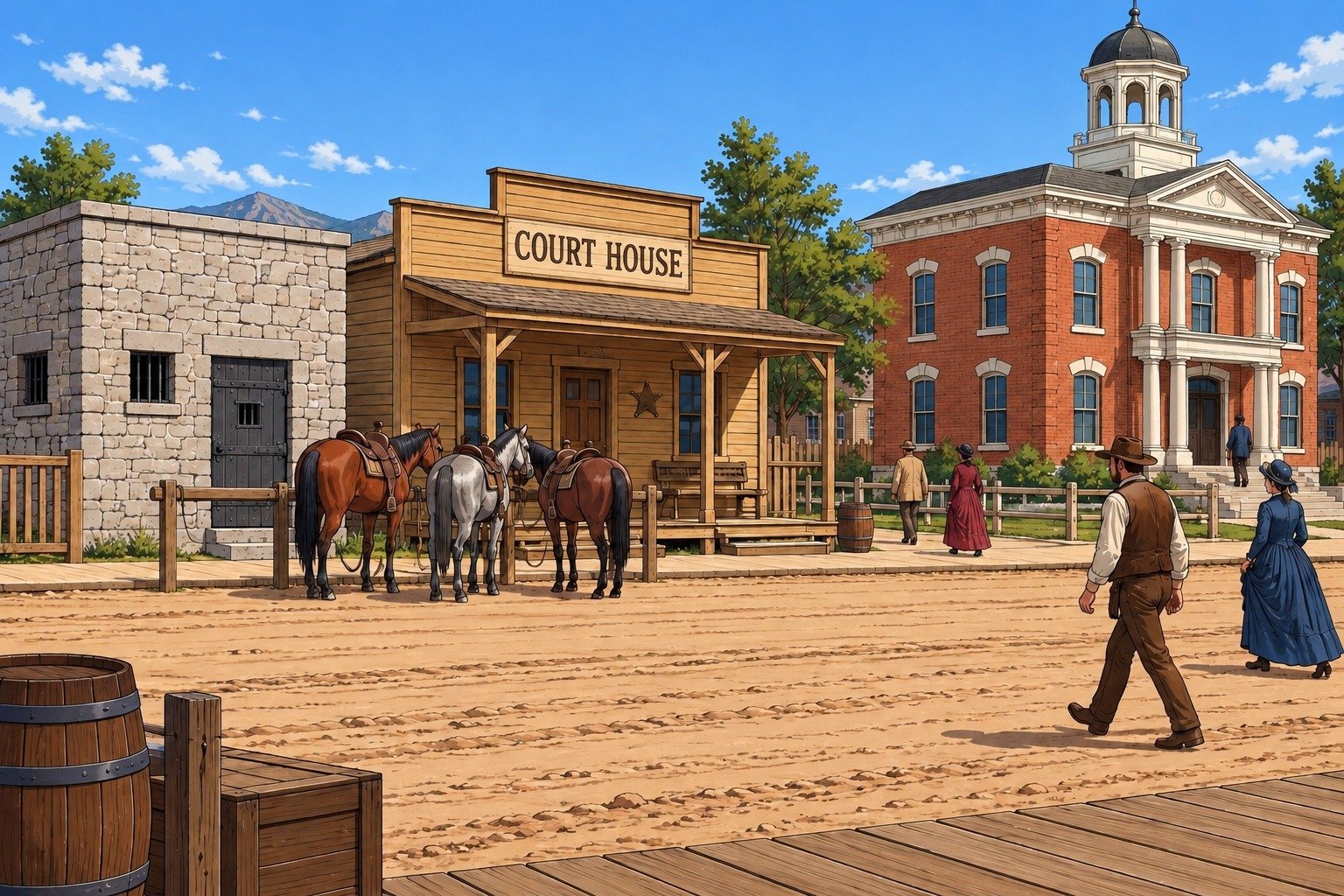 **Offices.** Who each office answers to, where its authority runs and whether it may arrest are in **Who answers to whom** at the end of this chapter; the rule for play is in the Era Rules, Law in Play. The office-holders and limits a reader needs are these. The county sheriff serves the district court, runs the county jail, arrests under warrant and summons a posse; Laramie County's sheriff has two or three deputies, appointed by him to serve process and keep the peace; a deputy can arrest on a warrant and without one for a crime in his presence. Arapahoe County's sheriff covers Denver (Denver County dates from 1902); David J. Cook was Arapahoe County sheriff from 1869 to 1873, and city marshal of Denver from 1866 to 1869. Cheyenne elected a city marshal in August 1867; Denver had a city marshal from 1859 and set up a police department with a chief of police in April 1874 (see Denver). A justice of the peace is the lowest court: he hears small civil cases up to $100 and sits as examining magistrate, but cannot hear a matter in which title to land is in dispute. The district court is held by one of the territory's three supreme court justices sitting in his district, with chancery and common-law jurisdiction and the powers of a federal circuit and district court; the first six days of each term go to federal-law cases. The territorial supreme court is the chief justice and two associates, appointed for four years, as are the U.S. Marshal and the territorial attorney. Wyoming’s first marshal was Church Howe (April 1869). The marshal appoints deputies, who serve federal process anywhere in the territory and are paid by fee, not salary; a deputy has no deputies and no jail of his own. Michael Deveney (Era Cast) is a fictional deputy U.S. marshal stationed at Cheyenne. Stock association detectives are private men with no arrest power beyond a citizen's.
**How a criminal case runs.** The following sequence is the ordinary common-law one used in the territories.
1. **Complaint.** A victim or witness swears out a complaint before a justice of the peace, or the police act on the street.
2. **Warrant and arrest.** The justice issues a warrant. A constable, marshal, sheriff or deputy makes the arrest. An officer may arrest without a warrant for an offense in his presence.
3. **Examination.** The justice, sitting as examining magistrate, holds a hearing: discharge, bind over to the grand jury, or commit to jail. Bail is set at this point for most offenses.
4. **Jail.** Cheyenne's jail and the county jails hold prisoners awaiting the district court's term. A town may also have a city jail or calaboose.
5. **Grand jury.** The grand jury at the district court's term decides whether to indict. The first mixed-sex grand jury in Wyoming met in Laramie on 7 March 1870.
6. **Trial.** The district judge sits with a trial jury drawn by the county. Murder, robbery and stock theft are tried in the district court; small matters stay with the justice.
7. **Sentence and appeal.** The judge sentences; the sheriff executes the sentence. Appeals go to the territorial supreme court.
8. **Federal crimes.** An offense against federal law, such as robbing the mail, trading arms or liquor to a Tribal Nation, or crimes on a military reservation, is a federal case, tried in the same district court in its federal capacity and served by the U.S. Marshal and his deputies. A deputy marshal arrests for a federal offense on a warrant from a federal judge, a commissioner or a justice of the peace, or without one for a federal offense in his presence; for a territorial offense he is a citizen unless he also holds a county or town commission.
**Juries and elections.** Wyoming's suffrage act of 10 December 1869 gave women the vote and the right to hold office, and in Colorado only men voted; the dated entries (the act, the first election, the first women jurors, Campbell, Howe, Stewart and Post) are in the Historical Reference. A territorial law of 7 December 1869 limited jury duty to men, but women sat on Wyoming juries from March 1870 until Chief Justice Howe left the bench in October 1871, and generally not again until 1949.
**Practice against paper.** The law is written for a settled county. In 1874 a sheriff may have one or two deputies for a county the size of a state; a territorial judge visits a county twice a year; the Army and the railroad police their own property; and the Tribal Nations govern themselves under treaty. A stock thief can be across a boundary before a warrant is signed, and the same horse can be claimed by two owners in two jurisdictions. The Organic Acts, the Treaty of Fort Laramie and the Army's orders each define a different edge.
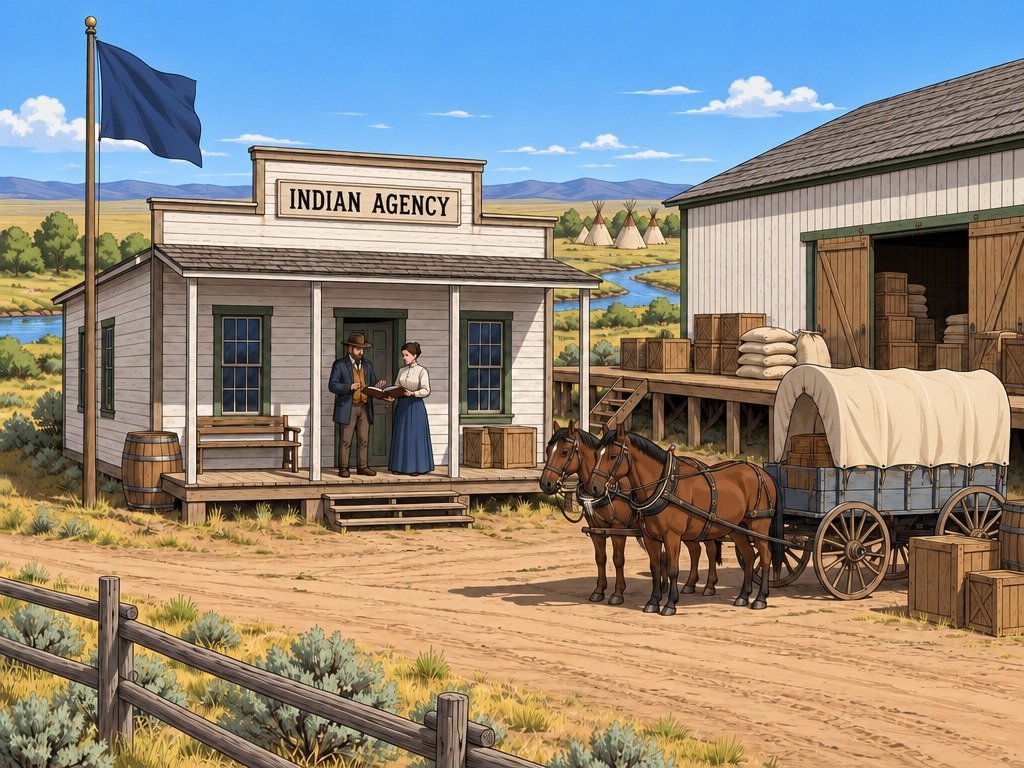 **What it wants.** Quiet agencies, annuities delivered on time, children in school, and a record that justifies its appropriation. For the agents' sponsors, converts. For both, a Tribal Nation that farms, stays put and does not need the Army.
**What it can do.** Issue rations and goods, hold the annuity list, license traders, expel unauthorized whites (the Army enforces), report to the Commissioner, and withhold rations. Under the 1868 Fort Laramie treaty, the agent must live at the agency, keep an office open, and forward complaints to the Commissioner. Clothing is due by 1 August each year, with cash and rations for specified periods.
**What it cannot do.** Make a Tribal Nation sign: the treaty requires the signatures of three-fourths of the adult men for any cession of the reservation (Article XII). Control the Army, or the miners who trespass. Choose a leader for a Tribal Nation, though it often tries.
**Where it operates.** At the agencies: the Red Cloud and Spotted Tail Agencies in northwest Nebraska, Wind River (Eastern Shoshone), the Ute agencies in Colorado, the Darlington Agency in Indian Territory. The Red Cloud Agency was set up in 1871 on the North Platte at the Nebraska line, moved in August 1873 to the White River in northwest Nebraska, and had Camp Robinson beside it from March 1874.
**How it treats the players.** An agent trades with the players on the Bureau's terms: licenses for traders, passes for visitors, and a standing suspicion of anyone who might sell whiskey or arms or encourage a faction. An interpreter or trader is useful; a prospector is a problem.
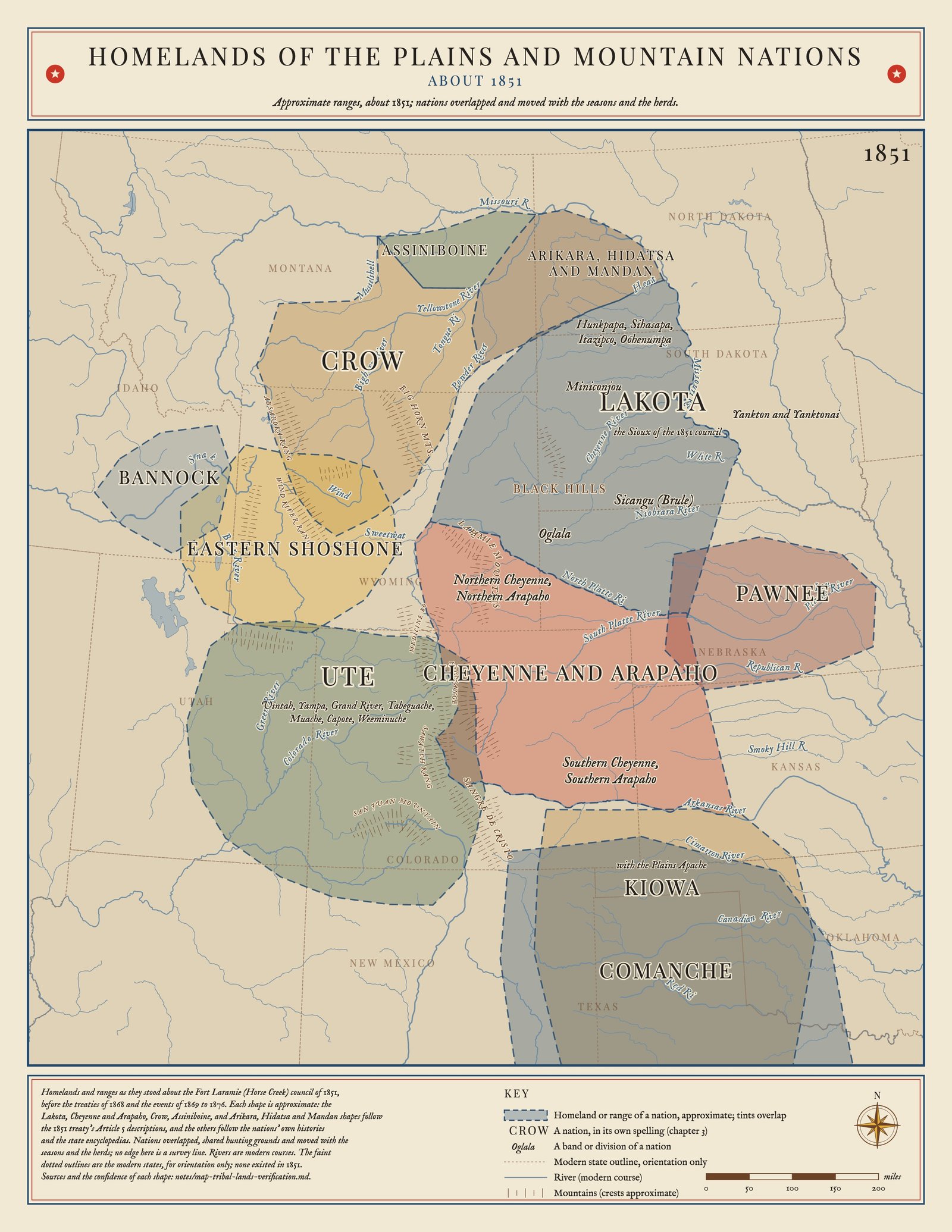
 **What it can do.** Move people, goods, cattle and troops; hire thousands of workers, including Irish graders and, from 1869, Chinese workers sent to repair the Union Pacific (the 1880 census counted 914 Chinese residents in Wyoming); survey and sell land; make or break a town by where it puts the depot; run its own police and special agents; and shape the news.
**What it cannot do.** Control the Army or the Tribal Nations' treaty lands. Survey lines into the unceded territory conflict with the Oglala treaty rights.
**Where it operates.** The Union Pacific mainline across southern Wyoming, with the Cheyenne division point; the Denver Pacific between Cheyenne and Denver; the Kansas Pacific from Kansas City to Denver; the Colorado Central between Golden and Denver, with a branch to Longmont from April 1873; its line north from Longmont to the Union Pacific just west of Cheyenne opened on 7 November 1877, after the play range.
**How it treats the players.** As customers or as employees. A freighter, a drover or a stock owner depends on the shipping rates; an employee depends on the foreman. The land department treats a squatter as a problem and a buyer as a friend.
**Resources.** Money, trains, telegraph, land, lawyers, and the goodwill of the Army and the territorial government.
**Internal splits.** Between railroads (the Denver Pacific, Kansas Pacific and Union Pacific compete for Denver's trade), between the engineers and the owners, and between the workers (Irish, Chinese, native-born) and the bosses. Cheyenne's economy suffered after the Union Pacific crews left, and the Panic of 1873 hit credit.
**Allies and rivals.** Allies: the Army (which guards the line), the territorial governments, the cattle interests and the mining interests. Rivals: each other, and the Tribal Nations whose land the survey crosses.
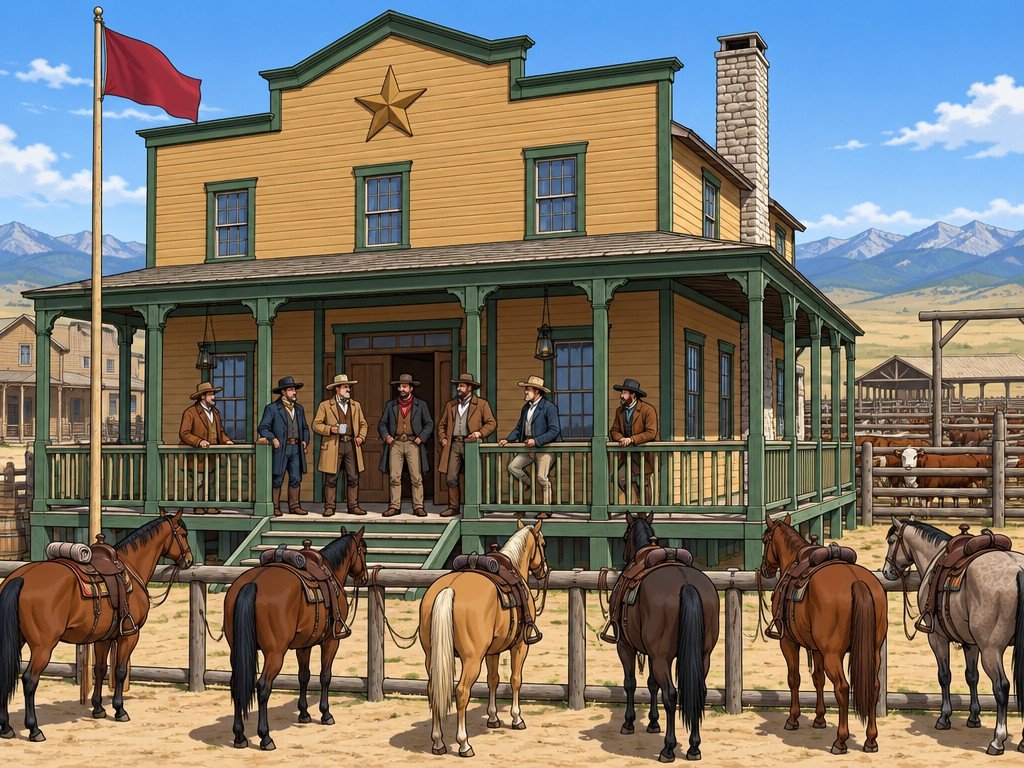 **Who leads it.** The stock association came together in three steps: a Wyoming Stock Graziers' Association sponsored by Governor Campbell in May 1871; the association's own founding date of 1872; and the Laramie County Stock Association meeting of 29 November 1873, formed by many of the Graziers' former members, which became the nucleus of the body renamed the Wyoming Stock Growers Association in 1879. M. V. Boughton chaired the 1873 meeting and was president from 1874 to 1876; Alexander Hamilton Swan followed him in 1876. The Cheyenne Club (1880) at 17th Street and Warren Avenue belongs to the next decade.
**What it wants.** Open range, low costs, no thieves, and a government that does what the association tells it.
**What it can do.** Organize roundups, schedule shipments, record brands, and hire private detectives for stock theft: the association began paying for detectives in 1875 and had them on its payroll by 1877. It later became the de facto territorial government, and many of its rules became state law. The Maverick Law is 1884, outside the range.
**What it cannot do.** Make arrests as a private body beyond what any citizen can. Close the range to sheep and farmers by itself in 1874.
**Where it operates.** The plains around Cheyenne, the Laramie plains, and the roads from Texas to the Union Pacific.
**How it treats the players.** As hired hands, if they work; as suspects, if they own a branding iron they cannot explain. Hands are wage laborers; the best-paid are the foremen. Ybarra and Tolliver (Era Cast) are the type of hand who gets paid by the herd or the day. Outfits sometimes pay some hands less than others for the same work, as Ybarra's history shows, and the association is a body of owners.
**Resources.** Capital, cattle, range, the association's brand book, and friends in the legislature.
**Internal splits.** Large against small outfits, Eastern investors against local operators, and cattle against sheep (the Durbin brothers brought sheep to Laramie County in 1870).
**Allies and rivals.** Allies: the Union Pacific, the Cheyenne Leader, the Territorial government. Rivals: thieves like Wade Carrick (Era Cast), sheep raisers, Tribal Nations' claim to the land, and homesteaders.
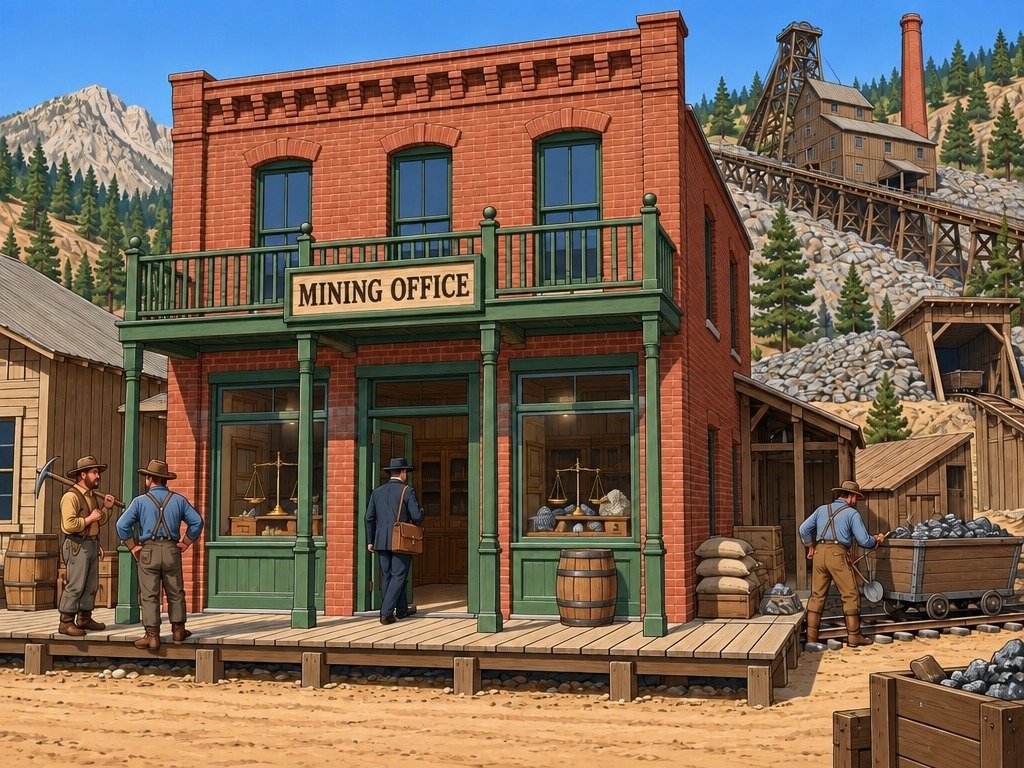 **Who leads it.** Local mining districts, company superintendents, and territorial officials who depend on the revenue. The Brunot Agreement of 1873 opened the San Juans to mining by cession from the Ute.
**What it wants.** Access to ore, labor, rail connections to Denver, and the land the treaties and agreements reserve.
**What it can do.** Hire, bring in capital, shape territorial law and press for cessions. In 1874 the Custer expedition into the Black Hills (2 July to 30 August) increased the pressure, and thousands of citizens entered the hills illegally in the next two years while the government withdrew its troops.
**What it cannot do.** Occupy the Black Hills lawfully. The Army expelled trespassers before 1874.
**Where it operates.** Colorado's mountain camps and the San Juans; Wyoming's South Pass district; the Black Hills (illegally).
**How it treats the players.** As labor, as customers or as claim jumpers. A claim is defended by the district's rules and by guns, and a stranger without papers gets a hearing at the miners' meeting.
**Resources.** Capital, labor (German, Welsh, Cornish, Irish), tools, mills, access to Denver's banks.
**Internal splits.** Capital against labor; large against small claims; the Colorado mining interests against the Ute and the Utah and Wyoming interests.
**Allies and rivals.** Allies: the Denver Pacific, the territorial government, merchants. Rivals: the Ute, the Lakota, and the Army when it enforces the treaties.
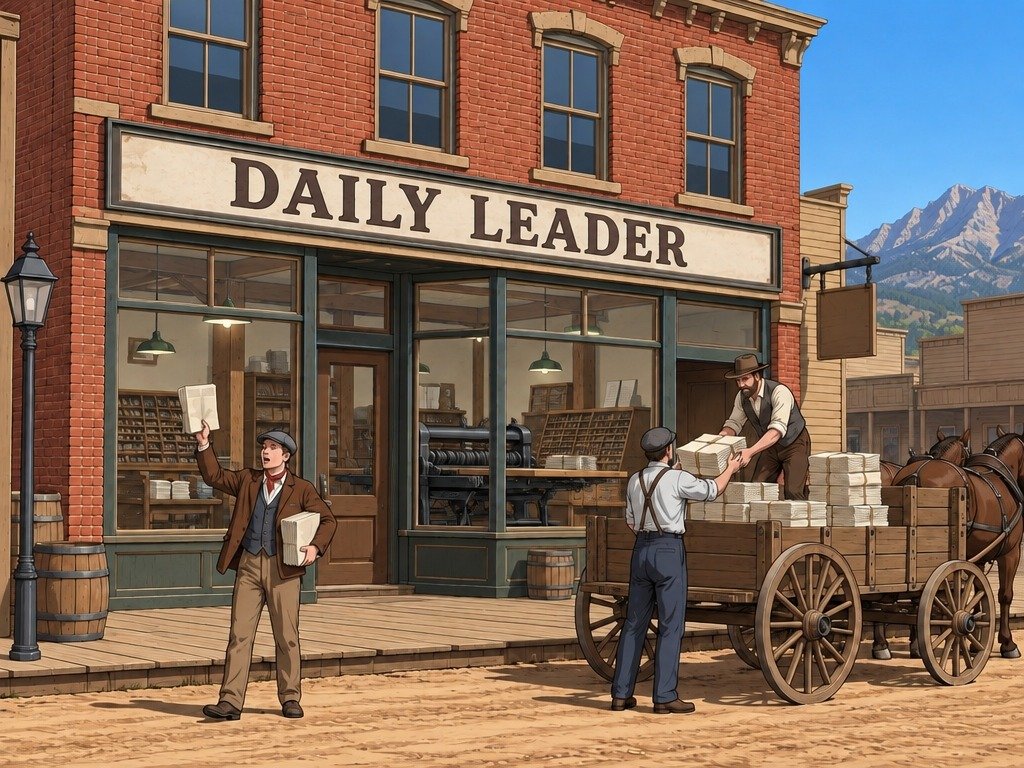 **Who leads it.** Editors. In Cheyenne, Nathan Baker of the Leader opposed women jurors, arguing that "the feminine mind is too susceptible" to emotion.
**What it wants.** Subscribers, advertisers, public printing contracts, and a part in territorial politics.
**What it can do.** Print a rumor, a grievance, an advertisement, or a warning. It can help a stockman's case or sink a candidate. It sets the terms of a scandal.
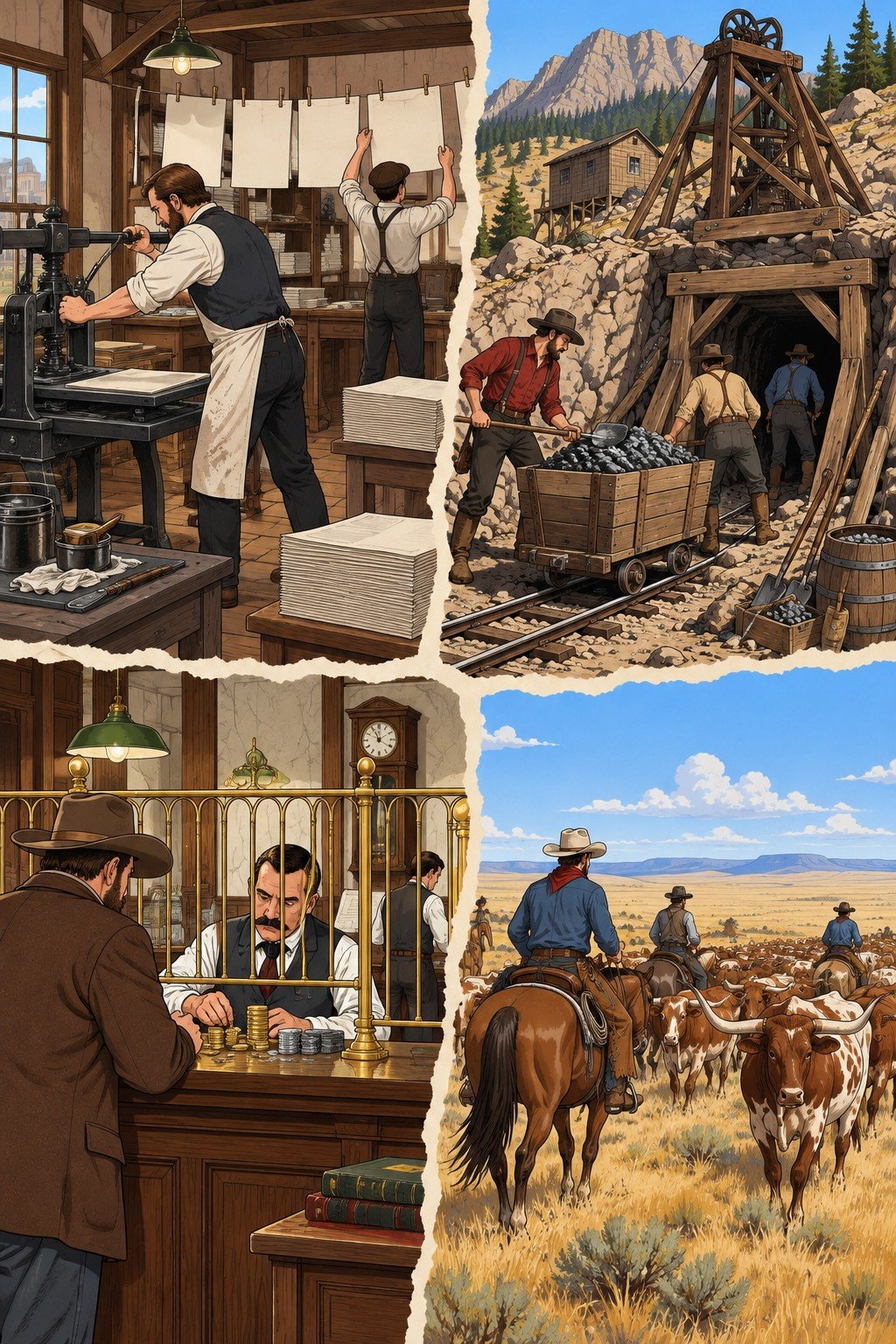
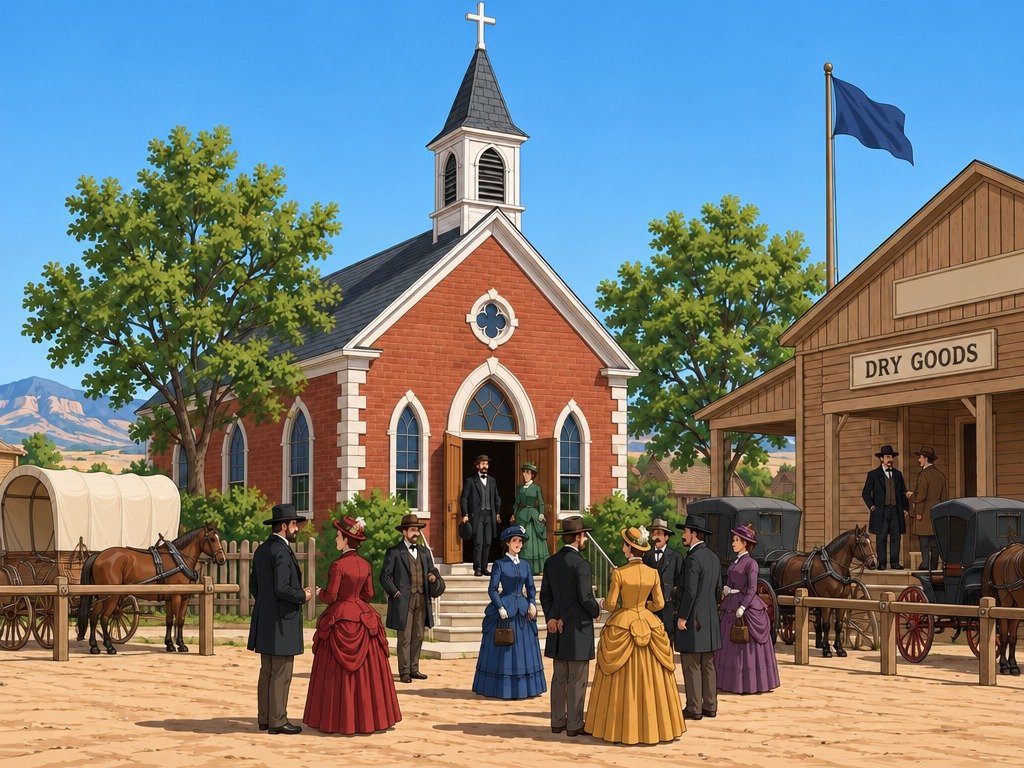 **Who leads it.** Pastors, priests, rabbis, lay boards, lodges' officers, and women's committees.
**What it wants.** Members, a building, charity money, order, and a moral voice in local politics.
**What it can do.** Run schools and hospitals, feed and bury the poor, shape what is said in a parlor, and refuse a funeral. It can lobby for temperance or Sunday closing. Under the Peace Policy it nominates agents and sends missionaries.
**What it cannot do.** Make or enforce laws. A church cannot compel a jury.
**Where it operates.** Towns and the agencies.
**How it treats the players.** With charity to those in need, with suspicion to visitors of ill repute, and with respect for those who attend.
**Resources.** Buildings, schools, donors, volunteers, and (for lodges) a fraternal network that moves a man from town to town. Lodge membership (Masons, Odd Fellows) and veterans' posts matter as a network: Denver Lodge No. 5 dates from an 1859 dispensation, Cheyenne's Masonic lodge from 1868, and an 1870 directory lists Grand Army of the Republic posts in the principal Colorado towns.
**Internal splits.** Denominations against each other, reformers against the owners of saloons and houses, and congregations on the Peace Policy.
**Allies and rivals.** Allies: reformers, benevolent merchants, the Bureau. Rivals: saloon and house keepers, other churches, a bitter press.