# Cheyenne
*The Old West, An Exodus NDS Era Book, Wyoming and Colorado, 1869 to 1876. Source: https://oldwest.exodusnds.com/cheyenne*
Cheyenne, Wyoming Territory, is a Union Pacific town, the territorial capital, the county seat of Laramie County and the supply door to Fort D.A. Russell and the Black Hills road. Cattle buyers, soldiers, railroad money, lawyers and the territory's legislators all work within a few blocks of each other. This chapter gives the town as it stood between 1869 and 1876, with the earlier history behind it.
##### DATES AND STREET NAMES
- **Dates.** A year in a table is the earliest year the thing is known to exist. Anything dated after 1876 is not in town; see "Not yet in town."
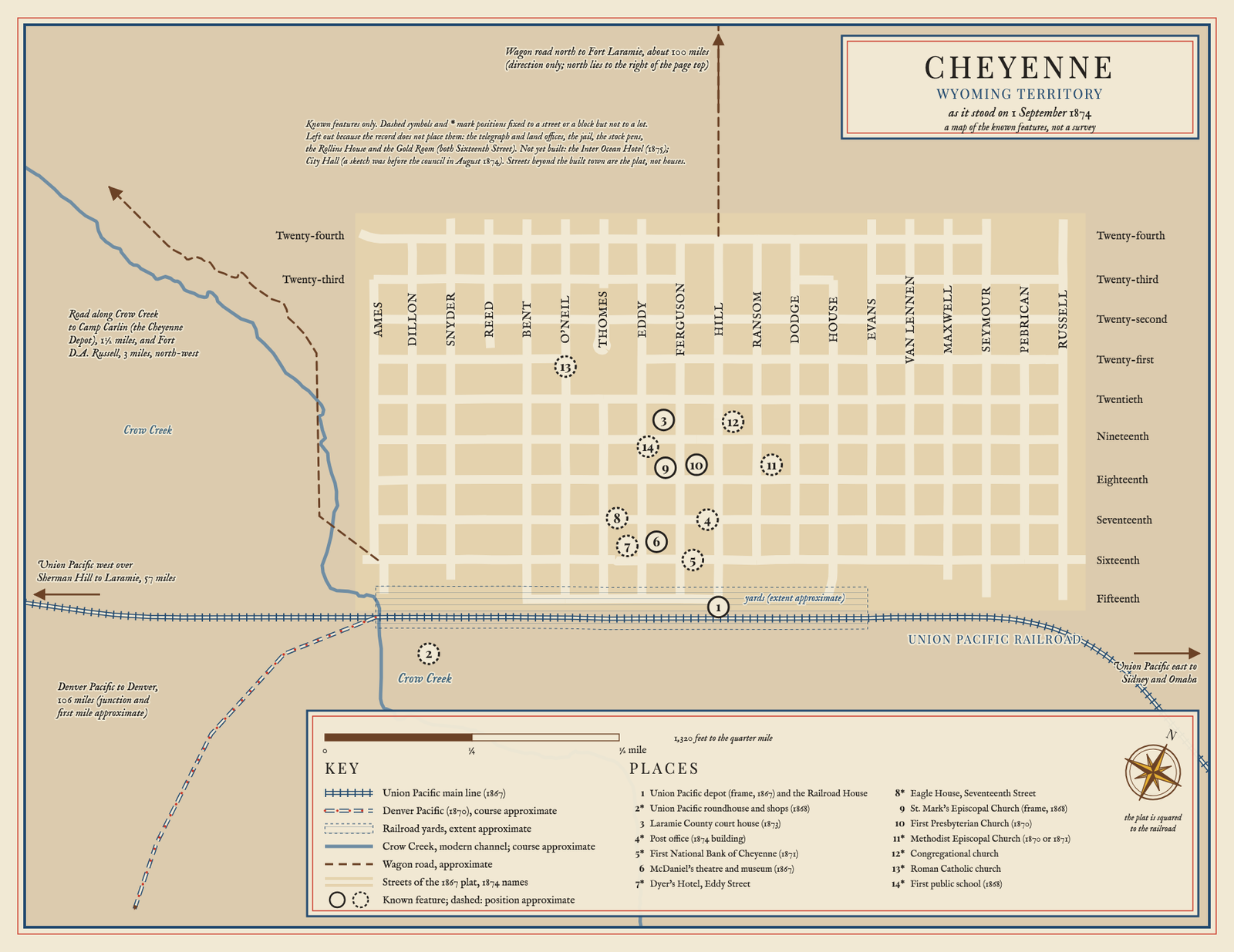
- **Street names.** Use the period names. Hill Street is today's Capitol Avenue (renamed 3 May 1887), Ferguson Street is Carey Avenue, Eddy Street is Pioneer Avenue, Dodge Street is Warren Avenue and Ransom Street is Central Avenue.
- **Prices.** A price appears only where one is known. Gear and Prices has the price lists.
## A Town Built for the Railroad
Cheyenne is a planned railroad town, laid out by the Union Pacific on the Crow Creek flats and platted to a grid of four square miles. It stood in Dakota Territory when it was founded and became part of Wyoming Territory in 1869.
##### TRAINS
- **The main line.** Union Pacific track reaches Cheyenne on 13 November 1867, and for about six months the town is the end of it. The through trains run east to Omaha, a day and a night away, and west over Sherman Hill to Laramie, Green River, Evanston and Ogden. Cheyenne is a 30-minute meal stop on them and the largest town between Omaha and Ogden.
- **The Denver Pacific.** Track to Denver is finished on 22 June 1870 and the first train runs on 24 June. Denver is 106 miles and one day south; the Kansas Pacific carries on from there to Kansas City. Places and Campaign Tools has the distances and times, Gear and Prices the fares.
- **The company in town.** The depot, freight office, stock pens and yards stand at the foot of Hill Street. The railroad's stone buildings, a roundhouse of twenty stalls and a machine and repair shop employing fifty men, make the Union Pacific the town's steadiest employer, from agent and telegrapher to section hand and shopman.
- **The train as a scene.** A train's arrival sets the day. Mail goes to the post office, eastern papers reach the stands, freight is signed for and strangers step off onto Hill Street. The passenger train is a scene hook: who gets off, who is seen leaving, and who misses it and waits for the next one.
| Date | Event |
|:--|:--|
| 4 July 1867 | The Union Pacific chose the townsite at Crow Creek Crossing on 4 July 1867 and platted it on 5 July. |
| 9 July 1867 | The first residents arrive: three married couples and three men. |
| 22 July 1867 | The lot-sales office opens. |
| August 1867 | Captain Carling selects the site of the quartermaster depot; troops begin building Fort D.A. Russell. The town organizes a city government in August. |
| 8 September 1867 | The post is named Fort David A. Russell. |
| 19 September 1867 | The first issue of the *Cheyenne Leader*. |
| 13 November 1867 | The first Union Pacific track reaches Cheyenne. The town is an end-of-track town for roughly six months, supplying graders on Sherman Hill and the freight road toward Colorado. |
| 10 December 1867 | Camp Carlin begins receiving and issuing supplies. |
| 3 January 1868 | The Dakota legislature moves the Laramie County seat to Cheyenne. |
| 10 to 22 January 1868 | A citizens' vigilance committee seized three men accused of stealing $900; accounts differ on whether they were hanged or placarded and run out. The first hangings on record are 21 March 1868 (Historical Reference). |
| 6 January 1868 | The first public school is dedicated. |
| 23 August 1868 | St. Mark's Episcopal Church is dedicated. |
| 19 May 1869 | Wyoming Territory is organized. Cheyenne is named the temporary capital that month. |
| 12 October to 10 December 1869 | The first territorial legislature meets in Cheyenne. On 10 December it passes the law giving women the vote. |
| 11 January 1870 | A fire burns two blocks and about 88 buildings, including the *Leader* building. A fire recorded for 1869 may be a separate event. |
| 24 June 1870 | The Denver Pacific's first train runs between Cheyenne and Denver on 24 June 1870 (track finished 22 June). |
| 6 September 1870 | The first territorial election with women voting. |
| 1872 to 1873 | A courthouse is built; the 1873 legislature meets in it. |
| 29 November 1873 | The Laramie County stock association is organized in Cheyenne; it is renamed the Wyoming Stock Growers Association in 1879. |
| 1874 | City Hall is built. |
| 1875 | The Black Hills rush opens on the Army's lifting of its prohibition on prospectors that summer. Cheyenne lobbies as the outfitting point. |
| February 1876 | Yates and Brown run three trips to Custer City on 3, 7 and 10 February 1876 and sell the line on 12 February. The first run to Deadwood, on 25 September 1876, falls after the play range closes on 1 August 1876 and is an epilogue. |
Population figures are thin. The 1869 territorial census counted 2,305 in Cheyenne and 360 at Camp Carlin and Fort Russell; the 1870 federal census counted 2,957 in Laramie County and 1,450 in Cheyenne itself (828 more at Fort D.A. Russell). A residents' estimate for 1867 was around 4,000, and the *Leader* claimed 5,000 for July 1868; these were boomtown numbers. A traveler in 1873 wrote that the town had fallen from about 6,000 to about 4,000, and a visitor in 1877 put the resident population at no more than 4,000 and the whole, with transients, at about 5,000. About 3,250 is estimated for 1876, and the 1880 census counted 3,456. Use "a few thousand" at the table.
## Layout and Districts
Dodge laid the grid with north-south streets named for the railroad's friends and east-west streets numbered. The streets in play, with their period names:
| Period name | Today | Note |
|:--|:--|:--|
| Dodge Street | Warren Avenue | The street named for the railroad's chief engineer; the depot stands at its foot, on the same site as the later stone depot. |
| Ransom Street | Central Avenue | |
| Hill Street | Capitol Avenue | The main business axis, leading from the depot north. Renamed 3 May 1887. |
| Ferguson Street | Carey Avenue | The first frame house stood at Ferguson and Sixteenth, 25 July 1867. |
| Eddy Street | Pioneer Avenue | The theater and saloon street. Renamed by 1913, after the range. |
| Sixteenth Street | Lincolnway | The main east-west business street. |
### The Depot and Rail Yards
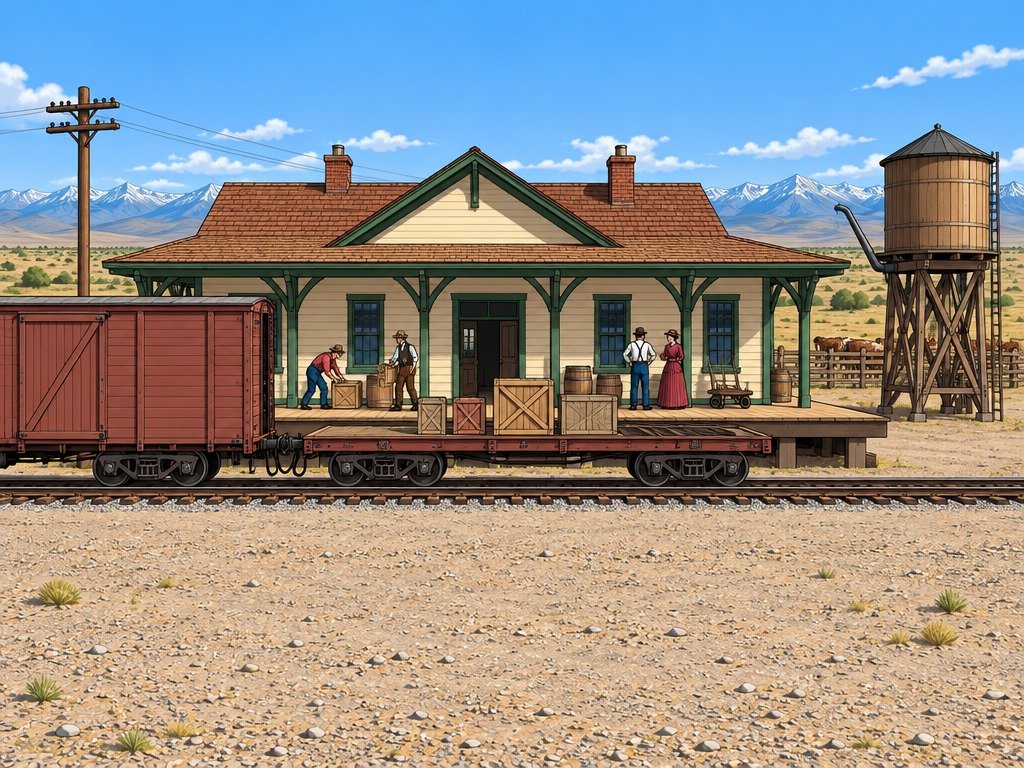
The Union Pacific depot and yards stand at the south end of Hill Street, with the tracks running east and west. This is where the Union Pacific placed its mountain-region headquarters in 1867, where cattle are loaded from July 1870, and where the Denver Pacific connection departs from June 1870. The frame depot of 1867 serves the whole range on the north side of the main line; the stone depot visitors know today was built on the same site in 1886 to 1887. Crow Creek, which gave the first townsite its name, lies on the town's southern side; stock pens, freight sheds and the wagon yards cluster by the tracks.
### Hill Street and the Business District
Hill Street (Capitol Avenue) and Sixteenth Street meet at the business core. The Inter Ocean Hotel stands at that corner from 1875 (see Hotels). Banks, outfitters, saddlers, clothiers and law offices line the blocks around it. The business district is built largely of wood in 1869; the fire of 11 January 1870 burned two blocks, and some rebuilding in brick follows. The current state capitol does not exist in this range; the legislature meets in rented rooms: in 1869 the Council in the McLeland Building at 17th and Ferguson and the House in the Arcade Building, in 1871 both houses at the Rollins House on 16th Street between Ferguson and Eddy, and in 1873 the new courthouse.
### Residential Areas
Wealthier families, officials and officers' wives live in frame houses north of the business blocks; railroad workers and laborers live near the yards and in boarding houses; the first frame house was at Ferguson and Sixteenth. In 1875 the town's largest tree is no bigger than a lilac bush; the streets are treeless and open to the wind.
### Saloon, Dance Hall and Parlor House Districts
Eddy Street (Pioneer Avenue) is the street of theaters, saloons and gambling rooms. McDaniel's museum on Eddy opened in 1867, and his theater (500 seats by the time the Opera House replaced it in 1882) and gambling rooms followed, with a stage and tables for faro, roulette and keno. Fifteenth Street is remembered as the red-light street where railroad men hung lanterns (local lore). The Gold Room, a saloon, theater and dance hall with gaming tables, was built by Jim Allen in 1867 on Sixteenth Street.
Prostitution in Cheyenne is tolerated or ignored by the authorities. No city fine or tax on houses is on record. A woman of age who keeps a house can vote, because Wyoming Territory gives women the vote from 10 December 1869. Parlor houses rank above the saloon upstairs rooms and dance halls in price and standing, and town leaders do business in their front rooms. Women with money run them. Odette Marchand keeps one such house (see the Era Cast).
### Fort D.A. Russell and Camp Carlin
Fort D.A. Russell lies about three miles northwest of the depot on Crow Creek; Camp Carlin, the quartermaster's depot, is about halfway (Factions and Powers). A road follows the creek through the depot to the fort, and the men paid at both spend their money on Eddy and Sixteenth Streets (What the Army Adds).
### Where Communities Live
##### NEIGHBORHOODS
Cheyenne has no mapped ethnic neighborhoods before 1876. Assign a group a "quarter" only if a period map or directory shows one.
| Community | In town |
|:--|:--|
| Black residents | A Black community settles within a few years of 1867, many for railroad or other labor. Black men vote in Wyoming Territory, and Black women are among the voters on 6 September 1870. Barney L. Ford's Inter Ocean Hotel opens in 1875. A Black congregation leaves First Methodist in 1875 and is organized as Allen Chapel (African Methodist Episcopal) in 1878 |
| Irish | Irish Catholics are among the graders, soldiers and tradespeople; a priest is sent to Cheyenne in fall 1867 to serve Catholics across a wide area |
| German | German-born keepers, tradesmen and railroad men are in town from the first years; no German society or quarter is on record before 1876 |
| Chinese | Cheyenne has no known Chinese quarter or named laundries before 1876. Cheyenne is a transit stop for Chinese traveling to the Black Hills by stage in January 1876. The Era covers the territory's Chinese workers and families; Denver covers that city's quarter. Wong Yik Lun (Era Cast), a Denver merchant, trades here a week in every month. |
| Mexican American and Tejano | Texas herds reach Laramie County from 1869; Tejano hands and horse breakers come north with them |
| Tribal Nations | Lakota, Cheyenne and Pawnee people are part of the early frontier population of the town |
Prejudice follows the situational social condition in Era Rules.
## Government and Law
### City, County, Territory
| Body | Year it exists | Notes |
|:--|:--|:--|
| City of Cheyenne | Organized August 1867; charter from the Dakota legislature in 1868 | City Hall built 1874. A court-ordered ruling in March 1868 held that only businesses named in the charter had to pay license fees, which hurt the city's income. Mayors in the play range: Jervis Joslin (1871 to 1872), M. Sloan (1872), M. V. Boughton (1873 to 1874), George Cassels (1874) (Factions and Powers). |
| Laramie County | Created 8 January 1867; Cheyenne county seat from 3 January 1868 | One of Wyoming Territory's first four counties on 19 May 1869. A courthouse is built in 1872 to 1873. |
| Wyoming Territory | Organized 19 May 1869 | Cheyenne is the capital from May 1869. The legislature considered Laramie and Evanston as alternate capitals in 1871 and 1873. |
| Federal officers | From 1869 | A U.S. Marshal, U.S. Attorney and federal district judges serve the territory. The first marshal was Church Howe (1869 to late 1870). The marshal keeps an office at the capital and deputies at Cheyenne and along the line. The wife of the U.S. Marshal at Cheyenne is among the women who vote on 6 September 1870. |
| Territorial courts | Court in session in Cheyenne on 25 May 1869 | Each of the territory's three justices holds district court in his own district and sits with the others as the supreme court (Factions and Powers). |
The territory is governed by officers appointed in Washington. Governor John A. Campbell is appointed on 3 April 1869 and signs the suffrage law on 10 December 1869. The legislature is elected, and it is where Wyoming gives women the vote and the right to hold office. Women are seated as jurors in Laramie in March 1870 and in Cheyenne on grand and trial juries in March and July 1871; after 1871 a stricter reading of the law ends the practice.
### Law Enforcement and Justice
Four kinds of lawman work Cheyenne, and their jurisdictions differ: the **city marshal** (Cheyenne), the **county sheriff** (Laramie County), the **U.S. Marshal** (federal crimes and the federal side of the district court's docket; his deputies serve it across the whole territory) and the **Army** (soldiers and the reservation at Fort Russell). Soldiers answer to the Army; no set arrangement for handing over each other's offenders is on record.
| Year | Reference |
|:--|:--|
| 1867 to 1868 | Justices of the peace and a probate judge act under Dakota law. The Dakota legislature attached Laramie County to its second judicial district and ordered a term of district court at Cheyenne each March from 1868. The vigilance committee of January 1868 is in Historical Reference. |
| 1869 to 1877 | 1869: Seth M. Preshaw, interim, appointed May 1869. 1870 to 1873: Thomas Jeff Carr, elected 1870 and 1872. 1874 to 1875: N. J. O'Brien, formerly a deputy U.S. marshal (Historical Reference). 1876 to 1877: Carr again. |
| 1873 | A traveler's account says the vigilance committee dealt with 120 "ruffians" in a fortnight. |
Michael Deveney, the Era Cast character, is a fictional deputy U.S. marshal stationed at Cheyenne; the sheriffs and marshals named here are the real office-holders, and he works beside them, not in their chairs.
**Jail and lockup**. No detailed description of Cheyenne’s city or county jail buildings for 1869–1876 survives. A prisoner awaiting the district court is held in whatever lockup the sheriff maintains. Before the territorial penitentiary opened, convicted felons were sent out of the territory (commonly to the Detroit House of Correction). The Wyoming Territorial Penitentiary at Laramie took its first prisoners from Cheyenne on 14 January 1873; from that date a sentence of hard labor is served there. A deputy U.S. marshal has no jail of his own. A federal prisoner is lodged in the county jail by arrangement; the United States pays the county the ordinary expense of his keep.
**Arms in town.** A Cheyenne ordinance of 30 September 1867 barred anyone but the police from carrying firearms or dangerous weapons inside the city limits, with a fine of $5 to $100 or up to 30 days, and gave strangers 30 minutes to comply. Enforcement in 1869–1876 is not recorded. For play, treat the ordinance as real but unevenly applied: most openly carried weapons draw a warning or a fine, while a drawn weapon or a fight brings immediate arrest.
## Commerce
### Freight, Stage and Rail
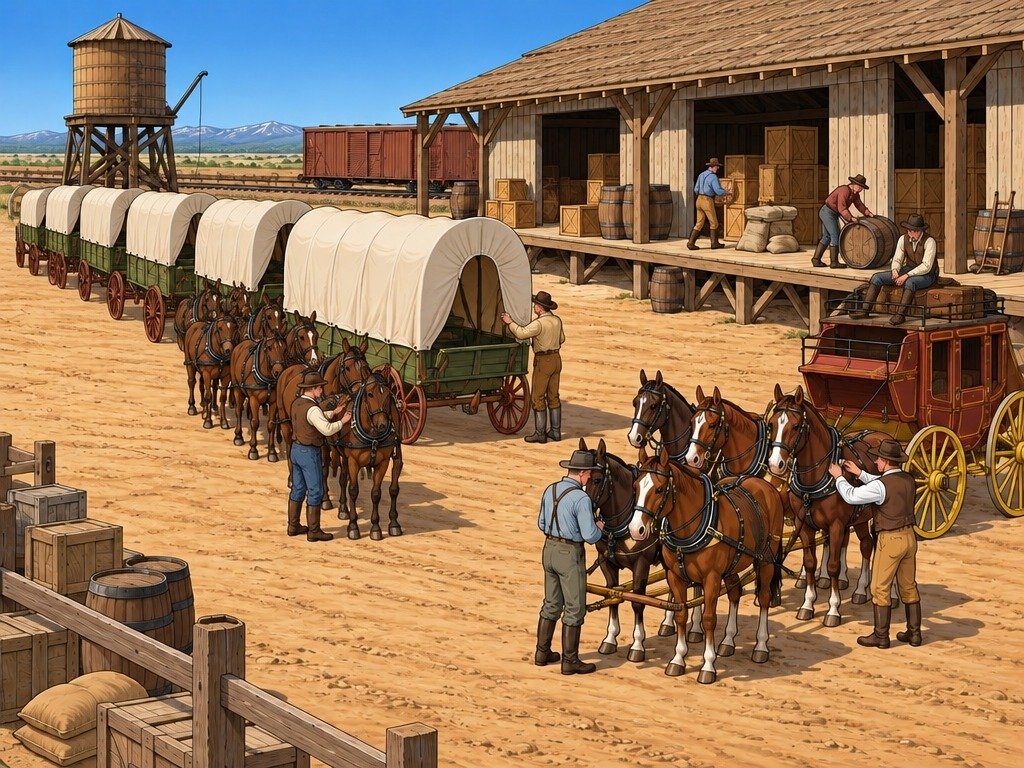
The Union Pacific brings freight in; wagon trains and stage lines carry it out.
| Route | Existed | Notes |
|:--|:--|:--|
| Union Pacific, east and west | From 13 November 1867 | The main line. |
| Denver Pacific to Denver | First train 24 June 1870 (track finished 22 June) | About a hundred miles. The older Denver and Cheyenne stage trade ends with the rail. |
| Camp Carlin freight trains | From 10 December 1867 | Wagon and mule trains to twelve posts and agencies (What the Army Adds). |
| Mail to Fort Laramie and the northern agencies | Before 1876 | A government mail ambulance carries the mail north from Cheyenne by way of Fort Laramie; the Black Hills stage takes it over in 1876 (Places and Campaign Tools). |
| Cheyenne and Black Hills Stage and Express | February 1876 on | Yates and Brown run three trips to Custer City on 3, 7 and 10 February 1876 and sell the line on 12 February; the new owners have regular service by 1 March and send out their first Concord coaches on 3 April 1876, and the first stage reaches Deadwood on 25 September 1876, after the play range closes on 1 August 1876 (an epilogue). About 300 miles; teams change about every hundred miles. |
Cheyenne is the principal outfitting point for the Black Hills in the late 1870s. The rush peaks after the range, but 1875 and 1876 are the first seasons. Sidney, Nebraska, is its rival.
### Cattle and the Stock Growers
Laramie County has roughly 36,000 cattle in 1867. Texas herds start arriving in 1869. The first Wyoming-finished cattle are shipped from the Cheyenne depot in July 1870. By 1871 an estimated 60,000 to 80,000 head graze within 100 miles of town. Sheep are brought in from 1870. The Laramie County stock association (29 November 1873), renamed the Wyoming Stock Growers Association in 1879, speaks for the large owners. The Cheyenne Club does not open until 1880.
### Banks, Newspapers, Telegraph
| Institution | Year | Notes |
|:--|:--|:--|
| First National Bank of Cheyenne | Organized 29 December 1870; chartered 7 March 1871 | Charter 1800 (national bank charters are numbered in order). It took over Henry J. Rogers's private bank, with Rogers as cashier and A. R. Converse as president. Stebbins, Post and Company is a private bank in town by 1876. |
| *Cheyenne Leader* | 19 September 1867 | Renamed the *Cheyenne Daily Leader* in January 1870, in the week after the fire. The first issue sold for 15 cents. |
| *Wyoming Tribune* | 20 November 1869 | A weekly, published on Saturdays, founded by S. Allen Bristol. |
| Telegraph | By November–December 1867 (Union Pacific wire built with the track; depot office) | Denver line complete 31 December 1868. Office at the depot. |
### Hotels, Boarding and Restaurants
| House | Existed by | Notes |
|:--|:--|:--|
| Rollins House | 26 April 1868 | A supper there on that date is recorded. |
| Dyer’s Hotel and its Tin Restaurant | By 1875 (advertised on Eddy Street) | Advertised as a hotel and French restaurant offering meals and board; a free bus to the trains. Where cowboys were hired for bullwhacking. |
| Eagle Hotel | 1869 | |
| Inter Ocean Hotel | 1875 | Built by Barney L. Ford at 16th and Hill Street (Capitol Avenue) at a cost of about $65,000; President Grant stayed there a month after it opened. The hotel is the Cheyenne departure point of the Black Hills coach. |
| Boarding houses | Throughout | Most workers lodge here. |
Hotel
## Religion and Civic Life
| Institution | Year | Notes |
|:--|:--|:--|
| Catholic mission | Fall 1867 | A priest is sent to Cheyenne to serve Catholics over a wide area. A parish church is dedicated in 1879 as St. John's and renamed St. Mary's in 1887 (outside the range). |
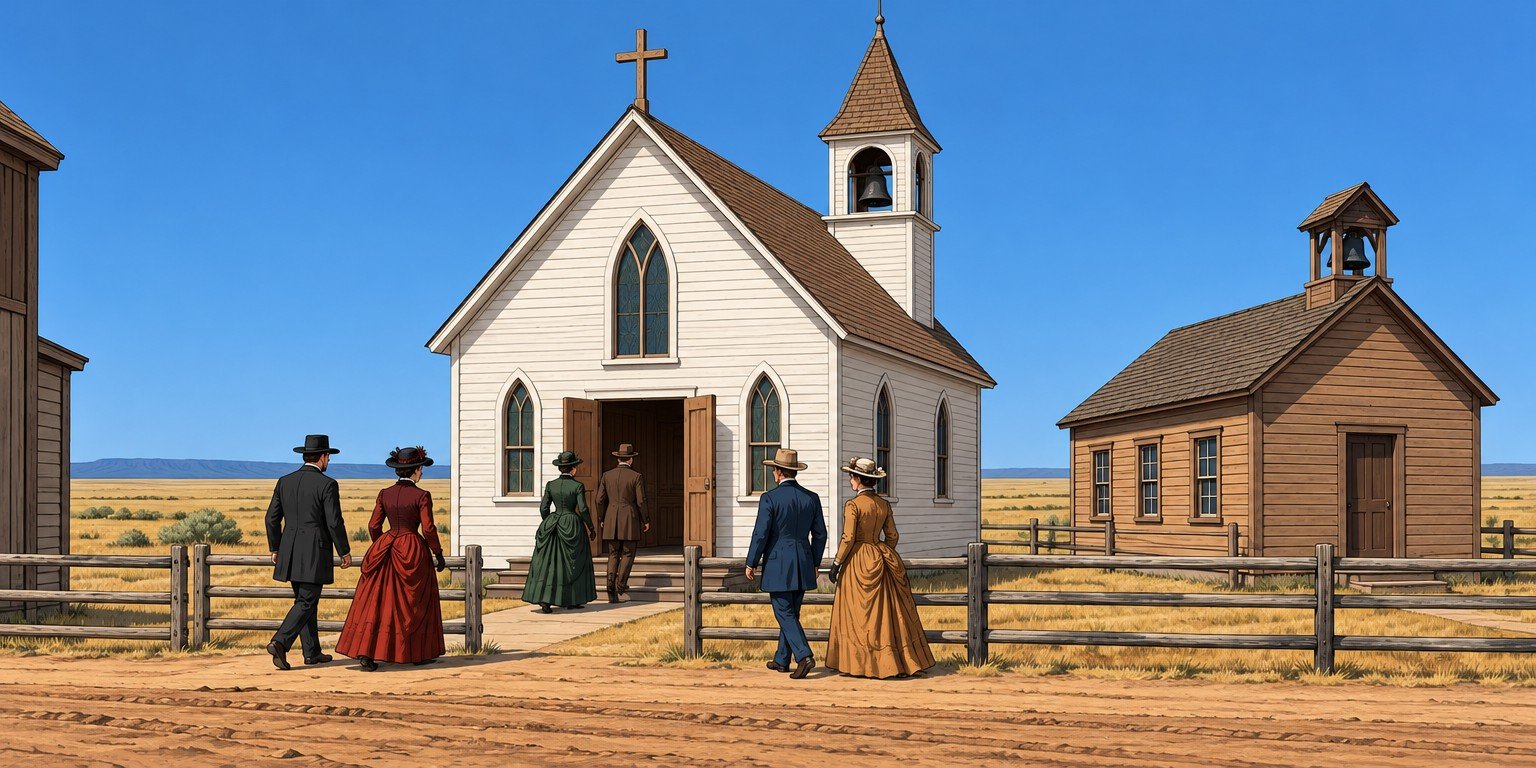
| St. Mark's Episcopal | Organized January 1868; frame church begun June 1868 at 18th and Ferguson; dedicated 23 August 1868 | The Reverend Joseph W. Cook arrives 14 January 1868. The stone church of 1886 to 1888 is not in range. |
| Methodist Episcopal | Congregation founded 1867; church dedicated 23 September 1871 | Churches were built on Union Pacific lots for a nominal payment. Churchgoing is thin at first. |
| Presbyterian | Founded by nine members in 1869; church dedicated 17 July 1870 | |
| Congregational | Organized 1868–1869; church dedicated 19 December 1869 | First Congregational Church of Cheyenne. |
| Baptist | Organized 21 September 1877 | First Baptist Church of Cheyenne; outside the range. |
| Allen Chapel (African Methodist Episcopal) | 1878 | A Black congregation leaves First Methodist in 1875 and is organized as Allen Chapel in 1878, outside the range. |
| Masonic lodge | Colorado dispensation 22 February 1868; chartered 7 October 1868 as Cheyenne Lodge No. 16 | Under the Grand Lodge of Wyoming it is Cheyenne Lodge No. 1, chartered 16 December 1874. |
| Other lodges, temperance and mutual-aid societies | Odd Fellows lodge instituted 13 April 1868; others active but undated | |
| Jewish community | Jewish merchants and families present from 1867; no organized congregation before 1888 | |
**Schools.** Cheyenne opens the territory's first public school: a wooden building put up in the winter of 1867 and dedicated on 6 January 1868, with more than 110 students in its first year. The school stands at the southwest corner of 19th and Ferguson. The first territorial legislature creates the school system in its 1869 session.
## Medicine
Cheyenne’s first medical care is the Union Pacific’s tent hospital for injured workers, pitched near 15th Street and Capitol Avenue in 1867. The city’s founders buy the tent for $125 in 1868; it serves until early that year, after which care moves to the second story of a wooden building. In 1870 the facility relocates to the Dodge House. A permanent hospital is not built until 1882–1883 (outside the range). The Army surgeon at Fort Russell treats soldiers; Camp Carlin has no hospital. Doctors and druggists in town are private practitioners; drugstores and apothecaries operate by the early 1870s.
At the table, medicine in Cheyenne means a physician in a rented room, a druggist, or a post surgeon. For illness and care rules see Era Rules; for drugs and poisons see The Apothecary.
## Social Life and Recreation
| Entertainment | Year | Notes |
|:--|:--|:--|
| McDaniel's theater, museum and gambling saloon, Eddy Street | Museum 1867; theater and gambling rooms followed | A free museum and zoo, a stage, a Brussels organ, and tables for roulette, keno and faro. A reopening is advertised in November 1869. |
| Billiard halls and saloons | Throughout | The *Leader* reports gunfire in saloons and bronco busting on Sixteenth Street in 1873. |
| Churches and lodges | See above | |
## What the Army Adds
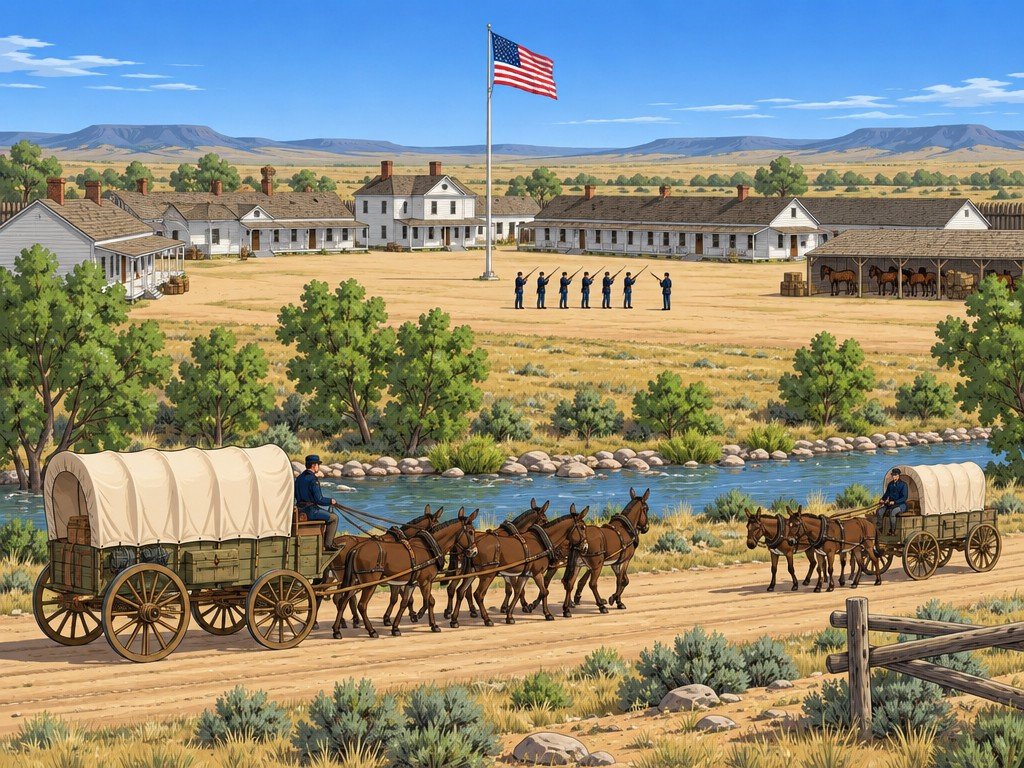
Fort Russell and Camp Carlin are the town's other economy. The fort is built from August 1867 by units of the 30th Infantry, and the first cavalry (Company H, 2nd Cavalry) arrives in September 1867. The garrison changes by year; the 3rd Cavalry is at the post in 1876. Camp Carlin, the quartermaster's depot on Crow Creek between town and fort (Factions and Powers has its name and history), receives and issues supplies from 10 December 1867 and provisions twelve posts and agencies by wagon trains of 10 to 30 wagons and by pack mules carrying about 200 pounds each.
For play: soldiers drink on Eddy Street; depot clerks and teamsters have pay and access to goods; the quartermaster hires interpreters, scouts and teamsters; the Army provides escorts and patrols for travel to Fort Laramie and beyond. Soldiers are subject to the Army's discipline, not the city marshal's, unless the colonel hands a man over.
## Nearby Destinations
| Destination | Notes |
|:--|:--|
| Fort D.A. Russell | About three miles northwest of the depot on Crow Creek (Places and Campaign Tools). |
| Camp Carlin | Halfway between town and fort, on Crow Creek. |
| Crow Creek | The creek after which the first camp was named; the road to the fort follows it. |
| Laramie Plains road | West on the Union Pacific main line over Sherman Hill: Sherman 33 miles, Laramie 57 (Places and Campaign Tools). |
| Denver | One hundred miles south by the Denver Pacific from 24 June 1870. See Denver. |
| Fort Laramie and the Black Hills road | North; the stage line runs about 300 miles to the Black Hills by 1876. |
## Services a Visitor Meets
Gear and Prices has the price lists. The table lists what existed and when; a price appears only where one is known.
| Service | Where | Existed by | Price shown |
|:--|:--|:--|:--|
| Newspaper | Newsstand and by subscription | 1867 | 15 cents, first issue, 19 September 1867 |
| Letter carried to Deadwood by stage | Stage office | November 1876 (after the range) | 10 cents per stamped envelope |
| Hotel room | Inter Ocean, Eagle, Rollins | 1868 to 1876 | $3 to $4 a day for a stopover (corridor-wide, 1872); $12 to $15 a week at a first-class house (1877) |
| Meal | Hotel dining rooms, Union Pacific eating house | 1867 | 75 cents to $1 in currency (1872) |
| Boarding house | Throughout | 1867 | $6 to $9 a week, bed and meals (1877) |
| Livery and horse keeping | Eddy and Sixteenth Streets | 1867 | A saddle horse $2 a day, a team and rig $4 to $7 (1879); see The Stable |
| Laundry | Throughout | Not dated | About $1.50 a dozen pieces (Gear and Prices) |
| Telegraph | Depot | 1867 to 1868 (Denver line 31 December 1868) | Ten words to Chicago $1, to Deadwood $2.50 (1877); see Places and Campaign Tools, How News and Mail Travel |
| Doctor and druggist | Town | 1867 (the railroad's tent hospital) | A visit $3 by day, $5 at night (Denver, 1871); patent medicine $1 a bottle |
| Lawyer | Business blocks | 1869 | $10 a case before a justice, $100 a district court case, $25 a land matter (Gear and Prices, estimated) |
## Not Yet in Town
These did not exist in Cheyenne before the dates given.
| Item | Date |
|:--|:--|
| The Cheyenne Club | 1880 |
| The stone depot | 1886 to 1887 |
| The current state capitol | Begun September 1886; cornerstone 18 May 1887; central building finished March 1888, wings 1890 |
| The stone St. Mark's | 1886 to 1888 |
| Hospital at 23rd and Evans | 1882 or 1883 |
| Capitol Avenue as a name | 3 May 1887 |
## Fictional People of Cheyenne
##### Amos Fenn, Livery Keeper (fictional)
Rents horses and stalls on Eddy Street and knows every horse in town by its brand. He sells to anyone and can tell which buyers are in a hurry. He is a contact for Ybarra and Tolliver, and for Deveney, who asks him about strange stock. Hook: a horse with a freshly altered brand is stabled under another name.
##### Bridget Kearney, Boarding-House Keeper (fictional)
An Irish widow with fourteen beds near the yards. Her lodgers are graders, teamsters and clerks, so she learns who is paid, who is owed and who left in the night. She reports arguments about money to the sheriff. Hook: a lodger's trunk is left unclaimed and has a railroad survey map in it.
##### Lyman Voss, Clerk at the Land Office (fictional)
Copies plats and files claims, and keeps the office's books to the letter. He answers to his superiors and knows Edmund Harrow by sight. Hook: a filing is recorded twice with different dates, and each copy has a different owner; the office is behind, and the second entry could be a clerk's error, a claimant's forgery or a rival's payment to someone in the building.
##### Nell Ashby, Telegraph Operator (fictional)
Works the key at the depot and reads every message that passes through. She is paid to keep quiet about them. Hook: a message for the wrong man arrives, and the sender has already left on the afternoon train.
##### Moy Bak Yuen, Laundry Owner (fictional)
A Chinese laundryman from Taishan who runs a laundry near the yards and employs three countrymen. He keeps accounts in two languages, charges $1.50 a dozen pieces, and sends money home through a Hong Kong house. He pays no one for protection. He buys his stock from Wong Yik Lun (Era Cast). Hook: he holds a soldier's coat with a map sewn into the lining and asks to be paid in full before it is returned.
##### Thaddeus Pruitt, Wagon Master at Camp Carlin (fictional)
A civilian freighter under contract to the quartermaster. He hires teamsters by the trip and keeps a careful tally of every load. Hook: a load for a distant post is short by six crates and the manifest has been rewritten; he wants it found before the contractor's bookkeeper, the post's clerk or the depot's loaders are blamed.
##### Heinrich Vogel, Saloon Keeper (fictional)
A German-born keeper on Sixteenth Street who cooks for lodgers and records debts in a ledger. He takes no side in disputes between customers. Hook: a man pays his bar bill in gold dust, and a stranger asks the next morning where the gold came from.
##### Ellen Doyle, Laundress at Fort D.A. Russell (fictional)
An Irish soldier's widow who washes for the companies at the fort and the officers' households. She hears which men are drinking, who is in debt and who is leaving the service. Hook: a trooper leaves a bundle with her to be mended, and a letter is sewn into the lining.
##### Martha Whitlock, Schoolteacher (fictional)
A Union veteran's daughter from Ohio who teaches the town's children in a rented room. She writes letters for parents who cannot, and knows who sends money home and who does not. Hook: a pupil brings a pistol to school, and she wants to know where the boy found it.
##### Louisa Brandt, Midwife and Nurse (fictional)
A German-born midwife who attends births in the boarding houses and the dance halls alike, and sits with the sick when there is no doctor. She is trusted on every side of Sixteenth Street and repeats nothing. Hook: she asks for a man who will carry a woman in labor to the fort surgeon at night, and will not say who the woman is.
## Hooks Tied to the Era Cast
##### Stolen Stock at the Depot
Michael Deveney asks the group to trace a bunch of cattle sold at the Cheyenne depot with a fresh brand. The cattle carry the agency contractor's road brand: government beef, which makes the matter federal and his. The trail leads to a buyer who pays cash and asks no questions, and to Wade Carrick's outfit. **Cast:** Deveney (patron), Wade Carrick (adversary), Tolliver or Ybarra (trackers).
##### A Fair Hearing at Marchand's
Odette Marchand hosts a political meeting at her house for a candidate whose backers want the legislature's ear. The group is hired to guard the door or to learn who pays for the candidate. **Cast:** Marchand (patron), Deveney (guest).
##### The Survey Stakes
Edmund Harrow needs a surveyor's party escorted past the fort, and a clerk at the land office has misfiled a claim. The Northern Cheyenne interpreter, who works for the Army, is asked to read the stakes' terms to a party that will not like them; the Oglala warrior watches from outside the town. **Cast:** Harrow (patron), the interpreter, the Oglala warrior (a wary witness).
##### Wagons to the Hills, 1876
A freighter at Camp Carlin needs an escort for a wagon train to Custer City. Black Hills gold seekers fill the Inter Ocean. **Cast:** Tolliver, Ybarra, Carrick (road agent).
##### A Coat for Moy Bak Yuen
A soldier pawned his coat to the laundry, and the quartermaster's clerk wants it back. **Cast:** none; use Moy Bak Yuen and Thaddeus Pruitt.
Odette Marchand hosts a political meeting in Cheyenne

 ### The Depot and Rail Yards
The Union Pacific depot and yards stand at the south end of Hill Street, with the tracks running east and west. This is where the Union Pacific placed its mountain-region headquarters in 1867, where cattle are loaded from July 1870, and where the Denver Pacific connection departs from June 1870. The frame depot of 1867 serves the whole range on the north side of the main line; the stone depot visitors know today was built on the same site in 1886 to 1887. Crow Creek, which gave the first townsite its name, lies on the town's southern side; stock pens, freight sheds and the wagon yards cluster by the tracks.
 ### Hill Street and the Business District
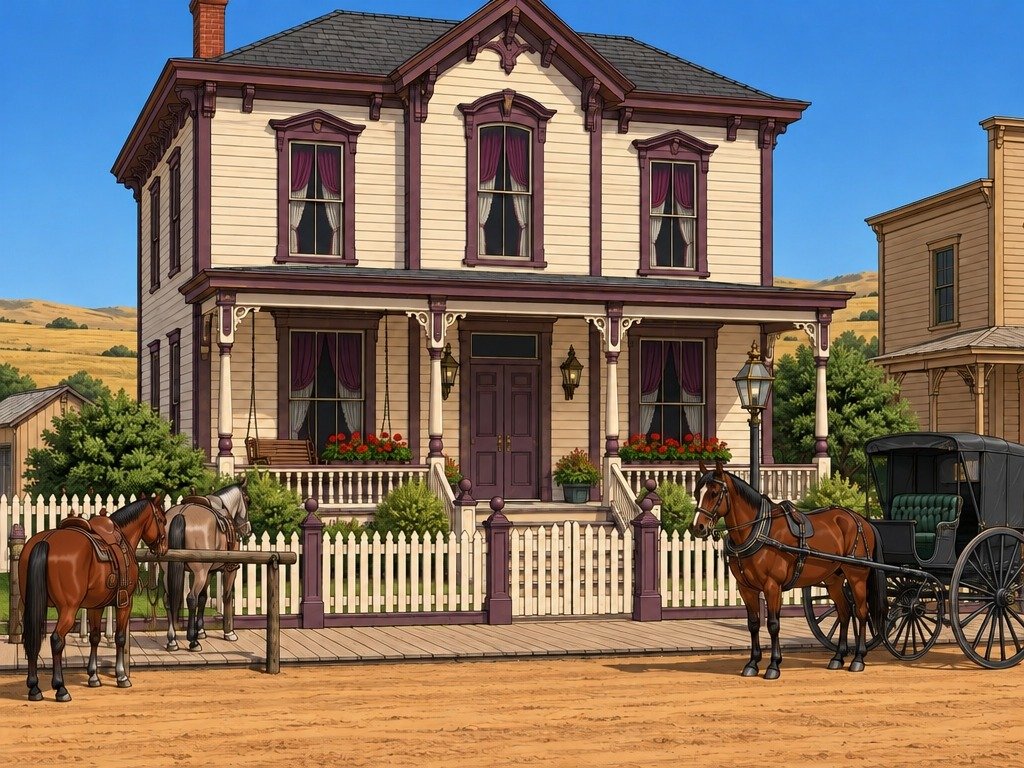
Hill Street (Capitol Avenue) and Sixteenth Street meet at the business core. The Inter Ocean Hotel stands at that corner from 1875 (see Hotels). Banks, outfitters, saddlers, clothiers and law offices line the blocks around it. The business district is built largely of wood in 1869; the fire of 11 January 1870 burned two blocks, and some rebuilding in brick follows. The current state capitol does not exist in this range; the legislature meets in rented rooms: in 1869 the Council in the McLeland Building at 17th and Ferguson and the House in the Arcade Building, in 1871 both houses at the Rollins House on 16th Street between Ferguson and Eddy, and in 1873 the new courthouse.
### Residential Areas
Wealthier families, officials and officers' wives live in frame houses north of the business blocks; railroad workers and laborers live near the yards and in boarding houses; the first frame house was at Ferguson and Sixteenth. In 1875 the town's largest tree is no bigger than a lilac bush; the streets are treeless and open to the wind.
 ### Saloon, Dance Hall and Parlor House Districts
Eddy Street (Pioneer Avenue) is the street of theaters, saloons and gambling rooms. McDaniel's museum on Eddy opened in 1867, and his theater (500 seats by the time the Opera House replaced it in 1882) and gambling rooms followed, with a stage and tables for faro, roulette and keno. Fifteenth Street is remembered as the red-light street where railroad men hung lanterns (local lore). The Gold Room, a saloon, theater and dance hall with gaming tables, was built by Jim Allen in 1867 on Sixteenth Street.
 Prostitution in Cheyenne is tolerated or ignored by the authorities. No city fine or tax on houses is on record. A woman of age who keeps a house can vote, because Wyoming Territory gives women the vote from 10 December 1869. Parlor houses rank above the saloon upstairs rooms and dance halls in price and standing, and town leaders do business in their front rooms. Women with money run them. Odette Marchand keeps one such house (see the Era Cast).
 ### Fort D.A. Russell and Camp Carlin
Fort D.A. Russell lies about three miles northwest of the depot on Crow Creek; Camp Carlin, the quartermaster's depot, is about halfway (Factions and Powers). A road follows the creek through the depot to the fort, and the men paid at both spend their money on Eddy and Sixteenth Streets (What the Army Adds).
 ### Where Communities Live
| Community | In town |
|:--|:--|
| Black residents | A Black community settles within a few years of 1867, many for railroad or other labor. Black men vote in Wyoming Territory, and Black women are among the voters on 6 September 1870. Barney L. Ford's Inter Ocean Hotel opens in 1875. A Black congregation leaves First Methodist in 1875 and is organized as Allen Chapel (African Methodist Episcopal) in 1878 |
| Irish | Irish Catholics are among the graders, soldiers and tradespeople; a priest is sent to Cheyenne in fall 1867 to serve Catholics across a wide area |
| German | German-born keepers, tradesmen and railroad men are in town from the first years; no German society or quarter is on record before 1876 |
| Chinese | Cheyenne has no known Chinese quarter or named laundries before 1876. Cheyenne is a transit stop for Chinese traveling to the Black Hills by stage in January 1876. The Era covers the territory's Chinese workers and families; Denver covers that city's quarter. Wong Yik Lun (Era Cast), a Denver merchant, trades here a week in every month. |
| Mexican American and Tejano | Texas herds reach Laramie County from 1869; Tejano hands and horse breakers come north with them |
| Tribal Nations | Lakota, Cheyenne and Pawnee people are part of the early frontier population of the town |
Prejudice follows the situational social condition in Era Rules.
## Government and Law
### City, County, Territory
| Body | Year it exists | Notes |
|:--|:--|:--|
| City of Cheyenne | Organized August 1867; charter from the Dakota legislature in 1868 | City Hall built 1874. A court-ordered ruling in March 1868 held that only businesses named in the charter had to pay license fees, which hurt the city's income. Mayors in the play range: Jervis Joslin (1871 to 1872), M. Sloan (1872), M. V. Boughton (1873 to 1874), George Cassels (1874) (Factions and Powers). |
| Laramie County | Created 8 January 1867; Cheyenne county seat from 3 January 1868 | One of Wyoming Territory's first four counties on 19 May 1869. A courthouse is built in 1872 to 1873. |
| Wyoming Territory | Organized 19 May 1869 | Cheyenne is the capital from May 1869. The legislature considered Laramie and Evanston as alternate capitals in 1871 and 1873. |
| Federal officers | From 1869 | A U.S. Marshal, U.S. Attorney and federal district judges serve the territory. The first marshal was Church Howe (1869 to late 1870). The marshal keeps an office at the capital and deputies at Cheyenne and along the line. The wife of the U.S. Marshal at Cheyenne is among the women who vote on 6 September 1870. |
| Territorial courts | Court in session in Cheyenne on 25 May 1869 | Each of the territory's three justices holds district court in his own district and sits with the others as the supreme court (Factions and Powers). |
The territory is governed by officers appointed in Washington. Governor John A. Campbell is appointed on 3 April 1869 and signs the suffrage law on 10 December 1869. The legislature is elected, and it is where Wyoming gives women the vote and the right to hold office. Women are seated as jurors in Laramie in March 1870 and in Cheyenne on grand and trial juries in March and July 1871; after 1871 a stricter reading of the law ends the practice.
### Law Enforcement and Justice
Four kinds of lawman work Cheyenne, and their jurisdictions differ: the **city marshal** (Cheyenne), the **county sheriff** (Laramie County), the **U.S. Marshal** (federal crimes and the federal side of the district court's docket; his deputies serve it across the whole territory) and the **Army** (soldiers and the reservation at Fort Russell). Soldiers answer to the Army; no set arrangement for handing over each other's offenders is on record.
 | Year | Reference |
|:--|:--|
| 1867 to 1868 | Justices of the peace and a probate judge act under Dakota law. The Dakota legislature attached Laramie County to its second judicial district and ordered a term of district court at Cheyenne each March from 1868. The vigilance committee of January 1868 is in Historical Reference. |
| 1869 to 1877 | 1869: Seth M. Preshaw, interim, appointed May 1869. 1870 to 1873: Thomas Jeff Carr, elected 1870 and 1872. 1874 to 1875: N. J. O'Brien, formerly a deputy U.S. marshal (Historical Reference). 1876 to 1877: Carr again. |
| 1873 | A traveler's account says the vigilance committee dealt with 120 "ruffians" in a fortnight. |
Michael Deveney, the Era Cast character, is a fictional deputy U.S. marshal stationed at Cheyenne; the sheriffs and marshals named here are the real office-holders, and he works beside them, not in their chairs.
**Jail and lockup**. No detailed description of Cheyenne’s city or county jail buildings for 1869–1876 survives. A prisoner awaiting the district court is held in whatever lockup the sheriff maintains. Before the territorial penitentiary opened, convicted felons were sent out of the territory (commonly to the Detroit House of Correction). The Wyoming Territorial Penitentiary at Laramie took its first prisoners from Cheyenne on 14 January 1873; from that date a sentence of hard labor is served there. A deputy U.S. marshal has no jail of his own. A federal prisoner is lodged in the county jail by arrangement; the United States pays the county the ordinary expense of his keep.
**Arms in town.** A Cheyenne ordinance of 30 September 1867 barred anyone but the police from carrying firearms or dangerous weapons inside the city limits, with a fine of $5 to $100 or up to 30 days, and gave strangers 30 minutes to comply. Enforcement in 1869–1876 is not recorded. For play, treat the ordinance as real but unevenly applied: most openly carried weapons draw a warning or a fine, while a drawn weapon or a fight brings immediate arrest.
## Commerce
### Freight, Stage and Rail
The Union Pacific brings freight in; wagon trains and stage lines carry it out.
 | Route | Existed | Notes |
|:--|:--|:--|
| Union Pacific, east and west | From 13 November 1867 | The main line. |
| Denver Pacific to Denver | First train 24 June 1870 (track finished 22 June) | About a hundred miles. The older Denver and Cheyenne stage trade ends with the rail. |
| Camp Carlin freight trains | From 10 December 1867 | Wagon and mule trains to twelve posts and agencies (What the Army Adds). |
| Mail to Fort Laramie and the northern agencies | Before 1876 | A government mail ambulance carries the mail north from Cheyenne by way of Fort Laramie; the Black Hills stage takes it over in 1876 (Places and Campaign Tools). |
| Cheyenne and Black Hills Stage and Express | February 1876 on | Yates and Brown run three trips to Custer City on 3, 7 and 10 February 1876 and sell the line on 12 February; the new owners have regular service by 1 March and send out their first Concord coaches on 3 April 1876, and the first stage reaches Deadwood on 25 September 1876, after the play range closes on 1 August 1876 (an epilogue). About 300 miles; teams change about every hundred miles. |
Cheyenne is the principal outfitting point for the Black Hills in the late 1870s. The rush peaks after the range, but 1875 and 1876 are the first seasons. Sidney, Nebraska, is its rival.
### Cattle and the Stock Growers
Laramie County has roughly 36,000 cattle in 1867. Texas herds start arriving in 1869. The first Wyoming-finished cattle are shipped from the Cheyenne depot in July 1870. By 1871 an estimated 60,000 to 80,000 head graze within 100 miles of town. Sheep are brought in from 1870. The Laramie County stock association (29 November 1873), renamed the Wyoming Stock Growers Association in 1879, speaks for the large owners. The Cheyenne Club does not open until 1880.
### Banks, Newspapers, Telegraph
| Institution | Year | Notes |
|:--|:--|:--|
| First National Bank of Cheyenne | Organized 29 December 1870; chartered 7 March 1871 | Charter 1800 (national bank charters are numbered in order). It took over Henry J. Rogers's private bank, with Rogers as cashier and A. R. Converse as president. Stebbins, Post and Company is a private bank in town by 1876. |
| *Cheyenne Leader* | 19 September 1867 | Renamed the *Cheyenne Daily Leader* in January 1870, in the week after the fire. The first issue sold for 15 cents. |
| *Wyoming Tribune* | 20 November 1869 | A weekly, published on Saturdays, founded by S. Allen Bristol. |
| Telegraph | By November–December 1867 (Union Pacific wire built with the track; depot office) | Denver line complete 31 December 1868. Office at the depot. |
### Hotels, Boarding and Restaurants
| House | Existed by | Notes |
|:--|:--|:--|
| Rollins House | 26 April 1868 | A supper there on that date is recorded. |
| Dyer’s Hotel and its Tin Restaurant | By 1875 (advertised on Eddy Street) | Advertised as a hotel and French restaurant offering meals and board; a free bus to the trains. Where cowboys were hired for bullwhacking. |
| Eagle Hotel | 1869 | |
| Inter Ocean Hotel | 1875 | Built by Barney L. Ford at 16th and Hill Street (Capitol Avenue) at a cost of about $65,000; President Grant stayed there a month after it opened. The hotel is the Cheyenne departure point of the Black Hills coach. |
| Boarding houses | Throughout | Most workers lodge here. |
 | Institution | Year | Notes |
|:--|:--|:--|
| Catholic mission | Fall 1867 | A priest is sent to Cheyenne to serve Catholics over a wide area. A parish church is dedicated in 1879 as St. John's and renamed St. Mary's in 1887 (outside the range). |
| St. Mark's Episcopal | Organized January 1868; frame church begun June 1868 at 18th and Ferguson; dedicated 23 August 1868 | The Reverend Joseph W. Cook arrives 14 January 1868. The stone church of 1886 to 1888 is not in range. |
| Methodist Episcopal | Congregation founded 1867; church dedicated 23 September 1871 | Churches were built on Union Pacific lots for a nominal payment. Churchgoing is thin at first. |
| Presbyterian | Founded by nine members in 1869; church dedicated 17 July 1870 | |
| Congregational | Organized 1868–1869; church dedicated 19 December 1869 | First Congregational Church of Cheyenne. |
| Baptist | Organized 21 September 1877 | First Baptist Church of Cheyenne; outside the range. |
| Allen Chapel (African Methodist Episcopal) | 1878 | A Black congregation leaves First Methodist in 1875 and is organized as Allen Chapel in 1878, outside the range. |
| Masonic lodge | Colorado dispensation 22 February 1868; chartered 7 October 1868 as Cheyenne Lodge No. 16 | Under the Grand Lodge of Wyoming it is Cheyenne Lodge No. 1, chartered 16 December 1874. |
| Other lodges, temperance and mutual-aid societies | Odd Fellows lodge instituted 13 April 1868; others active but undated | |
| Jewish community | Jewish merchants and families present from 1867; no organized congregation before 1888 | |
**Schools.** Cheyenne opens the territory's first public school: a wooden building put up in the winter of 1867 and dedicated on 6 January 1868, with more than 110 students in its first year. The school stands at the southwest corner of 19th and Ferguson. The first territorial legislature creates the school system in its 1869 session.
## Medicine
Cheyenne’s first medical care is the Union Pacific’s tent hospital for injured workers, pitched near 15th Street and Capitol Avenue in 1867. The city’s founders buy the tent for $125 in 1868; it serves until early that year, after which care moves to the second story of a wooden building. In 1870 the facility relocates to the Dodge House. A permanent hospital is not built until 1882–1883 (outside the range). The Army surgeon at Fort Russell treats soldiers; Camp Carlin has no hospital. Doctors and druggists in town are private practitioners; drugstores and apothecaries operate by the early 1870s.
At the table, medicine in Cheyenne means a physician in a rented room, a druggist, or a post surgeon. For illness and care rules see Era Rules; for drugs and poisons see The Apothecary.
## Social Life and Recreation
| Entertainment | Year | Notes |
|:--|:--|:--|
| McDaniel's theater, museum and gambling saloon, Eddy Street | Museum 1867; theater and gambling rooms followed | A free museum and zoo, a stage, a Brussels organ, and tables for roulette, keno and faro. A reopening is advertised in November 1869. |
| Billiard halls and saloons | Throughout | The *Leader* reports gunfire in saloons and bronco busting on Sixteenth Street in 1873. |
| Churches and lodges | See above | |
## What the Army Adds
Fort Russell and Camp Carlin are the town's other economy. The fort is built from August 1867 by units of the 30th Infantry, and the first cavalry (Company H, 2nd Cavalry) arrives in September 1867. The garrison changes by year; the 3rd Cavalry is at the post in 1876. Camp Carlin, the quartermaster's depot on Crow Creek between town and fort (Factions and Powers has its name and history), receives and issues supplies from 10 December 1867 and provisions twelve posts and agencies by wagon trains of 10 to 30 wagons and by pack mules carrying about 200 pounds each.
For play: soldiers drink on Eddy Street; depot clerks and teamsters have pay and access to goods; the quartermaster hires interpreters, scouts and teamsters; the Army provides escorts and patrols for travel to Fort Laramie and beyond. Soldiers are subject to the Army's discipline, not the city marshal's, unless the colonel hands a man over.
## Nearby Destinations
| Destination | Notes |
|:--|:--|
| Fort D.A. Russell | About three miles northwest of the depot on Crow Creek (Places and Campaign Tools). |
| Camp Carlin | Halfway between town and fort, on Crow Creek. |
| Crow Creek | The creek after which the first camp was named; the road to the fort follows it. |
| Laramie Plains road | West on the Union Pacific main line over Sherman Hill: Sherman 33 miles, Laramie 57 (Places and Campaign Tools). |
| Denver | One hundred miles south by the Denver Pacific from 24 June 1870. See Denver. |
| Fort Laramie and the Black Hills road | North; the stage line runs about 300 miles to the Black Hills by 1876. |
## Services a Visitor Meets
Gear and Prices has the price lists. The table lists what existed and when; a price appears only where one is known.
 | Service | Where | Existed by | Price shown |
|:--|:--|:--|:--|
| Newspaper | Newsstand and by subscription | 1867 | 15 cents, first issue, 19 September 1867 |
| Letter carried to Deadwood by stage | Stage office | November 1876 (after the range) | 10 cents per stamped envelope |
| Hotel room | Inter Ocean, Eagle, Rollins | 1868 to 1876 | $3 to $4 a day for a stopover (corridor-wide, 1872); $12 to $15 a week at a first-class house (1877) |
| Meal | Hotel dining rooms, Union Pacific eating house | 1867 | 75 cents to $1 in currency (1872) |
| Boarding house | Throughout | 1867 | $6 to $9 a week, bed and meals (1877) |
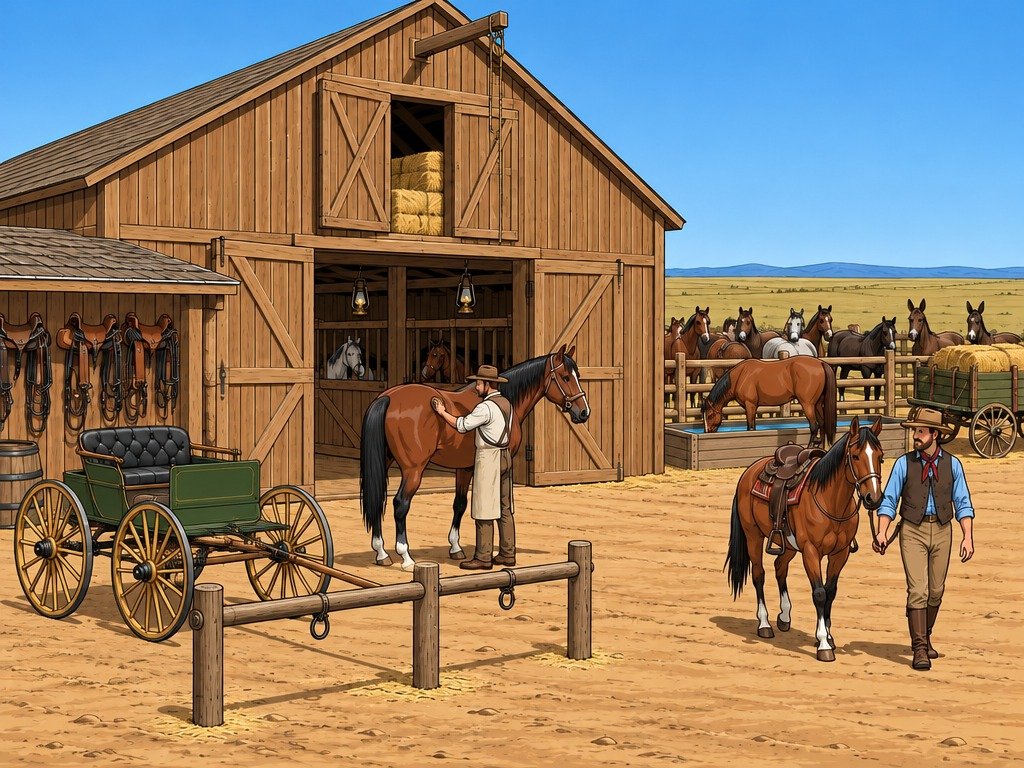
| Livery and horse keeping | Eddy and Sixteenth Streets | 1867 | A saddle horse $2 a day, a team and rig $4 to $7 (1879); see The Stable |
| Laundry | Throughout | Not dated | About $1.50 a dozen pieces (Gear and Prices) |
| Telegraph | Depot | 1867 to 1868 (Denver line 31 December 1868) | Ten words to Chicago $1, to Deadwood $2.50 (1877); see Places and Campaign Tools, How News and Mail Travel |
| Doctor and druggist | Town | 1867 (the railroad's tent hospital) | A visit $3 by day, $5 at night (Denver, 1871); patent medicine $1 a bottle |
| Lawyer | Business blocks | 1869 | $10 a case before a justice, $100 a district court case, $25 a land matter (Gear and Prices, estimated) |
## Not Yet in Town
These did not exist in Cheyenne before the dates given.
| Item | Date |
|:--|:--|
| The Cheyenne Club | 1880 |
| The stone depot | 1886 to 1887 |
| The current state capitol | Begun September 1886; cornerstone 18 May 1887; central building finished March 1888, wings 1890 |
| The stone St. Mark's | 1886 to 1888 |
| Hospital at 23rd and Evans | 1882 or 1883 |
| Capitol Avenue as a name | 3 May 1887 |
## Fictional People of Cheyenne
